"Unlimited Money Printing" Bug Lurked for Four Years, Privacy Coin ZEC Plummets 50% in One Day

Odaily星球日报Published on 2026-06-05Last updated on 2026-06-05

Abstract

A critical "unlimited, undetectable counterfeit" vulnerability existed for nearly four years in the Orchard privacy pool of Zcash (ZEC), a privacy-focused cryptocurrency. The bug, which could theoretically allow attackers to create unlimited fake ZEC, was disclosed by founder Zooko Wilcox on June 5th. While officially patched and deemed low-probability for exploitation, the news triggered a market panic. ZEC's price plummeted over 50% in a single day. The core crisis stems from the inability to prove whether any counterfeit ZEC was created during the vulnerability's active period, as Orchard's design inherently hides transaction details. This casts severe doubt on ZEC's total supply integrity. The sell-off accelerated after prominent investor and ZEC narrative supporter Arthur Hayes announced he had sold his entire position, citing the inability to cryptographically prove the impossibility of extra minting. Community trust eroded further upon learning the bug was discovered with AI-assisted auditing, raising questions about Zcash's development and security review processes. The incident has evolved from a price correction into a fundamental crisis of confidence regarding the network's core security promises.

Original | Odaily Planet Daily (@OdailyChina)

Author | Asher (@Asher_0210)

In the early hours of June 5th, Zcash founder Zooko Wilcox published a statement confirming that Orchard, Zcash's next-generation privacy pool enabled in 2022, once contained a critical counterfeiting vulnerability. Although Zcash officials emphasized that the bug has been fixed and believe the probability of its exploitation is low, it still couldn't stop the spread of market panic.

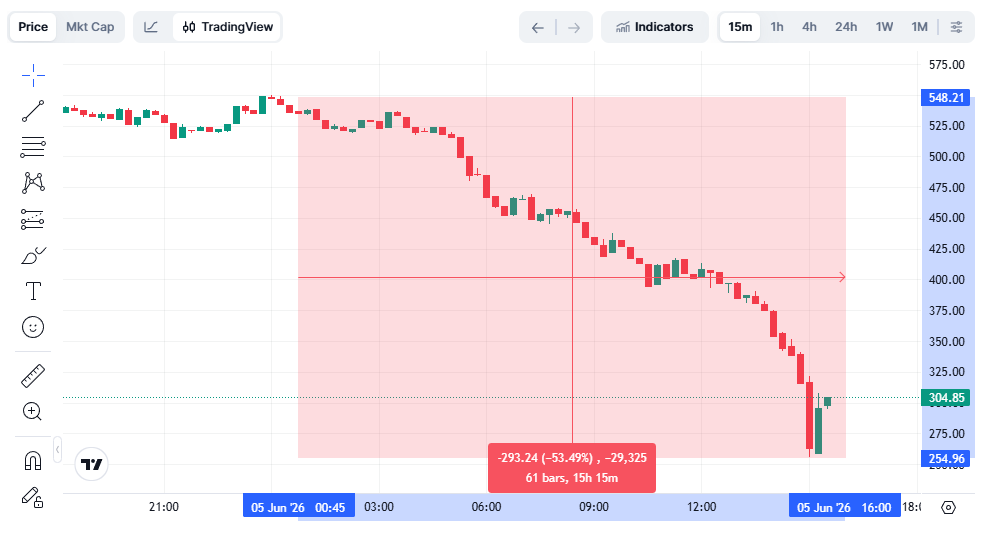
After the news broke, the Zcash token ZEC quickly nosedived, plummeting over 30% in a short time; by the afternoon, the sell-off didn't stop, panic continued to spread, and the price once fell to around $250, with the intraday loss widening to over 50%.
Security researcher Taylor Hornby discovered the issue on May 29th and has completed vulnerability verification in a local environment, generating test counterfeit ZEC, further validating that the vulnerability is an executable attack path. Currently, the two biggest controversies surrounding Zcash are: First, whether counterfeit ZEC has ever appeared in the privacy pool over the past four years; Second, how can officials prove that no counterfeit ZEC has flowed into the privacy pool, an extremely difficult task to disprove.

Where Did the "Unlimited Minting" ZEC Come From?

The security of Orchard (Zcash's privacy-protecting "shielded pool") relies on zero-knowledge proof circuits, with the core rule being asset conservation: the spend of each transaction must come from legitimate inputs, and ZEC cannot be created out of thin air. Users can hide balances and transaction amounts, but the system must verify the transaction's legitimacy.

Security researcher Taylor Hornby discovered that a constraint in the Orchard circuit was incomplete (under-constrained), allowing attackers to input data that should not have passed, yet verification could still return as successful. In other words, without needing administrator privileges or controlling nodes, and not being a backdoor, as long as the system mistakenly deems a transaction legitimate, originally non-existent ZEC could be recorded as legitimate assets within Orchard.

Shielded Labs called it "unlimited, undetectable counterfeit ZEC".

The Bug is Fixed, but Historical Issues Remain Unresolved

For ordinary security incidents, the biggest fear is large losses, but the most troublesome aspect of Zcash's current crisis is that the losses cannot be directly quantified.

If an attack occurred on the transparent chain, the market could at least see the attack address, fund flows, and affected assets. However, Orchard's transaction amounts, balances, and fund paths are inherently hidden. Once counterfeit ZEC might have appeared in the pool, it's difficult for outsiders to judge whether it's still lingering in Orchard or has gradually flowed out through normal transactions.

More critically, Orchard is not a completely isolated black box. Users can migrate assets between different fund pools, and both real ZEC and potential counterfeit ZEC could mix within the pool.

The Zcash ecosystem can emphasize that there is currently no evidence of the vulnerability being exploited and can explain that the probability of malicious exploitation is low. But for traders, "no anomalies have been found" and "it has been proven that nothing happened" are not the same thing.

This is the core reason for ZEC's expanding decline. Until the question of whether counterfeit ZEC ever appeared in Orchard is proven, ZEC's supply credibility will remain under a shadow.

Arthur Hayes Liquidates Position, Igniting Market Confidence Crisis

After the ZEC vulnerability was exposed, BitMEX co-founder Arthur Hayes's public liquidation further amplified market panic.

Arthur Hayes stated on platform X that he has sold his entire ZEC holdings. Hayes said he learned about the attack yesterday but did not realize its conflict with his narrative framework. ZEC's 30% drop prompted him to reconsider and decide to take full profits on that position. He added that while he believes the possibility of additional minting is extremely low, he cannot formally prove its impossibility at the cryptographic level; he will continuously reassess his judgment and, if his assumption is disproven, will repurchase, hoping to build a position at a lower price; privacy is priceless, and he wouldn't mind repurchasing at a higher price.

This was quite damaging for ZEC. Over the past period, Arthur Hayes has been one of the key narrative drivers for ZEC. His bullish view was based on the long-term logic of privacy assets regaining pricing power in the context of AI, government surveillance, and big tech expansion. Therefore, his liquidation wasn't just a major holder taking profits; it resembled a public downgrade of ZEC's current narrative.

When a top narrative supporter chooses to exit first, long positions originally supported by belief and expectations are more likely to turn into collective profit-taking and risk aversion.

Community Sentiment Spiral, ZEC Transforms from Price Correction to Trust Crisis

Perhaps influenced by Arthur Hayes's liquidation, community discussions about ZEC quickly shifted from "whether to buy the dip" to "whether it can still be trusted."

On one hand, the community repeatedly emphasized the severity of the vulnerability itself. Compared to short-term price drops, many users were more concerned that a vulnerability theoretically capable of creating unlimited counterfeit coins had lurked in Orchard for nearly four years. For them, the price drop was just the surface; what truly shook confidence was the question mark placed on Zcash's core security assumptions.

On the other hand, the process of AI-assisted vulnerability discovery further exacerbated distrust. Taylor Hornby, with the aid of AI tools, conducted a targeted review of the Orchard circuit, ultimately discovered the vulnerability, wrote an exploit program, and generated counterfeit ZEC in a local environment. Although AI did not perform the audit independently, what the community more easily remembered was the narrative that "a key vulnerability existing for years was assisted in being found by AI in a short time," which quickly gained traction.

This turned public criticism towards Zcash's development and audit systems. The community questioned why a vulnerability existing since 2022 could go undetected on the mainnet for years? If even the core privacy pool could have constraint omissions, how can users trust Zcash's promises on supply and privacy security again?

Therefore, this decline is no longer just profit-taking. Before Zcash provides more convincing proof, no one is really willing to hold ZEC long-term.


Trending Cryptos

Related Reads

human.tech Launches Clean SDK for Privacy-First Web3 Apps

human.tech has launched the Clean SDK, a toolkit enabling developers to build privacy-first Web3 applications with transparent accountability. Released alongside Aztec's version 5, the SDK provides components for integrating zero-knowledge identity verification, sanctions screening, and private transactions, without developers handling sensitive user data or building compliance infrastructure from scratch. It uses zero-knowledge proofs and programmable verification to allow apps to confirm user legitimacy and sanctions compliance while keeping identities confidential. The first application built on the SDK, Shield, a privacy bridge to Aztec, also launched. It allows users to transfer assets privately while proving a unique human is behind each transfer and that funds have passed sanctions checks, as verified by a May 2026 audit. The SDK offers three core verification techniques: Proof of Innocence (sanctions screening against 23 sources), Proof of Personhood (simpler verification via Human Passport), and Proof of Clean Hands (higher-assurance zero-knowledge government ID checks). This allows apps to authenticate users and transactions without exposing personal data. Designed for Aztec builders, the SDK lets developers add programmable privacy to decentralized apps, eliminating the need to create their own verification and ZK infrastructure. Shield demonstrates its practical use for private bridges, but the SDK aims to enable a wider ecosystem of private, accountable financial apps and services. The launch addresses growing demand for infrastructure that balances privacy and accountability. The SDK avoids traditional identity databases, storing encrypted data off-chain, screening at both entry and exit points, and including a gated disclosure mechanism for legal requests. human.tech's products, including the Clean SDK, focus on using zero-knowledge technology to enable verifiable personhood and privacy in digital systems.

TheNewsCrypto25m ago

human.tech Launches Clean SDK for Privacy-First Web3 Apps

TheNewsCrypto25m ago

Unlocking $100 Million in Liquidity? Pump.fun's New Policy Tests the 5-Minute Pump Technique

Pump.fun, a popular meme coin launchpad, has introduced a new standard mechanism called BOOST. It aims to address a significant capital efficiency issue: when a newly launched token graduates from its initial bonding curve to a liquidity pool (LP), roughly 20% of its liquidity becomes permanently locked as "dead liquidity," estimated to waste over $100 million annually. Instead of locking these funds permanently, BOOST repurposes them. Upon a token's migration, approximately 20% of the settlement funds (e.g., 17.6 SOL or ~$2516 USDC) are used to buy back the token on the open market over a 5-minute period via a Time-Weighted Average Price (TWAP) mechanism. All purchased tokens are immediately burned. This creates a brief, systematic buy pressure immediately after migration, potentially generating a short-term price surge ("pump") while permanently reducing the token's circulating supply. The goal is to enhance the immediate post-launch trading experience, potentially increasing trader retention and sustainable protocol revenue, which funds ongoing token buybacks. However, concerns exist that this artificial 5-minute boost could lower the barrier for launching low-quality tokens and lead to steeper price crashes once the buy pressure stops, if followed by large sell-offs. The feature automatically applies to tokens migrating after July 21, 2024, but not to previously migrated tokens or those launched via the Mayhem AI Agent lab.

marsbit33m ago

Unlocking $100 Million in Liquidity? Pump.fun's New Policy Tests the 5-Minute Pump Technique

marsbit33m ago

Podcast Notes | Conversation with GSR Asset Management Head: To Determine if This Crypto Rally is Real, Just Watch the Lending Rates on Aave

Podcast Summary: Dialogue with GSR's Head of Asset Management: To Determine if This Crypto Rally is Real, Just Check Lending Rates on Aave Andy Baehr, Managing Director of Asset Management at GSR, discusses the current crypto market, characterizing it as stuck in a state of "ambivalence" with short-lived, unsustainable rallies. He outlines a simple framework: the market moves between "ambivalence" and "conviction" (sustained upward momentum). Currently, every rally resembles a single-stage rocket booster that quickly fizzles out. Baehr identifies three key signals to watch: 1) DeFi lending rates, 2) the potential passage of the CLARITY Act, and 3) the market forming a consensus on the "Fed hawkish peak." He emphasizes that the most immediate indicator for the sustainability of the recent CPI-triggered rally is the USDC borrowing rate on Aave, currently around 3.75%—close to U.S. Treasury yields. The absence of a credit spread indicates low leverage demand and a lack of market energy. He explains that a healthy, sustained rally requires layered buying pressure. Last year's rally progressed from an ETH short squeeze to crypto-native trader influx and finally to ETF inflows. Currently, this structure is missing. Other potential structural buyers like Digital Asset Treasury (DAT) companies are absent, and ETF flows have proven transient. Baehr notes that while small-cap crypto tokens outperformed large caps in Q2—a potential sign of capitation in major assets—capital is also flowing to more exciting opportunities like AI stocks and tech IPOs, leaving crypto sidelined. Regarding DeFi, he highlights that platforms like Aave provide a clear, real-time signal of leverage demand through their supply/demand-driven interest rates. A significant, sustained rate increase would signal genuine market conviction. He also observes the quiet emergence of fixed-income-like products and vaults in DeFi. On regulation, the probability of the CLARITY Act passing before the August 7th deadline has dropped linearly from 75% to below 40% on Polymarket. Baehr suggests its passage would be treated as a bullish surprise, a potent driver for price movement. However, political hurdles, including ethical clause debates and disclosures about the First Family's crypto profits, remain significant obstacles. Ultimately, the market awaits clarity on the Fed's terminal rate under Chair Warsh. Until the "Fed Solstice"—the point where the market collectively understands the peak of hawkish policy—sustained conviction will be difficult to achieve.

marsbit1h ago

Podcast Notes | Conversation with GSR Asset Management Head: To Determine if This Crypto Rally is Real, Just Watch the Lending Rates on Aave

marsbit1h ago

Trading

Spot

Hot Articles

How to Buy ZEC

Welcome to HTX.com! We've made purchasing Zcash (ZEC) simple and convenient. Follow our step-by-step guide to embark on your crypto journey.Step 1: Create Your HTX AccountUse your email or phone number to sign up for a free account on HTX. Experience a hassle-free registration journey and unlock all features.Get My AccountStep 2: Go to Buy Crypto and Choose Your Payment MethodCredit/Debit Card: Use your Visa or Mastercard to buy Zcash (ZEC) instantly.Balance: Use funds from your HTX account balance to trade seamlessly.Third Parties: We've added popular payment methods such as Google Pay and Apple Pay to enhance convenience.P2P: Trade directly with other users on HTX.Over-the-Counter (OTC): We offer tailor-made services and competitive exchange rates for traders.Step 3: Store Your Zcash (ZEC)After purchasing your Zcash (ZEC), store it in your HTX account. Alternatively, you can send it elsewhere via blockchain transfer or use it to trade other cryptocurrencies.Step 4: Trade Zcash (ZEC)Easily trade Zcash (ZEC) on HTX's spot market. Simply access your account, select your trading pair, execute your trades, and monitor in real-time. We offer a user-friendly experience for both beginners and seasoned traders.

3.9k Total ViewsPublished 2024.03.29Updated 2026.06.02

How to Buy ZEC

Discussions

Welcome to the HTX Community. Here, you can stay informed about the latest platform developments and gain access to professional market insights. Users' opinions on the price of ZEC (ZEC) are presented below.

活动图片












