Author: Claude, Deep Chao TechFlow
Deep Chao Introduction: Trump's newly disclosed OGE 278-T form shows he executed 3,642 stock trades in Q1 2026, averaging about 60 trades per day, breaking the precedent of using a "blind trust" set by presidents since Lyndon Johnson.
The disclosure reveals that after buying $1 million to $5 million worth of Dell stock on February 10th, Trump publicly urged people on May 8th at the White House to "go buy Dell," following which the stock surged 96%. Multiple trades, including those in Nvidia and Intel, occurred ahead of related policy moves, rapidly fueling a conflict-of-interest controversy.
Trump's personal stock trading record is becoming one of the most contentious documents in Washington.
According to Benzinga, documents released this week by the Office of Government Ethics (OGE) show Trump executed 3,642 securities transactions in Q1 2026, averaging about 58 per day. The 113-page OGE 278-T form was signed by Trump on May 8th, delivered to the OGE on May 12th, and had "Filer paid late fee" handwritten on the cover page, indicating it exceeded the 30- to 45-day filing window stipulated by federal regulations.
This trading frequency breaks the nearly continuous blind trust arrangement precedent since Lyndon Johnson. Most former U.S. presidents placed personal assets in qualified blind trusts to limit conflicts of interest; Carter even liquidated his peanut farm, Obama held Treasury bonds and index funds, and Biden also employed a blind trust arrangement during his term.
Massively Sold Tech Giants, Heavily Bet on AI Chip Supply Chain
Disclosure documents show Trump significantly reduced holdings in Amazon, Meta, and Microsoft in Q1, all falling within the highest valuation bracket of $5 million to $25 million. However, while selling heavily, Trump maintained exposure to these three companies through smaller purchases.
More notably are the new positions. Trump established new positions in the $1 million to $5 million range in Nvidia (NVDA), Broadcom (AVGO), Synopsys (SNPS), Cadence Design Systems (CDNS), and Texas Instruments (TXN), covering almost every core segment of the U.S. AI chip supply chain. Large buys also appeared in Apple, Oracle, ServiceNow, Adobe, and Workday within the same range.
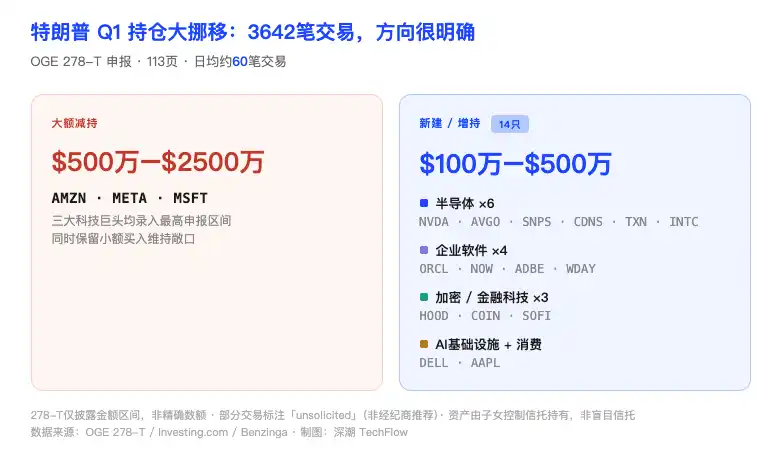
The semiconductor holdings closely align with the White House's policy direction of boosting domestic chip production capacity. According to Quiver Quantitative analysis, the purchase of Nvidia occurred before CEO Jensen Huang accompanied Trump on a visit to China, a trip expected to involve discussions on AI chip exports and semiconductor policy.
White House "Stock Tip" Three Months After Buying Dell, Stock Up 96%
The focus of the conflict-of-interest controversy centers on Dell.
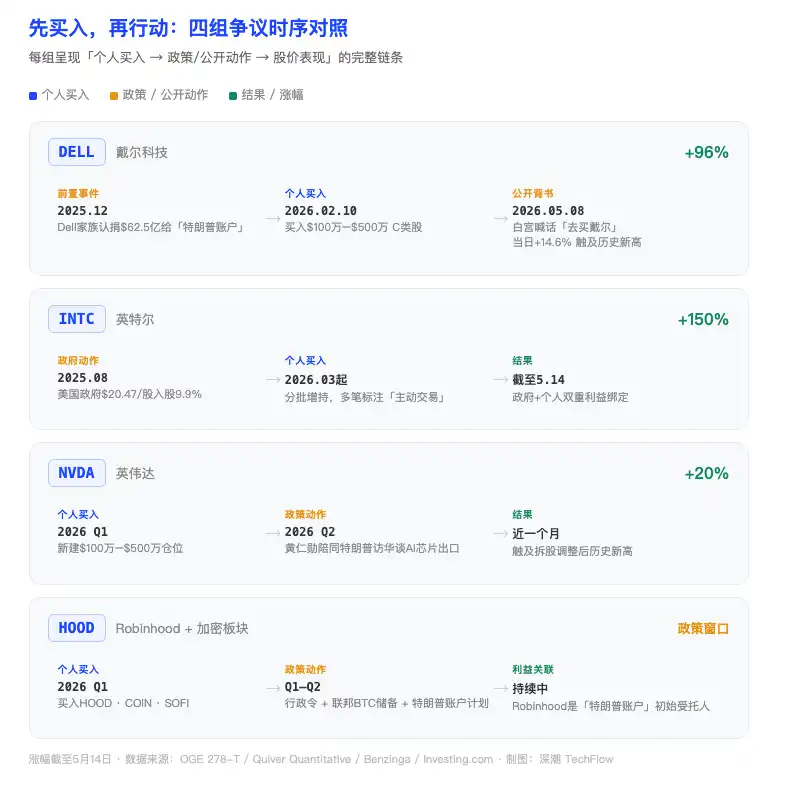
Documents show Trump bought $1 million to $5 million worth of Dell Technologies Class C stock on February 10, 2026. Three months later, at a Mother's Day event on May 8th, Trump thanked Michael Dell and Susan Dell by name at the White House and made the remark that sparked an uproar to those present—telling Americans to "go buy Dell."
That day, Dell's stock price surged as much as 14.6%, hitting a record high of $263.99. From Trump's purchase to the present, Dell's stock price has risen 96% cumulatively.
Another detail in the timeline intensified the controversy. On December 2, 2025, Michael Dell and Susan Dell pledged $6.25 billion to the "Trump Accounts," one of the largest private donations in recent years to a signature project of a sitting president. The White House has not responded to whether there was coordination between the President's public endorsement and the Dell family's donation.
Intel Shares Soar 150% After Purchase, Government Holds 9.9% Stake
Intel's trades are also worth examining.
Trump began buying Intel in batches starting in early March 2026, with several trades marked as "unsolicited," meaning not broker-recommended. Since the initial purchase on March 2nd, Intel's stock price has risen 150%.
Prior to this, the U.S. government purchased 433.3 million shares of Intel in August 2025 at $20.47 per share, giving it a 9.9% stake. In other words, Trump was buying Intel stock in the open market in his personal capacity while, in his presidential role, promoting government investment in Intel.
Additionally, purchases of Coinbase, Robinhood, and SoFi occurred during a period of active government promotion of crypto-friendly policies, including executive orders, a federal bitcoin reserve, and the "Trump Accounts" retirement plan. Robinhood is the initial trustee for that plan.
Non-Blind Trust Sparks Constitutional Debate, White House Claims Compliance
Critics view the alignment of these trading timelines as posing a conflict-of-interest risk. The White House argues that the filings fully comply with the STOCK Act's requirements.
Trump's assets are held in trusts controlled by his children, but the latest documents show numerous trades were executed by brokers acting as agents. The documents do not specify exactly which accounts hold the trading positions nor who gave the trading instructions.
An OGE spokesperson declined to comment on whether the trades reflect Trump's direct trading activity or operations through managed accounts, stating only that "the OGE is committed to transparency and citizen oversight of government."
According to Quiver Quantitative analysis, to their knowledge, this is the first time Trump has actively traded individual stocks while in office. The conservative, bond-heavy portfolio seen in previous 278-T filings has been completely overturned.






