Crypto Crime Crackdown Escalates As Myanmar Targets Scammers With Execution

bitcoinistPublished on 2026-05-16Last updated on 2026-05-16

Abstract

Myanmar's military government has proposed a harsh new law, the Anti-Online Fraud Bill, which mandates prison sentences of 10 years to life for digital currency fraud, with the death penalty for operators of scam centers whose coerced or trafficked workers die. The bill responds to online fraud threatening national stability. This crackdown is part of a broader regional effort; China executed 11 people in January linked to Myanmar-based scams, and U.S. authorities have collaborated internationally to arrest hundreds and shut down centers. Southeast Asian scam compounds, often using cryptocurrency, pose a global law enforcement challenge. The move comes as the FBI reports Americans lost over $11 billion to crypto fraud in 2024. Myanmar's parliament, reconvening after a 2021 coup and controversial 2026 elections, may consider the bill in June.

Americans lost more than $11 billion to crypto-related fraud last year, according to an FBI report released in April — and the pressure on governments across Southeast Asia to crack down has only grown since then.

A Deadly Business

Myanmar’s military government has now responded with one of the harshest proposed laws of its kind anywhere in the world.

The Anti-Online Fraud Bill, made public Thursday, would send anyone convicted of digital currency fraud to prison for anywhere between ten years and life.

In the most serious cases, offenders could face the death penalty.

The law specifically targets operators of scam centers who cause the death of workers coerced or trafficked into committing fraud on their behalf — those individuals would be sentenced to death under the proposed legislation.

Myanmar’s parliament, the Pyidaungsu Hluttaw, said it drafted the bill in response to online fraud that threatened the country’s sovereignty and stability.
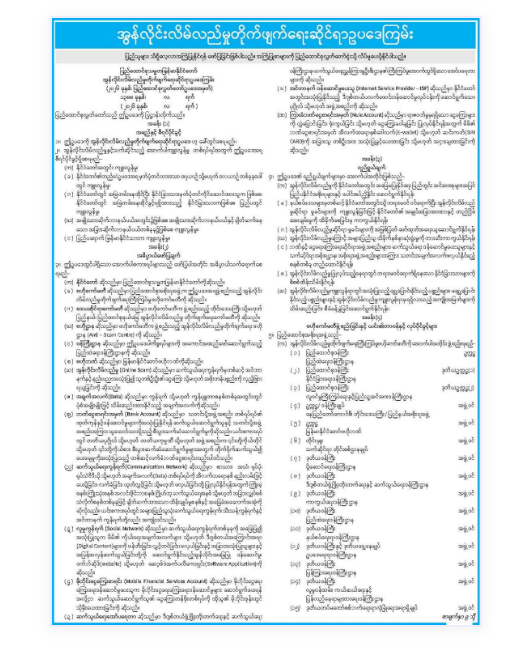
Source: Myanmar National Portal

Not The First Execution In The Region

Myanmar is not alone in taking a hard line. China executed 11 people in January tied to Myanmar-based scam operations, according to reports. Those operations had been responsible for trafficking Chinese nationals into forced labor inside the compounds.

The US has also stepped up its response. In April, American authorities worked alongside officials in China and Dubai to arrest more than 200 people and shut down nine scam centers.

US President Donald Trump signed an executive order in March directing officials to go after scam compounds and cybercrime.

BTCUSD now trading at $78,336. Chart: TradingView

The FBI’s Scam Center Strike Force has since focused its investigations on senior figures running compounds in Cambodia, Laos, and Burma, including affiliates of Chinese organized crime networks.

Online scam centers across Southeast Asia have become a growing problem for law enforcement worldwide. Schemes range from pig butchering and romance scams to fake investment platforms — many of them relying on crypto to move money.

A Government With A Complicated Record

Myanmar’s military took power in a coup in 2021. The country’s parliament did not meet again until March 2026, following elections that independent observers said were neither free nor fair. The government is scheduled to convene during the first week of June, when lawmakers may take up the bill.

Beyond crypto fraud, Americans lost more than $20 billion in total to online scams in 2025, FBI data shows. The agency’s task force has been working to identify and prosecute leaders of the most dangerous scam operations in the region.

Featured image from Unsplash, chart from TradingView

Related Questions

QWhat is the maximum penalty for digital currency fraud under Myanmar's proposed Anti-Online Fraud Bill?

AUnder the proposed Anti-Online Fraud Bill, the maximum penalty for digital currency fraud in Myanmar is the death penalty, applicable in the most serious cases, such as when scam center operators cause the death of coerced or trafficked workers.

QAccording to the article, how much did Americans lose to crypto-related fraud last year based on the FBI report?

AAccording to an FBI report released in April, Americans lost more than $11 billion to crypto-related fraud last year.

QWhich other country has executed people connected to Myanmar-based scam operations, as mentioned in the article?

AChina executed 11 people in January who were tied to Myanmar-based scam operations, according to reports cited in the article.

QWhat is the name of the FBI task force investigating senior figures running scam compounds in Southeast Asia?

AThe FBI task force investigating senior figures running scam compounds in Southeast Asia is called the Scam Center Strike Force.

QWhen is Myanmar's parliament, the Pyidaungsu Hluttaw, scheduled to convene, potentially to take up the Anti-Online Fraud Bill?

AMyanmar's parliament, the Pyidaungsu Hluttaw, is scheduled to convene during the first week of June, when lawmakers may take up the Anti-Online Fraud Bill.

Related Reads

Robots Begin to 'Consume Data': The Hidden Production Chain from Indian Data Factories to Billion-Dollar Humanoid Robots

Robots have started to 'consume data,' driving the formation of a new industrial supply chain focused on producing training data for embodied AI. Unlike large language models, which are trained on vast internet text corpora, embodied AI models face a 'data desert' in the physical world. This has created a massive demand for first-person perspective video data (Ego Data), captured by workers wearing cameras in places like Indian garment factories. Companies like Neocambrian AI are establishing 'data factories' where workers perform standardized tasks (e.g., sorting clothes, kitchen organization) to generate thousands of hours of video. Research, such as NVIDIA's EgoScale, demonstrates that scaling this human demonstration data predictably improves robot performance, particularly for dexterous manipulation. This has validated a training path combining large-scale human data for pre-training with smaller amounts of robot-specific data for fine-tuning. The value of different data types varies significantly, forming a 'data pyramid.' The base consists of low-cost, large-scale internet and Ego Data. Higher layers include more expensive motion-capture data (e.g., from data gloves), simulation/synthetic data, and the most costly and scarce layer: real robot teleoperation data. This demand has spawned a layered ecosystem of data suppliers: low-cost data factories, motion capture and alignment specialists, robot-native teleoperation service providers, simulation data companies, and platforms aiming for data standardization. Robot companies themselves are adopting a 'layered procurement' strategy: outsourcing generic Ego Data while building in-house capabilities for robot-specific adaptation data and the critical deployment/failure data generated in real-world applications. The industry is shifting focus from hardware and basic mobility to the data pipelines required for general-purpose capability. While parallels exist to data labeling companies like Scale AI in the LLM boom, the physical complexity of robot data—involving action success ambiguity and sim-to-real gaps—requires more integrated solutions for data collection, annotation, and a continuous feedback loop. The race is on to build the data engines that will teach robots to operate reliably in the unstructured real world.

marsbit2h ago

Robots Begin to 'Consume Data': The Hidden Production Chain from Indian Data Factories to Billion-Dollar Humanoid Robots

marsbit2h ago

Spicy Commentary | Michael Saylor's 'Player Talk'; 60-Year-Old Aunt Liquidated After 'Scamming a Young Man'

**"Spicy Commentary": Three Tales of Crypto's Wild Week** This week's "Spicy Commentary" column highlights three dramatic stories from the cryptocurrency world. First, **MicroStrategy's Michael Saylor** addressed the controversy over his company potentially selling Bitcoin. At the BTC Prague event, he clarified, "I never said the company can't sell Bitcoin. I told *you* never to sell *your* Bitcoin." This "do as I say, not as I do" stance was criticized by netizens as peak linguistic gymnastics, noting a history of him previously stating the company would "never" sell. Second, a **bizarre fraud case** emerged from Beijing. A 60-year-old woman, obsessed with getting rich from crypto but unwilling to risk her own savings, posed online as the 20-something "god-daughter" of a high-ranking official. She catfished a young man, convincing him to give her over 200,000 yuan for fabricated emergencies. She then invested all the stolen money into cryptocurrency with 10x leverage, only to lose everything in a market crash. The woman was sentenced to four years in prison for fraud. Finally, a **sobering trader's tale** surfaced on Reddit. A user posted "Tale of a crypto trader," confessing their net worth had plummeted from a peak of $45 million to roughly $17,200, primarily due to holding meme coins too long. The post, described as a crypto "book of confessions," sparked reactions ranging from sympathy to critique about greed, poor risk management, and the perils of treating meme coins as long-term investments instead of taking profits. The column concludes that this week featured masterful rhetoric, elaborate scams, and extreme financial volatility, stitching together another chapter in crypto's unpredictable theater.

Foresight News3h ago

Spicy Commentary | Michael Saylor's 'Player Talk'; 60-Year-Old Aunt Liquidated After 'Scamming a Young Man'

Foresight News3h ago

Tremble Humans, AI Continues Its Accelerated Sprint

Trembling, Humans: AI Continues Its Accelerated Sprint Yes, AI is still rapidly accelerating. While deep learning seemed to stall quickly in its early years, large models after years of development show no sign of hitting their ceiling. At the Zhiyuan Conference 2026, the focus is on enabling AI to move from the digital world into the physical world. Scaling Law remains effective, continuing to drive advancements in both large language models and multimodal models. The industry is now entering a phase of pursuing World Models, though unresolved technical paths and data issues mean this exploration may take 3-5 more years. Concurrently, breakthroughs in Agents are accelerating AI's real-world application in fields like healthcare and meetings. Making Agents truly useful requires key hardware-software co-design, evident from the strong presence of chip vendors at the conference. We stand at a new historical threshold where AI is becoming a foundational force reshaping the world. The first day of the conference highlighted AI's evolution from "knowing how to chat" to "knowing how to work." Scaling Law persists, World Models are the next key battleground, and Agents are transitioning from usable to好用 (user-friendly). Scaling Law is not ending but diversifying. New models like Anthropic's Fable 5 demonstrate scaling through parameter size, synthetic data, and reinforcement learning. Advancements in AI Coding and Agent deployment are enabling a trend of AI self-evolution, potentially allowing AI to take over digital world iterations. World Models represent the next frontier for large models extending into the physical realm, but no current model is truly impressive at solving real-world problems. Technical consensus is lacking, with debates on data sources (video, simulation, real-world). Different approaches are emerging: language-centric, pixel-centric, 3D-structure-centric, and visual-representation-centric models. Zhiyuan Institute is exploring a fifth path: unified latent space modeling fusing language and visual representations, and introduced its own under-development World Model, Physis-v0.1. On the product side, Agents are key to bringing AI into daily life. Since 2025, the "Year of the Agent," products have become more proactive and capable of complex tasks. Zhiyuan showcased four vertical Agents for cardiac diagnosis, autonomous research, meeting summarization, and protein risk discovery. However, technical challenges remain, particularly in context engineering like memory and orchestration. "Harness" – the engineering framework around an Agent – is crucial for maximizing its capabilities by clarifying intent, designing workflows, and incorporating validation and feedback. In summary, AI's breakneck pace continues on multiple fronts: foundational model scaling, the ambitious pursuit of World Models for physical understanding, and the ongoing refinement of practical Agents. The journey from capable to truly reliable and useful AI systems is well underway.

marsbit3h ago

Tremble Humans, AI Continues Its Accelerated Sprint

marsbit3h ago

The Backside of Musk's Trillion-Dollar Fortune: 85% Can't Be Sold

Elon Musk becomes the world's first trillionaire, driven by SpaceX's IPO valuing the company at $1.77 trillion. However, his vast wealth is largely illiquid: he holds over 85% voting control, likely through super-voting shares that are subject to lock-ups and selling restrictions. While his net worth surpasses $1 trillion across SpaceX, Tesla, and private holdings, only a tiny fraction (potentially under 2% annually) could be converted to cash without jeopardizing control and market confidence. SpaceX's IPO also creates paper millionaires for roughly 4,400 employees, but their holdings face lock-up periods, exercise costs, and taxes, delaying and reducing actual cash proceeds. Only 4.2% of total shares are initially available for public trading, making the stock price highly sensitive to limited net buying or selling pressure. A major test will come when lock-ups expire for the remaining 96% of shares. The article contrasts SpaceX's wealth distribution with potential AI IPOs. Anthropic and OpenAI could generate employee wealth pools 20 times larger than SpaceX's in paper value, due to their higher valuations relative to revenue and potentially more distributed ownership. However, sustaining those high price-to-sales multiples post-IPO is uncertain. A key financial puzzle for SpaceX investors is its xAI unit. While it has locked in an estimated $26 billion in annual compute revenue from clients like Anthropic and Google, the unit reported a $6.4 billion loss in 2025. More critically, estimated annual capital expenditures of ~$30.8 billion exceed that revenue. The long-term viability of SpaceX's AI narrative hinges on whether this compute income can eventually cover the unit's massive ongoing investments and losses.

链捕手3h ago

The Backside of Musk's Trillion-Dollar Fortune: 85% Can't Be Sold

链捕手3h ago

Trading

Spot
Futures
活动图片