Trump Executed 3,600 Stock Trades in Q1, Bought Nvidia, Dell, Then Made a 'Stock Tip,' Sparking Conflict-of-Interest Controversy

marsbitPublished on 2026-05-15Last updated on 2026-05-15

Abstract

Former President Donald Trump executed 3,642 individual stock trades in Q1 2026, averaging about 60 trades per day, according to a recent OGE 278-T disclosure. This breaks from the modern presidential tradition of using blind trusts. The filings reveal Trump sold large positions in Amazon, Meta, and Microsoft while making significant new purchases in AI and semiconductor firms like NVIDIA, Broadcom, and Intel. Notably, he bought $1-5 million worth of Dell stock on February 10. Three months later, on May 8, he publicly urged Americans to "buy Dell" at a White House event; the stock has since risen 96%. His Intel purchases began in early March, after which the stock surged 150%. The U.S. government had taken a 9.9% stake in Intel in August 2025. These transactions, occurring close to related policy actions or public endorsements, have ignited significant controversy over potential conflicts of interest. While the White House maintains full compliance with the STOCK Act, critics highlight the unprecedented scale of trading and the timing coinciding with his official duties and donors' interests.

Author: Claude, Deep Chao TechFlow

Deep Chao Introduction: Trump's newly disclosed OGE 278-T form shows he executed 3,642 stock trades in Q1 2026, averaging about 60 trades per day, breaking the precedent of using a "blind trust" set by presidents since Lyndon Johnson.

The disclosure reveals that after buying $1 million to $5 million worth of Dell stock on February 10th, Trump publicly urged people on May 8th at the White House to "go buy Dell," following which the stock surged 96%. Multiple trades, including those in Nvidia and Intel, occurred ahead of related policy moves, rapidly fueling a conflict-of-interest controversy.

Trump's personal stock trading record is becoming one of the most contentious documents in Washington.

According to Benzinga, documents released this week by the Office of Government Ethics (OGE) show Trump executed 3,642 securities transactions in Q1 2026, averaging about 58 per day. The 113-page OGE 278-T form was signed by Trump on May 8th, delivered to the OGE on May 12th, and had "Filer paid late fee" handwritten on the cover page, indicating it exceeded the 30- to 45-day filing window stipulated by federal regulations.

This trading frequency breaks the nearly continuous blind trust arrangement precedent since Lyndon Johnson. Most former U.S. presidents placed personal assets in qualified blind trusts to limit conflicts of interest; Carter even liquidated his peanut farm, Obama held Treasury bonds and index funds, and Biden also employed a blind trust arrangement during his term.

Massively Sold Tech Giants, Heavily Bet on AI Chip Supply Chain

Disclosure documents show Trump significantly reduced holdings in Amazon, Meta, and Microsoft in Q1, all falling within the highest valuation bracket of $5 million to $25 million. However, while selling heavily, Trump maintained exposure to these three companies through smaller purchases.

More notably are the new positions. Trump established new positions in the $1 million to $5 million range in Nvidia (NVDA), Broadcom (AVGO), Synopsys (SNPS), Cadence Design Systems (CDNS), and Texas Instruments (TXN), covering almost every core segment of the U.S. AI chip supply chain. Large buys also appeared in Apple, Oracle, ServiceNow, Adobe, and Workday within the same range.
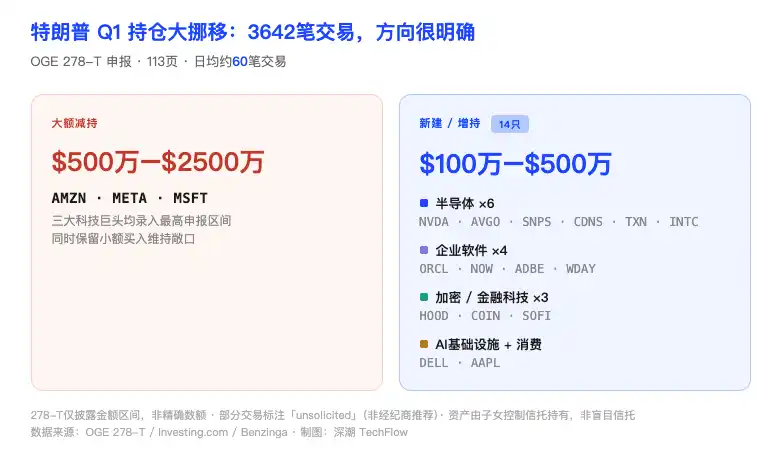
The semiconductor holdings closely align with the White House's policy direction of boosting domestic chip production capacity. According to Quiver Quantitative analysis, the purchase of Nvidia occurred before CEO Jensen Huang accompanied Trump on a visit to China, a trip expected to involve discussions on AI chip exports and semiconductor policy.

White House "Stock Tip" Three Months After Buying Dell, Stock Up 96%

The focus of the conflict-of-interest controversy centers on Dell.

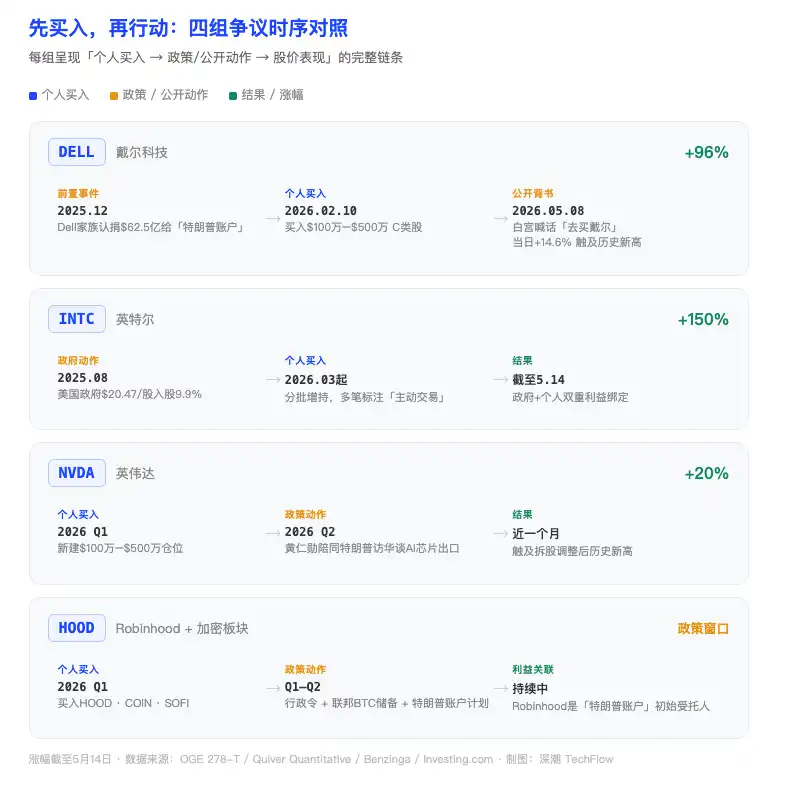
Documents show Trump bought $1 million to $5 million worth of Dell Technologies Class C stock on February 10, 2026. Three months later, at a Mother's Day event on May 8th, Trump thanked Michael Dell and Susan Dell by name at the White House and made the remark that sparked an uproar to those present—telling Americans to "go buy Dell."

That day, Dell's stock price surged as much as 14.6%, hitting a record high of $263.99. From Trump's purchase to the present, Dell's stock price has risen 96% cumulatively.

Another detail in the timeline intensified the controversy. On December 2, 2025, Michael Dell and Susan Dell pledged $6.25 billion to the "Trump Accounts," one of the largest private donations in recent years to a signature project of a sitting president. The White House has not responded to whether there was coordination between the President's public endorsement and the Dell family's donation.

Intel Shares Soar 150% After Purchase, Government Holds 9.9% Stake

Intel's trades are also worth examining.

Trump began buying Intel in batches starting in early March 2026, with several trades marked as "unsolicited," meaning not broker-recommended. Since the initial purchase on March 2nd, Intel's stock price has risen 150%.

Prior to this, the U.S. government purchased 433.3 million shares of Intel in August 2025 at $20.47 per share, giving it a 9.9% stake. In other words, Trump was buying Intel stock in the open market in his personal capacity while, in his presidential role, promoting government investment in Intel.

Additionally, purchases of Coinbase, Robinhood, and SoFi occurred during a period of active government promotion of crypto-friendly policies, including executive orders, a federal bitcoin reserve, and the "Trump Accounts" retirement plan. Robinhood is the initial trustee for that plan.
Non-Blind Trust Sparks Constitutional Debate, White House Claims Compliance

Critics view the alignment of these trading timelines as posing a conflict-of-interest risk. The White House argues that the filings fully comply with the STOCK Act's requirements.

Trump's assets are held in trusts controlled by his children, but the latest documents show numerous trades were executed by brokers acting as agents. The documents do not specify exactly which accounts hold the trading positions nor who gave the trading instructions.

An OGE spokesperson declined to comment on whether the trades reflect Trump's direct trading activity or operations through managed accounts, stating only that "the OGE is committed to transparency and citizen oversight of government."

According to Quiver Quantitative analysis, to their knowledge, this is the first time Trump has actively traded individual stocks while in office. The conservative, bond-heavy portfolio seen in previous 278-T filings has been completely overturned.


Related Questions

QWhat is the primary controversy surrounding Donald Trump's stock trades in Q1 2026 as detailed in the article?

AThe primary controversy is the potential conflict of interest, as Trump conducted numerous personal stock trades (3642 in total) while in office, a break from the tradition of modern presidents using blind trusts. Specific concerns include his purchase of Dell stock followed by a public endorsement to "buy Dell" from the White House, and trades in companies like Nvidia and Intel that coincided with or preceded related government policy actions.

QHow did Donald Trump's investment activity in Dell become a focal point of the conflict-of-interest allegations?

ATrump purchased between $1 million and $5 million worth of Dell stock on February 10, 2026. Three months later, on May 8, he publicly told attendees at a White House event to "go buy Dell." Following this endorsement, Dell's stock price surged, having already risen 96% from his purchase date. This sequence created the appearance of using his presidential platform to influence a stock in which he held a significant personal financial stake.

QWhat significant change does the article note in Trump's investment strategy during his presidency compared to his previous disclosures?

AThe article notes a dramatic shift from a conservative, bond-heavy portfolio in his previous financial disclosures to an active trading strategy focused on individual stocks, particularly within the AI chip and technology sectors. This represents his first known period of active individual stock trading while in office.

QAccording to the article, what action did the US government take regarding Intel before Trump's personal stock purchases?

AIn August 2025, the US government purchased 433.3 million shares of Intel at $20.47 per share, acquiring a 9.9% stake in the company. Trump subsequently began personally buying Intel stock in March 2026.

QHow has the White House responded to criticism about the timing of Trump's stock trades?

AThe White House has defended the transactions, stating that the financial disclosures are fully compliant with the requirements of the STOCK Act. However, it has not commented on whether there was any coordination between the president's public endorsements and related stock trades or political donations.

Related Reads

ENS Founder Seeks to 'Seize Power' from DAO

On June 29th, the ENS community entered the on-chain voting phase for a proposal to renew the ENS DAO Security Council's veto power for two more years. Shortly after voting began, ENS founder Nick Johnson used his substantial ENS holdings to cast over 3.55 million votes against the proposal, swinging the outcome despite initial strong support. The Security Council was established in July 2024 with a 4/8 multisig veto power to protect the DAO's treasury (valued over $350 million) from malicious proposals during a period of low voter participation. Its powers were limited to vetoing only harmful proposals, not normal ones. Nick Johnson's opposition stems from broader concerns about ENS DAO's governance. In late 2025, he and others expressed frustration that the DAO had become mired in political gamesmanship, with capable contributors leaving and leadership falling to less experienced or misaligned parties. This context set the stage for a major restructuring proposal by ENS COO Katherine Wu on June 19th, titled "Next Era of ENS DAO: Empowering the ENS Foundation." The controversial proposal aims to transfer daily operations, treasury management, and long-term strategy to a restructured ENS Foundation with a professional board, while the DAO would retain core protocol governance powers. Critics, including original ENS constitution author Brantly Millegan, argue this effectively transfers treasury control from token holders to ENS Labs (the core development team), undermining the DAO's original decentralized design. Nick's massive "no" vote on the Security Council renewal is seen as the first move in this power struggle. He explained his vote was due to concerns about insufficient checks on the Council's power and the potential for its veto to be used politically. In response, Katherine Wu submitted a revised proposal with higher execution thresholds (5/8 instead of 4/8) and stricter limits. The push for change comes as ENS's annual revenue has declined significantly, from over $10 million in 2023 to under $2 million in 2025, increasing pressure to manage the treasury more effectively. Nick Johnson now faces the challenge of proving that a more structured foundation can steer ENS better than the current DAO model.

Foresight News9m ago

ENS Founder Seeks to 'Seize Power' from DAO

Foresight News9m ago

Predicting World Cup Knockout Matches: Why Are Different AI Models So Far Apart?

AI performance in predicting the 2026 FIFA World Cup knockout matches varied significantly, according to an analysis of models including ChatGPT, Grok, DeepSeek, Gemini, and Claude. The standout predictions came from DeepSeek and Gemini for the Netherlands vs. Morocco match. Gemini precisely forecasted a 1-1 draw and a penalty shootout win for Morocco, while DeepSeek correctly identified the high probability of a draw and Morocco's potential to advance via a defensive and counter-attacking strategy. Grok and Tongyi Qianwen (千问) demonstrated strength in predicting accurate scores for matches with clearer favorites. They correctly called the narrow 1-0 win for Canada over South Africa and Brazil's 2-1 victory over Japan, as well as Norway's 2-1 win over Ivory Coast. ChatGPT and Claude excelled more in match process analysis than in predicting exact scores or upsets. They frequently identified potential challenges for favorites, such as Japan's pressing against Brazil or DR Congo's defensive tactics against England, even when predicting the favorite's ultimate victory. A notable failure was the unanimous misjudgment of Germany vs. Paraguay. All models incorrectly favored Germany, underestimating Paraguay's ability to force a penalty shootout and cause an upset. In summary, Gemini and DeepSeek showed the most insight for high-stakes, unpredictable matches. Grok and Qianwen were reliable "score predictors" for less volatile games. ChatGPT and Claude were strong "analytical models," adept at outlining match dynamics but often hesitant to predict upsets.

Odaily星球日报38m ago

Predicting World Cup Knockout Matches: Why Are Different AI Models So Far Apart?

Odaily星球日报38m ago

Will There Be a Next Wave of Web3 Games? Veteran Player's Review: At the Peak of Hype, You Should at Least Sell Half

**Title: Is There Another Wave for Web3 Gaming? A Veteran Player's Review: When Hype Peaks, You Must Exit at Least Half** **Summary:** In an interview, veteran player "Earn Money Chicken" shares his journey and reflections on Web3 gaming. He transitioned from being a traditional in-game trader to a Web3 gamer, having profited from games like Mobox, StepN, and Seraph, but also experiencing significant losses. He defines himself primarily as a player, not an investor, attracted to Web3 games for the blend of earning potential, engaging gameplay, and the satisfaction of researching game mechanics. While he enjoys strategic "gambling" within games, he emphasizes it's not about zero-sum competition with other players. The interview explores the complex, often adversarial relationship between players, projects, and major investors (whales). The player's experience as a traditional game merchant helped develop his analytical mindset for spotting opportunities, but wasn't directly transferable. He identifies the core sources of profit in early Web3 gaming as **"era红利" (era-specific红利)** and strategic foresight, not just simple calculations. He warns that the biggest mistake ordinary players make is calculating their return-on-investment (ROI) period at peak hype, as asset and yield depreciation can trap them. Reflecting on his wins and losses, he now advocates for managing expectations. His most successful exit was from Seraph, where he sold at a relatively good time. The key problem with current Web3 games, he argues, is that most are not mature games first. A successful Web3 game must primarily be a **good, fun game** with a genuine player base willing to spend money for enjoyment, not just participants seeking profit. The blockchain element should solve problems within that context, not be the primary driver. While he believes the sector might see another speculative boom (possibly another strong "Ponzi" model attracting hype), a truly mature and sustainable Web3 game likely needs to come from a traditional major game studio. It would leverage a proven IP, mature content, a functional NFT trading system, and attract both traditional and crypto-native players, offering more normalized returns rather than extreme暴利. His final advice: Newcomers without prior experience should avoid the space now, as it's like searching for a diamond in the rough. For those remaining, the rule is: be brave when assets are low and overlooked, but **when everyone is talking about it (at peak hype), you must sell at least half your holdings.**

marsbit1h ago

Will There Be a Next Wave of Web3 Games? Veteran Player's Review: At the Peak of Hype, You Should at Least Sell Half

marsbit1h ago

Trading

Spot
活动图片