
Trading Moment: Silver Plunges After Hitting New High, Institutions Warn of Precious Metals Correction Risk, Bitcoin Shows 'Dead Cat Bounce'?

marsbitPublished on 2025-12-29Last updated on 2025-12-29

Abstract

Silver prices hit a record high above $84/oz before sharply retreating to around $78 amid profit-taking, dragging gold and other precious metals lower. While factors like Fed rate cut expectations and central bank buying persist, new supply concerns emerged as China plans export controls on silver from 2026. Institutions are divided: Goldman Sachs sees gold potentially surpassing $4,900, but UBS and Capital Economics warn of a correction, with silver possibly falling to $42 by end-2026. Bitcoin briefly reclaimed $90k but faces cautious sentiment, with analysts debating if it’s a "dead cat bounce" or a setup for a rally toward $112k. ETF outflows and low trading volume signal fragility, though some expect rotation from metals to crypto. Ethereum hovered near $3k, with key support at $2,775; a break could trigger a drop toward $1,800. Key data: BTC at $89,989, ETH at $3,033, fear index at 24. Over $151M liquidated in 24h. ETF flows: Bitcoin ETFs saw $782M outflows last week, Ethereum ETFs $102M. Notable events: Lighter TGE expected Dec 29, Flow hacked for $3.9M, and several tokens facing unlocks worth hundreds of millions.

Daily key data review and trend analysis, produced by PANews.

1. Market Observation

At the start of the new week, the precious metals market took center stage. Spot silver broke through $84/oz to hit a new historical high, but then faced selling pressure from profit-taking, quickly plunging and turning negative intraday, eventually fluctuating around $78. This rollercoaster ride directly impacted related financial products, with spot gold retreating from near its historical high of $4550, and platinum and palladium both falling close to or over 7%. Beyond the traditional logic of Fed rate cut expectations and continued central bank gold buying, the market began pricing in a new narrative of "commodity control," where the importance of geopolitics and supply chain security is increasingly highlighted, especially after China announced export licensing for silver effective January 1, 2026, further exacerbating expectations of tight global physical supply. However, market divergence also intensified. The Chicago Mercantile Exchange (CME) raised margins on silver futures for the second time in two weeks, sparking concerns about a historical replay of the 2011 silver crash triggered by similar measures. Institutions like Goldman Sachs remain bullish on gold continuing its strength into 2026, with a target price potentially exceeding $4900, but UBS and Capital Economics warned that precious metal prices have detached from fundamentals, accumulating correction risks, with Capital Economics even predicting silver could fall back to $42 by the end of next year. For silver, despite its strong industrial demand in sectors like solar energy, analysis suggests that prices reaching $134/oz could lead to demand destruction; while copper, as a potential substitute, poses little short-term threat as factory retrofits take at least 4 years. Institutions like Guojin Securities believe the 2026 investment theme is already visible across commodities, supply chains, and foreign exchange markets—under a structure where investment outweighs consumption,大宗商品 trading ranges are lengthening, China's manufacturing advantages are prominent, and industrial resources resonating with AI investment and global manufacturing recovery are worth watching.

Compared to the剧烈 volatility in the precious metals market, the cryptocurrency market overall was permeated with cautious and sluggish sentiment, even as Bitcoin broke through $90,000 again today. Most analysts are cautious about the outlook. For example, analyst Killa believes that although there might be short-term bounces, the broader trend is still downward seeking support below $70,000, judging that this cycle has ended. Ali Charts expressed similar views, suggesting that against a backdrop of net capital outflows reaching $4.5 billion and Bitcoin ETFs seeing nearly $1 billion in net outflows over the past two weeks, any rebound is likely a "dead cat bounce" lacking support from spot demand. A report from 10x Research also pointed out that current crypto market trading volume is 30% lower than normal, with undercurrents beneath the surface calm making the market particularly fragile. However, there are also bullish voices in the market. Analyst Astronomer, through liquidity analysis, indicated that the market has built sufficient short liquidity in the $94,000 to $95,000 region, creating conditions for a price surge towards the $112,000 target. Michaël van de Poppe expects that as funds rotate from the overheated precious metals market to the crypto market, Bitcoin could move towards $100,000 in the coming week. Analyst Plan B, by recalling the history of the 2021 bull market which experienced a correction of over 50% mid-cycle before hitting new highs, suggested the current pullback might just be a normal correction within the cycle. Samson Mow made the bold assertion that "2025 is the bear market," predicting Bitcoin might embark on a decade-long bull run. On the technical front, analysts are closely watching key levels. Ardi pointed out that whether Bitcoin can effectively break through the resistance zone between $90,000 and $94,600, and hold the support band between $80,000 and $86,300, is core to judging the future direction.

Ethereum broke through $3000 again, but market sentiment remains cautious. On-chain analyst Murphy provided a deeper analysis, suggesting the main矛盾 (contradiction) for Ethereum currently is not the overhead selling pressure from trapped positions, but the overly dispersed structure of profitable筹码 (chips/holdings) below. He noted that $2700 is one of the few levels that can form a consensus strong承接区 (support area); if lost, the price could enter a "vacuum zone" lacking effective support, with the nearest gap area below between $1800 and $2600. Nonetheless, he also observed that the whale group holding over 100,000 ETH has been adding positions near $2700, showing a posture of "long-term optimism, short-term caution." For short-term movements, technical analyst CyrilXBT described Ethereum as a "coiled spring," believing it needs to break through $3345 to release upward momentum. Michaël van de Poppe gave specific key levels: $2775 is an unbreakable support level, otherwise it could trigger a chain reaction decline; while a break above the $3000 resistance could lead to a rapid冲击 (assault) on $3650.

The market is currently most concerned about the TGE of the decentralized perpetual exchange Lighter, widely expected to occur on December 29. According to its airdrop details, the team confirmed the airdrop will account for 25% of the total supply, requiring no claim and will be sent directly to user wallets. The team also clarified that recent large token transfers were for safeguarding investor and team allocations. Meanwhile, the public chain project Flow experienced a security incident over the weekend, where an attacker exploited a vulnerability in its execution layer to transfer approximately $3.9 million, leading validators to temporarily halt operations to deploy a fix; the project team stated that user balances were unaffected and the protocol faces no solvency risk. Additionally, the ZEROBASE token ZBT saw its price briefly突破 (break through) $0.2, with a 78% gain in 24 hours.

2. Key Data (As of 13:00 HKT, December 29)

(Data sources: CoinAnk, Upbit, SoSoValue, CoinMarketCap)

  • Bitcoin: $89,989 (Year-to-date -3.25%), daily spot trading volume $31.45 billion

  • Ethereum: $3,033 (Year-to-date -9.2%), daily spot trading volume $28.28 billion

  • Fear & Greed Index: 24 (Fear)

  • Average GAS: BTC: 1.75 sat/vB, ETH: 0.02 Gwei

  • Market Dominance: BTC 59.1%, ETH 12%

  • Upbit 24-hour trading volume ranking: BTC, ZBT, XRP, ETH, 0G

  • 24-hour BTC Long/Short Ratio: 50.99% / 49.01%

  • Sector Performance: Crypto sectors generally rose, SocialFi sector up over 3%, only Layer2 sector slightly down

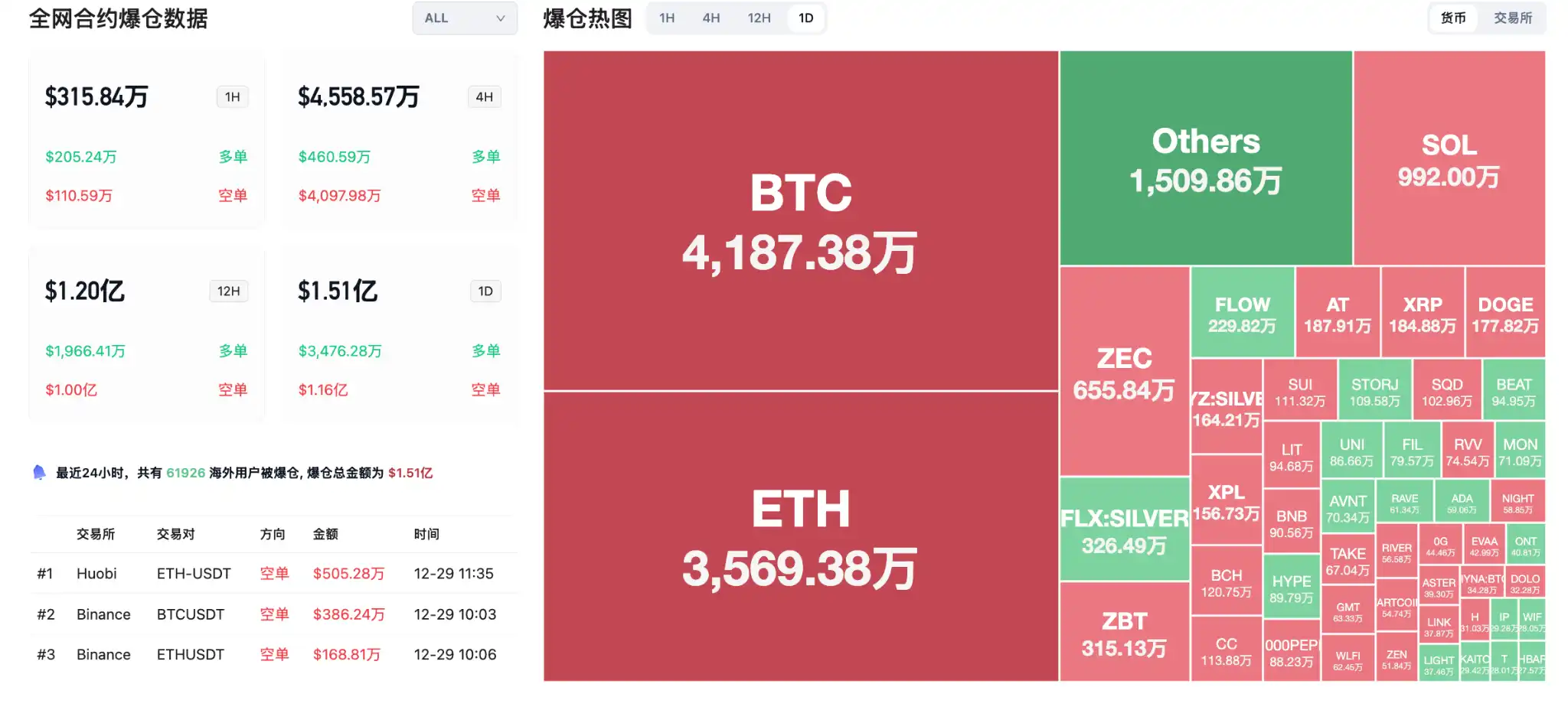
  • 24-hour Liquidation Data: 61,926 people liquidated globally, total liquidation amount $151 million,其中 (including) BTC liquidations $41.87 million, ETH liquidations $35.69 million, ZEC liquidations $6.55 million
3. ETF Flows (As of December 26)

  • Bitcoin ETFs: Net outflow of $782 million last week, BlackRock's IBIT led with net outflow of $435 million

  • Ethereum ETFs: Net outflow of $102 million last week, BlackRock's ETHA led with net outflow of $69.42 million

  • Solana ETF: Net inflow of $13.14 million last week

  • XRP ETF: Net inflow of $64 million last week

4. Today's Preview

  • "Lantian Gerui Case" fund refund registration deadline is December 29, missing it may affect fund return

  • Binance will delist EIGEN/FDUSD, ARB/FDUSD and other FDUSD margin trading pairs on December 30

  • Web3 game studio ChronoForge will shut down on December 30 due to funding shortage

  • Padre: PADRE holders will receive PUMP based on their holdings, need to submit wallet address by December 30

  • SHFE: From close on December 30, price limits for gold and silver futures contracts adjusted to 15%,同时 (simultaneously) adjusting margin ratios

  • SDIC Silver LOF: Class A定投 (fixed investment)上限 (upper limit) reduced back to 100 yuan, Class C shares will begin suspending subscriptions, effective December 29

  • 51VR, Chantecaille (Linshangtang) expected to list on HKEX on December 30

  • Hyperliquid (HYPE) will unlock approximately 9.92 million tokens at 15:30 on December 29, representing about 2.87% of circulating supply, value approx. $256 million;

  • Kamino (KMNO) will unlock approximately 229 million tokens at 20:00 on December 30, representing about 5.35% of circulating supply, value approx. $11.8 million;

  • Slash Vision Labs (SVL) will unlock approximately 234 million tokens at 08:00 on December 30, representing about 2.96% of circulating supply, value approx. $6.8 million;

  • Zora (ZORA) will unlock approximately 166 million tokens at 08:00 on December 30, representing about 4.17% of circulating supply, value approx. $6.7 million.

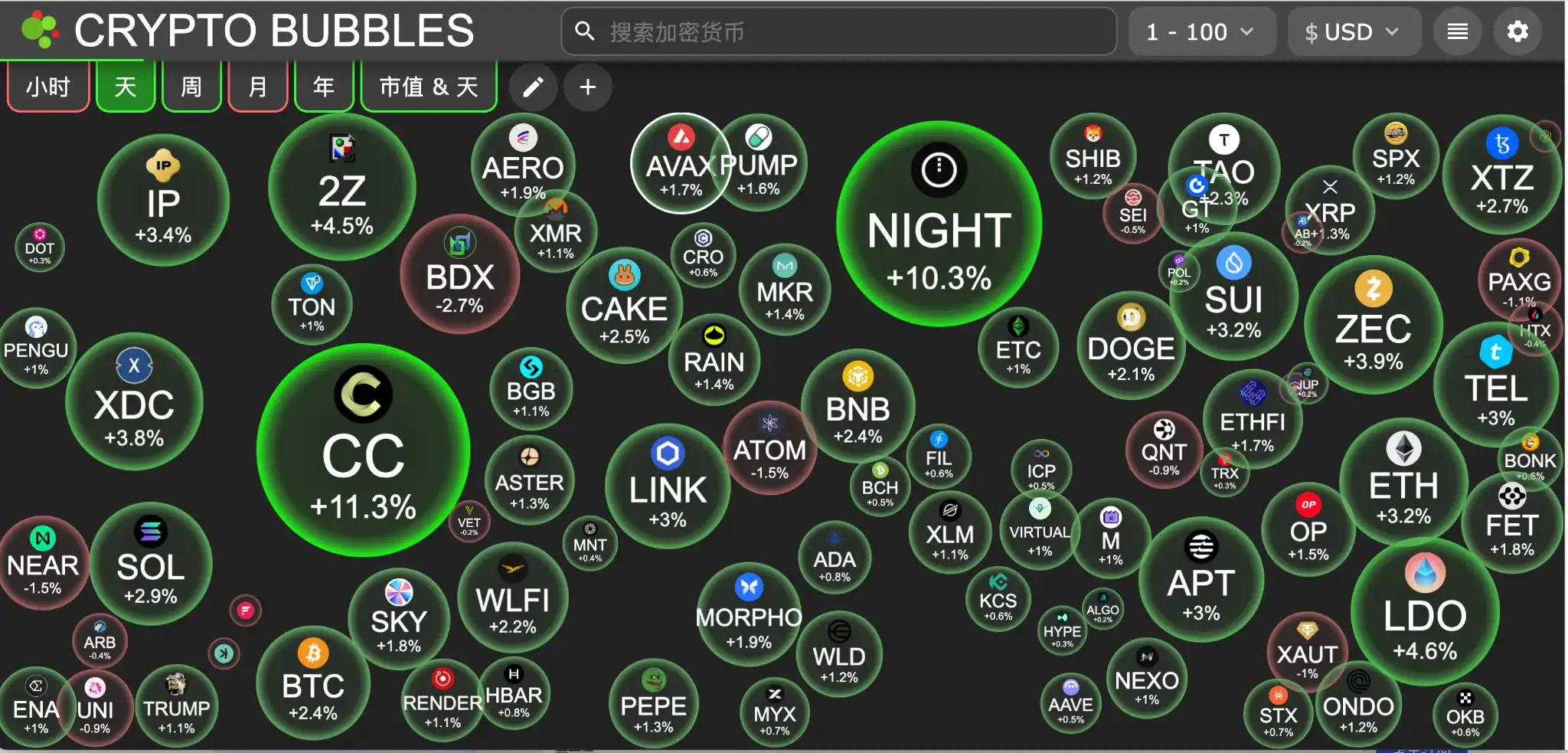
Today's Top 100 Coins by Market Cap - Maximum Gains: Canton Network up 11.3%, Midnight up 10.3%, DoubleZero up 4.7%, Lido DAO up 4.5%, Zcash up 3.9%.
5. Hot News

  • Data: HYPE, SUI, EIGEN and other tokens to see large unlocks next week,其中 (with) HYPE unlock value approx. $256 million

  • Weekly Preview | EU, UK, Hong Kong and other regions implement relevant new regulations for digital assets; Hyperliquid (HYPE) to unlock tokens worth ~$256 million

  • Suspected Trend Research purchased another 11,520 ETH, worth $34.93 million

  • Analysis: Bitcoin spot ETFs累计 (accumulated) net outflows nearly $6 billion over past nine weeks, market funding and sentiment remain under pressure

  • Hyperliquid's weekly revenue仅为 (only) $9.16 million, hitting a new low since early May

  • Solana DEX spot trading volume year-to-date exceeds $1.7 trillion, surpassing Bybit to rank second

  • A whale withdrew 2,218 ETH, 37.1 million SKY, and 4,772 AAVE from Kraken 7 hours ago

  • Spot silver breaks through $80/oz, setting a new record

  • Hyperliquid Co-founder: 1.2 million HYPE tokens will be allocated to team members on January 6 after unlock

  • Bubblemaps: Meme coin project ATLAS疑似 (suspected) insider trading, 68 wallets already hold 47% of token supply

  • Coinbase Bitcoin Premium Index has been in negative premium for two consecutive weeks, currently reported at -0.0784%

  • 100 million UNI burned from Uniswap treasury, worth $596 million

  • Flow hacked for $3.9 million loss, user deposits unaffected

Trending Cryptos

Related Questions

QWhat happened to the price of silver after it hit a new all-time high, and what was a key factor contributing to the subsequent volatility?

AAfter hitting a new all-time high above $84/oz, the price of silver experienced a sharp pullback, falling to around $78/oz. A key factor contributing to this volatility was profit-taking by traders. Additionally, the CME raised margin requirements for silver futures for the second time in two weeks, which historically has triggered sell-offs.

QAccording to analysts cited, what is the prevailing sentiment in the cryptocurrency market despite Bitcoin's price breaking through $90,000?

AThe prevailing sentiment in the cryptocurrency market is one of caution and pessimism. Analysts like Killa and Ali Charts view any price rebounds as potential 'dead cat bounces'—temporary recoveries lacking genuine demand—due to significant capital outflows from Bitcoin ETFs and a general market downturn.

QWhat critical price level for Ethereum did on-chain analyst Murphy identify as a major support zone, and what was the concern if it were broken?

AOn-chain analyst Murphy identified $2,700 as a critical support zone for Ethereum. The concern was that if this level were broken, the price could enter a 'vacuum zone' with little support, potentially falling to a range between $1,800 and $2,600.

QWhat major event is the market anticipating for the decentralized perpetual exchange Lighter, and what is unique about its token airdrop distribution?

AThe market is anticipating the Token Generation Event (TGE) for the decentralized perpetual exchange Lighter, widely expected to occur on December 29th. A unique feature of its airdrop is that it will distribute 25% of the total token supply directly to users' wallets without requiring them to claim it.

QBased on the ETF flow data provided, what was the net flow trend for Bitcoin and Ethereum ETFs for the week ending December 26th?

AFor the week ending December 26th, both Bitcoin and Ethereum ETFs experienced net outflows. Bitcoin ETFs saw a net outflow of $782 million, while Ethereum ETFs had a net outflow of $102 million.

Related Reads

7 Months After the Collapse of Huiwang, Southeast Asia's Escrow Platforms Undergo a Major Reshuffle

Following the collapse of Huione Pay—dubbed the "Alipay of Southeast Asia"—seven months ago, the region's underground financial guarantee platform sector is undergoing a significant reshuffle. This power vacuum has been swiftly filled by emerging platforms such as XinBi, Tiger/Navigator, JinBei (renamed JinBo), Dali/Tiancheng, and FullyLight. These platforms, operating largely via Telegram and offering services like escrow for illicit transactions, have absorbed the vast user base and markets left behind by Huione. While positioning themselves as "trust intermediaries," their primary clientele consists of networks involved in online scams, money laundering, illegal gambling, and even human trafficking. For instance, the Tiger/Navigator platform explicitly provides "escrow" services for kidnapping-for-ransom operations ("强押车交易"). Data underscores the immense scale: Huione alone processed over $103 billion in cryptocurrency payments and facilitated over $31 billion through its escrow market before its downfall, linking it to Cambodia's notorious Prince Group. Since its collapse, competitors have seen explosive growth. For example, the XinBi platform has accumulated over $1.6 billion in total USDT revenue, while platforms like NewPay, OkPay (under Dali), and FullyLight Wallet collectively processed over $4.8 billion in USDT in a single year. This ecosystem thrives in regions like Cambodia and Myanmar, where regulatory gaps allow these platforms to act as critical financial infrastructure for sprawling cybercrime industries, from scam compounds to online casinos. The article concludes that the moniker "Southeast Asian Alipay" is a misnomer, obscuring the platforms' fundamental role in enabling serious criminal enterprises rather than representing legitimate financial innovation.

Odaily星球日报38m ago

7 Months After the Collapse of Huiwang, Southeast Asia's Escrow Platforms Undergo a Major Reshuffle

Odaily星球日报38m ago

The Changing Landscape: What Are Crypto VCs Experiencing?

Title: The Shifting Landscape of Crypto Venture Capital The era of dedicated crypto venture capital funds is undergoing a significant transformation. Once essential for navigating the sector's complexity and high risk, these specialized funds are now facing an identity crisis as the market matures. This shift mirrors historical patterns in other specialized investment classes like cleantech and SPACs, where initial information advantages dissipate as technologies become mainstream and integrated into existing industry frameworks. The article argues that crypto is reaching a critical inflection point, transitioning from a "building phase" to an "integration phase." Major players like Stripe, BlackRock, and Visa now engage with crypto not for its novel mechanics but as a foundational financial infrastructure. Their needs—regulatory compliance, banking partnerships, distribution channels—align with traditional fintech, a domain easily understood by large, generalist funds like Sequoia and Founders Fund. This evolution creates a "barbell effect" within the VC landscape. On one end are massive, diversified platforms that can incorporate crypto as one vertical among many. On the other are small, nimble funds focused on niche, experimental projects. The middle ground—medium-sized dedicated crypto funds—is being squeezed out. Their typical fund size makes it impossible to generate sufficient returns solely from early-stage crypto bets, yet they cannot compete with giants for later-stage deals. Consequently, leading crypto-native firms like Paradigm and Framework Ventures are expanding into AI, robotics, and other sectors, driven partly by LP pressure for better returns amid a broader VC DPI crisis. Others, like Dragonfly and a16z, have narrowed their crypto focus predominantly to financial infrastructure like stablecoins, reframing the sector's core narrative. For crypto entrepreneurs, this consolidation presents challenges. While generalist funds offer larger checks and broader resources, crypto projects now compete fiercely with AI for attention and capital within these firms. Furthermore, the long-term, non-commercial foundational work that built the ecosystem—funded by dedicated crypto VCs—is less likely to attract generalist capital focused on direct returns. The conclusion is that "crypto investor" as a standalone category is becoming obsolete, akin to "internet investor." Crypto is becoming a baseline infrastructure layer. The future will see a barbell structure: large-scale growth financing handled by generalist funds, while pioneering, speculative projects are funded by small, specialized vehicles. The dedicated crypto funds of the 2017-2021 boom, which incubated core infrastructure, are giving way to this new, bifurcated reality.

Foresight News56m ago

The Changing Landscape: What Are Crypto VCs Experiencing?

Foresight News56m ago

As Consensus Accelerates, What Are Young Investors Betting On?

Title: As Consensus Forms Faster, What Are Young Investors Betting On? In the rapid evolution of tech investment, a new generation of young investors is navigating a landscape where AI, robotics, commercial aerospace, and quantum computing are advancing simultaneously. Traditional investment logic based on financial models is giving way to a need for deep technical understanding and the ability to act before industry consensus forms. An analysis of trends from the "WAIC FUTURE TECH" list of young investment leaders reveals key shifts in focus. The first major trend is the movement of AI from the digital screen into the physical world. Investment is shifting from large language models and chatbots towards embodied AI, robotics, AI hardware, and edge computing. While demonstrations generate excitement, the real challenge lies in achieving scalable, reliable, and cost-effective delivery in complex real-world environments like factories and logistics. Success depends not just on algorithms but on the integration of sensors, actuators, and control systems. Second, the competitive focus for large models is moving beyond raw capability toward building an "intelligence flywheel." The goal is to create self-reinforcing systems where user interaction generates data, improving the model, which in turn enhances the user experience and attracts more engagement. Companies that successfully embed AI into workflows to create these closed-loop systems can build lasting value that isn't easily erased by the next model upgrade. Third, facing a potential bottleneck in high-quality human-generated data, investors are looking at new underlying technologies. Reinforcement learning and self-play, as demonstrated by AlphaGo Zero, offer paths for AI to generate its own experience. Scientific foundation models, which aim to build general AI capabilities for fields like life sciences and materials discovery, represent a non-consensus direction that could unlock new frontiers of knowledge and data. Finally, in deep-tech areas like quantum computing, commercial aerospace, and space-based infrastructure, patient capital is essential. These fields have long, uncertain development and validation cycles involving complex engineering, supply chains, and regulations. Investment here requires a long-term view, focusing on foundational team capabilities and the eventual emergence of market demand, even if commercial returns are distant. Collectively, these trends illustrate how young investors are adapting to a new era. They are learning to make earlier, technically-informed judgments, balance hype with real-world viability, and provide the patient capital needed to build the deep-tech foundations of the future.

marsbit1h ago

As Consensus Accelerates, What Are Young Investors Betting On?

marsbit1h ago

Trading

Spot

Hot Articles

What is $BITCOIN

DIGITAL GOLD ($BITCOIN): A Comprehensive Analysis Introduction to DIGITAL GOLD ($BITCOIN) DIGITAL GOLD ($BITCOIN) is a blockchain-based project operating on the Solana network, which aims to combine the characteristics of traditional precious metals with the innovation of decentralized technologies. While it shares a name with Bitcoin, often referred to as “digital gold” due to its perception as a store of value, DIGITAL GOLD is a separate token designed to create a unique ecosystem within the Web3 landscape. Its goal is to position itself as a viable alternative digital asset, although specifics regarding its applications and functionalities are still developing. What is DIGITAL GOLD ($BITCOIN)? DIGITAL GOLD ($BITCOIN) is a cryptocurrency token explicitly designed for use on the Solana blockchain. In contrast to Bitcoin, which provides a widely recognized value storage role, this token appears to focus on broader applications and characteristics. Notable aspects include: Blockchain Infrastructure: The token is built on the Solana blockchain, known for its capacity to handle high-speed and low-cost transactions. Supply Dynamics: DIGITAL GOLD has a maximum supply capped at 100 quadrillion tokens (100P $BITCOIN), although details regarding its circulating supply are currently undisclosed. Utility: While precise functionalities are not explicitly outlined, there are indications that the token could be utilized for various applications, potentially involving decentralized applications (dApps) or asset tokenization strategies. Who is the Creator of DIGITAL GOLD ($BITCOIN)? At present, the identity of the creators and development team behind DIGITAL GOLD ($BITCOIN) remains unknown. This situation is typical among many innovative projects within the blockchain space, particularly those aligning with decentralized finance and meme coin phenomena. While such anonymity may foster a community-driven culture, it intensifies concerns about governance and accountability. Who are the Investors of DIGITAL GOLD ($BITCOIN)? The available information indicates that DIGITAL GOLD ($BITCOIN) does not have any known institutional backers or prominent venture capital investments. The project seems to operate on a peer-to-peer model focused on community support and adoption rather than traditional funding routes. Its activity and liquidity are primarily situated on decentralized exchanges (DEXs), such as PumpSwap, rather than established centralized trading platforms, further highlighting its grassroots approach. How DIGITAL GOLD ($BITCOIN) Works The operational mechanics of DIGITAL GOLD ($BITCOIN) can be elaborated on based on its blockchain design and network attributes: Consensus Mechanism: By leveraging Solana’s unique proof-of-history (PoH) combined with a proof-of-stake (PoS) model, the project ensures efficient transaction validation contributing to the network's high performance. Tokenomics: While specific deflationary mechanisms have not been extensively detailed, the vast maximum token supply implies that it may cater to microtransactions or niche use cases that are still to be defined. Interoperability: There exists the potential for integration with Solana’s broader ecosystem, including various decentralized finance (DeFi) platforms. However, the details regarding specific integrations remain unspecified. Timeline of Key Events Here is a timeline that highlights significant milestones concerning DIGITAL GOLD ($BITCOIN): 2023: The initial deployment of the token occurs on the Solana blockchain, marked by its contract address. 2024: DIGITAL GOLD gains visibility as it becomes available for trading on decentralized exchanges like PumpSwap, allowing users to trade it against SOL. 2025: The project witnesses sporadic trading activity and potential interest in community-led engagements, although no noteworthy partnerships or technical advancements have been documented as of yet. Critical Analysis Strengths Scalability: The underlying Solana infrastructure supports high transaction volumes, which could enhance the utility of $BITCOIN in various transaction scenarios. Accessibility: The potential low trading price per token could attract retail investors, facilitating wider participation due to fractional ownership opportunities. Risks Lack of Transparency: The absence of publicly known backers, developers, or an audit process may yield skepticism regarding the project's sustainability and trustworthiness. Market Volatility: The trading activity is heavily reliant on speculative behavior, which can result in significant price volatility and uncertainty for investors. Conclusion DIGITAL GOLD ($BITCOIN) emerges as an intriguing yet ambiguous project within the rapidly evolving Solana ecosystem. While it attempts to leverage the “digital gold” narrative, its departure from Bitcoin's established role as a store of value underscores the need for a clearer differentiation of its intended utility and governance structure. Future acceptance and adoption will likely depend on addressing the current opacity and defining its operational and economic strategies more explicitly. Note: This report encompasses synthesised information available as of October 2023, and developments may have transpired beyond the research period.

972 Total ViewsPublished 2025.05.13Updated 2025.05.13

What is $BITCOIN

Discussions

Welcome to the HTX Community. Here, you can stay informed about the latest platform developments and gain access to professional market insights. Users' opinions on the price of BTC (BTC) are presented below.

活动图片















