Top Meme Coin Under $0.003: Why Little Pepe (LILPEPE) Is Gaining Attention in Presale

TheNewsCryptoPublished on 2026-04-07Last updated on 2026-04-07

Abstract

In the volatile 2026 crypto market, meme coins under $0.003 are drawing interest, with Little Pepe (LILPEPE) standing out in its presale. Currently in Stage 13 priced at $0.0022, the presale is 98% complete, having raised over $28.1M. Early buyers have seen 120% gains. LILPEPE differentiates itself with a Layer-2 Ethereum ecosystem offering zero transaction taxes, staking rewards, DAO governance, and a meme launchpad. Major drivers include a $777K giveaway and over 15 ETH in rewards tied to presale participation. In comparison, Shiba Inu (SHIB) remains stable but slow, while PEPE is active yet volatile. LILPEPE's strong presale performance and utility-focused approach make it a notable low-priced meme coin.

The crypto market in 2026 has been seesaw, with major assets like Bitcoin trading around the mid-$60K range and Ethereum holding near $1,900–$2,000 levels. At the same time, meme coins are showing mixed performance—larger tokens are moving slowly, while newer low-priced coins are attracting fresh attention.

Among meme coins trading under $0.003, three names stand out right now: Little Pepe (LILPEPE), Shiba Inu (SHIB), and PEPE. Each is at a different stage, but the contrast between them is what’s driving market interest.

Little Pepe (LILPEPE) Presale Nears Completion With Strong Numbers

Little Pepe is currently in Stage 13 of its presale, priced at $0.0022, with the next stage set at $0.0023. The ongoing presale stage is almost complete, with $28.1M raised out of a $28.77M stage target, and over 16.94 billion tokens sold out of 17.25 billion allocated, which is about 98% completion.
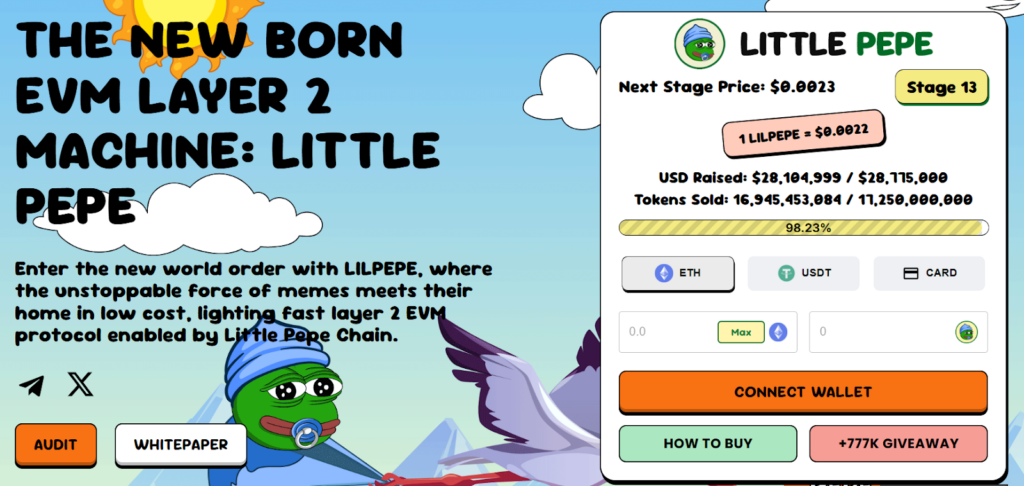
From a growth perspective, the token has already moved up significantly from its initial price of $0.001, delivering over 120% gains for early buyers.

There is still short-term upside built into the presale structure. With plans for listings on major centralized exchanges and a target of entering the top 100 on CoinMarketCap with a $1 billion market cap, buyers at the current level may see gains before launch based on stage pricing alone.

Features That Set LILPEPE Apart

Unlike typical meme coins, Little Pepe is built around a Layer-2 blockchain ecosystem on Ethereum. This gives it more than just hype-based value.

Key features include:

  • Zero tax on transactions
  • Sniper bot protection for fair trading
  • Staking rewards
  • DAO governance model
  • Meme launchpad for new projects

The project focuses on combining meme culture with actual utility, including faster transactions and lower fees through its Layer-2 setup.

$777K Giveaway and 15+ ETH Rewards Driving Demand

One of the biggest drivers of attention right now is the scale of its community campaigns.

Little Pepe has launched a $777,000 giveaway, where 10 winners receive $77,000 worth of tokens each.

Alongside that, there is a mega giveaway of over 15 ETH, structured as:

  • 5 ETH for the top buyer
  • 3 ETH for second place
  • 2 ETH for third place
  • 0.5 ETH each for 15 random participants

These incentives are directly tied to presale participation, which is helping maintain strong inflows as the project moves toward its final stages.

Shiba Inu (SHIB) Still Stable but Moving Slowly

Shiba Inu is one of the largest memecoin next to DOGE. SHIB is currently trading around $0.000005907, holding above a key support level near $0.000005283. Since the start of 2026 SHIB has faced selling pressure that pulled the token from $0.000010 to current price as the global market entered the red zone. But now SHIB has shown signs of stabilization after the first week of March.

On-chain indicators show that selling pressure is easing slightly, but the coin is still in a recovery phase rather than a strong uptrend.

Right now, the main resistance zone sits between $0.0000085 and $0.000009, and a breakout above that could push the price toward $0.000010 levels.Overall, SHIB remains a large-cap meme coin with strong community backing, but its growth pace has slowed compared to earlier cycles.

Pepe (PEPE) Remains Highly Active but Volatile

At the start of 2026, PEPE got an early rally as meme coins saw renewed speculative interest, with sharp gains in January and volume spikes during the first weeks of the year. After that initial bounce, PEPE has been trading in a range with volatile swings, struggling to break strong resistance while holding key support levels around its recent lows.

Right now PEPE is trading around $0.00000334, with a market cap near $1.37 billion, showing it’s still one of the biggest memecoins by community and volume. From a technical view, PEPE is holding support near $0.000003144, while facing resistance around $0.0000040.

If momentum continues, analysts are watching for a possible move toward the $0.0000045–$0.0000048 range, which suggests a 20–30% upside in the short term. However, due to its already large market cap, significant price jumps require much stronger market-wide momentum as it did previously since the launch.

Final Take

When comparing all three, the difference becomes clear. PEPE is active and driven by short-term momentum, SHIB is stable but slower, and Little Pepe is still in an early growth phase with structured price increases and strong presale demand.

With over 98% of its presale already completed, $28M+ raised, built-in price progression, and active giveaway campaigns, Little Pepe is currently one of the few low-priced meme coins showing both strong participation and ongoing development.

As the price moves toward the next stage at $0.0023 and the remaining allocation gets tighter, the project is entering a phase where timing is becoming more important for those looking at early-stage entries.

  • Website: https://littlepepe.com/
  • Twitter/X: https://x.com/littlepepetoken
  • Telegram: https://t.me/littlepepetoken

Disclaimer: TheNewsCrypto does not endorse any content on this page. The content depicted in this Press Release does not represent any investment advice. TheNewsCrypto recommends our readers to make decisions based on their own research. TheNewsCrypto is not accountable for any damage or loss related to content, products, or services stated in this Press Release.


TagsBlockchainCryptocurrencyLittle PEPE

Trending Cryptos

Related Questions

QWhat is the current presale stage and price for Little Pepe (LILPEPE)?

ALittle Pepe is currently in Stage 13 of its presale, priced at $0.0022.

QWhat are some key features that differentiate Little Pepe from typical meme coins?

AKey features include zero tax on transactions, sniper bot protection, staking rewards, a DAO governance model, and a meme launchpad for new projects. It is built on a Layer-2 blockchain ecosystem on Ethereum.

QWhat is the total amount raised and the completion percentage of the current Little Pepe presale stage?

AThe ongoing presale stage has raised $28.1M out of a $28.77M target, with over 16.94 billion tokens sold out of 17.25 billion allocated, which is about 98% complete.

QWhat are the giveaway campaigns that Little Pepe is running to drive demand?

ALittle Pepe has launched a $777,000 giveaway with 10 winners receiving $77,000 each, and a mega giveaway of over 15 ETH, with rewards for the top buyers and random participants.

QHow does the article contrast the current state of Shiba Inu (SHIB) and Pepe (PEPE) with Little Pepe?

AThe article states that PEPE is active and driven by short-term momentum, SHIB is stable but slower in growth, and Little Pepe is in an early growth phase with structured price increases and strong presale demand.

Related Reads

Amidst Capital's Encirclement, Decentralization is the Sole Defense for Public Blockchains

In a landscape dominated by power and profit motives, the author argues that decentralization is not merely one desirable feature among many in blockchain design—it is the singular, non-negotiable defense against corporate and capital capture. The article adopts a Machiavellian, realist perspective on human institutions, positing that businesses will inevitably attempt to co-opt any valuable network to protect their profits and dominance. While external attacks like 51% forks are often discussed, the greater existential risk is internal capture—the gradual erosion of a protocol’s neutrality by vested interests, as seen historically with platforms like Visa and Google. The piece critiques permissioned chains, highly centralized “permissionless” layer-1s, and layer-2s without sufficient decentralization (e.g., single sequencers) as inherently vulnerable. These compromised systems, promoted by established financial players, are framed as delaying tactics to stifle truly open networks that threaten existing high-fee, inefficient business models. Real-world examples, such as closed enterprise consortiums that exclude competitors, illustrate how such systems cement oligopolies rather than foster innovation. The author concludes that while decentralized protocols like Ethereum are imperfect and costly to operate, they represent the only viable long-term equilibrium. In a market where value naturally flows to the most secure and neutral settlement layer, only maximally decentralized public blockchains can resist being subsumed by capital and powerful incumbents.

Foresight News2m ago

Amidst Capital's Encirclement, Decentralization is the Sole Defense for Public Blockchains

Foresight News2m ago

Who Decides the Rules of Bitcoin? BIP-110 Ignites Governance Debate

Bitcoin's governance is once again at the center of a heated debate, this time ignited by BIP-110, the "Reduced Data Temporary Softfork." This proposal aims to curb non-monetary data (like inscriptions and Runes) by introducing seven new consensus-layer restrictions over a year, such as limiting new output scripts to 34 bytes and restoring the OP_RETURN cap to 83 bytes. The controversy stems from BIP-110's fundamental shift: it moves the battle against "spam" from node relay and miner policies to the consensus layer, rendering currently valid transactions invalid. Supporters, arguing that default policy governance has failed (highlighted by Bitcoin Core v30's relaxation of OP_RETURN limits), see this as necessary to protect node resources and Bitcoin's monetary focus. Opponents, led by figures like Michael Saylor and Adam Back, warn it dangerously centralizes governance. Saylor listed 110 reasons against it, criticizing its low 55% miner activation threshold and potential for chain splits. Back emphasized Bitcoin's "permissionless" ethos, arguing no single group should impose value judgments via consensus rules. Further complicating matters, technical critiques suggest BIP-110 may be technically circumventable, and a "BlockSlop" vulnerability in its upgrade path poses a consensus risk. The debate has drawn in diverse stakeholders: miners (with pools like Ocean signaling support and Foundry polling clients), node operators (like Bitcoin Knots), and new players like corporate treasury holder MicroStrategy (Saylor), whose market influence adds a novel dimension. Ultimately, BIP-110 acts as a governance stress test, exposing the unresolved question: who decides Bitcoin's rules? It pits the authority of miners, node operators, developers, and capital holders against each other, with each side claiming to defend Bitcoin's core principles of neutrality and security.

marsbit19m ago

Who Decides the Rules of Bitcoin? BIP-110 Ignites Governance Debate

marsbit19m ago

Who Decides Bitcoin's Rules? BIP-110 Ignites Governance Debate

Title: Who Decides Bitcoin's Rules? BIP-110 Ignites Governance Debate A new technical proposal, BIP-110 (Reduced Data Temporary Softfork), has sparked a fundamental governance debate within the Bitcoin community. It aims to impose new consensus rules for one year to limit non-financial data (like inscriptions and Runes) on-chain, moving beyond simple node and miner policy filters to invalidate currently valid transactions. Supporters argue that default policies have failed due to workarounds, necessitating consensus-layer changes to protect Bitcoin's core monetary function from data spam. Critics, including Michael Saylor and Adam Back, contend this dangerously centralizes judgment, undermines permissionlessness, and sets a risky governance precedent. They advocate for market-based solutions like fees or Layer 2s instead. The debate exposes deeper tensions: miners are divided on activation; node operators assert their sovereignty; Bitcoin Core developers influence defaults without direct accountability; and large corporate holders like MicroStrategy now wield narrative influence. Technically, BIP-110 may not fully block data and carries a disclosed consensus bug risk. Ultimately, BIP-110 acts as a stress test, forcing the community to confront the unresolved question: who legitimately decides what Bitcoin is and how it evolves, amidst competing claims from miners, nodes, developers, and capital holders.

链捕手30m ago

Who Decides Bitcoin's Rules? BIP-110 Ignites Governance Debate

链捕手30m ago

Zcash's New Node Zakura Goes Live: Privacy Payments Can Reach 50,000 TPS, Aiming to Rival Visa and Mastercard

Zcash, a privacy-focused cryptocurrency, has launched a new full node software called Zakura version 1.0.0. Developed by Zcash co-founder Sean Bowe and Dev Ojha, with private ZEC donations, its goal is to enable Zcash to process over 50,000 transactions per second (TPS)—matching the scale of Visa and Mastercard—while maintaining full transaction privacy and verifiability. This addresses a key bottleneck, as Zcash currently handles only about 1 private transaction per second. Zakura is a fork of the Zcash Foundation's Zebra node. It features chain pruning and snapshots, reducing disk usage and allowing new nodes to sync in under two minutes. It also offers compatibility with the legacy `zcashd` client interface. The scalability challenge stems from the large data size of privacy proofs. Bowe's Tachyon project aims to use recursive proofs to reduce consensus-layer data needs from ~500 MB/s to ~100 MB/s. For wallet scalability, Valar Group is researching Private Information Retrieval (PIR) tech to allow wallets to fetch their data privately. Zakura supports fast block propagation and the upcoming "Ironwood" network upgrade (NU6.3), scheduled for activation around July 28th. Ironwood was created to contain a critical inflation bug discovered in the Orchard shielded pool in May 2024. The fix uses "turnstiles" to trap any counterfeit ZEC created during the vulnerability period within the shielded pool, preventing it from entering circulation and restoring supply integrity.

marsbit45m ago

Zcash's New Node Zakura Goes Live: Privacy Payments Can Reach 50,000 TPS, Aiming to Rival Visa and Mastercard

marsbit45m ago

Trading

Spot

Hot Articles

Discussions

Welcome to the HTX Community. Here, you can stay informed about the latest platform developments and gain access to professional market insights. Users' opinions on the price of MEME (MEME) are presented below.

活动图片