Top Meme Coin Under $0.003: Why Little Pepe (LILPEPE) Is Gaining Attention in Presale

TheNewsCryptoPublished on 2026-04-07Last updated on 2026-04-07

Abstract

In the volatile 2026 crypto market, meme coins under $0.003 are drawing interest, with Little Pepe (LILPEPE) standing out in its presale. Currently in Stage 13 priced at $0.0022, the presale is 98% complete, having raised over $28.1M. Early buyers have seen 120% gains. LILPEPE differentiates itself with a Layer-2 Ethereum ecosystem offering zero transaction taxes, staking rewards, DAO governance, and a meme launchpad. Major drivers include a $777K giveaway and over 15 ETH in rewards tied to presale participation. In comparison, Shiba Inu (SHIB) remains stable but slow, while PEPE is active yet volatile. LILPEPE's strong presale performance and utility-focused approach make it a notable low-priced meme coin.

The crypto market in 2026 has been seesaw, with major assets like Bitcoin trading around the mid-$60K range and Ethereum holding near $1,900–$2,000 levels. At the same time, meme coins are showing mixed performance—larger tokens are moving slowly, while newer low-priced coins are attracting fresh attention.

Among meme coins trading under $0.003, three names stand out right now: Little Pepe (LILPEPE), Shiba Inu (SHIB), and PEPE. Each is at a different stage, but the contrast between them is what’s driving market interest.

Little Pepe (LILPEPE) Presale Nears Completion With Strong Numbers

Little Pepe is currently in Stage 13 of its presale, priced at $0.0022, with the next stage set at $0.0023. The ongoing presale stage is almost complete, with $28.1M raised out of a $28.77M stage target, and over 16.94 billion tokens sold out of 17.25 billion allocated, which is about 98% completion.
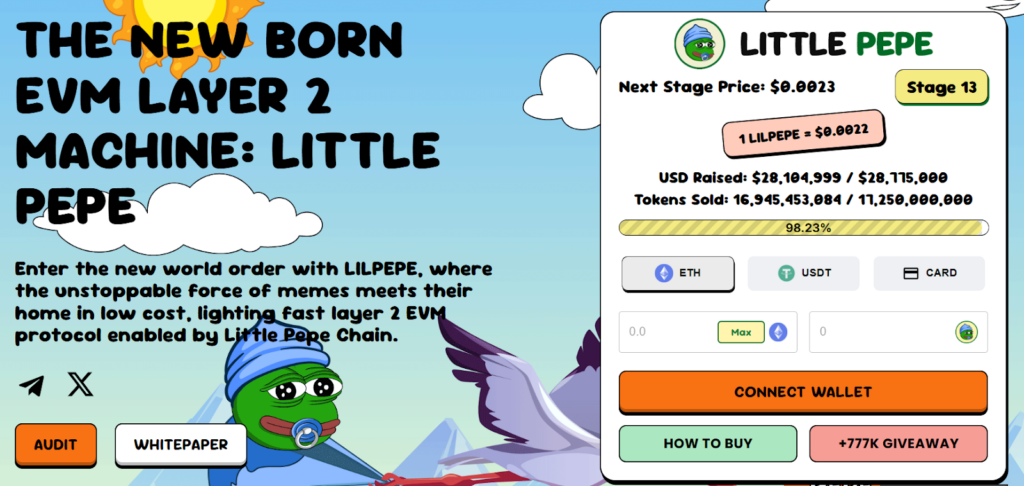
From a growth perspective, the token has already moved up significantly from its initial price of $0.001, delivering over 120% gains for early buyers.

There is still short-term upside built into the presale structure. With plans for listings on major centralized exchanges and a target of entering the top 100 on CoinMarketCap with a $1 billion market cap, buyers at the current level may see gains before launch based on stage pricing alone.

Features That Set LILPEPE Apart

Unlike typical meme coins, Little Pepe is built around a Layer-2 blockchain ecosystem on Ethereum. This gives it more than just hype-based value.

Key features include:

  • Zero tax on transactions
  • Sniper bot protection for fair trading
  • Staking rewards
  • DAO governance model
  • Meme launchpad for new projects

The project focuses on combining meme culture with actual utility, including faster transactions and lower fees through its Layer-2 setup.

$777K Giveaway and 15+ ETH Rewards Driving Demand

One of the biggest drivers of attention right now is the scale of its community campaigns.

Little Pepe has launched a $777,000 giveaway, where 10 winners receive $77,000 worth of tokens each.

Alongside that, there is a mega giveaway of over 15 ETH, structured as:

  • 5 ETH for the top buyer
  • 3 ETH for second place
  • 2 ETH for third place
  • 0.5 ETH each for 15 random participants

These incentives are directly tied to presale participation, which is helping maintain strong inflows as the project moves toward its final stages.

Shiba Inu (SHIB) Still Stable but Moving Slowly

Shiba Inu is one of the largest memecoin next to DOGE. SHIB is currently trading around $0.000005907, holding above a key support level near $0.000005283. Since the start of 2026 SHIB has faced selling pressure that pulled the token from $0.000010 to current price as the global market entered the red zone. But now SHIB has shown signs of stabilization after the first week of March.

On-chain indicators show that selling pressure is easing slightly, but the coin is still in a recovery phase rather than a strong uptrend.

Right now, the main resistance zone sits between $0.0000085 and $0.000009, and a breakout above that could push the price toward $0.000010 levels.Overall, SHIB remains a large-cap meme coin with strong community backing, but its growth pace has slowed compared to earlier cycles.

Pepe (PEPE) Remains Highly Active but Volatile

At the start of 2026, PEPE got an early rally as meme coins saw renewed speculative interest, with sharp gains in January and volume spikes during the first weeks of the year. After that initial bounce, PEPE has been trading in a range with volatile swings, struggling to break strong resistance while holding key support levels around its recent lows.

Right now PEPE is trading around $0.00000334, with a market cap near $1.37 billion, showing it’s still one of the biggest memecoins by community and volume. From a technical view, PEPE is holding support near $0.000003144, while facing resistance around $0.0000040.

If momentum continues, analysts are watching for a possible move toward the $0.0000045–$0.0000048 range, which suggests a 20–30% upside in the short term. However, due to its already large market cap, significant price jumps require much stronger market-wide momentum as it did previously since the launch.

Final Take

When comparing all three, the difference becomes clear. PEPE is active and driven by short-term momentum, SHIB is stable but slower, and Little Pepe is still in an early growth phase with structured price increases and strong presale demand.

With over 98% of its presale already completed, $28M+ raised, built-in price progression, and active giveaway campaigns, Little Pepe is currently one of the few low-priced meme coins showing both strong participation and ongoing development.

As the price moves toward the next stage at $0.0023 and the remaining allocation gets tighter, the project is entering a phase where timing is becoming more important for those looking at early-stage entries.

  • Website: https://littlepepe.com/
  • Twitter/X: https://x.com/littlepepetoken
  • Telegram: https://t.me/littlepepetoken

Disclaimer: TheNewsCrypto does not endorse any content on this page. The content depicted in this Press Release does not represent any investment advice. TheNewsCrypto recommends our readers to make decisions based on their own research. TheNewsCrypto is not accountable for any damage or loss related to content, products, or services stated in this Press Release.


TagsBlockchainCryptocurrencyLittle PEPE

Related Questions

QWhat is the current presale stage and price for Little Pepe (LILPEPE)?

ALittle Pepe is currently in Stage 13 of its presale, priced at $0.0022.

QWhat are some key features that differentiate Little Pepe from typical meme coins?

AKey features include zero tax on transactions, sniper bot protection, staking rewards, a DAO governance model, and a meme launchpad for new projects. It is built on a Layer-2 blockchain ecosystem on Ethereum.

QWhat is the total amount raised and the completion percentage of the current Little Pepe presale stage?

AThe ongoing presale stage has raised $28.1M out of a $28.77M target, with over 16.94 billion tokens sold out of 17.25 billion allocated, which is about 98% complete.

QWhat are the giveaway campaigns that Little Pepe is running to drive demand?

ALittle Pepe has launched a $777,000 giveaway with 10 winners receiving $77,000 each, and a mega giveaway of over 15 ETH, with rewards for the top buyers and random participants.

QHow does the article contrast the current state of Shiba Inu (SHIB) and Pepe (PEPE) with Little Pepe?

AThe article states that PEPE is active and driven by short-term momentum, SHIB is stable but slower in growth, and Little Pepe is in an early growth phase with structured price increases and strong presale demand.

Related Reads

Telegram Takes Direct Control of TON, Social Traffic Rewrites the Public Chain Narrative

Telegram founder Pavel Durov announced that Telegram will replace the TON Foundation as the core driver and largest validator of The Open Network (TON). Key initiatives include a sixfold reduction in transaction fees, performance upgrades, and improved developer tools within the next few weeks. This marks a strategic shift from Telegram merely providing user access to deeply integrating TON into its platform's core infrastructure. The goal is to transform Telegram's massive social traffic into sustainable on-chain activity. While viral mini-apps like Notcoin have demonstrated Telegram's ability to drive user adoption, TON aims to support frequent, low-value transactions inherent to social platforms—such as tipping, in-app payments, and game rewards. Ultra-low fees and sub-second finality (0.6 seconds) are crucial to making blockchain interactions seamless and nearly invisible within the Telegram user experience. However, Telegram's increased central role raises questions about network decentralization. Durov argues that Telegram's participation will attract more large validators, thereby enhancing decentralization. TON also offers high annual staking rewards (18.8%), aiming to retain capital within its ecosystem. The fundamental challenge for TON is no longer leveraging Telegram's user base, but becoming an indispensable, seamless infrastructure layer for Telegram's everyday applications—moving from an adjacent chain to an embedded utility.

marsbit3m ago

Telegram Takes Direct Control of TON, Social Traffic Rewrites the Public Chain Narrative

marsbit3m ago

OpenAI Post-Training Engineer Weng Jiayi Proposes a New Paradigm Hypothesis for Agentic AI

OpenAI engineer Weng Jiayi's "Heuristic Learning" experiments propose a new paradigm for Agentic AI, suggesting that intelligent agents can improve not just by training neural networks, but also by autonomously writing and refining code based on environmental feedback. In the experiment, a coding agent (powered by Codex) was tasked with developing and maintaining a programmatic strategy for the Atari game Breakout. Starting from a basic prompt, the agent iteratively wrote code, ran the game, analyzed logs and video replays to identify failures, and then modified the code. Through this engineering loop of "code-run-debug-update," it evolved a pure Python heuristic strategy that achieved a perfect score of 864 in Breakout and performed competitively with deep reinforcement learning (RL) algorithms in MuJoCo control tasks like Ant and HalfCheetah. This approach, termed Heuristic Learning (HL), contrasts with Deep RL. In HL, experience is captured in readable, modifiable code, tests, logs, and configurations—a software system—rather than being encoded solely into opaque neural network weights. This offers potential advantages in explainability, auditability for safety-critical applications, easier integration of regression tests to combat catastrophic forgetting, and more efficient sample use in early learning stages, as demonstrated in broader tests on 57 Atari games. However, the blog acknowledges clear limitations. Programmatic strategies struggle with tasks requiring long-horizon planning or complex perception (e.g., Montezuma's Revenge), areas where neural networks excel. The future vision is a hybrid architecture: specialized neural networks for fast perception (System 1), HL systems for rules, safety, and local recovery (also System 1), and LLM agents providing high-level feedback and learning from the HL system's data (System 2). The core proposition is that in the era of capable coding agents, a significant portion of an AI's learned experience could be maintained as an auditable, evolving software system.

marsbit1h ago

OpenAI Post-Training Engineer Weng Jiayi Proposes a New Paradigm Hypothesis for Agentic AI

marsbit1h ago

Your Claude Will Dream Tonight, Don't Disturb It

This article explores the recent phenomenon of AI companies increasingly using anthropomorphic language—like "thinking," "memory," "hallucination," and now "dreaming"—to describe machine learning processes. Focusing on Anthropic's newly announced "Dreaming" feature for its Claude Agent platform, the piece explains that this function is essentially an automated, offline batch processing of an agent's operational logs. It analyzes past task sessions to identify patterns, optimize future actions, and consolidate learnings into a persistent memory system, akin to a form of reinforcement learning and self-correction. The article draws parallels to similar features in other AI agent systems like Hermes Agent and OpenClaw, which also implement mechanisms for reviewing historical data, extracting reusable "skills," and strengthening long-term memory. It notes a key difference from human dreaming: these AI "dreams" still consume computational resources and user tokens. Further context is provided by discussing the technical challenges of managing AI "memory" or context, highlighting the computational expense of large context windows and innovations like Subquadratic's new model claiming drastically longer contexts. The core critique argues that this strategic use of human-centric vocabulary does more than market products; it subtly reshapes user perception. By framing algorithms with terms associated with consciousness, companies blur the line between tool and autonomous entity. This linguistic shift can influence user expectations, tolerance for errors, and even perceptions of responsibility when systems fail, potentially diverting scrutiny from the companies and engineers behind the technology. The article concludes by speculating that terms like "daydreaming" for predictive task simulation might be next, continuing this trend of embedding the idea of an "inner life" into computational processes.

marsbit1h ago

Your Claude Will Dream Tonight, Don't Disturb It

marsbit1h ago

Trading

Spot
Futures

Hot Articles

Discussions

Welcome to the HTX Community. Here, you can stay informed about the latest platform developments and gain access to professional market insights. Users' opinions on the price of MEME (MEME) are presented below.

活动图片