Tools for Humanity expands World app toward super-app model

cointelegraphPublished on 2025-12-12Last updated on 2025-12-12

Abstract

Tools for Humanity, co-founded by OpenAI CEO Sam Altman, is expanding its World app into a super-app model by adding encrypted messaging, financial services, and third-party mini-apps. The update includes end-to-end encrypted messaging with verified accounts, support for stablecoins like USDC and EURC, and yield products offering up to 18% returns. Users in Argentina can make QR code payments at over a million merchants, and virtual US dollar accounts are available in 18 countries. This move aligns with a broader trend in the U.S., where companies like Elon Musk’s X and Coinbase are also developing super-apps that integrate social, financial, and payment features.

Tools for Humanity is broadening its World platform beyond digital identity and crypto payments, adding encrypted messaging and financial services to its app as part of a push toward a super-app model.

The company, co-founded by OpenAI CEO Sam Altman, introduced an in-app messaging feature with end-to-end encryption that distinguishes between verified and unverified World ID accounts and enables users to send or request digital assets within chats.

According to an announcement, the application now supports third-party mini-apps, including prediction markets, games and financial tools, that run inside conversations. Tools for Humanity said it plans to add optional profile photo verification to help reduce impersonation and misuse.

The changes were released in San Francisco on Thursday by co-founders Altman and Alex Blania.
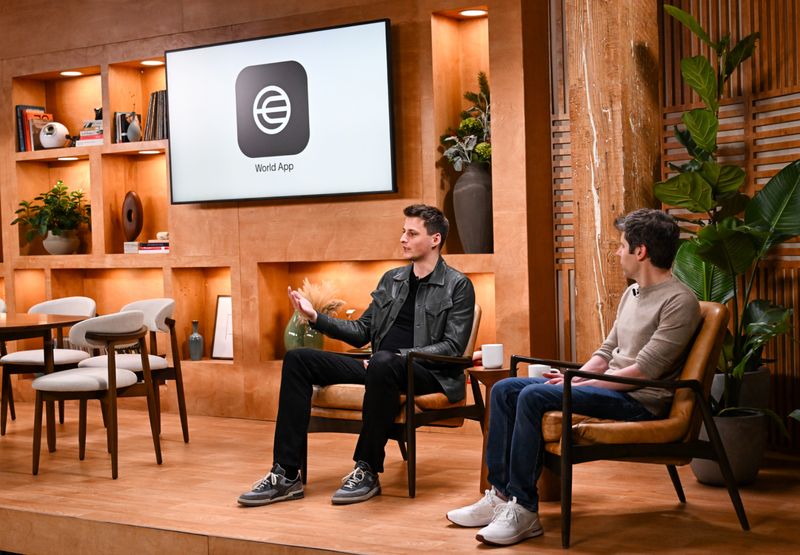
Alex Blania, left, and Sam Altman. Source: Tools for Humanity

World App has also expanded stablecoin support to include USDC (USDC), EURC (EURC) and several Latin American peso-linked tokens. The release introduces yield products offering rates of up to 18% on Worldcoin (WLD) holdings and up to 15% on USDC, powered by the DeFi protocol Morpho, according to the company.

On the payments side, users in Argentina will be able to pay at more than one million merchants using QR codes.

The update also adds US dollar virtual accounts powered by Bridge in 18 countries, including the United States, Japan and several markets across Latin America, allowing users to receive wages, fund accounts from banks and spend USDC inside the app.

Tools for Humanity is a technology company that led the development of World Network and operates World App. World, formerly known as Worldcoin, is the digital identity and financial infrastructure project developed and operated by Tools for Humanity.

Related: Thai regulators raid alleged World iris scanning site, arrest multiple suspects

The evolution of super apps in the US

Tools for Humanity is joining a growing group of companies trying to build super-app ecosystems in Western countries. After buying Twitter in October 2022, Elon Musk posted that “buying Twitter” was the “accelerant to creating X, the everything app.”
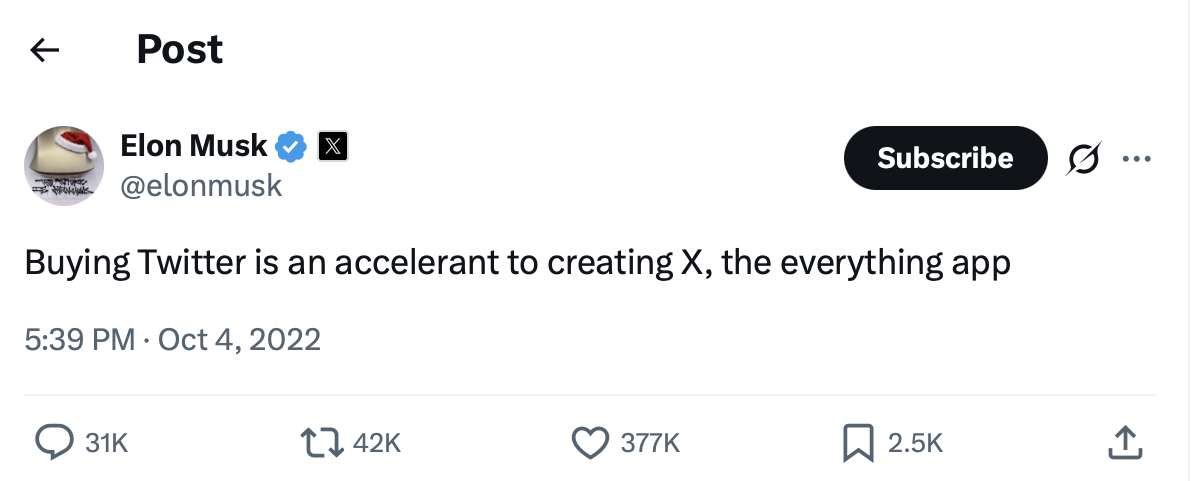
Source: Elon Musk

A super app is a single platform that combines social interaction, payments, commerce and financial services, a model popularized in Asia by services like WeChat. Today, several US companies are expanding crypto, payments and financial tools as they inch toward becoming their own versions of everything apps.

In October, Musk said X has rebuilt its messaging infrastructure into a standalone product called “X Chat,” describing it as a peer-to-peer, encrypted messaging service designed to compete with Telegram and WhatsApp.

Musk, who co-founded OpenAI with Sam Altman in 2015 and has had an ongoing feud with the OpenAI CEO since Musk left the organization in 2018, said in December on the People by WTF podcast that he likes the idea of having a “unified app or website where you can do anything you want” and that he sees China’s WeChat as a model for X.

“There’s no real WeChat outside of China,” he added.

Cryptocurrency exchange Coinbase also signaled a push toward a super app by rebranding Coinbase Wallet as the “Base app,” combining trading, payments, social features, messaging and mini-apps.

In addition, the banking app owned by Walmart OnePay is expected to roll out cryptocurrency trading and custody later this year, beginning with support for Bitcoin (BTC) and Ether (ETH). The app already offers banking, credit, loans and wireless plans and has positioned itself as a US-style super-app.

Magazine: Quantum attacking Bitcoin would be a waste of time: Kevin O’Leary

Trending Cryptos

Related Reads

Mathematicians Refute Open AI's Claim of Proving Connes Rigidity Conjecture Within 24 Hours: 'AI Proved Every Sentence Correct, but They Are No Longer About the Original Conjecture'

Mathematician Refutes OpenAI's Claim of Disproving Connes Rigidity Conjecture in 24 Hours OpenAI claimed its next-generation AI model solved 10 world-class problems, including disproving the Connes Rigidity Conjecture. The next day, mathematician J. L. Nielsen from the University of Kansas published a paper refuting the AI's counterexample. Nielsen meticulously reviewed OpenAI's publicly released 37,000 lines of Lean 4 code, mapping each object back to its mathematical origin. He identified two independent failure paths in the AI's argument. He concluded that one of the two groups constructed by the AI does not satisfy the required conditions (specifically ICC and Kazhdan's property (T)) necessary to serve as a valid counterexample to the original conjecture. This means the AI may have successfully proven something about its constructed objects, but that statement is not equivalent to disproving the Connes Rigidity Conjecture itself. The incident highlights a crucial limitation of formal verification tools like Lean. While Lean's kernel can verify the logical correctness of a proof's steps, it cannot verify whether the formal statement being proven correctly corresponds to the intended mathematical conjecture. Human oversight remains essential to ensure the alignment between the formalized problem and the original research question. This case exemplifies what researchers call "successfully proving the wrong statement." The Connes Rigidity Conjecture, concerning the uniqueness of group von Neumann algebras under certain conditions, remains an open problem.

marsbit6m ago

Mathematicians Refute Open AI's Claim of Proving Connes Rigidity Conjecture Within 24 Hours: 'AI Proved Every Sentence Correct, but They Are No Longer About the Original Conjecture'

marsbit6m ago

When Crypto Assets Become Mortgage Collateral: The Triangular Dilemma of Regulation, Cost, and Tokenized Equity

When Crypto Assets Become Mortgage Collateral: The Trilemma of Regulation, Cost, and Tokenized Rights Better, in partnership with Coinbase, has launched a mortgage solution allowing borrowers to pledge Bitcoin or USDC as collateral. This facilitates two loans: a primary, Fannie Mae-compliant mortgage and a separate private loan for the down payment, secured by the crypto assets and a second lien on the property. The product targets asset-rich but cash-poor buyers, with high collateral requirements (250% for Bitcoin, 125% for USDC) and no margin calls. The initiative has drawn significant regulatory scrutiny. Seven U.S. Senators, led by Dick Durbin and Elizabeth Warren, sent a letter to the FHFA urging a halt, arguing the high collateral ratio itself acknowledges crypto's risk and that combined loan costs could be 1.5 percentage points higher, potentially burdening taxpayers. Despite criticism and Bitcoin's price volatility, Better's CEO Vishal Garg plans to expand support to tokenized equities (e.g., Tesla, SpaceX) and envisions using retirement accounts to help family members buy homes. A core challenge for tokenized assets is clarifying the legal rights conferred by holding such tokens. To reduce costs, Better partnered with Framework Ventures, aiming to lower capital expenses by over 100 basis points and offer sub-5% rates. While the company posted a loss in Q1 2025, it reports strong demand, with a waitlist representing ~$250M in potential loans. Garg remains committed to the model, viewing it as a key channel for integrating digital assets into the banking system.

marsbit16m ago

When Crypto Assets Become Mortgage Collateral: The Triangular Dilemma of Regulation, Cost, and Tokenized Equity

marsbit16m ago

Trading

Spot

Hot Articles

How to Buy SUPER

Welcome to HTX.com! We've made purchasing SuperFarm (SUPER) simple and convenient. Follow our step-by-step guide to embark on your crypto journey.Step 1: Create Your HTX AccountUse your email or phone number to sign up for a free account on HTX. Experience a hassle-free registration journey and unlock all features.Get My AccountStep 2: Go to Buy Crypto and Choose Your Payment MethodCredit/Debit Card: Use your Visa or Mastercard to buy SuperFarm (SUPER) instantly.Balance: Use funds from your HTX account balance to trade seamlessly.Third Parties: We've added popular payment methods such as Google Pay and Apple Pay to enhance convenience.P2P: Trade directly with other users on HTX.Over-the-Counter (OTC): We offer tailor-made services and competitive exchange rates for traders.Step 3: Store Your SuperFarm (SUPER)After purchasing your SuperFarm (SUPER), store it in your HTX account. Alternatively, you can send it elsewhere via blockchain transfer or use it to trade other cryptocurrencies.Step 4: Trade SuperFarm (SUPER)Easily trade SuperFarm (SUPER) on HTX's spot market. Simply access your account, select your trading pair, execute your trades, and monitor in real-time. We offer a user-friendly experience for both beginners and seasoned traders.

5.6k Total ViewsPublished 2024.03.29Updated 2026.06.02

How to Buy SUPER

Discussions

Welcome to the HTX Community. Here, you can stay informed about the latest platform developments and gain access to professional market insights. Users' opinions on the price of SUPER (SUPER) are presented below.

活动图片