Today, Claude Cowork Major Update: Close Your Laptop, It Works for You Overnight

marsbitPublished on 2026-07-08Last updated on 2026-07-08

Abstract

Anthropic's Claude Cowork has received a major upgrade, officially launching on mobile and web platforms. This allows users to manage and monitor tasks from any device, freeing them from needing to stay at their computers. The key innovation is that tasks now run in the cloud on Anthropic's servers, meaning work continues even when a user's personal device is offline or closed. The update merges Chat and Cowork into a single interface and extends usage quotas. Engineers highlight three core capabilities now unified: precise context understanding, support for long-running tasks, and complete independence from a user's physical device. The workflow is described as a full cycle: a user assigns a complex task (e.g., preparing a meeting summary, drafting emails, post-meeting analysis). Claude Cowork autonomously breaks it down, connects to necessary tools like Slack and email, gathers information, and executes. It pauses only for critical user decisions, sending a notification to the user's phone for approval before proceeding. Product managers share use cases like monitoring AI agents during a soccer game or resuming a cloud-based task seamlessly after a flight, emphasizing the new flexibility. The article frames this as part of a larger trend where tech giants (OpenAI, Microsoft, Google) are competing to bring AI agents into the daily workflows of general knowledge workers, not just developers. The ultimate battleground is becoming an indispensable, seamless part of everyday ...

Watching the World Cup, catching a flight—nothing stops AI from working for you. Cowork has completely detached from devices, turning your phone into a command center in seconds, only popping up with a message when a decision needs your approval.

Cowork has received another significant upgrade!

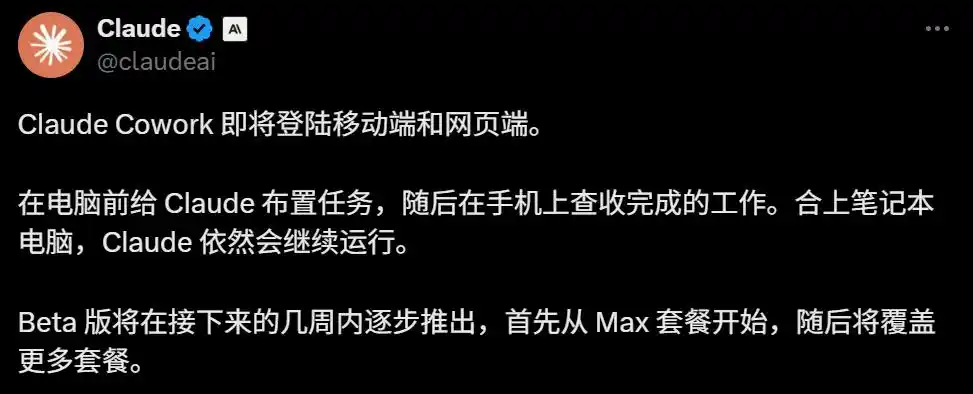
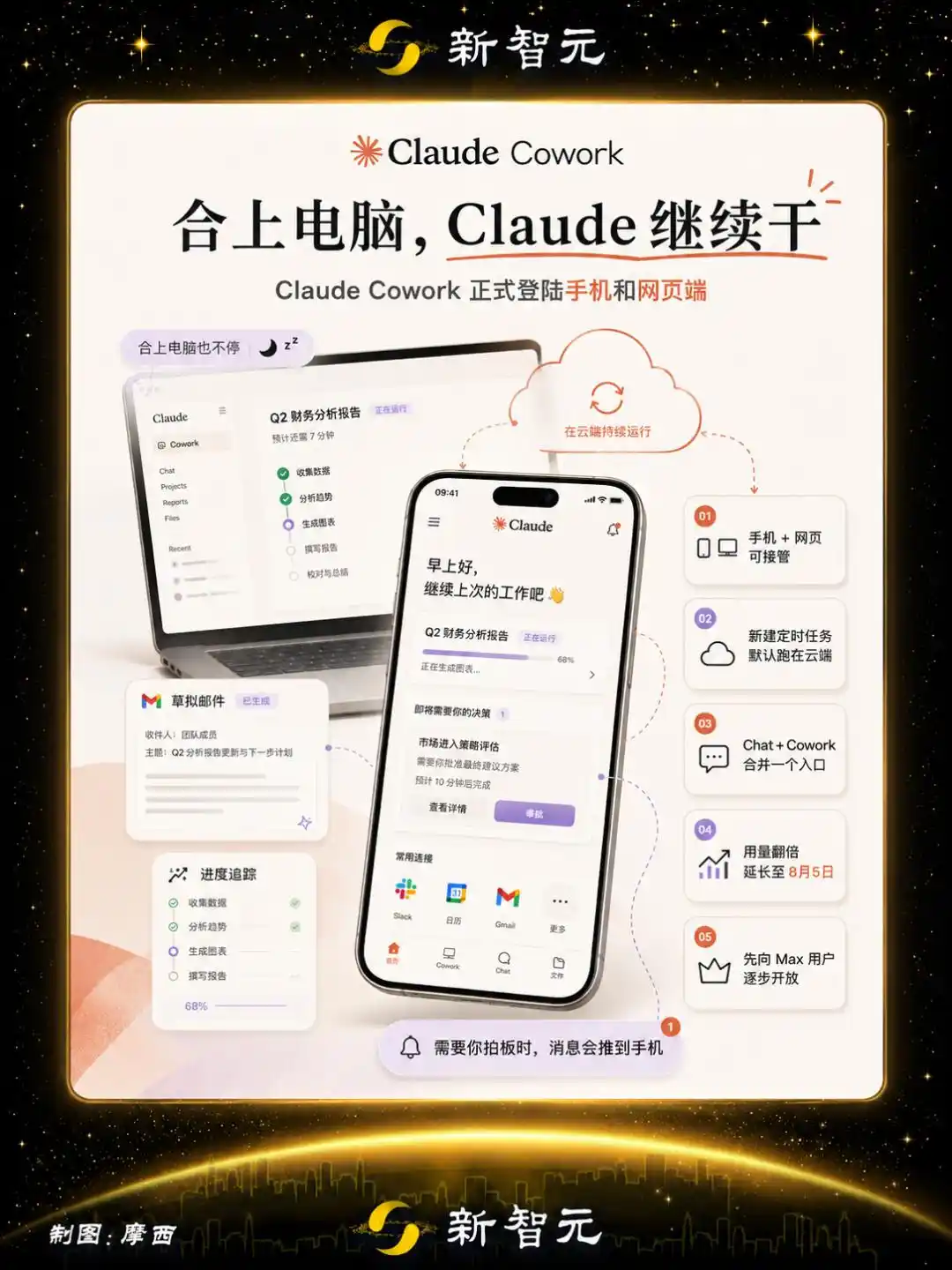
Just now, Anthropic announced: Claude Cowork is officially available on mobile and web.

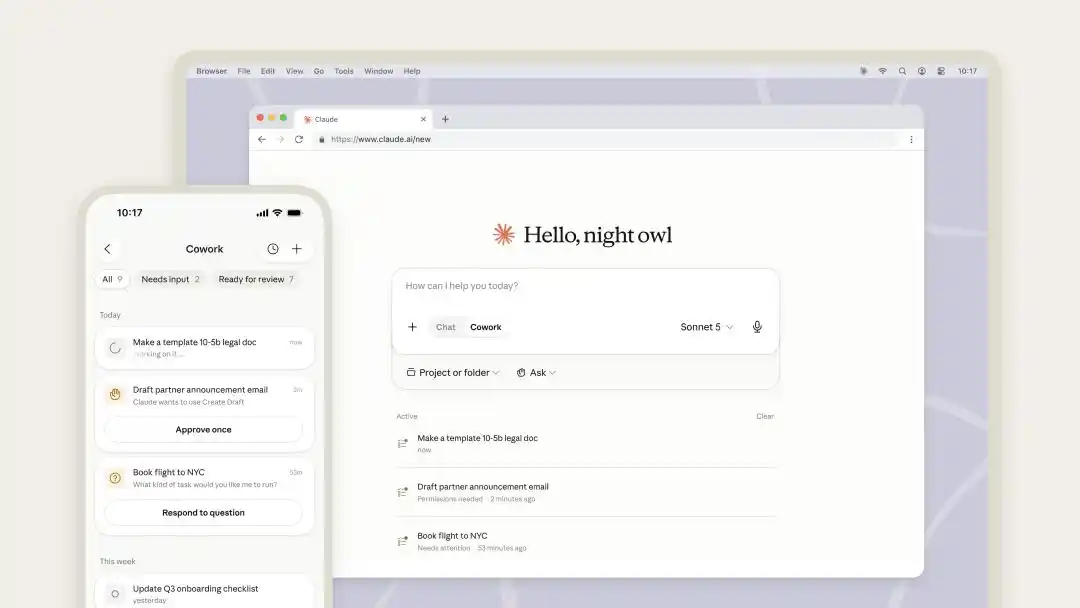
Now, tasks on your desktop can be tracked on your phone for progress, and you can take over operations from any device at any time. Cowork has leaped from 'requiring your presence' straight into 'it works even when you're not there.'

Furthermore, Chat and Cowork have been merged into a single entry point, and the doubled usage quota will be extended directly until August 5th.
Anthropic engineer Felix Rieseberg stated that this is the first time Cowork has assembled the three key 'puzzle pieces'—

Accurate context acquisition, advanced loops supporting long-duration tasks, and complete freedom from the constraint of requiring a device to be online at all times.

It's worth noting that the first two were each a limiting weakness in the past, and this time, they have finally been seamlessly 'welded' together.
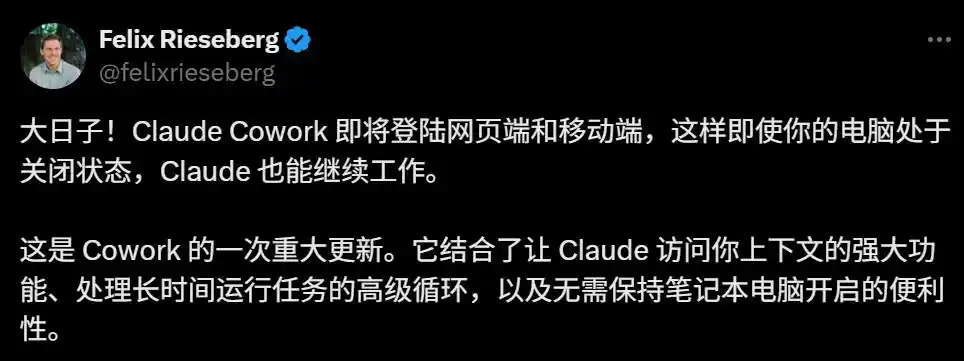
Cloud Takeover: AI Runs All Night After You Close the Laptop

After Cowork lands on mobile, the most immediate sensation is that workers finally don't have to sit in front of their computers.

Now, you just need to throw out all the tasks you need done: pulling data, creating documents, flagging risks, drafting emails without sending, scheduling execution, post-meeting reviews.

Cowork will break them down, prioritize them, and set execution times itself—no need for you to break down steps or write prompt templates.
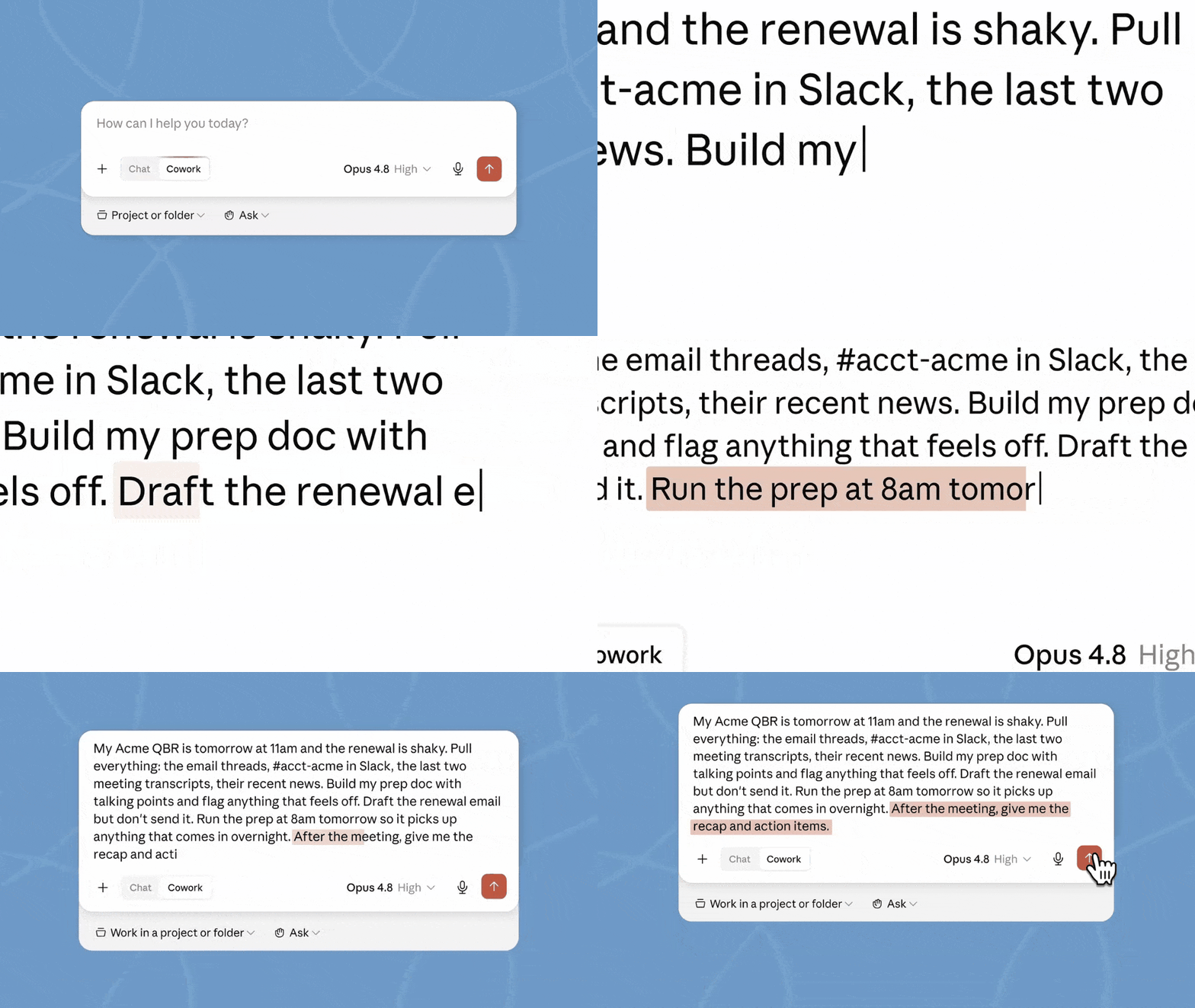
After receiving the tasks, Claude doesn't immediately dive in headfirst.

It first outputs a thought process, reiterating what the user has explained to confirm understanding—when to prepare, keeping emails in the draft folder for someone to send, conducting reviews after the meeting.

Next, Cowork will automatically detect available connectors—Slack, email, calendar—and connect them one by one.

Only after establishing these connections does it truly start sifting through Acme's chat history in Slack, reviewing emails, and compiling scattered information into the preparation document.

Then, the laptop closes, the screen goes black. From this moment, the task is completely decoupled from your device.

Remember, previously, using a phone to assign tasks to AI required the computer to stay on as the host; if the network disconnected, the work stopped. Now it runs on Anthropic's cloud. Whether you're there or not, whether the computer is on or off, doesn't stop it from finishing the job.

Once the preparation document is fully assembled and the follow-up email is drafted, it will pause and push the issue to the phone—a notification pops up, waiting for your tap.

In other words, from start to finish, Cowork has executed a complete work cycle: receiving the brief → autonomous planning → finding tools → pulling data → creating documents → pausing at decisions for human approval → output stopping at draft stage.

Phone Becomes Command Center: Watch the Game, Work Gets Done

Anthropic product manager Robert Bye strongly recommends based on personal experience—

He can now thoroughly enjoy watching the World Cup while calmly 'supervising' his several running agents on his phone.

Ramp's customer success manager Armmand Hosseini also experienced a taste of 'seamless transition.'

He was using Cowork to build a customer tracking dashboard. The work was halfway done when he had to leave to catch a flight. After landing, he pulled out his phone at the baggage carousel and saw the cloud session was still running smoothly.

At that moment, Cowork恰好popped up a decision requiring his personal approval—a light tap to confirm, closing the phone, grabbing the suitcase, and walking away, all in one fluid motion.

Of course, the desktop is still the place for deep work, with full access to local files and browsers; the phone and web are subsets, suitable for follow-up and light interaction.
Giants Enter the Fray, Battling for the Ordinary Person's Desk

Half a year ago, AI agents were still something programmers commanded in terminals. Now, several giants are simultaneously pushing them into ordinary people's phones.

OpenAI's Codex weekly active users have exceeded 5 million, with knowledge workers accounting for about 20%, growing more than three times faster than developers.

Microsoft analyzed 100,000 dialogues from its Copilot: 49% supported cognitive work like analysis, evaluation, and problem-solving, unrelated to coding.

Google's Gemini Agent Mode is also competing for the same space.

The numbers from these companies point to the same conclusion: the real growth market for agents isn't in code editors, but in the daily chores of ordinary workers.
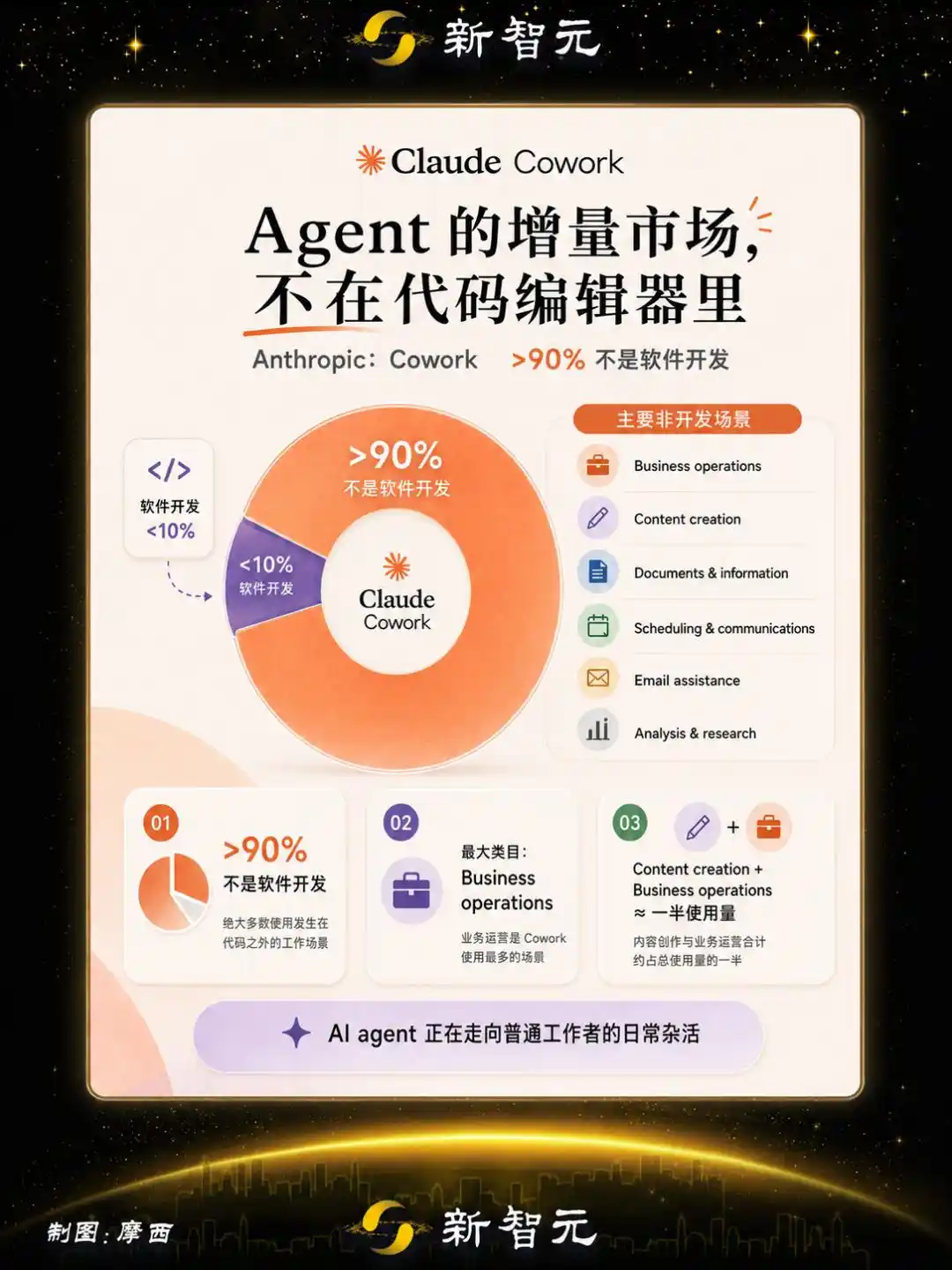
Looking back at Cowork's expansion path over the past six months, Anthropic is laying out a strategy.

Desktop launch in January, expansion to ordinary office workers in February, followed by Dispatch enabling remote task assignment from phones, and now pushing into mobile and web with scheduled tasks independent of devices.

From desktop to palm to cloud, flags have been planted on all interfaces where work happens.

In the end, this competition might not be about whose agent is smarter, but about who becomes part of ordinary people's daily lives first.

However, for you, it's just one more colleague on your phone—

You assign tasks, it works, pops up a message when a decision needs your approval, you approve it on the subway, and it continues.

It's still there when you're off work. It's still there when you're asleep.

References:

https://claude.com/blog/cowork-web-mobile/

This article is from the WeChat public account "新智元" (XinZhiYuan), author: 新智元, editor: Moshe

Related Questions

QWhat are the three key capabilities that Claude Cowork has achieved according to the article?

AAccording to the article, Claude Cowork has now achieved three key capabilities: precise context acquisition, advanced looping to support long-duration tasks, and complete independence from device constraints, meaning it can operate without needing a user's device to be constantly online.

QHow does the new Cowork update fundamentally change the user's interaction with the AI?

AThe new Cowork update fundamentally changes the interaction by allowing tasks to run in the cloud, completely independent of the user's computer or device. Users can initiate a task, close their laptop, and the AI will continue working. It will only interrupt with a notification (e.g., on the user's phone) when a decision or approval is needed.

QWhat example does the article provide to illustrate the seamless transition between desktop and mobile?

AThe article provides the example of Ramp's customer success manager, Armmand Hosseini. He started building a customer tracking dashboard on his desktop using Cowork. When he had to leave for a flight, he could seamlessly switch to his phone, where the cloud-based session was still running and waiting for his input on a decision needed from him.

QAccording to the data cited in the article, where is the real growth market for AI agents?

ACiting data from OpenAI, Microsoft, and Google, the article concludes that the real growth market for AI agents is not in code editors for developers, but in the daily, mundane tasks of ordinary knowledge workers. This includes activities like analysis, evaluation, and problem-solving.

QWhat is Anthropic's overall strategic expansion plan for Cowork, as described in the article?

AAnthropic's strategic plan for Cowork has been a staged expansion. It started with a desktop launch, then expanded to general office workers. It added features like Dispatch for remote task assignment from mobile, and now with the latest update, it has entered the mobile and web spaces and enabled scheduled tasks to run independently of devices. The goal is to establish a presence in every interface where work happens—from desktop to palm to cloud.

Related Reads

MiCA is coming for DeFi vaults, but regulation will be difficult

The European Commission is exploring whether to extend the Markets in Crypto-Assets (MiCA) regulation to cover decentralized finance (DeFi) lending and borrowing, including lending vaults. These vaults, which channel billions into on-chain credit markets, present significant regulatory challenges because their decentralized structure doesn't map neatly onto existing financial frameworks. Their legal status is currently based on non-binding interpretations that they fall outside MiCA and EU fund rules. The article uses Morpho's decentralized lending protocol as an example, illustrating how responsibilities are divided among various participants (owner, curator, allocator, sentinel), making it difficult to identify a single "provider" to regulate. Experts warn that broadly categorizing "DeFi lending" could inadvertently capture vastly different structures. They argue that any regulatory approach should focus on the specific structure and control mechanisms of a vault, rather than using decentralization as a simple dividing line, and that DeFi lending may require a dedicated, carefully crafted framework distinct from traditional finance. The Commission's consultation closes on September 30, 2026. The core challenge for regulators is not just whether to regulate DeFi lending, but how to design rules that distinguish between different forms of on-chain lending and the entities that control them.

cointelegraph1h ago

MiCA is coming for DeFi vaults, but regulation will be difficult

cointelegraph1h ago

Grayscale Report: Financial Privacy in the AI Era, Why Zcash Should Not Be Overlooked?

Title: Grayscale Report: Financial Privacy in the AI Era – Why Zcash Should Not Be Overlooked The article argues that privacy is a fundamental, not niche, attribute of functional money. It highlights that technological shifts, like the rise of AI and stablecoins, are driving a new wave of public focus on financial privacy. Zcash, a decentralized digital currency similar to Bitcoin but with built-in privacy via zero-knowledge proofs, is positioned to address this need. Unlike transparent blockchains, Zcash offers users the option to conduct "shielded" transactions that hide sender, receiver, and amount while remaining verifiable. The report details Zcash's evolution, noting key upgrades that improved usability and security. It points to rising on-chain usage of privacy features as evidence of real demand. Currently, ZEC holds a minimal share (~0.4%) of the total crypto market cap. Grayscale suggests this reflects a market assumption that privacy is a marginal concern. The investment thesis hinges on a potential market re-evaluation: if privacy is recognized as a core monetary feature in an era of enhanced surveillance, Zcash's current valuation represents significant upside potential. Key risks discussed include regulatory challenges, historical trusted setup concerns for older pools (mitigated by newer protocols), quantum computing threats, and execution risks associated with future technical upgrades. The conclusion is that while the future scale of private digital currency is uncertain, the market currently prices in little chance of its value increasing substantially, presenting a potential opportunity for investors.

marsbit3h ago

Grayscale Report: Financial Privacy in the AI Era, Why Zcash Should Not Be Overlooked?

marsbit3h ago

Trading

Spot
活动图片