To Hyperliquid: Stop Talking About 'Decentralization' and Learn from BNB's 'Strong Operations'

marsbitPublished on 2026-01-09Last updated on 2026-01-09

Abstract

The article critiques Hyperliquid's overemphasis on "decentralization" and urges it to adopt a "strong operations" model akin to Binance's BNB ecosystem. It argues that the perpetual decentralized exchange (Perp DEX) market is saturated, with over 20 projects aiming for Token Generation Events (TGE) by Q1 2026, leading to intense competition. While Hyperliquid excels in liquidity and professional trading体验 for assets like BTC/ETH, its native token HYPE and HyperEVM ecosystem lack synergistic value capture, unlike BNB's integrated model. The author highlights that Binance’s success stems from its "listing effect" and operational synergy between Binance main站 and BNB Chain, which sustains project viability post-listing. In contrast, Hyperliquid’s minimalist, hands-off approach to HyperEVM has hindered ecosystem growth, causing projects to fail quickly after HYPE distribution. The piece suggests Hyperliquid should learn from BNB Chain’s "strong operations" to foster ecosystem collaboration, such as endorsing key DeFi sectors (e.g., lending, swaps), without compromising decentralization entirely. Ultimately, Hyperliquid’s engineering strengths are noted, but it must evolve beyond its current passive strategy to maintain competitiveness against rivals like Lighter and Aster, which are expanding into L2s/chains. The conclusion urges Hyperliquid to embrace complexity and operational rigor to secure long-term growth and token value.

There are no secrets in the crypto market, only differences in the speed of information dissemination.

It is indeed time to write a follow-up on Perp DEX. Over 20 projects are set to embark on their TGE journey by Q1 2026. From Aster's trading volume to StandX's maker points, the noise output to the market is unsettling everyone.

This should not cast doubt on Hyperliquid. The synergistic flywheel between HyperEVM and HYPE has not been successfully established, but Lighters cannot overwhelm the new king. We are immersed in firsthand accounts of the Binance and FTX rivalry, causing the Perp DEX War to become a secondhand memory.

Trapped in the New Chapter of HYPE

"Lighter isn't Lighter, Hyper is more Hyper"

Lighter is undoubtedly a successful project. It successfully landed after Hyperliquid validated the Perp赛道 (Perp赛道 is often used to refer to the perpetual futures exchange sector), creating the established impression that Hyperliquid is a counterpart to Binance, and Lighter is a counterpart to Hyperliquid.

Turtles cannot keep stacking indefinitely. Referring to the competitive landscape of exchanges themselves, OKX, outside of Binance, struggles immensely to operate OKB, and Coinbase's market capitalization is over 5 times that of Kraken's valuation.

Trading has a natural monopolistic effect. Even the second player in the industry cannot achieve self-sustaining cycles. The Perp DEX sector has already entered a red ocean phase. Large-scale market growth is impossible; what remains is merely a game of existing shares fought for the sake of TGE.

First, let's set the record straight on BNB. Binance Main站 (main platform) and BNB Chain need a connector, an action that HYPE has yet to complete.
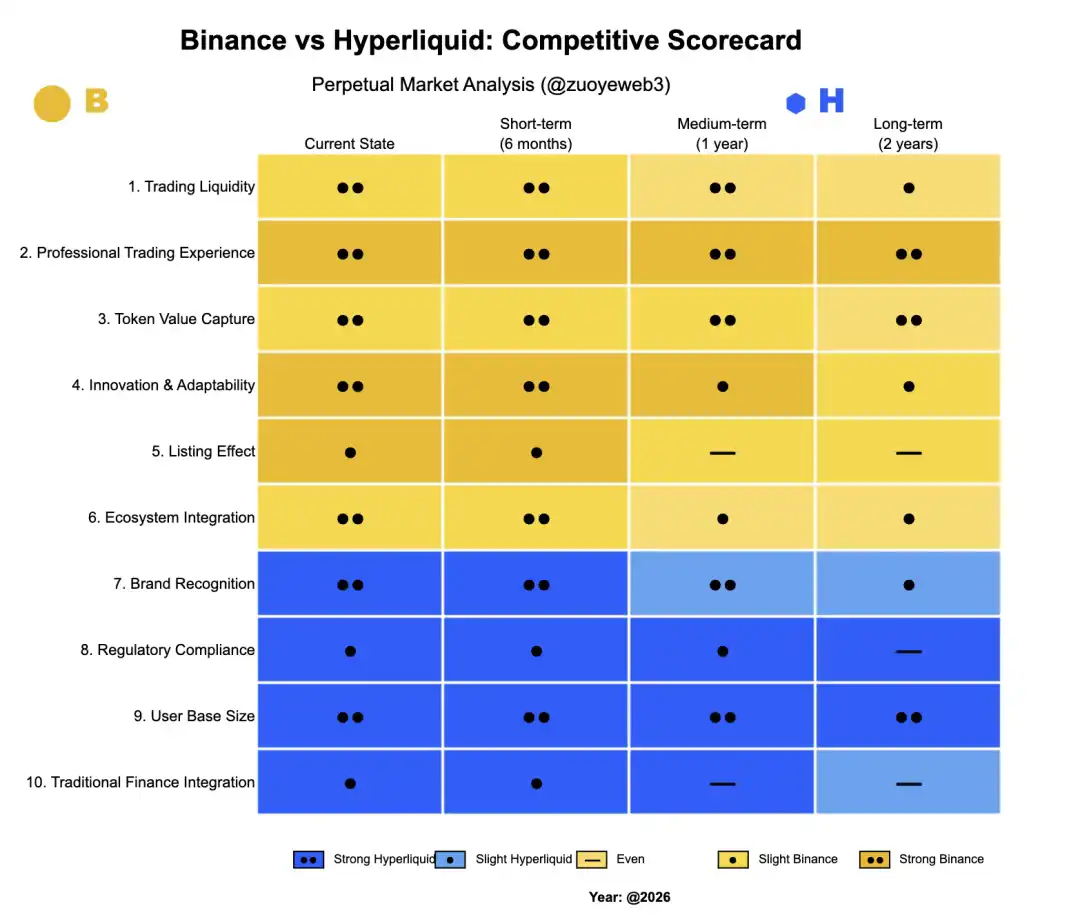
Image description: Comparison between Binance and Hyperliquid. Image source: @zuoyeweb3

Projects need Binance's "listing effect," hence they are willing to pay the highest channel fees. From Binance Main站's spot and futures trading to pre-market trading, and then to Wallet's Alpha and YZi Labs' EASY Residency, this is all true.

Binance needs projects' "traffic operations" outside the main platform to尽量延缓 (try to delay) the post-listing death curve. Therefore, favored projects on BNB Chain (like PancakeSwap and ListaDAO) need to absorb the projects' assets, using operational actions to延续 (continue) the next wave of the listing effect.

This is the real role of the entire BNB and BNB Chain for Binance. However, this is predicated on the existence of a listing effect on the Binance Main站, which conversely triggers Hyperliquid's need for self-breakthrough.

If we were to correct the logic above, Hyperliquid's rise is proof. Perps have long followed the established logic of "spot first, then futures," but Hyperliquid did not. Instead, it focused on 「trading Perps」 itself. This is based on the consensus across the industry, especially among exchanges, that the listing effect can no longer be guaranteed, and trading mainstream assets has become the norm.

  • OKX and others cannot maintain project prices after listing. They lack both liquidity and on-chain DeFi ecosystems,只能充当 (can only act as) second-tier distributors for projects. OKB lacks on-chain value capture capability and can only be used as an on-site coupon, losing the fundamental role of a token.

  • Hyperliquid provides traders with a professional experience. After FTX's collapse, HyperCore became synonymous with on-chain trading. The larger the trade, the more it needs Hyperliquid's liquidity support.

Let me add, Aster and CZ once promoted "privacy/dark pool trading," but could not shake Hyperliquid's market share. Aside from a minority need for money laundering, privacy is not a priority for traders. The need for KYC on Binance's main platform is also irrelevant.
​​

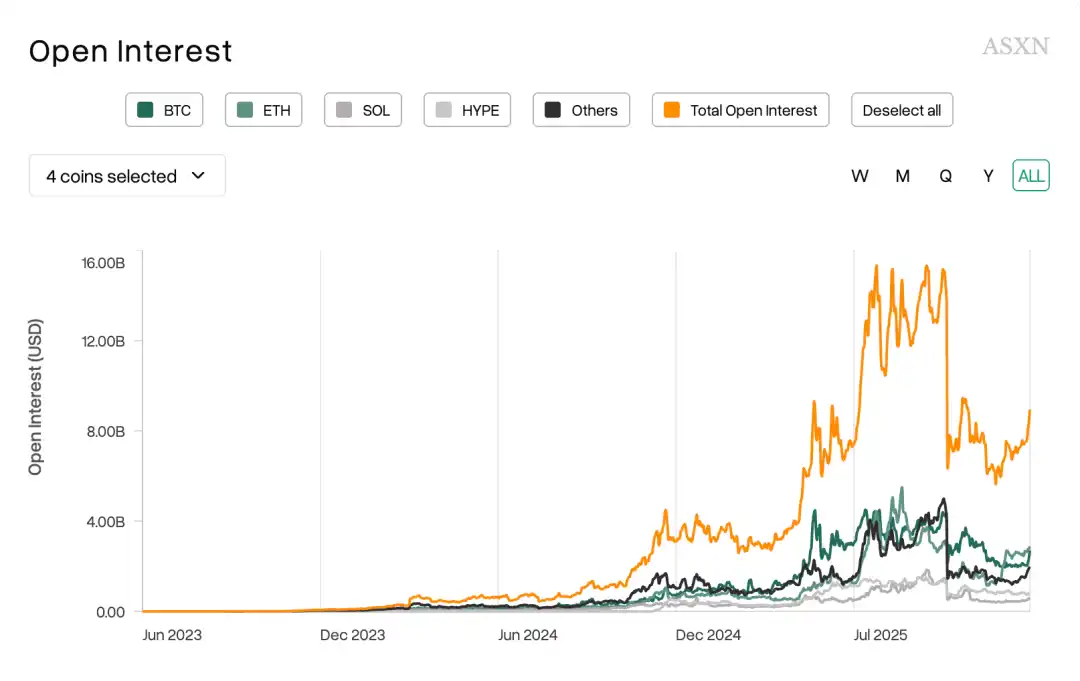
Image description: Mainly trading mainstream coins. Image source: @asxn_r

The truly fundamental and irreversible trend is that people only trade mainstream coins like BTC/ETH. New coins only have significant trading volume at launch. This holds true from BeraChain to the new generation L1s like Monad and Sonic.

The "listing effect" that top exchanges rely on for survival, and the fees that second and third-tier exchanges depend on, have无可奈何地走入历史 (helplessly become history). This might be the real reason behind exchanges operating their own Perp DEXs, promoting the trading of everything, and embracing traditional finance (stocks, forex, precious metals).

But none of this will harm Hyperliquid's liquidity. In the article 'RFQ Architecture: Market Makers, a Different Choice for Latecomer Perp DEXs', I pointed out that Variational's advantage/characteristic lies in opening the market maker architecture to ordinary retail users. This is a real market demand. However, the刷量积分赛 (volume-brushing points competition) for most Perp DEXs is a form of "前期负债" (early-stage debt), waiting to be cashed out at the TGE moment.

If you think Bitget's flashy marketing can capture Binance's derivatives market share, then StandX's maker points can challenge Hyperliquid's market share.

Markets with better liquidity naturally become the daily venue for traders. In the Perp DEX field, where the listing effect is even more lacking, the profiles of airdrop hunters and real users diverge even further. Let's not forget, most people are still relying on CEXs to buy dual-currency wins, let alone actually operate Perps on-chain.
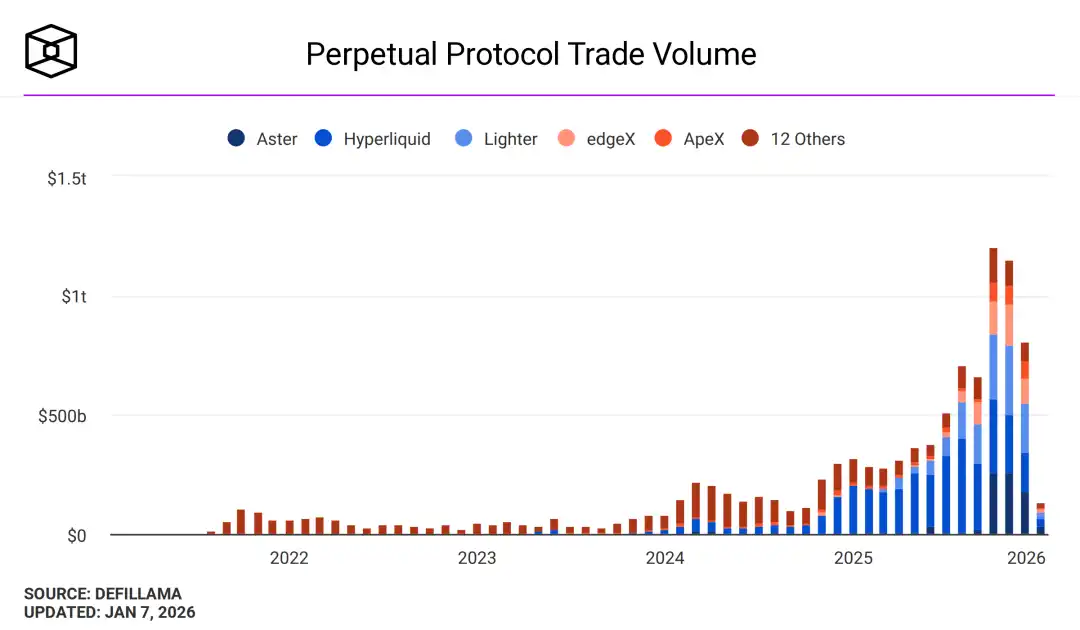
Image description: Perp DEX trading volume. Image source: @TheBlock__

Lighter accepts forex, Edge builds its own Chain. Without first overcoming HyperCore's liquidity, they have inevitably become complex to support their narratives. This will in turn reduce their token's value capture capability, evolving into something similar to OKB—an on-site coupon. Let's seriously address the expected "discount" due to regulation on Hyperliquid. From BitMEX onwards, CEXs/DEXs have never been rejected by the market due to US regulatory actions. Only incidents of theft or crashes have caused significant changes in market share.

  • Theft group: KuCoin (2020), ByBit (2025, over $1.4B stolen)

  • Crash group: BitMEX March 12, 2020, pulling the plug

  • Reputation group: Huobi—Sun Ge's pGala incident

Additionally, only SBF's FTX was FUDded to death by Coindesk, and it lost due to less江湖经验 (street smarts) compared to CZ. From this perspective, the 1011 incident is just an annual routine for veteran exchanges like Binance.

Now is a rare moment of relaxed regulation by the SEC. Binance has officially上岸 (come ashore) in Abu Dhabi. Hashkey has completed its Hong Kong IPO. Hyperliquid does not exist in a state that cannot be regulated. Even if the Hyperliquid team insists on the appearance of "decentralization," it can refer to Binance's multi-entity regulatory approach, bringing core clearing parts into the regulatory framework.

Law is an access restriction for the weak; compliance is the price of上岸 (coming ashore) for the strong.

Public Chains Need Strong Operations

"Rewind the clock of history, retro becomes the main theme."

The listing effect on CEXs and the刷量效果 (brushing volume effect) on DEXs are both declining. Hyperliquid's liquidity is not a problem. HYPE has crossed the斩杀线 (slaughter line) and will not become the second FTT.

This is not the whole story. HYPE至今和HyperEVM生态对不齐 (HYPE still doesn't align with the HyperEVM ecosystem), unable to create a 'false prosperity' similar to BNB's ecosystem, rather than a DeFi system like Ethereum's mainnet. This phenomenon was detailed in对不齐: Ethereum Bleeding, Hyperliquid Losing Speed, and won't be repeated here.

This article focuses on the causes of the phenomenon and where the way out lies.

The relationship between rocket fuel and thrust is logarithmic. The relationship between HyperCore trading volume and HYPE price is also logarithmic.

Limited to the chemical rocket architecture, this means the fuel mass needs to increase exponentially to achieve linear speed improvement. Right now, HyperCore trading fees support HYPE's price. But HyperCore's trading volume cannot increase indefinitely, especially with Binance and other Perp DEXs diverting flow全力 (with full force).
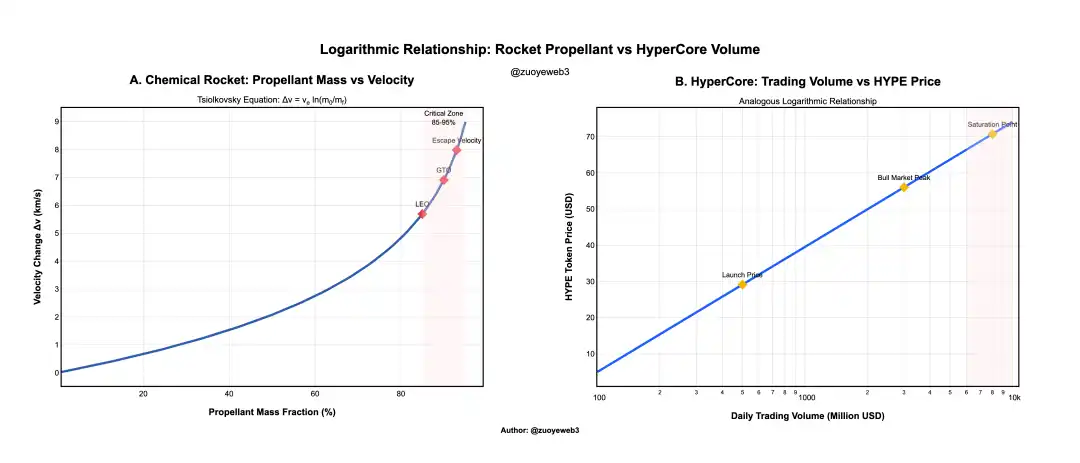
Image description: Token price and trading volume. Image source: @zuoyeweb3

Note: The above is only for illustrative purposes of motion change. HYPE's initial price was in the single digits, but真正稳定在 (stabilizing at) $30 is the "initial fair valuation" in the public eye. The trading volume has also been modified to illustrate the relationship between token price and HyperCore trading volume.

Note, this does not conflict with the fact that Perp DEXs cannot卷死 (overwhelm) Hyperliquid. The only assets in the crypto circle are BTC/ETH. The overall Perp market size has already reached a阶段性触顶 (stage peak).

Let's deconstruct where the Hyperliquid team's "Buddhist系" (laid-back attitude) comes from. Maybe this reason isn't complicated, but it's cruel enough. The Hyper team still uses BTC as the public chain standard and still uses FTX as a reference for derivative exchanges. Learn from the good, avoid the bad.

The auction Ticker for USDH is very telling. Hyperliquid official nodes do not participate in voting, nor do they designate any teams, nor will they provide official liquidity support. The现状 (current situation) is that USDH lacks sufficient development potential and has no significant advantage compared to USDC and USDe.

The Hyperliquid team's "无为而治" (governing by non-interference) is the biggest problem with HyperEVM currently. This is not to say that Hyperliquid lacks operational willingness or capability. Everyone might remember that Hyperliquid first gained attention because of Meme. Subsequently, the launched Unit also had the de facto status of an "official" cross-chain bridge. USDC has long used Arbitrum to connect directly to HyperCore.

But all this is limited to HyperCore. Perhaps in the view of the Hyperliquid team, HyperCore is the product, and HyperEVM is the ecosystem. The product requires strong operations; the ecosystem needs to be open enough.

Unfortunately, times have changed. Today's public chains are more like Super Apps, and similar to internet giants, there haven't been new全民单品 (nationwide hit products) for years. TON/Monad/Berachain/Sonic are all like this. Even Plasma doesn't seem like a stablecoin chain, but more like a Vault incarnate.

The excessive maturity of on-chain infrastructure means public chains/L2s no longer have direct network effects. They either fight for存量 (existing shares) like ETH L1/Solana, or introduce RWA like Canton to offer SaaS-like services, or artificially maintain like BNB Chain.

However, Jeff wants to竭力避免 (avoid at all costs) the disaster caused by FTX's strong operations, thus adopting a conservative strategy for the HyperEVM ecosystem. This leads to projects relying solely on community autonomy, unable to build interaction with HYPE, and只能速生速死 (only having a short life cycle) after distributing HYPE.

Even the operational actions of HyperCore follow the principle of minimal intervention. You can follow the accounts of Hyperliquid, Jeff, and Hyper Foundation; they basically have no interaction with projects.

This situation was suitable for the 2017 or 2020 DeFi Summer era. The on-chain space lacked corresponding products for certain niches. Creating one meant traffic and profits, even excessive imagination about the token. These conditions have now disappeared.

Moreover, Hyperliquid doesn't need to drastically change its style. It just needs to learn from BNB's playbook to build its own unique growth flywheel.

The way out for HYPE is to imitate BNB.
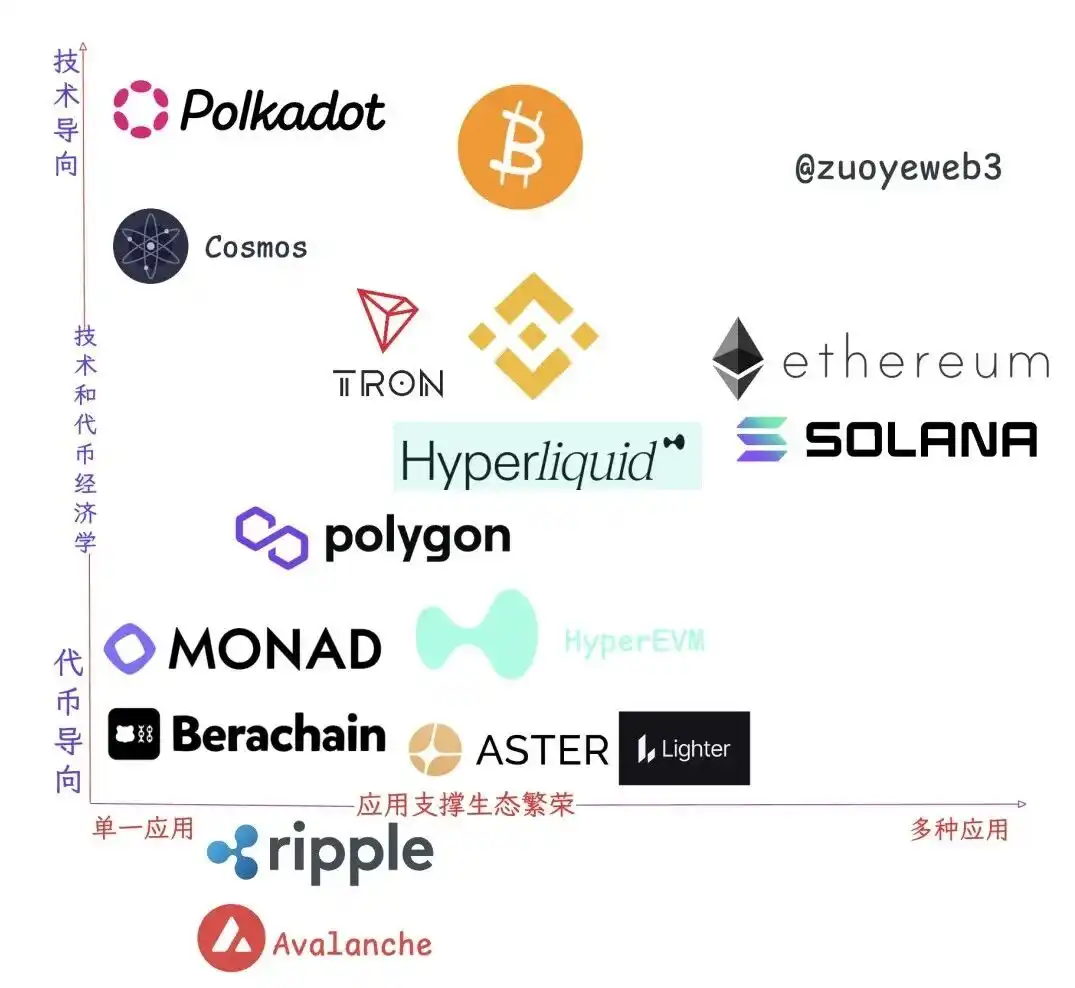
Image description: Ecosystem and application relationship. Image source: @zuoyeweb3

Observing the public chains/L2s that can survive today, it's not simply an interaction between ecological prosperity and strong mainnet token value capture. Reality is far more complex than theory. The only one that fits the既定印象 (established impression) is ETH itself. The rest basically cannot be simply categorized.

In other words, ideals are ideals precisely because they don't manifest in reality.

  • Single Application Group: TRON and Polygon survive on a single application, the former with USDT, the latter with Polymarket;

  • Tech-Oriented Group (Tears of the Era Group): Polkadot and ATOM, advanced in technology and理念 (concept), but tokens cannot capture economic value;

  • Pure Token-Oriented: Monad/Berachain, no need to elaborate, their historical mission is complete after token issuance.

  • Ecologically Prosperous Group: Solana and Ethereum

  • Existentialist Group: Ripple, Avalanche, existence is everything, everything is existence.

Further细分 (subdivision) is possible. Binance Main站 and HyperCore belong to the "bucket group." Their tokens have extremely strong value capture capabilities. Their products are multi-empowering: spot/perp trading, wealth management, staking, even transfers. They are not public chains but resemble them.

The value of BNB Chain is as a component of Binance Main站 in the form of a "public chain." Dragon Mama left, Rong Mama came. The reason Binance never gives up on BNB Chain is also here. Many things are more convenient to do on a public chain than on an exchange. The value of traffic is long-term value.

However, Hyperliquid's HIP-3 is also an overflow of HyperCore's liquidity, essentially competing with HyperEVM for traffic入口 (entry points). This internal traffic fight now happens not only among HIP-3 projects but also between Builder Code and HyperEVM projects.

Hyperliquid wants to become the AWS of liquidity, but the internal organizational structure hasn't been sorted out.

BNB Chain is not the perfect form Binance wanted, but it's sufficient for Hyperliquid to learn from.

BNB Chain is a distribution channel for Binance Main站. It cannot achieve self-hematopoiesis without strong operations, let alone feed back to Binance itself. But this is already sufficient for HyperEVM at its current stage.

Between not harming the principle of minimal operations and maintaining HyperEVM's openness, there is room to push forward. "Appointing" leaders in various tracks like lending, SWAP, and LST. The aborted HIP-5 proposal was too crude. Using回购的HYPE (repurchased HYPE) to iteratively repurchase project tokens is also not feasible.

Ecological collaboration does not violate any principles. The Hyperliquid team almost has no "dealings" with any projects. Perhaps they prefer off-chain cooperation similar to the MM alliance. But on-chain exposure is still needed.

If even the minimum level of HyperEVM operation is not done, we will likely see a $50 HYPE. Lacking the imaginative power of HyperEVM's network effects, HYPE will lose the支撑 (support) for exponential growth imagination.

Without the assistance of HyperEVM, HyperCore would need to reach OKX's level of liquidity solely on its own, but even that would not be able to build the HYPE flywheel.

In a nutshell, for the on-chain ecosystem, the "decentralized" HyperEVM has no retreat.

Conclusion

"Hyperliquid is lighter than Binance with higher capital efficiency. Lighter is not lighter than Hyperliquid. Aster is eager to become complex."

Perp DEXs that are having or approaching TGE, like Aster and Edge, will build their own L2/public chains. This is part of the plan to increase valuation, just like PumpChain is part of the token issuance plan.

Now is the critical time for Hyperliquid to become complex, using its scale advantage to换取 (exchange for) the future.

As mentioned before, Hyperliquid is not good at innovating某类产品 (certain types of products) (Jeff also worked on prediction markets). Its strength lies in the engineering ability to combine elements. If FTX is not a good learning object, then BNB Chain is a good one to imitate now.


Trending Cryptos

Related Questions

QWhat is the main criticism the author levels against Hyperliquid team's current approach?

AThe author criticizes Hyperliquid's team for their 'minimalist' or 'hands-off' operational style, particularly regarding the HyperEVM ecosystem. They argue that this 'decentralized' approach is outdated and prevents the formation of a synergistic flywheel between HyperCore and HYPE, hindering the ecosystem's growth and value capture.

QAccording to the article, why is the 'listing effect' of top exchanges like Binance diminishing in importance for Perp DEXs?

AThe 'listing effect' is diminishing because traders are increasingly focusing only on mainstream assets like BTC and ETH. New tokens have short-lived trading volume after launch, making the traditional exchange model of profiting from frequent new listings less sustainable.

QWhat specific exchange and its token does the author suggest Hyperliquid should learn from and emulate?

AThe author suggests that Hyperliquid should learn from and emulate Binance and its BNB token, specifically the 'strong operations' model of the BNB Chain which acts as a distribution channel and extension of the main exchange.

QWhat does the author identify as the fundamental, irreversible trend in crypto trading that benefits Hyperliquid?

AThe author identifies the trend of traders concentrating almost exclusively on mainstream cryptocurrencies like BTC and ETH. This trend benefits Hyperliquid because its deep liquidity for these assets makes it the preferred venue for professional and large-volume traders.

QWhat is the perceived problem with the relationship between HYPE, HyperCore, and the HyperEVM ecosystem?

AThe problem is that HYPE's value is logarithmically tied to HyperCore's trading volume, which has a natural ceiling. The HyperEVM ecosystem has failed to create a synergistic 'flywheel' with HYPE to provide additional value capture and growth potential, unlike the relationship between BNB and the BNB Chain ecosystem.

Related Reads

After Three Consecutive Quarters of Decline, Can the Crypto Market Find a Window for Stabilization in Q3?

The cryptocurrency market has just concluded its worst-performing quarter since 2022, with total capitalization dropping 12.6% to $2.1 trillion. All core metrics indicate capital is leaving the sector, not just rotating within it. Bitcoin fell 14.2% and Ethereum dropped 25.4% in Q2, breaking their previous correlation with US tech stocks. A key driver is the reversal in US spot Bitcoin ETF flows, which saw a net outflow of approximately $4.67 billion in Q2, including a record monthly outflow near $4.5 billion in June. While recent data suggests long-term holders are accumulating again, sustained ETF outflows mean continued selling pressure. Market focus is now singularly on the Federal Reserve. The upcoming July FOMC meeting is seen as the most critical event for Q3. A dovish signal could support Bitcoin reclaiming a $68,000-$84,000 range, while a hawkish stance might establish a new trading band around $50,000-$56,000. Additionally, regulatory uncertainty persists, with the progress of the crucial *CLARITY Act* stalling in the Senate, reducing its perceived 2026 passage probability to 40-45%. Despite the broad downturn, a few sectors showed growth. Prediction markets saw nominal volume surge 48.7% year-over-year to $113.8 billion, and tokenized collectibles transaction volume rose 143% quarterly to $1.4 billion. The Real-World Asset (RWA) tokenization sector also continued steady growth, now representing ~$28.1 billion in on-chain value. The market's foundation for an extreme crash appears limited, with Bitcoin price hovering near its 200-week moving average. However, the trading paradigm has shifted from narrative-driven speculation to decisions based on price action, policy developments, and interest rate expectations, making a broad sentiment-driven rally unlikely in the near term.

marsbit10h ago

After Three Consecutive Quarters of Decline, Can the Crypto Market Find a Window for Stabilization in Q3?

marsbit10h ago

BIT Trading Moment: BTC Still Suppressed by Weekly 200 EMA, Rejection May Restart Decline; Storage and Semiconductors that Surged Last Night Begin Falling in Evening Trading

**Crypto & Stock Market Wrap: Bitcoin Tests Resistance, Stocks Retreat After AI Surge** Bitcoin consolidates around $66,000, facing key resistance near $68,000—an area seen as a major psychological and technical hurdle where previous rallies have failed. Analysts note the cryptocurrency is caught between its 200-week moving average (~$63,333) and 200-week EMA (~$68,328). A clear break above $68k is needed to signal a stronger bullish trend, while a rejection could lead to a retest of $63k support. Market sentiment remains cautious, with low futures open interest pointing to a low-liquidity rebound rather than a full bull market. Bitcoin spot ETFs saw another $203 million inflow. US stock futures pointed lower after a strong Tuesday session led by a massive rebound in semiconductors and memory stocks. The rally was fueled by renewed optimism about AI-driven hardware demand, with Micron, SanDisk, and SK Hynix surging. However, those gains reversed in pre-market trading. Super Micro Computer (SMCI) soared over 20% after hours on strong guidance and a record backlog. Other standouts included Rocket Lab and nuclear energy plays Oklo and X-Energy. Rising oil prices (Brent above $91) and climbing Treasury yields (10-year near 4.64%), however, are reigniting inflation concerns and acting as a headwind for equities. In Asia, markets were mixed. South Korea's KOSPI pared early gains to close slightly higher as semiconductor stocks like SK Hynix gave back initial surges. Japan's Nikkei edged lower as the yen hit a fresh 38-year low against the dollar, raising fears of potential market intervention. Key events to watch include the Samsung Galaxy launch, AMD's AI event, and a slew of major tech earnings from Alphabet, Tesla, and IBM after the close on Wednesday, followed by the ECB meeting and Intel's earnings on Thursday.

marsbit10h ago

BIT Trading Moment: BTC Still Suppressed by Weekly 200 EMA, Rejection May Restart Decline; Storage and Semiconductors that Surged Last Night Begin Falling in Evening Trading

marsbit10h ago

Former CFTC Chairman, Circle President Tarbert: Preaching Long-Termism While Cashing Out $30 Million Himself

Former CFTC Chairman and Circle President Heath Tarbert has consistently advocated for a long-term vision in public, urging patience from investors as Circle’s stock price has fallen significantly from its peak. However, it has been revealed that since Circle’s IPO, Tarbert has continuously sold his CRCL shares through pre-arranged trading plans, cashing out approximately $30 million, without making any public market purchases. This contrast between his public messaging and personal actions has drawn criticism. Tarbert joined Circle in July 2023 as Chief Legal Officer, leveraging his regulatory experience to help guide the company through its IPO and expansion. Despite promoting stablecoins as long-term infrastructure, he established a 10b5-1 trading plan just before Circle went public, leading to substantial stock sales over the following year. In March 2026, he initiated another plan to sell more shares. His career trajectory highlights a pattern of moving between high-level regulatory roles and influential positions in the financial sector. After resigning as CFTC Chairman in early 2021, he joined Citadel Securities as Chief Legal Officer just 27 days later, during a period of intense regulatory scrutiny for the firm. He later joined Circle, aiding its efforts to navigate regulatory challenges for its public listing. While Tarbert's expertise in policy and compliance is valuable to companies like Circle, his actions—advocating long-term confidence while personally divesting—raise questions about the alignment between his public statements and his private financial decisions, leaving investors who followed his advice to bear the market risks.

marsbit10h ago

Former CFTC Chairman, Circle President Tarbert: Preaching Long-Termism While Cashing Out $30 Million Himself

marsbit10h ago

Gate Research Institute: The 'Wall Street-ization' Wave of Crypto Financial Products – Competition or Integration?

The article titled "Gate Research Institute: Are Crypto Financial Products Sparking a 'Wall Street' Wave—Competition or Convergence?" explores the evolving relationship between the crypto ecosystem and traditional finance (TradFi). The piece begins by reflecting on Bitcoin's original 2009 vision of decentralization, disintermediation, and moving away from banks. It then contrasts this with the 2024 landscape, where key crypto assets like Bitcoin are increasingly held through Wall Street products like ETFs issued by giants like BlackRock. The article questions whether this signifies that TradFi is systematically taking over the rights to issue, price, custody, and distribute crypto financial assets. The core argument is that this is not a zero-sum takeover but rather a bidirectional convergence where each side addresses the other's weaknesses. Crypto offers 24/7 global markets, programmable settlement, and open access but lacks compliant channels, institutional-grade custody, deep fiat liquidity, and mainstream distribution. TradFi possesses these but is constrained by legacy systems, limited operating hours, and slow settlement. Two primary convergence paths are highlighted: * **Path A (CEX to TradFi):** Exemplified by Gate, which has progressed from offering tokenized stocks and CFDs to providing direct, real stock trading (US, Hong Kong, South Korea) within its platform, using USDT. * **Path B (TradFi to Crypto):** Exemplified by Robinhood, which has integrated crypto trading, acquired exchanges like Bitstamp, and is moving traditional assets like stocks onto the blockchain via tokenization and its own Layer 2. Both paths are ultimately competing to become the next-generation, unified financial account—a "super account" where users can seamlessly trade cryptocurrencies, stocks, ETFs, RWA (Real World Assets), and tokenized treasury products in one interface. The growth of RWA and tokenized treasuries (e.g., BlackRock's BUIDL) is presented as the asset-layer fusion, providing stable, yield-bearing assets on-chain and acting as a bridge between the two worlds. In conclusion, the "Wall Street-ization" of crypto is framed as a mutual transformation. Decentralized ideals persist in the protocol layer, while at the application layer, a more efficient, global, and accessible unified capital market is emerging from this convergence. The future competition lies not between crypto exchanges and stockbrokers, but between platforms vying to offer the most comprehensive asset coverage, liquidity, and user experience within a single account.

marsbit10h ago

Gate Research Institute: The 'Wall Street-ization' Wave of Crypto Financial Products – Competition or Integration?

marsbit10h ago

Trading

Spot

Hot Articles

What is SONIC

Sonic: Pioneering the Future of Gaming in Web3 Introduction to Sonic In the ever-evolving landscape of Web3, the gaming industry stands out as one of the most dynamic and promising sectors. At the forefront of this revolution is Sonic, a project designed to amplify the gaming ecosystem on the Solana blockchain. Leveraging cutting-edge technology, Sonic aims to deliver an unparalleled gaming experience by efficiently processing millions of requests per second, ensuring that players enjoy seamless gameplay while maintaining low transaction costs. This article delves into the intricate details of Sonic, exploring its creators, funding sources, operational mechanics, and the timeline of significant events that have shaped its journey. What is Sonic? Sonic is an innovative layer-2 network that operates atop the Solana blockchain, specifically tailored to enhance the existing Solana gaming ecosystem. It accomplishes this through a customised, VM-agnostic game engine paired with a HyperGrid interpreter, facilitating sovereign game economies that roll up back to the Solana platform. The primary goals of Sonic include: Enhanced Gaming Experiences: Sonic is committed to offering lightning-fast on-chain gameplay, allowing players and developers to engage with games at previously unattainable speeds. Atomic Interoperability: This feature enables transactions to be executed within Sonic without the need to redeploy Solana programmes and accounts. This makes the process more efficient and directly benefits from Solana Layer1 services and liquidity. Seamless Deployment: Sonic allows developers to write for Ethereum Virtual Machine (EVM) based systems and execute them on Solana’s SVM infrastructure. This interoperability is crucial for attracting a broader range of dApps and decentralised applications to the platform. Support for Developers: By offering native composable gaming primitives and extensible data types - dining within the Entity-Component-System (ECS) framework - game creators can craft intricate business logic with ease. Overall, Sonic's unique approach not only caters to players but also provides an accessible and low-cost environment for developers to innovate and thrive. Creator of Sonic The information regarding the creator of Sonic is somewhat ambiguous. However, it is known that Sonic's SVM is owned by the company Mirror World. The absence of detailed information about the individuals behind Sonic reflects a common trend in several Web3 projects, where collective efforts and partnerships often overshadow individual contributions. Investors of Sonic Sonic has garnered considerable attention and support from various investors within the crypto and gaming sectors. Notably, the project raised an impressive $12 million during its Series A funding round. The round was led by BITKRAFT Ventures, with other notable investors including Galaxy, Okx Ventures, Interactive, Big Brain Holdings, and Mirana. This financial backing signifies the confidence that investment foundations have in Sonic’s potential to revolutionise the Web3 gaming landscape, further validating its innovative approaches and technologies. How Does Sonic Work? Sonic utilises the HyperGrid framework, a sophisticated parallel processing mechanism that enhances its scalability and customisability. Here are the core features that set Sonic apart: Lightning Speed at Low Costs: Sonic offers one of the fastest on-chain gaming experiences compared to other Layer-1 solutions, powered by the scalability of Solana’s virtual machine (SVM). Atomic Interoperability: Sonic enables transaction execution without redeployment of Solana programmes and accounts, effectively streamlining the interaction between users and the blockchain. EVM Compatibility: Developers can effortlessly migrate decentralised applications from EVM chains to the Solana environment using Sonic’s HyperGrid interpreter, increasing the accessibility and integration of various dApps. Ecosystem Support for Developers: By exposing native composable gaming primitives, Sonic facilitates a sandbox-like environment where developers can experiment and implement business logic, greatly enhancing the overall development experience. Monetisation Infrastructure: Sonic natively supports growth and monetisation efforts, providing frameworks for traffic generation, payments, and settlements, thereby ensuring that gaming projects are not only viable but also sustainable financially. Timeline of Sonic The evolution of Sonic has been marked by several key milestones. Below is a brief timeline highlighting critical events in the project's history: 2022: The Sonic cryptocurrency was officially launched, marking the beginning of its journey in the Web3 gaming arena. 2024: June: Sonic SVM successfully raised $12 million in a Series A funding round. This investment allowed Sonic to further develop its platform and expand its offerings. August: The launch of the Sonic Odyssey testnet provided users with the first opportunity to engage with the platform, offering interactive activities such as collecting rings—a nod to gaming nostalgia. October: SonicX, an innovative crypto game integrated with Solana, made its debut on TikTok, capturing the attention of over 120,000 users within a short span. This integration illustrated Sonic’s commitment to reaching a broader, global audience and showcased the potential of blockchain gaming. Key Points Sonic SVM is a revolutionary layer-2 network on Solana explicitly designed to enhance the GameFi landscape, demonstrating great potential for future development. HyperGrid Framework empowers Sonic by introducing horizontal scaling capabilities, ensuring that the network can handle the demands of Web3 gaming. Integration with Social Platforms: The successful launch of SonicX on TikTok displays Sonic’s strategy to leverage social media platforms to engage users, exponentially increasing the exposure and reach of its projects. Investment Confidence: The substantial funding from BITKRAFT Ventures, among others, emphasizes the robust backing Sonic has, paving the way for its ambitious future. In conclusion, Sonic encapsulates the essence of Web3 gaming innovation, striking a balance between cutting-edge technology, developer-centric tools, and community engagement. As the project continues to evolve, it is poised to redefine the gaming landscape, making it a notable entity for gamers and developers alike. As Sonic moves forward, it will undoubtedly attract greater interest and participation, solidifying its place within the broader narrative of blockchain gaming.

1.9k Total ViewsPublished 2024.04.04Updated 2024.12.03

What is SONIC

What is $S$

Understanding SPERO: A Comprehensive Overview Introduction to SPERO As the landscape of innovation continues to evolve, the emergence of web3 technologies and cryptocurrency projects plays a pivotal role in shaping the digital future. One project that has garnered attention in this dynamic field is SPERO, denoted as SPERO,$$s$. This article aims to gather and present detailed information about SPERO, to help enthusiasts and investors understand its foundations, objectives, and innovations within the web3 and crypto domains. What is SPERO,$$s$? SPERO,$$s$ is a unique project within the crypto space that seeks to leverage the principles of decentralisation and blockchain technology to create an ecosystem that promotes engagement, utility, and financial inclusion. The project is tailored to facilitate peer-to-peer interactions in new ways, providing users with innovative financial solutions and services. At its core, SPERO,$$s$ aims to empower individuals by providing tools and platforms that enhance user experience in the cryptocurrency space. This includes enabling more flexible transaction methods, fostering community-driven initiatives, and creating pathways for financial opportunities through decentralised applications (dApps). The underlying vision of SPERO,$$s$ revolves around inclusiveness, aiming to bridge gaps within traditional finance while harnessing the benefits of blockchain technology. Who is the Creator of SPERO,$$s$? The identity of the creator of SPERO,$$s$ remains somewhat obscure, as there are limited publicly available resources providing detailed background information on its founder(s). This lack of transparency can stem from the project's commitment to decentralisation—an ethos that many web3 projects share, prioritising collective contributions over individual recognition. By centring discussions around the community and its collective goals, SPERO,$$s$ embodies the essence of empowerment without singling out specific individuals. As such, understanding the ethos and mission of SPERO remains more important than identifying a singular creator. Who are the Investors of SPERO,$$s$? SPERO,$$s$ is supported by a diverse array of investors ranging from venture capitalists to angel investors dedicated to fostering innovation in the crypto sector. The focus of these investors generally aligns with SPERO's mission—prioritising projects that promise societal technological advancement, financial inclusivity, and decentralised governance. These investor foundations are typically interested in projects that not only offer innovative products but also contribute positively to the blockchain community and its ecosystems. The backing from these investors reinforces SPERO,$$s$ as a noteworthy contender in the rapidly evolving domain of crypto projects. How Does SPERO,$$s$ Work? SPERO,$$s$ employs a multi-faceted framework that distinguishes it from conventional cryptocurrency projects. Here are some of the key features that underline its uniqueness and innovation: Decentralised Governance: SPERO,$$s$ integrates decentralised governance models, empowering users to participate actively in decision-making processes regarding the project’s future. This approach fosters a sense of ownership and accountability among community members. Token Utility: SPERO,$$s$ utilises its own cryptocurrency token, designed to serve various functions within the ecosystem. These tokens enable transactions, rewards, and the facilitation of services offered on the platform, enhancing overall engagement and utility. Layered Architecture: The technical architecture of SPERO,$$s$ supports modularity and scalability, allowing for seamless integration of additional features and applications as the project evolves. This adaptability is paramount for sustaining relevance in the ever-changing crypto landscape. Community Engagement: The project emphasises community-driven initiatives, employing mechanisms that incentivise collaboration and feedback. By nurturing a strong community, SPERO,$$s$ can better address user needs and adapt to market trends. Focus on Inclusion: By offering low transaction fees and user-friendly interfaces, SPERO,$$s$ aims to attract a diverse user base, including individuals who may not previously have engaged in the crypto space. This commitment to inclusion aligns with its overarching mission of empowerment through accessibility. Timeline of SPERO,$$s$ Understanding a project's history provides crucial insights into its development trajectory and milestones. Below is a suggested timeline mapping significant events in the evolution of SPERO,$$s$: Conceptualisation and Ideation Phase: The initial ideas forming the basis of SPERO,$$s$ were conceived, aligning closely with the principles of decentralisation and community focus within the blockchain industry. Launch of Project Whitepaper: Following the conceptual phase, a comprehensive whitepaper detailing the vision, goals, and technological infrastructure of SPERO,$$s$ was released to garner community interest and feedback. Community Building and Early Engagements: Active outreach efforts were made to build a community of early adopters and potential investors, facilitating discussions around the project’s goals and garnering support. Token Generation Event: SPERO,$$s$ conducted a token generation event (TGE) to distribute its native tokens to early supporters and establish initial liquidity within the ecosystem. Launch of Initial dApp: The first decentralised application (dApp) associated with SPERO,$$s$ went live, allowing users to engage with the platform's core functionalities. Ongoing Development and Partnerships: Continuous updates and enhancements to the project's offerings, including strategic partnerships with other players in the blockchain space, have shaped SPERO,$$s$ into a competitive and evolving player in the crypto market. Conclusion SPERO,$$s$ stands as a testament to the potential of web3 and cryptocurrency to revolutionise financial systems and empower individuals. With a commitment to decentralised governance, community engagement, and innovatively designed functionalities, it paves the way toward a more inclusive financial landscape. As with any investment in the rapidly evolving crypto space, potential investors and users are encouraged to research thoroughly and engage thoughtfully with the ongoing developments within SPERO,$$s$. The project showcases the innovative spirit of the crypto industry, inviting further exploration into its myriad possibilities. While the journey of SPERO,$$s$ is still unfolding, its foundational principles may indeed influence the future of how we interact with technology, finance, and each other in interconnected digital ecosystems.

156 Total ViewsPublished 2024.12.17Updated 2024.12.17

What is $S$

What is AGENT S

Agent S: The Future of Autonomous Interaction in Web3 Introduction In the ever-evolving landscape of Web3 and cryptocurrency, innovations are constantly redefining how individuals interact with digital platforms. One such pioneering project, Agent S, promises to revolutionise human-computer interaction through its open agentic framework. By paving the way for autonomous interactions, Agent S aims to simplify complex tasks, offering transformative applications in artificial intelligence (AI). This detailed exploration will delve into the project's intricacies, its unique features, and the implications for the cryptocurrency domain. What is Agent S? Agent S stands as a groundbreaking open agentic framework, specifically designed to tackle three fundamental challenges in the automation of computer tasks: Acquiring Domain-Specific Knowledge: The framework intelligently learns from various external knowledge sources and internal experiences. This dual approach empowers it to build a rich repository of domain-specific knowledge, enhancing its performance in task execution. Planning Over Long Task Horizons: Agent S employs experience-augmented hierarchical planning, a strategic approach that facilitates efficient breakdown and execution of intricate tasks. This feature significantly enhances its ability to manage multiple subtasks efficiently and effectively. Handling Dynamic, Non-Uniform Interfaces: The project introduces the Agent-Computer Interface (ACI), an innovative solution that enhances the interaction between agents and users. Utilizing Multimodal Large Language Models (MLLMs), Agent S can navigate and manipulate diverse graphical user interfaces seamlessly. Through these pioneering features, Agent S provides a robust framework that addresses the complexities involved in automating human interaction with machines, setting the stage for myriad applications in AI and beyond. Who is the Creator of Agent S? While the concept of Agent S is fundamentally innovative, specific information about its creator remains elusive. The creator is currently unknown, which highlights either the nascent stage of the project or the strategic choice to keep founding members under wraps. Regardless of anonymity, the focus remains on the framework's capabilities and potential. Who are the Investors of Agent S? As Agent S is relatively new in the cryptographic ecosystem, detailed information regarding its investors and financial backers is not explicitly documented. The lack of publicly available insights into the investment foundations or organisations supporting the project raises questions about its funding structure and development roadmap. Understanding the backing is crucial for gauging the project's sustainability and potential market impact. How Does Agent S Work? At the core of Agent S lies cutting-edge technology that enables it to function effectively in diverse settings. Its operational model is built around several key features: Human-like Computer Interaction: The framework offers advanced AI planning, striving to make interactions with computers more intuitive. By mimicking human behaviour in tasks execution, it promises to elevate user experiences. Narrative Memory: Employed to leverage high-level experiences, Agent S utilises narrative memory to keep track of task histories, thereby enhancing its decision-making processes. Episodic Memory: This feature provides users with step-by-step guidance, allowing the framework to offer contextual support as tasks unfold. Support for OpenACI: With the ability to run locally, Agent S allows users to maintain control over their interactions and workflows, aligning with the decentralised ethos of Web3. Easy Integration with External APIs: Its versatility and compatibility with various AI platforms ensure that Agent S can fit seamlessly into existing technological ecosystems, making it an appealing choice for developers and organisations. These functionalities collectively contribute to Agent S's unique position within the crypto space, as it automates complex, multi-step tasks with minimal human intervention. As the project evolves, its potential applications in Web3 could redefine how digital interactions unfold. Timeline of Agent S The development and milestones of Agent S can be encapsulated in a timeline that highlights its significant events: September 27, 2024: The concept of Agent S was launched in a comprehensive research paper titled “An Open Agentic Framework that Uses Computers Like a Human,” showcasing the groundwork for the project. October 10, 2024: The research paper was made publicly available on arXiv, offering an in-depth exploration of the framework and its performance evaluation based on the OSWorld benchmark. October 12, 2024: A video presentation was released, providing a visual insight into the capabilities and features of Agent S, further engaging potential users and investors. These markers in the timeline not only illustrate the progress of Agent S but also indicate its commitment to transparency and community engagement. Key Points About Agent S As the Agent S framework continues to evolve, several key attributes stand out, underscoring its innovative nature and potential: Innovative Framework: Designed to provide an intuitive use of computers akin to human interaction, Agent S brings a novel approach to task automation. Autonomous Interaction: The ability to interact autonomously with computers through GUI signifies a leap towards more intelligent and efficient computing solutions. Complex Task Automation: With its robust methodology, it can automate complex, multi-step tasks, making processes faster and less error-prone. Continuous Improvement: The learning mechanisms enable Agent S to improve from past experiences, continually enhancing its performance and efficacy. Versatility: Its adaptability across different operating environments like OSWorld and WindowsAgentArena ensures that it can serve a broad range of applications. As Agent S positions itself in the Web3 and crypto landscape, its potential to enhance interaction capabilities and automate processes signifies a significant advancement in AI technologies. Through its innovative framework, Agent S exemplifies the future of digital interactions, promising a more seamless and efficient experience for users across various industries. Conclusion Agent S represents a bold leap forward in the marriage of AI and Web3, with the capacity to redefine how we interact with technology. While still in its early stages, the possibilities for its application are vast and compelling. Through its comprehensive framework addressing critical challenges, Agent S aims to bring autonomous interactions to the forefront of the digital experience. As we move deeper into the realms of cryptocurrency and decentralisation, projects like Agent S will undoubtedly play a crucial role in shaping the future of technology and human-computer collaboration.

824 Total ViewsPublished 2025.01.14Updated 2025.01.14

What is AGENT S

Discussions

Welcome to the HTX Community. Here, you can stay informed about the latest platform developments and gain access to professional market insights. Users' opinions on the price of S (S) are presented below.

活动图片












