This Bitcoin Metric Shows That Inflows To Binance Skew Heavily Toward Whales

bitcoinistPublished on 2026-01-05Last updated on 2026-01-05

Abstract

Bitcoin is reclaiming the $92,000 level amid a broader market recovery, but a key metric reveals significant whale activity on Binance. The Monthly Inflow Mean to the exchange surged from 0.86 BTC in early 2024 to 21.7 BTC by December 2025—a 34x increase in average deposit size. This trend accelerated around the approval of Spot Bitcoin ETFs, suggesting institutional involvement. Analysts note that large holders accumulated approximately 270,000 BTC ($23 billion) over the past month, the largest net purchase in 13 years. This accumulation often occurs during uncertain periods, indicating long-term bullish positioning rather than imminent selling pressure.

The broader cryptocurrency market seems to be slowly turning bullish, with the price of Bitcoin reclaiming the $92,000 mark after weeks of trading beneath the level. Despite a rebound, a key metric shows that massive BTC inflows to the Binance exchange have not yet slowed down as whale activity heats up.

Whale-Sized Bitcoin Inflows Hit Binance

While the market is regaining upside traction, Bitcoin is experiencing a persistent and notable shift in exchange activity. In a CryptoQuant quicktake, Maartunn, a market expert and investor, has outlined a steady uptick in flows to Binance, the world’s largest cryptocurrency exchange, and there are increasingly whale-sized transfers.

Typically, such movement of BTC raises questions about a potential sell-off, strategic positioning, or preparing for volatility. However, considering the current market state, these major players may be gearing up for the market’s next phase rather than sitting on the sidelines.

Maartunn determined the shift in exchange activity after examining the Bitcoin Inflow Mean metric on the monthly time frame. The key metric shows the average BTC per inflow transaction, which is signaling that larger holders are now more active on the Binance crypto exchange. As seen in the chart, the Monthly Inflow Mean to Binance increased to 21.7 BTC in December 2025.
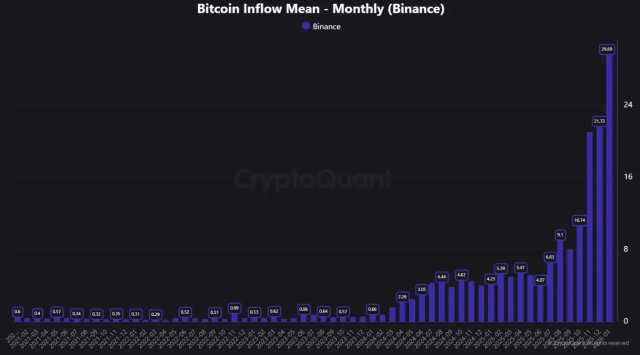
Source: Chart from CryptoQuant on X

It is worth noting that the metric has been rising in the last 2 years, moving from 0.86 BTC in early January 2024 to 21.7 BTC in 2026. To put into context, this growth represents a 34x increase in the average size of each deposit. Maartunn highlighted that this trend started accelerating in early 2024, just around the period the Spot Bitcoin Exchange-Traded Funds (ETFs) were approved by the US Securities and Exchange Commission (US SEC).

The timing suggests that larger organizations may have begun using Binance as an exchange alongside institutional adoption. However, this could just be a coincidence. As a result of the persistent inflow to Binance from large holders, the expert declares that the crypto exchange is poisoning itself as a key venue for whale flows.

BTC Purchase Firing Up Among Large Holders

Bitcoin accumulation among large holders or whales has also increased sharply lately. NoLimit, the analyst who predicted the Bitcoin bottom at $16,000 and its top at $126,000 in October 2025, reported that the cohort scooped up around 270,000 BTC, valued at roughly $23 billion over the past 30 days. This represents 1.3% of BTC’s total supply, and it is the largest net purchase from the investors in the last 13 years.

A key development in this buying activity is the period during which it is being conducted. Historically, this kind of whale concentration has occurred during uncertain times rather than at clear tops. While most individuals are preoccupied with other things and aren’t paying attention to inflows, this type of placement takes place quietly.

NoLimit stated that this does not mean that BTC gets to move upward tomorrow, but it does imply that investors with the longest time horizons are aggressively increasing their exposure. Meanwhile, investors in shitcoins are complaining about the coins not moving upward.

BTC trading at $92,563 on the 1D chart | Source: BTCUSDT on Tradingview.com

Related Questions

QWhat does the Bitcoin Inflow Mean metric indicate about whale activity on Binance?

AThe Bitcoin Inflow Mean metric shows the average amount of Bitcoin per inflow transaction. It has surged from 0.86 BTC in early 2024 to 21.7 BTC in December 2025, indicating a 34x increase and signaling that much larger, whale-sized transactions are now dominating inflows to the Binance exchange.

QAccording to the analyst Maartunn, what event coincided with the acceleration of this trend of increasing inflow sizes?

AMaartunn highlighted that the trend of increasing average transaction sizes began to accelerate in early 2024, which was around the same time that Spot Bitcoin Exchange-Traded Funds (ETFs) were approved by the US Securities and Exchange Commission (US SEC).

QHow much Bitcoin have large holders (whales) accumulated in the past 30 days, according to the analyst NoLimit?

AAccording to analyst NoLimit, large holders or whales have accumulated approximately 270,000 BTC over the past 30 days, which is valued at roughly $23 billion and represents 1.3% of Bitcoin's total supply.

QWhat is the historical significance of the current whale buying activity, as mentioned in the article?

AHistorically, this kind of concentrated buying activity from whales has occurred during periods of market uncertainty rather than at clear market tops. It often happens quietly while most individual investors are not paying attention.

QWhat does the persistent and large inflow of Bitcoin to Binance suggest about the exchange's role in the market?

AThe persistent and large inflow of Bitcoin to Binance from large holders suggests that the exchange is positioning itself as a key venue for whale flows, potentially used by larger organizations for strategic positioning alongside broader institutional adoption.

Related Reads

In-Depth Report on the On-Chain Lending Market: When Off-Chain Credit Meets On-Chain Liquidation

The on-chain lending market has evolved from a peripheral DeFi niche into core financial infrastructure. As of early 2026, total value locked (TVL) in on-chain lending protocols has reached $64.3 billion, accounting for 53.54% of total DeFi TVL, making it the largest and most mature vertical within decentralized finance. Aave dominates the sector with approximately $32.9 billion in TVL, commanding nearly half of the market—a leadership position that is unlikely to be challenged in the foreseeable future. However, the path of on-chain lending forward is not without risk. Liquidation cascades, credit defaults, and cross-chain vulnerabilities remain systemic threats hanging over the industry. At the same time, a deeper structural transformation is underway: on-chain lending is shifting from a “leverage tool for crypto-native users” to a “compliant gateway for institutional capital”. The scale of RWA (Real World Asset) lending has surpassed $18.5 billion, with U.S. Treasuries and government securities increasingly serving as core collateral. Institutional capital inflows are reshaping both the user base and risk appetite of the sector. This report systematically analyzes the evolution of on-chain lending definitions, competitive dynamics, core risks, and future trends, providing a comprehensive industry outlook for investors and trade practitioners. Key findings suggest that the “one dominant player with several strong challengers” structure will persist in the short term, while fixed-rate lending, compliant collateral, and institutional credit underwriting will define the next phase of competition. For investors focused on DeFi infrastructure, three key opportunity tracks stand out, namely, the Aave ecosystem (Morpho, Spark), RWA lending protocols (Ondo, Maple) and fixed-rate innovation (Notional, Pendle).

HTX Learn32m ago

In-Depth Report on the On-Chain Lending Market: When Off-Chain Credit Meets On-Chain Liquidation

HTX Learn32m ago

Fu Peng's First Public Speech in 2026: What Exactly Are Crypto Assets? Why Did I Join the Crypto Asset Industry?

Fu Peng, a renowned macroeconomist and now Chief Economist at New火 Group, delivered his first public speech of 2026 at the Hong Kong Web3 Festival. He explained his perspective on crypto assets and why he joined the industry, framing it within the context of macroeconomic trends and financial evolution. Fu emphasized that crypto assets are transitioning from an early, belief-driven phase to a mature, institutionally integrated asset class. He drew parallels to the 1970s-80s, when technological advances (like computing) revolutionized traditional finance, leading to the rise of FICC (Fixed Income, Currencies, and Commodities). Similarly, current advancements in AI, data, and blockchain are reshaping finance, with crypto assets becoming part of a new "FICC + C" (C for Crypto) framework. He noted that institutional capital, including traditional hedge funds, avoided early crypto due to its speculative nature but are now engaging as regulatory clarity emerges (e.g., stablecoin laws, CFTC classifying crypto as a commodity). Fu predicted that 2025-2026 marks a turning point where crypto becomes a standardized, financially viable asset for diversified portfolios, akin to commodities or derivatives in traditional finance. Fu defined Bitcoin not as "digital gold" in a simplistic sense but as a value-preserving, financially tradable asset. He highlighted that crypto's future lies in regulated, institutional adoption, moving away from retail-dominated trading. His entry into crypto signals this maturation, where traditional finance integrates crypto into mainstream asset management.

marsbit1h ago

Fu Peng's First Public Speech in 2026: What Exactly Are Crypto Assets? Why Did I Join the Crypto Asset Industry?

marsbit1h ago

Justin Sun Sues Trump Family: What $75 Million Bought Was Only a Blacklist

Justin Sun, founder of Tron, has filed a lawsuit in federal court against World Liberty Financial (WLF), alleging he was made the "primary target of a fraudulent scheme" after investing $75 million. Sun claims the investment secured him an advisor title and WLFI tokens, which were later frozen by WLF, causing "hundreds of millions in losses." The dispute began in late 2024 when Sun's investment helped revive WLF's struggling token sale, which ultimately raised $550 million. Shortly after, the SEC dropped its lawsuit against Sun following Donald Trump's inauguration. However, relations soured when Sun refused WLF's demands for additional funding. In August 2025, WLF added a "blacklist" function to its smart contract, allowing it to unilaterally freeze tokens. Sun's holdings, worth approximately $107 million, were frozen, and he was threatened with token destruction. The lawsuit highlights WLF's structure, which directs 75% of token sale profits to the Trump family, who had earned $1 billion by December 2025. WLF's CEO is Zach Witkoff, son of U.S. Middle East envoy Steve Witkoff. The project faces scrutiny for opaque operations, including a controversial loan arrangement on the Dolomite platform, co-founded by a WLF advisor. Despite Sun's history with the SEC, the case underscores centralization risks within DeFi, as WLF controls governance and holds powers to freeze assets arbitrarily. Sun's tokens remain frozen as legal proceedings begin.

marsbit1h ago

Justin Sun Sues Trump Family: What $75 Million Bought Was Only a Blacklist

marsbit1h ago

Trading

Spot
Futures

Hot Articles

What is $BITCOIN

DIGITAL GOLD ($BITCOIN): A Comprehensive Analysis Introduction to DIGITAL GOLD ($BITCOIN) DIGITAL GOLD ($BITCOIN) is a blockchain-based project operating on the Solana network, which aims to combine the characteristics of traditional precious metals with the innovation of decentralized technologies. While it shares a name with Bitcoin, often referred to as “digital gold” due to its perception as a store of value, DIGITAL GOLD is a separate token designed to create a unique ecosystem within the Web3 landscape. Its goal is to position itself as a viable alternative digital asset, although specifics regarding its applications and functionalities are still developing. What is DIGITAL GOLD ($BITCOIN)? DIGITAL GOLD ($BITCOIN) is a cryptocurrency token explicitly designed for use on the Solana blockchain. In contrast to Bitcoin, which provides a widely recognized value storage role, this token appears to focus on broader applications and characteristics. Notable aspects include: Blockchain Infrastructure: The token is built on the Solana blockchain, known for its capacity to handle high-speed and low-cost transactions. Supply Dynamics: DIGITAL GOLD has a maximum supply capped at 100 quadrillion tokens (100P $BITCOIN), although details regarding its circulating supply are currently undisclosed. Utility: While precise functionalities are not explicitly outlined, there are indications that the token could be utilized for various applications, potentially involving decentralized applications (dApps) or asset tokenization strategies. Who is the Creator of DIGITAL GOLD ($BITCOIN)? At present, the identity of the creators and development team behind DIGITAL GOLD ($BITCOIN) remains unknown. This situation is typical among many innovative projects within the blockchain space, particularly those aligning with decentralized finance and meme coin phenomena. While such anonymity may foster a community-driven culture, it intensifies concerns about governance and accountability. Who are the Investors of DIGITAL GOLD ($BITCOIN)? The available information indicates that DIGITAL GOLD ($BITCOIN) does not have any known institutional backers or prominent venture capital investments. The project seems to operate on a peer-to-peer model focused on community support and adoption rather than traditional funding routes. Its activity and liquidity are primarily situated on decentralized exchanges (DEXs), such as PumpSwap, rather than established centralized trading platforms, further highlighting its grassroots approach. How DIGITAL GOLD ($BITCOIN) Works The operational mechanics of DIGITAL GOLD ($BITCOIN) can be elaborated on based on its blockchain design and network attributes: Consensus Mechanism: By leveraging Solana’s unique proof-of-history (PoH) combined with a proof-of-stake (PoS) model, the project ensures efficient transaction validation contributing to the network's high performance. Tokenomics: While specific deflationary mechanisms have not been extensively detailed, the vast maximum token supply implies that it may cater to microtransactions or niche use cases that are still to be defined. Interoperability: There exists the potential for integration with Solana’s broader ecosystem, including various decentralized finance (DeFi) platforms. However, the details regarding specific integrations remain unspecified. Timeline of Key Events Here is a timeline that highlights significant milestones concerning DIGITAL GOLD ($BITCOIN): 2023: The initial deployment of the token occurs on the Solana blockchain, marked by its contract address. 2024: DIGITAL GOLD gains visibility as it becomes available for trading on decentralized exchanges like PumpSwap, allowing users to trade it against SOL. 2025: The project witnesses sporadic trading activity and potential interest in community-led engagements, although no noteworthy partnerships or technical advancements have been documented as of yet. Critical Analysis Strengths Scalability: The underlying Solana infrastructure supports high transaction volumes, which could enhance the utility of $BITCOIN in various transaction scenarios. Accessibility: The potential low trading price per token could attract retail investors, facilitating wider participation due to fractional ownership opportunities. Risks Lack of Transparency: The absence of publicly known backers, developers, or an audit process may yield skepticism regarding the project's sustainability and trustworthiness. Market Volatility: The trading activity is heavily reliant on speculative behavior, which can result in significant price volatility and uncertainty for investors. Conclusion DIGITAL GOLD ($BITCOIN) emerges as an intriguing yet ambiguous project within the rapidly evolving Solana ecosystem. While it attempts to leverage the “digital gold” narrative, its departure from Bitcoin's established role as a store of value underscores the need for a clearer differentiation of its intended utility and governance structure. Future acceptance and adoption will likely depend on addressing the current opacity and defining its operational and economic strategies more explicitly. Note: This report encompasses synthesised information available as of October 2023, and developments may have transpired beyond the research period.

363 Total ViewsPublished 2025.05.13Updated 2025.05.13

What is $BITCOIN

Discussions

Welcome to the HTX Community. Here, you can stay informed about the latest platform developments and gain access to professional market insights. Users' opinions on the price of BTC (BTC) are presented below.

活动图片















