The Verdict Is In For Bitcoin: Majority Of Investors Say BTC Price Is Headed Lower, Here Are The Numbers

bitcoinistPublished on 2026-06-11Last updated on 2026-06-11

Abstract

The majority of Bitcoin investors and prediction markets are positioning for further price downside. According to analyst Winter Soldier, 64% of orders on prediction markets bet on BTC falling below $50,000 this year, with a 64% probability priced for a drop to $55,000 or lower by end of 2026. Comparing to the previous cycle, the analyst suggests a crash to the $35,000-$38,000 range cannot be ruled out, noting that the last bear market saw a 78% decline. Technical analysis shows Bitcoin in the "BUY!" band on the rainbow chart, appearing discounted relative to its long-term trend. However, the price structure has not confirmed a reversal, exhibiting lower highs and lows with persistent sell volume. Any bounce to the $65,000-$66,000 range is viewed as a potential bull trap gathering momentum for further declines. The prevailing sentiment is that Bitcoin may still experience a painful leg down to $50,000 or lower before forming a durable market bottom.

Across prediction markets, on-chain dashboards, and sentiment trackers, a clear majority of Bitcoin investors have positioned themselves for further downside.

Although Bitcoin has since recovered above $60,000, the recent crash below the level over the weekend has led many crypto traders to believe that there’s going to be another crash to the final bottom. According to crypto analyst Winter Soldier, 64% of orders on prediction markets are now betting on BTC dropping below $50,000 this year.

64% Of Orders Are Betting Bitcoin Breaks Below $50,000

Prediction market Polymarket is currently pricing a 64% probability that Bitcoin hits $55,000 or lower before the end of 2026. This outlook was also noted in a bearish call by crypto analyst Winter Soldier, who noted that 65% of orders on prediction markets are now positioned for BTC to fall below $50,000 before the end of the year.

However, the analyst also compared the current setup with the previous cycle, when many traders believed $28,000 would hold as the final low. Bitcoin later fell to $19,000, then to $15,000, before the market finally reached the level of fear needed for a true reversal. That is why the analyst believes a crash to the $35,000 to $38,000 range from the current price action cannot be ruled out.

Bitcoin dropped about 78% in the last bear cycle before beginning its next major expansion. This cycle could be shallower because of ETFs and institutional participation, but still, $50,000 should not be assumed automatically as the floor simply because everyone is watching it.

The Chart Says BTC Is Cheap, But Not Safe Yet

The rainbow chart added to the analysis by Winter Soldier shows Bitcoin now sitting in the “BUY!” band, and the price has spent 24 days in that band compared to an average of 18 days. That makes Bitcoin look discounted relative to its long-term logarithmic trend.

The chart also shows only a 5.5% drop to the lower band and a 27.2% move to the upper band, which is another sign that BTC is closer to the lower end of the historical value range than the upper end.
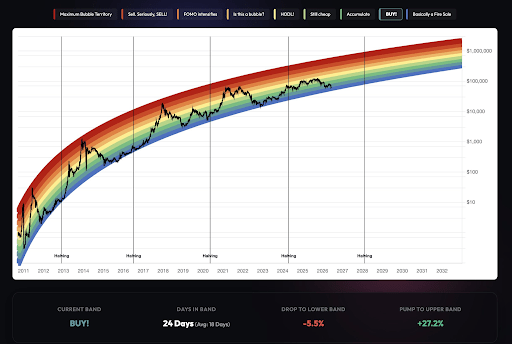
Source: Chart from Winter Soldier on X

However, the problem for bulls is that the price structure has not yet confirmed a reversal. Bitcoin has printed heavy red candles, lower highs, and lower lows, and sell volume has continued into the middle of the week. Everywhere you look, there’s supply and no demand. If the Bitcoin price bounces back into the range between $65,000 and $66,000, it’s most likely just gathering momentum to push lower, and this is a bull trap, not a buy signal.

The verdict is part of many predictions from a bearish camp that Bitcoin may still have one more painful leg to $50,000 before a durable bottom is formed. Interestingly, some analysts are calling for a further bottom below $50,000.

BTC trading at $60,965 on the 1D chart | Source: BTCUSDT on Tradingview.com

Trending Cryptos

Related Questions

QAccording to the article, what percentage of prediction market orders are betting that Bitcoin will drop below $50,000 this year?

AAccording to crypto analyst Winter Soldier, 64% (or 65% as noted in another part) of orders on prediction markets are betting on BTC dropping below $50,000 before the end of the year.

QWhat price range does analyst Winter Soldier believe a crash to, from current levels, cannot be ruled out?

AThe analyst believes a crash to the $35,000 to $38,000 range cannot be ruled out.

QAccording to the rainbow chart analysis, what band is Bitcoin currently sitting in, and what does that signify?

AThe rainbow chart shows Bitcoin sitting in the "BUY!" band. This makes Bitcoin look discounted relative to its long-term logarithmic trend, indicating it is closer to the lower end of its historical value range.

QWhy does the article suggest that a price bounce back to the $65,000-$66,000 range might not be a buy signal?

AThe article suggests such a bounce is most likely just gathering momentum to push lower, labeling it a bull trap rather than a true buy signal, as the price structure has not yet confirmed a reversal.

QWhat two factors mentioned in the article could make the current bear cycle shallower than the previous one?

AThe cycle could be shallower because of the introduction of ETFs and increased institutional participation.

Related Reads

human.tech Launches Clean SDK for Privacy-First Web3 Apps

human.tech has launched the Clean SDK, a toolkit enabling developers to build privacy-first Web3 applications with transparent accountability. Released alongside Aztec's version 5, the SDK provides components for integrating zero-knowledge identity verification, sanctions screening, and private transactions, without developers handling sensitive user data or building compliance infrastructure from scratch. It uses zero-knowledge proofs and programmable verification to allow apps to confirm user legitimacy and sanctions compliance while keeping identities confidential. The first application built on the SDK, Shield, a privacy bridge to Aztec, also launched. It allows users to transfer assets privately while proving a unique human is behind each transfer and that funds have passed sanctions checks, as verified by a May 2026 audit. The SDK offers three core verification techniques: Proof of Innocence (sanctions screening against 23 sources), Proof of Personhood (simpler verification via Human Passport), and Proof of Clean Hands (higher-assurance zero-knowledge government ID checks). This allows apps to authenticate users and transactions without exposing personal data. Designed for Aztec builders, the SDK lets developers add programmable privacy to decentralized apps, eliminating the need to create their own verification and ZK infrastructure. Shield demonstrates its practical use for private bridges, but the SDK aims to enable a wider ecosystem of private, accountable financial apps and services. The launch addresses growing demand for infrastructure that balances privacy and accountability. The SDK avoids traditional identity databases, storing encrypted data off-chain, screening at both entry and exit points, and including a gated disclosure mechanism for legal requests. human.tech's products, including the Clean SDK, focus on using zero-knowledge technology to enable verifiable personhood and privacy in digital systems.

TheNewsCrypto29m ago

human.tech Launches Clean SDK for Privacy-First Web3 Apps

TheNewsCrypto29m ago

Unlocking $100 Million in Liquidity? Pump.fun's New Policy Tests the 5-Minute Pump Technique

Pump.fun, a popular meme coin launchpad, has introduced a new standard mechanism called BOOST. It aims to address a significant capital efficiency issue: when a newly launched token graduates from its initial bonding curve to a liquidity pool (LP), roughly 20% of its liquidity becomes permanently locked as "dead liquidity," estimated to waste over $100 million annually. Instead of locking these funds permanently, BOOST repurposes them. Upon a token's migration, approximately 20% of the settlement funds (e.g., 17.6 SOL or ~$2516 USDC) are used to buy back the token on the open market over a 5-minute period via a Time-Weighted Average Price (TWAP) mechanism. All purchased tokens are immediately burned. This creates a brief, systematic buy pressure immediately after migration, potentially generating a short-term price surge ("pump") while permanently reducing the token's circulating supply. The goal is to enhance the immediate post-launch trading experience, potentially increasing trader retention and sustainable protocol revenue, which funds ongoing token buybacks. However, concerns exist that this artificial 5-minute boost could lower the barrier for launching low-quality tokens and lead to steeper price crashes once the buy pressure stops, if followed by large sell-offs. The feature automatically applies to tokens migrating after July 21, 2024, but not to previously migrated tokens or those launched via the Mayhem AI Agent lab.

marsbit36m ago

Unlocking $100 Million in Liquidity? Pump.fun's New Policy Tests the 5-Minute Pump Technique

marsbit36m ago

Podcast Notes | Conversation with GSR Asset Management Head: To Determine if This Crypto Rally is Real, Just Watch the Lending Rates on Aave

Podcast Summary: Dialogue with GSR's Head of Asset Management: To Determine if This Crypto Rally is Real, Just Check Lending Rates on Aave Andy Baehr, Managing Director of Asset Management at GSR, discusses the current crypto market, characterizing it as stuck in a state of "ambivalence" with short-lived, unsustainable rallies. He outlines a simple framework: the market moves between "ambivalence" and "conviction" (sustained upward momentum). Currently, every rally resembles a single-stage rocket booster that quickly fizzles out. Baehr identifies three key signals to watch: 1) DeFi lending rates, 2) the potential passage of the CLARITY Act, and 3) the market forming a consensus on the "Fed hawkish peak." He emphasizes that the most immediate indicator for the sustainability of the recent CPI-triggered rally is the USDC borrowing rate on Aave, currently around 3.75%—close to U.S. Treasury yields. The absence of a credit spread indicates low leverage demand and a lack of market energy. He explains that a healthy, sustained rally requires layered buying pressure. Last year's rally progressed from an ETH short squeeze to crypto-native trader influx and finally to ETF inflows. Currently, this structure is missing. Other potential structural buyers like Digital Asset Treasury (DAT) companies are absent, and ETF flows have proven transient. Baehr notes that while small-cap crypto tokens outperformed large caps in Q2—a potential sign of capitation in major assets—capital is also flowing to more exciting opportunities like AI stocks and tech IPOs, leaving crypto sidelined. Regarding DeFi, he highlights that platforms like Aave provide a clear, real-time signal of leverage demand through their supply/demand-driven interest rates. A significant, sustained rate increase would signal genuine market conviction. He also observes the quiet emergence of fixed-income-like products and vaults in DeFi. On regulation, the probability of the CLARITY Act passing before the August 7th deadline has dropped linearly from 75% to below 40% on Polymarket. Baehr suggests its passage would be treated as a bullish surprise, a potent driver for price movement. However, political hurdles, including ethical clause debates and disclosures about the First Family's crypto profits, remain significant obstacles. Ultimately, the market awaits clarity on the Fed's terminal rate under Chair Warsh. Until the "Fed Solstice"—the point where the market collectively understands the peak of hawkish policy—sustained conviction will be difficult to achieve.

marsbit1h ago

Podcast Notes | Conversation with GSR Asset Management Head: To Determine if This Crypto Rally is Real, Just Watch the Lending Rates on Aave

marsbit1h ago

Trading

Spot

Hot Articles

What is $BITCOIN

DIGITAL GOLD ($BITCOIN): A Comprehensive Analysis Introduction to DIGITAL GOLD ($BITCOIN) DIGITAL GOLD ($BITCOIN) is a blockchain-based project operating on the Solana network, which aims to combine the characteristics of traditional precious metals with the innovation of decentralized technologies. While it shares a name with Bitcoin, often referred to as “digital gold” due to its perception as a store of value, DIGITAL GOLD is a separate token designed to create a unique ecosystem within the Web3 landscape. Its goal is to position itself as a viable alternative digital asset, although specifics regarding its applications and functionalities are still developing. What is DIGITAL GOLD ($BITCOIN)? DIGITAL GOLD ($BITCOIN) is a cryptocurrency token explicitly designed for use on the Solana blockchain. In contrast to Bitcoin, which provides a widely recognized value storage role, this token appears to focus on broader applications and characteristics. Notable aspects include: Blockchain Infrastructure: The token is built on the Solana blockchain, known for its capacity to handle high-speed and low-cost transactions. Supply Dynamics: DIGITAL GOLD has a maximum supply capped at 100 quadrillion tokens (100P $BITCOIN), although details regarding its circulating supply are currently undisclosed. Utility: While precise functionalities are not explicitly outlined, there are indications that the token could be utilized for various applications, potentially involving decentralized applications (dApps) or asset tokenization strategies. Who is the Creator of DIGITAL GOLD ($BITCOIN)? At present, the identity of the creators and development team behind DIGITAL GOLD ($BITCOIN) remains unknown. This situation is typical among many innovative projects within the blockchain space, particularly those aligning with decentralized finance and meme coin phenomena. While such anonymity may foster a community-driven culture, it intensifies concerns about governance and accountability. Who are the Investors of DIGITAL GOLD ($BITCOIN)? The available information indicates that DIGITAL GOLD ($BITCOIN) does not have any known institutional backers or prominent venture capital investments. The project seems to operate on a peer-to-peer model focused on community support and adoption rather than traditional funding routes. Its activity and liquidity are primarily situated on decentralized exchanges (DEXs), such as PumpSwap, rather than established centralized trading platforms, further highlighting its grassroots approach. How DIGITAL GOLD ($BITCOIN) Works The operational mechanics of DIGITAL GOLD ($BITCOIN) can be elaborated on based on its blockchain design and network attributes: Consensus Mechanism: By leveraging Solana’s unique proof-of-history (PoH) combined with a proof-of-stake (PoS) model, the project ensures efficient transaction validation contributing to the network's high performance. Tokenomics: While specific deflationary mechanisms have not been extensively detailed, the vast maximum token supply implies that it may cater to microtransactions or niche use cases that are still to be defined. Interoperability: There exists the potential for integration with Solana’s broader ecosystem, including various decentralized finance (DeFi) platforms. However, the details regarding specific integrations remain unspecified. Timeline of Key Events Here is a timeline that highlights significant milestones concerning DIGITAL GOLD ($BITCOIN): 2023: The initial deployment of the token occurs on the Solana blockchain, marked by its contract address. 2024: DIGITAL GOLD gains visibility as it becomes available for trading on decentralized exchanges like PumpSwap, allowing users to trade it against SOL. 2025: The project witnesses sporadic trading activity and potential interest in community-led engagements, although no noteworthy partnerships or technical advancements have been documented as of yet. Critical Analysis Strengths Scalability: The underlying Solana infrastructure supports high transaction volumes, which could enhance the utility of $BITCOIN in various transaction scenarios. Accessibility: The potential low trading price per token could attract retail investors, facilitating wider participation due to fractional ownership opportunities. Risks Lack of Transparency: The absence of publicly known backers, developers, or an audit process may yield skepticism regarding the project's sustainability and trustworthiness. Market Volatility: The trading activity is heavily reliant on speculative behavior, which can result in significant price volatility and uncertainty for investors. Conclusion DIGITAL GOLD ($BITCOIN) emerges as an intriguing yet ambiguous project within the rapidly evolving Solana ecosystem. While it attempts to leverage the “digital gold” narrative, its departure from Bitcoin's established role as a store of value underscores the need for a clearer differentiation of its intended utility and governance structure. Future acceptance and adoption will likely depend on addressing the current opacity and defining its operational and economic strategies more explicitly. Note: This report encompasses synthesised information available as of October 2023, and developments may have transpired beyond the research period.

973 Total ViewsPublished 2025.05.13Updated 2025.05.13

What is $BITCOIN

Discussions

Welcome to the HTX Community. Here, you can stay informed about the latest platform developments and gain access to professional market insights. Users' opinions on the price of BTC (BTC) are presented below.

活动图片















