The Verdict Is In For Bitcoin: Majority Of Investors Say BTC Price Is Headed Lower, Here Are The Numbers

bitcoinistPublished on 2026-06-11Last updated on 2026-06-11

Abstract

The majority of Bitcoin investors and prediction markets are positioning for further price downside. According to analyst Winter Soldier, 64% of orders on prediction markets bet on BTC falling below $50,000 this year, with a 64% probability priced for a drop to $55,000 or lower by end of 2026. Comparing to the previous cycle, the analyst suggests a crash to the $35,000-$38,000 range cannot be ruled out, noting that the last bear market saw a 78% decline. Technical analysis shows Bitcoin in the "BUY!" band on the rainbow chart, appearing discounted relative to its long-term trend. However, the price structure has not confirmed a reversal, exhibiting lower highs and lows with persistent sell volume. Any bounce to the $65,000-$66,000 range is viewed as a potential bull trap gathering momentum for further declines. The prevailing sentiment is that Bitcoin may still experience a painful leg down to $50,000 or lower before forming a durable market bottom.

Across prediction markets, on-chain dashboards, and sentiment trackers, a clear majority of Bitcoin investors have positioned themselves for further downside.

Although Bitcoin has since recovered above $60,000, the recent crash below the level over the weekend has led many crypto traders to believe that there’s going to be another crash to the final bottom. According to crypto analyst Winter Soldier, 64% of orders on prediction markets are now betting on BTC dropping below $50,000 this year.

64% Of Orders Are Betting Bitcoin Breaks Below $50,000

Prediction market Polymarket is currently pricing a 64% probability that Bitcoin hits $55,000 or lower before the end of 2026. This outlook was also noted in a bearish call by crypto analyst Winter Soldier, who noted that 65% of orders on prediction markets are now positioned for BTC to fall below $50,000 before the end of the year.

However, the analyst also compared the current setup with the previous cycle, when many traders believed $28,000 would hold as the final low. Bitcoin later fell to $19,000, then to $15,000, before the market finally reached the level of fear needed for a true reversal. That is why the analyst believes a crash to the $35,000 to $38,000 range from the current price action cannot be ruled out.

Bitcoin dropped about 78% in the last bear cycle before beginning its next major expansion. This cycle could be shallower because of ETFs and institutional participation, but still, $50,000 should not be assumed automatically as the floor simply because everyone is watching it.

The Chart Says BTC Is Cheap, But Not Safe Yet

The rainbow chart added to the analysis by Winter Soldier shows Bitcoin now sitting in the “BUY!” band, and the price has spent 24 days in that band compared to an average of 18 days. That makes Bitcoin look discounted relative to its long-term logarithmic trend.

The chart also shows only a 5.5% drop to the lower band and a 27.2% move to the upper band, which is another sign that BTC is closer to the lower end of the historical value range than the upper end.
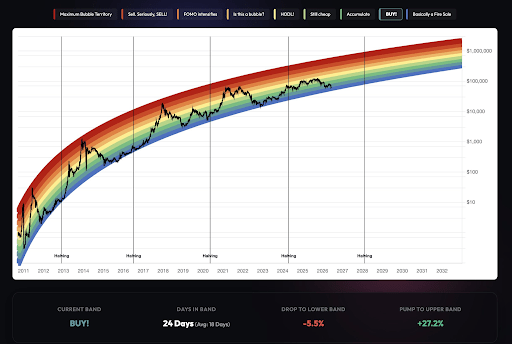
Source: Chart from Winter Soldier on X

However, the problem for bulls is that the price structure has not yet confirmed a reversal. Bitcoin has printed heavy red candles, lower highs, and lower lows, and sell volume has continued into the middle of the week. Everywhere you look, there’s supply and no demand. If the Bitcoin price bounces back into the range between $65,000 and $66,000, it’s most likely just gathering momentum to push lower, and this is a bull trap, not a buy signal.

The verdict is part of many predictions from a bearish camp that Bitcoin may still have one more painful leg to $50,000 before a durable bottom is formed. Interestingly, some analysts are calling for a further bottom below $50,000.

BTC trading at $60,965 on the 1D chart | Source: BTCUSDT on Tradingview.com

Related Questions

QAccording to the article, what percentage of prediction market orders are betting that Bitcoin will drop below $50,000 this year?

AAccording to crypto analyst Winter Soldier, 64% (or 65% as noted in another part) of orders on prediction markets are betting on BTC dropping below $50,000 before the end of the year.

QWhat price range does analyst Winter Soldier believe a crash to, from current levels, cannot be ruled out?

AThe analyst believes a crash to the $35,000 to $38,000 range cannot be ruled out.

QAccording to the rainbow chart analysis, what band is Bitcoin currently sitting in, and what does that signify?

AThe rainbow chart shows Bitcoin sitting in the "BUY!" band. This makes Bitcoin look discounted relative to its long-term logarithmic trend, indicating it is closer to the lower end of its historical value range.

QWhy does the article suggest that a price bounce back to the $65,000-$66,000 range might not be a buy signal?

AThe article suggests such a bounce is most likely just gathering momentum to push lower, labeling it a bull trap rather than a true buy signal, as the price structure has not yet confirmed a reversal.

QWhat two factors mentioned in the article could make the current bear cycle shallower than the previous one?

AThe cycle could be shallower because of the introduction of ETFs and increased institutional participation.

Related Reads

I Built Myself an Investment Workbench Using AI

For the past two weeks, I've been immersed in Vibe Coding—using AI to write code from natural language descriptions. This process has enabled me to quickly build functional tools that address long-standing personal ideas. Previously, I had many concepts but found execution too cumbersome. Key ideas included a unified dashboard for assets across US stocks, Crypto, HK stocks, and A-shares; a real-time alert system for price movements; an investment map visualizing sector relationships; and a tool to correlate prediction market bets with news and market data. Traditional development hurdles meant these often remained unrealized. Using AI (Codex, Claude Code, and DeepSeek API), I built four initial tools: 1. A **Cross-Market Asset Dashboard** showing total assets, daily P&L, and holdings by market, with added features for alerts and sector mapping. It's deployed locally for privacy. 2. A **Prediction Market (PM) Monitor** tracking bets on events (e.g., company valuations) and correlating probability shifts with news and market movements. I categorize bets by conviction to filter noise. 3. A **Simple Operations Backend** for managing my writing workflow (topics, progress, publishing). It's cloud-deployed for mobile access. 4. A **One-Click Formatting Tool** that automates converting drafts into various platform-specific formats, saving manual effort. While these tools are basic, they represent a significant shift: AI lowers the barrier to creating personalized systems. I believe individual investors can now feasibly build core systems for: * **Asset Observation** (tracking holdings and changes) * **Signal Monitoring** (watching for key market shifts) * **Sector Mapping** (understanding network relationships within a sector) * **Performance Review** (documenting rationale and outcomes) The power of Vibe Coding is its fast feedback loop. Ideas can be implemented, tested, and iterated on rapidly, turning "want-to-do" into "done." This marks the start of my new phase, where I'll share investment thoughts, tool tests, on-chain operations, and educational Web3 content.

marsbit4m ago

I Built Myself an Investment Workbench Using AI

marsbit4m ago

After Tokenization of Assets, How to Exit?

Title: How to Exit After Asset Tokenization? Author: Symbiotic Compiled by: Hu Tao, ChainCatcher Summary: Tokenization addresses how assets go on-chain but largely leaves the redemption question unresolved. While tokenized assets can settle instantly, the underlying redemption for assets like treasuries, private credit, or real estate can take from T+1 to 180 days. This gap hinders DeFi adoption of Real World Assets (RWAs). Three emerging models aim to provide instant exit liquidity, differing primarily in their capital structure and efficiency: 1. **Balance Sheet Model (e.g., Grove Basin):** A single entity (like Sky) provides immediate liquidity from its balance sheet, acting as a bridge during the settlement period. It offers simplicity and deep initial liquidity but is constrained by a single entity's capacity and risk appetite. 2. **Asset-Specific Vault Model (e.g., Upshift Clear):** Independent liquidity providers fund dedicated vaults for each supported asset, earning fees. It decentralizes capital sources but isolates liquidity and capital per asset, leading to potential fragmentation. 3. **Shared Liquidity Layer Model (e.g., Symbiotic Liquid Lane):** A shared capital pool supports multiple RWA types simultaneously. Funds remain productive between redemptions (e.g., earning yield in lending markets). Exits are settled via a competitive RFQ market. This model aims for higher capital efficiency, scalability across assets, and serves longer-duration assets like private credit. Key differentiators are: 1) Source of capital and risk bearer, 2) Redemption pricing mechanism, 3) Capital efficiency, 4) Scalability to new asset types, and 5) Composability. The shared liquidity layer model represents a move from piecemeal solutions toward scalable infrastructure, enabling T+0 exits by pooling capital, maintaining yield, and using competitive pricing, thus enhancing RWA utility in DeFi.

marsbit17m ago

After Tokenization of Assets, How to Exit?

marsbit17m ago

After Tokenizing Assets, How to Exit?

After tokenization, a key unresolved issue is providing holders with a reliable exit mechanism, as underlying asset settlement (taking days to months) lags far behind on-chain token settlement. Three primary models for instant liquidity have emerged, differing in their capital structure and efficiency: 1. **Balance Sheet Model (e.g., Grove Basin):** A single, well-capitalized entity (like Sky) provides immediate liquidity from its own reserves. This offers simplicity and deep initial liquidity but is constrained by that single balance sheet's capacity and risk appetite, limiting scalability. 2. **Dedicated Vault Model (e.g., Upshift Clear):** Independent liquidity providers (LPs) fund separate vaults for each supported asset. This decentralizes capital sources but isolates liquidity and capital, which becomes inefficient as the number of tokenized assets grows. 3. **Shared Liquidity Layer Model (Symbiotic Liquid Lane):** Independent capital providers fund shared vaults that can support multiple tokenized assets simultaneously. Capital remains productive between redemptions (e.g., earning yield in DeFi markets). Exits are settled via a competitive RFQ market where market makers bid. The article argues that the shared layer model offers superior capital efficiency and scalability. It transforms exit liquidity from an asset-specific patch into shared market infrastructure, allowing liquidity capacity to grow with overall market participation rather than being fragmented per asset. This is particularly valuable for longer-duration assets like private credit, where reliable T+0 exits can significantly enhance their utility in DeFi.

链捕手31m ago

After Tokenizing Assets, How to Exit?

链捕手31m ago

Anthropic's Triple Moment: Code Leak, Government Confrontation, and Weaponization

This article analyzes Anthropic's recent conflicts and strategic moves following the U.S. government's emergency halt of its new Fable model, citing national security concerns over potential "jailbreaks." The author argues this incident reveals deeper tensions between AI labs, governments, and the software industry. While critics view Anthropic's safety-focused rhetoric as marketing fear, the author suggests it serves as a commercial moat masking the company's core economic imperative: moving closer to end-users and their valuable data to avoid being commoditized. The piece outlines a coming clash between frontier AI labs like Anthropic and established software companies. Labs need real-world usage data for model improvement via reinforcement learning, creating a cycle where better products attract more users and more data. This threatens software firms who, as Microsoft's Satya Nadella warns, risk having their value captured by a few dominant models. Anthropic's controversial policy changes—initially secretly degrading Fable's performance for LLM development and expanding data retention—are framed as assertions of control, justified by its safety narrative. The company's foundational belief that it alone is sufficiently concerned about superintelligent AI dangers legitimizes its actions, from resisting government demands to shaping usage policies. The author concludes that this alignment of mission, talent, and business strategy is powerful but concerning, as it concentrates immense potential power in the hands of those convinced of their own righteous understanding.

marsbit41m ago

Anthropic's Triple Moment: Code Leak, Government Confrontation, and Weaponization

marsbit41m ago

Trading

Spot
Futures

Hot Articles

What is $BITCOIN

DIGITAL GOLD ($BITCOIN): A Comprehensive Analysis Introduction to DIGITAL GOLD ($BITCOIN) DIGITAL GOLD ($BITCOIN) is a blockchain-based project operating on the Solana network, which aims to combine the characteristics of traditional precious metals with the innovation of decentralized technologies. While it shares a name with Bitcoin, often referred to as “digital gold” due to its perception as a store of value, DIGITAL GOLD is a separate token designed to create a unique ecosystem within the Web3 landscape. Its goal is to position itself as a viable alternative digital asset, although specifics regarding its applications and functionalities are still developing. What is DIGITAL GOLD ($BITCOIN)? DIGITAL GOLD ($BITCOIN) is a cryptocurrency token explicitly designed for use on the Solana blockchain. In contrast to Bitcoin, which provides a widely recognized value storage role, this token appears to focus on broader applications and characteristics. Notable aspects include: Blockchain Infrastructure: The token is built on the Solana blockchain, known for its capacity to handle high-speed and low-cost transactions. Supply Dynamics: DIGITAL GOLD has a maximum supply capped at 100 quadrillion tokens (100P $BITCOIN), although details regarding its circulating supply are currently undisclosed. Utility: While precise functionalities are not explicitly outlined, there are indications that the token could be utilized for various applications, potentially involving decentralized applications (dApps) or asset tokenization strategies. Who is the Creator of DIGITAL GOLD ($BITCOIN)? At present, the identity of the creators and development team behind DIGITAL GOLD ($BITCOIN) remains unknown. This situation is typical among many innovative projects within the blockchain space, particularly those aligning with decentralized finance and meme coin phenomena. While such anonymity may foster a community-driven culture, it intensifies concerns about governance and accountability. Who are the Investors of DIGITAL GOLD ($BITCOIN)? The available information indicates that DIGITAL GOLD ($BITCOIN) does not have any known institutional backers or prominent venture capital investments. The project seems to operate on a peer-to-peer model focused on community support and adoption rather than traditional funding routes. Its activity and liquidity are primarily situated on decentralized exchanges (DEXs), such as PumpSwap, rather than established centralized trading platforms, further highlighting its grassroots approach. How DIGITAL GOLD ($BITCOIN) Works The operational mechanics of DIGITAL GOLD ($BITCOIN) can be elaborated on based on its blockchain design and network attributes: Consensus Mechanism: By leveraging Solana’s unique proof-of-history (PoH) combined with a proof-of-stake (PoS) model, the project ensures efficient transaction validation contributing to the network's high performance. Tokenomics: While specific deflationary mechanisms have not been extensively detailed, the vast maximum token supply implies that it may cater to microtransactions or niche use cases that are still to be defined. Interoperability: There exists the potential for integration with Solana’s broader ecosystem, including various decentralized finance (DeFi) platforms. However, the details regarding specific integrations remain unspecified. Timeline of Key Events Here is a timeline that highlights significant milestones concerning DIGITAL GOLD ($BITCOIN): 2023: The initial deployment of the token occurs on the Solana blockchain, marked by its contract address. 2024: DIGITAL GOLD gains visibility as it becomes available for trading on decentralized exchanges like PumpSwap, allowing users to trade it against SOL. 2025: The project witnesses sporadic trading activity and potential interest in community-led engagements, although no noteworthy partnerships or technical advancements have been documented as of yet. Critical Analysis Strengths Scalability: The underlying Solana infrastructure supports high transaction volumes, which could enhance the utility of $BITCOIN in various transaction scenarios. Accessibility: The potential low trading price per token could attract retail investors, facilitating wider participation due to fractional ownership opportunities. Risks Lack of Transparency: The absence of publicly known backers, developers, or an audit process may yield skepticism regarding the project's sustainability and trustworthiness. Market Volatility: The trading activity is heavily reliant on speculative behavior, which can result in significant price volatility and uncertainty for investors. Conclusion DIGITAL GOLD ($BITCOIN) emerges as an intriguing yet ambiguous project within the rapidly evolving Solana ecosystem. While it attempts to leverage the “digital gold” narrative, its departure from Bitcoin's established role as a store of value underscores the need for a clearer differentiation of its intended utility and governance structure. Future acceptance and adoption will likely depend on addressing the current opacity and defining its operational and economic strategies more explicitly. Note: This report encompasses synthesised information available as of October 2023, and developments may have transpired beyond the research period.

368 Total ViewsPublished 2025.05.13Updated 2025.05.13

What is $BITCOIN

Discussions

Welcome to the HTX Community. Here, you can stay informed about the latest platform developments and gain access to professional market insights. Users' opinions on the price of BTC (BTC) are presented below.

活动图片