The 'Stock Call King' Serenity: 3840% Annual Return, Beating Institutions to the Punch

Odaily星球日报Published on 2026-05-26Last updated on 2026-05-26

Abstract

This article profiles the mysterious stock trader and analyst known as Serenity, who has gained significant influence on social media platform X as a "stock call king." Serenity claims extraordinary annual returns of 3840% for the current year and 2256% over the past two years, primarily by focusing on overlooked companies within the AI and semiconductor supply chains. Operating anonymously, Serenity describes himself as a former Reddit WallStreetBets trader, an AI/semiconductor supply chain analyst, and a former AI research scientist. His core investment strategy, termed the "Chokepoint" theory, involves identifying small, critical bottleneck companies in the AI infrastructure ecosystem—such as those in photonics, substrates, and materials—that are essential yet undervalued. He argues these "invisible champions" become crucial as demand for AI hardware surges, creating significant investment opportunities before large institutions take notice. A frequently cited example is stock AXTI, which he has recommended for over two years and claims has yielded over 10,000% returns. The article notes that while Serenity's free, public posts on X have garnered a large following, his identity and exact portfolio size remain unverified, leading to some skepticism. Critics question if his reported returns are fabricated or if he might be manipulating prices of low-market-cap stocks. Serenity counters that he shares research freely to democratize information, allowing retail investors to ...

Original | Odaily Planet Daily (@OdailyChina)

Author | Golem (@web3_golem)
As an investor focused on US stocks in AI and semiconductors, if you haven't heard of Serenity, chances are you're still on the sidelines when it comes to investment research.

Why is that? Because he is currently the hottest "stock call king" on the entire internet. From retail investors to Wall Street, almost everyone is reading his reports and copying his trades. Some people even package his publicly available, free insights into courses to sell within communities.

On May 24th, Serenity announced his investment performance for this year on platform X: a year-to-date return of 3840.39%. Just the day before, he had also shared his investment return over the past two years, which was a staggering 2256.99%.
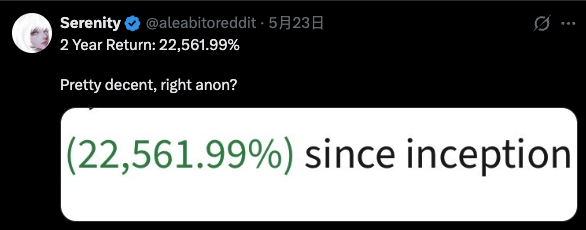
Serenity, "Far Ahead of the Pack"

Serenity only joined X in July 2025, and by May this year, his follower count had grown to 358k, with over 32k subscriptions—just under 15k less than Elon Musk's subscription count. Yet, to this day, no one knows Serenity's true identity. People's understanding of his background comes solely from his self-written bio:

  • Former famous Reddit WSB trader who switched to X(Odaily Note: WallStreetBets is the largest US retail trading community. Serenity was banned for recommending a stock with the ticker AXTI in 2022. This stock has risen over 700% year-to-date);
  • AI & semiconductor supply chain analyst, former RISC-V Foundation member, former AI research scientist;
  • Now primarily trades "those overlooked bottlenecks."

As can be seen from the bio, Serenity's persona is that of an AI expert. He has also claimed to have turned down an offer from Nvidia's AI team back in 2018. In a post, Serenity stated that his investments are also based on a thorough understanding and research of the AI and semiconductor industries. His typical investment research process is: first conduct initial paper research, then translate these ideas into actual plans and trades, followed by subsequent due diligence on the Alpha, and finally, celebrate when the stocks rise.

As shown in the image below, this is a list of Serenity's main stock holdings compiled by community user @kaikaibtc, primarily focused on sectors within the AI industry chain such as optical modules, silicon photonics, storage, CPO (Co-Packaged Optics), and substrates. None of these 21 stocks has a profit lower than 100%. Among them, AXTI, a stock Serenity has mentioned most frequently and "called" for over two years, has even yielded profits exceeding 10,000%. He has publicly stated that AXTI is his most legendary trade.
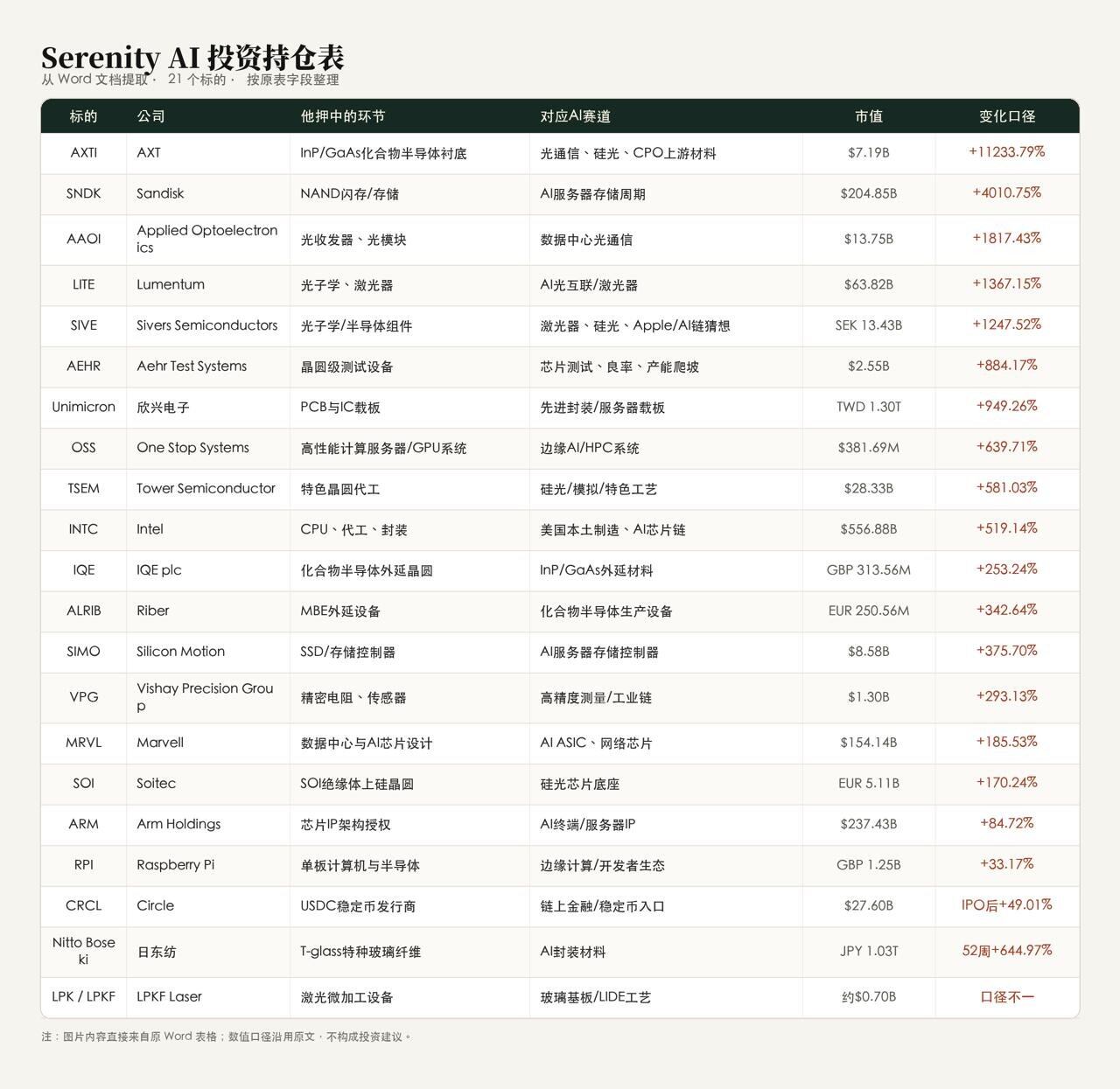
However, what's perhaps even more remarkable than these astonishing profits is that Serenity identified these targets before not only retail investors took notice, but even before institutions entered the market.

When Serenity posted about recommending a particular stock in the past, he was mostly met with skepticism. Only months or even a year later, when investors saw the exaggerated performance of the stock, would they belatedly realize he was right. Stocks like RPI, AXTI, SIVE, and others are vivid examples. When such cases repeatedly occurred, the Serenity account naturally became a must-read for retail investors, Wall Street, and even Silicon Valley investors.

Why is Serenity always ahead of the market and able to unearth those undervalued stocks? The secret lies in his self-constructed investment theory: the Supply Chain Bottleneck (Chokepoint) theory.

The Bottleneck (Chokepoint) Investment Method

Chokepoint is the highest-frequency word appearing in Serenity's posts and is also his core investment logic.

AI is undoubtedly the world's dominant narrative today, but the AI industry suffers from a clear supply-demand imbalance. On one hand, internet giants are spending lavishly on an "arms race" for AI infrastructure; on the other, the supply side is clearly insufficient, with even Nvidia's orders entering a "rationing system." Therefore, capital has also realized that the current stage of AI development has little to do with downstream applications but everything to do with the upstream supply chain. Whoever occupies a critical position in the AI supply chain, whoever is irreplaceable, deserves to be repriced.

Thus, over the past few months, the market's hype around the AI industry has deconstructed the supply chain step by step, starting from the initial GPU computing power. The second layer includes storage, data centers, and optical modules, further down to power, materials, networking equipment, etc. This layered deconstruction of the AI supply chain to find the key "chokepoint" companies in each segment is essentially Serenity's bottleneck investment method, except he acted far ahead of most retail investors and institutions.

On March 31st, Serenity used an analogy while calling AXTI to vividly explain what a bottleneck point is. He used the Strait of Hormuz as a comparison. Over 20% of the world's crude oil supply passes through the Strait of Hormuz, making it a critical chokepoint in global energy trade. AXTI's relationship to AI optical module companies is similar to the Strait of Hormuz's relationship to global energy trade.
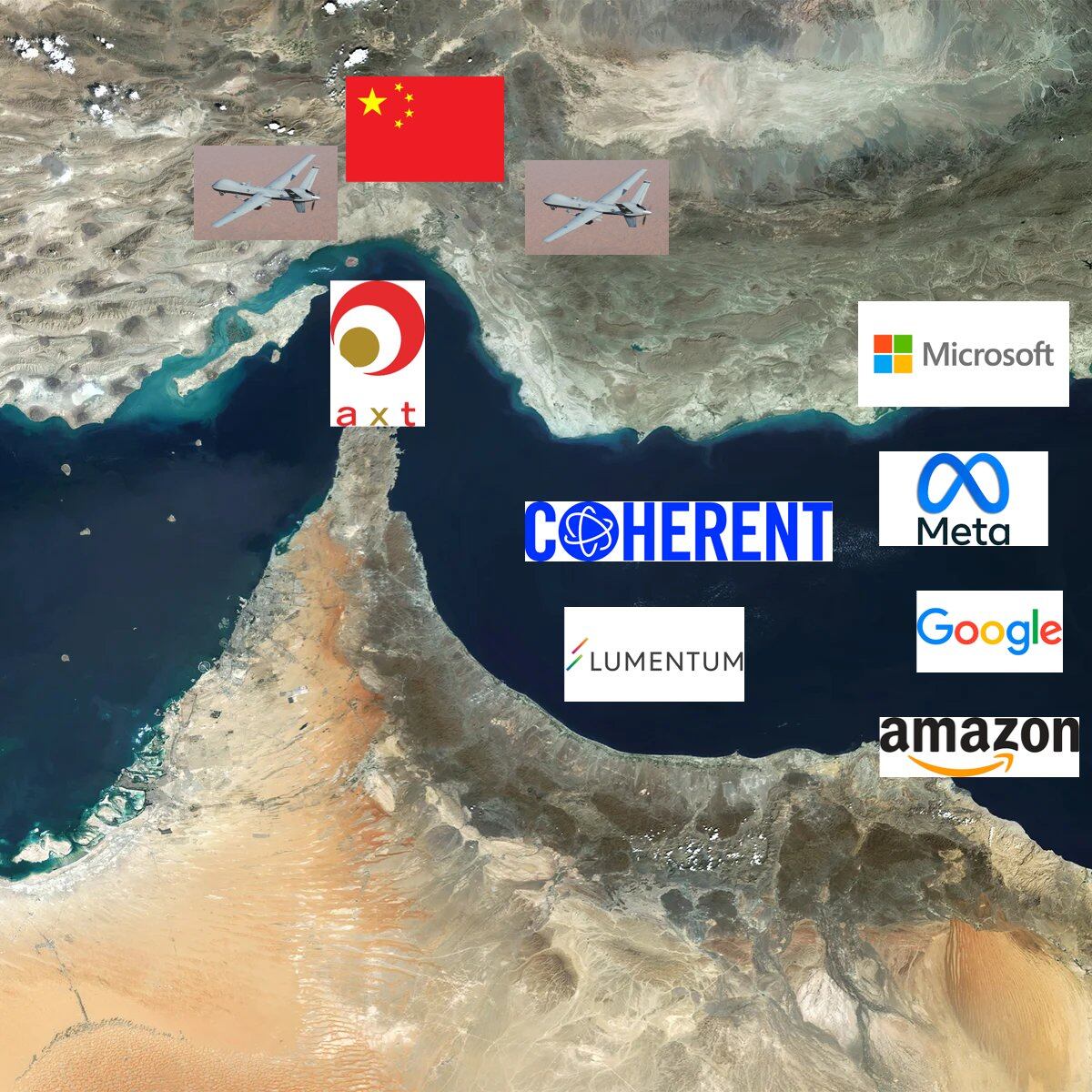
The essence of Serenity's ability to achieve excess returns still comes from market information asymmetry, using sharp thinking and foresight to seek out the "hidden champions" on the AI industry chain that are not fully priced. These companies are not as glamorous as giants like Nvidia, Micron, or SK Hynix, but they are small-scale monopolies whose shortage or shutdown could cause earthquakes in the trillion-dollar downstream AI industry.

For example, when Serenity called IQE in February-March this year, he repeatedly stated that both IQE and Landmark are major photonic chip epitaxial wafer foundries, but IQE's total capacity is much larger than Landmark's. At that time, Landmark's market cap was about $3.8 billion, while IQE's was only $135 million.

It's worth mentioning that Serenity is not superhuman either, knowing every aspect of the AI industry chain in detail. He often mentions using AI to assist in AI supply chain research, including deconstructing industry chains, digging up suppliers, and debating viewpoints with AI.

True Legend or "Photoshop Master"?

In the investment field, deifying any individual is extremely dangerous. Serenity's success rate is not 100%. Stocks he recommended earlier this year, such as CPSH and INFQ, also experienced significant pullbacks in February and March. Rather than copying his portfolio outright, retail investors and traders should learn his research framework and mindset, thereby forming their own system and ultimately finding their own Alpha.

Serenity is also a highly idealistic and mysterious figure. None of his publicly available personal information has third-party verification, and no one even knows if he is male or female. The only private information he has revealed is that he lives an international digital nomad life, currently in Japan learning Japanese. He also lived in Mainland China for a short period in the past, so he knows some Chinese, and frequently travels to countries like South Korea, the UK, Singapore, and Canada, claiming to have visited at least 28 countries.

Because Serenity only shares return rates and not actual portfolio positions, some have questioned whether his profits might be fabricated. Serenity's response to this is: "The reason for not disclosing specific amounts is that the amount is not important." He just wants to prove that users can also find purely valuable information from free posts, and that market return rates expressed as percentages are most suitable for validating a thesis. He also stated that he deeply despises traditional KOLs who flaunt money, luxury watches, cars, and private jets.

Opposing paywalls or paid communities is also a distinct characteristic of Serenity. Serenity publishes most of his core market research entirely on X, accessible for free by anyone, with no barriers, no paid communities. His account subscription costs only $1/month, and the content is merely an Excel spreadsheet. Even without subscribing, it does not affect understanding his core viewpoints in the slightest.

In this world where "all hustle and bustle is for profit," Serenity's behavior—which appears not to seek fame or fortune, generously sharing his market views—seems unnaturally altruistic. Therefore, some speculate that Serenity is merely using his influence to manipulate the prices of these low-market-cap stocks, building positions at low levels, pumping them up, and then selling high, leaving only a tiny "ant-sized" position in his account to fool followers, especially since he only ever reveals return rates, not real profits.

This has a flavor of "measuring the gentleman's heart with a小人's (villain's) mind." Of course, Serenity has his own gentlemanly explanation.

He believes the stock market is a positive-sum game. His goal is to share critical information before institutions "buy in," allowing retail investors to also get on the right path and reap profits. Especially when he sees they don't have to pay over $2000 to join any paid community to see the "wealth code," he feels proud, claiming he is changing the old model. For instance, he said if he didn't tell the IQE story, an institution like AVGO would simply quietly acquire IQE outright, and retail investors wouldn't get any profit at all.

Which version is the truth? Is Serenity someone who truly sees through the AI supply chain, or a top-tier player harvesting traders under the guise of the "bottleneck narrative"? We currently do not know. Whether Serenity will ultimately become a legend or a bubble, we can only leave that for time to answer.


Related Questions

QWhat is Serenity's reported annual investment return for the current year, according to the article?

AAccording to the article, Serenity's reported investment return for the year is 3840.39%.

QWhat is Serenity's primary investment strategy or theory, as described in the article?

ASerenity's primary investment strategy is the 'Chokepoint' or 'Supply Chain Bottleneck' investment theory. It involves identifying critical, undervalued companies in the AI supply chain that hold monopolistic or bottleneck positions, similar to strategic points like the Strait of Hormuz for oil trade.

QWhich stock is mentioned as Serenity's most legendary trade, with a profit exceeding 10,000%?

AThe stock mentioned as Serenity's most legendary trade, with a profit exceeding 10,000%, is AXTI.

QWhat are the main points of skepticism or criticism mentioned about Serenity's claims in the article?

AThe main points of skepticism are: 1) Serenity only shows percentage returns and not actual portfolio values or real-time trades, leading some to question if the returns are fabricated. 2) There is speculation that he might be using his influence to manipulate the price of low-market-cap stocks by buying low, promoting them, and selling high, leaving only a small 'ant position' for show.

QHow does the article describe Serenity's approach to sharing his investment research with the public?

AThe article describes Serenity's approach as highly transparent and anti-paywall. He shares his core research and ideas for free on platform X (formerly Twitter). His paid subscription is only $1 per month and provides just an Excel spreadsheet, with the free content being sufficient to understand his key investment theses. He opposes traditional paid communities and aims to give retail investors information before large institutions act.

Related Reads

A Nation Blocks Chips, a Giant Buys a Nuclear Power Plant: Why It's Time to Seriously Consider DeAI

**Title: Great Powers Blockade Chips, Giants Buy Nuclear Plants: Why It's Time to Seriously Consider DeAI** In May 2026, the US closed loopholes for Chinese firms to acquire advanced NVIDIA chips via overseas subsidiaries. That same month, Kenya halted a $1B geothermal data center project involving Microsoft, fearing its immense energy consumption. Meanwhile, Huawei announced mass production of its Ascend AI chip. These disparate events underscore a new reality: the competition for computing power ("compute") has escalated beyond the tech industry, becoming a geopolitical and infrastructural battleground. A new era of oligopoly is forming, with control over the AI stack—from GPU chips (NVIDIA) and cloud platforms (AWS, Azure, Google Cloud) to foundational models (OpenAI, Anthropic)—concentrating in a few Western "AI Octopus" corporations. This centralization creates systemic risks: pricing power and platform lock-in for users, infrastructure fragility, and a widening "compute divide" that threatens to marginalize nations without independent AI capacity. An "AI Iron Curtain" is deepening through export controls. In response, some nations like Saudi Arabia and the UAE are investing heavily to buy compute power, aiming to transition from oil to AI economies. The EU seeks to triple its compute capacity by 2030 to reduce dependency. However, the spending gap is vast, with four US tech giants alone planning ~$750B in AI capex for 2026. The race is increasingly constrained by energy, with AI tasks consuming up to 1000x more power than web searches, pushing firms to even acquire nuclear plants. This landscape is fueling interest in Decentralized AI (DeAI). It proposes a third way: using open protocols to coordinate a global network of idle GPUs, independent developers, and data centers, creating an AI infrastructure without a single controlling entity. Leveraging blockchain and cryptographic verification, DeAI aims to break market concentration, disperse energy demands, reduce geopolitical dependencies, and enhance transparency. While still nascent in performance and stability, DeAI's core promise is not immediate superiority but providing a crucial alternative architecture to resist monopoly, censorship, and centralized power. As specialized AI hardware costs fall and open-source models flourish, the window to build this foundation is open. The very existence of such competition serves as a vital check against the inevitable abuse of concentrated power.

marsbit37m ago

A Nation Blocks Chips, a Giant Buys a Nuclear Power Plant: Why It's Time to Seriously Consider DeAI

marsbit37m ago

Outpoll Review: A Prediction Market Platform Built for Active Traders

Outpoll Review: A Prediction Market Platform Built for Active Traders In recent years, prediction markets have grown from a niche sector to a mainstream arena, attracting billions in trading volume and institutional capital. However, the user experience and tools for traders have not kept pace. Outpoll, a new global prediction market platform, aims to fill this gap by providing enhanced trading infrastructure for active and professional traders. Built on standard prediction market principles, Outpoll allows users to trade on the outcome of specific events. It uses fully collateralized contracts with USDC settlement, charges a competitive 0.1% fee per trade, and provides clear settlement rules upfront to minimize disputes. A key focus for Outpoll is its professional-grade trading tools. The platform supports limit and market orders, as well as take-profit and stop-loss orders for open positions—features uncommon in prediction markets. For automated trading, Outpoll offers comprehensive REST and WebSocket APIs, enabling portfolio management, price arbitrage, and integration with existing tools. The platform also features a creator-led market model, where approved experts and community leaders can create and manage markets for niche topics under platform supervision. Its integrated interface combines news feeds directly with trading functions, allowing users to monitor events and manage positions seamlessly. Outpoll launched with a native Android app (available on Google Play) and plans an iOS version later this year. In summary, Outpoll distinguishes itself with trader-focused tools, practical APIs, transparent and collateralized markets, integrated news, and an expanding creator program. For active traders, its advanced order types and API access alone make it a platform worth watching. Outpoll is now globally accessible via outpoll.com and Google Play.

marsbit46m ago

Outpoll Review: A Prediction Market Platform Built for Active Traders

marsbit46m ago

Bitwise: Crypto Becomes a Contrarian Investment, Three Logics to Understand the Current Market

**Summary** Matt Hougan, Bitwise's CIO, analyzes the current crypto market through three key lenses, arguing it has shifted from a momentum-driven to a contrarian investment. **1) Crypto Becomes a Contrarian Play:** The market is weak, with major assets like Bitcoin and Ethereum down significantly. Capital has moved to hot sectors like AI, leaving crypto as an "unloved" asset class. This transforms crypto investing from trend-following to a test of patience and fundamental analysis. Investors now favor projects with solid fundamentals (e.g., Hyperliquid) over speculative ones. **2) Regulatory Overhang:** The uncertain fate of the U.S. CLARITY Act, a major crypto regulatory framework, is a key headwind. With its passage in 2024 seen as far from guaranteed (estimates range from 30-55%), institutional capital remains on the sidelines, choosing less risky alternatives like AI stocks. The market needs clarity—whether the bill passes or fails—more than any specific outcome to move decisively. **3) Capital Rotates to New Fundamentals:** This cycle differs from past bear markets where money fled to Bitcoin. Now, capital seeks smaller assets with strong use cases. While major cryptos fell in May 2024, tokens like Hyperliquid (+72%), Zcash (+50%), and XLM (+44%) rallied on their specific fundamentals. This rotation confirms the new contrarian, fundamentals-driven logic and signals the bear market may be in its later stages. **Conclusion:** Short-term pressure persists due to regulatory uncertainty and competition from AI narratives. Investing in crypto now requires a contrarian mindset—acting against the crowd and focusing on fundamental value. Patience and targeting high-quality projects based on their merits are essential for capturing long-term gains.

marsbit1h ago

Bitwise: Crypto Becomes a Contrarian Investment, Three Logics to Understand the Current Market

marsbit1h ago

ChatGPT Might Be Disappearing Soon

OpenAI announced at its "Intelligence at Work" event that its coding assistant, Codex, will be fully integrated into the ChatGPT app within weeks. This move marks a strategic shift from a conversational AI (Chat) towards a unified "agentic" platform capable of execution. Codex, originally launched to compete with Anthropic's Claude Code, has grown rapidly to 5 million weekly active users, with 20% being non-developers like analysts and designers. Its enterprise revenue now constitutes 40% of OpenAI's total. The integration is the first step in creating a super-app combining ChatGPT (interface), Codex (execution engine), and the Atlas browser (web access). OpenAI also unveiled new Codex features: specialized Agent plugins for six professional roles, an "Annotations" tool for direct document editing, and a "Sites" function to turn work into shareable web apps. Internally, this reflects a power shift; the Codex team now leads core product strategy. While the ChatGPT brand remains for its vast user base, the platform's future is focused on autonomous agents that perform tasks, not just chat. The article notes that competition with Claude Code pushed OpenAI's development, with Codex competing on cost-effectiveness and accessibility rather than raw coding quality. It concludes that the essence of "ChatGPT" is evolving from a chatbot into an AI agent platform, with the name potentially becoming a legacy symbol of its original function.

marsbit1h ago

ChatGPT Might Be Disappearing Soon

marsbit1h ago

Trading

Spot
Futures
活动图片