The Stablecoin Wars Just Got A New Contender — And This One Has 500,000 Retail Locations

bitcoinistPublished on 2026-06-02Last updated on 2026-06-02

Abstract

MoneyGram, one of the world's largest cross-border payments networks, launched its own branded US dollar stablecoin, MGUSD, on June 2. This marks a strategic shift from relying on third-party stablecoins like USDC to direct control over issuance and reserves. MoneyGram is an 85-year-old mainstream financial institution with 500,000 retail locations and over 50 million annual customers, primarily serving remittance-dependent families globally. Its launch of a native stablecoin, timed with the new US regulatory framework established by the 2026 GENIUS Act, significantly normalizes digital dollar instruments for a broad, non-crypto-native demographic. This move signals the stablecoin economy's convergence with the mainstream global payments industry.

MoneyGram, one of the world’s largest cross-border payments networks, announced on June 2 the launch of MGUSD — a native US dollar stablecoin bearing the company’s own brand and designed to serve as the foundational layer for a growing suite of financial services across its global remittance network, per the company’s official press release.

The move marks a decisive shift in MoneyGram’s stablecoin strategy. Until now the Dallas-based company had built its digital dollar services on third-party infrastructure — primarily Circle’s USDC, deployed through its Stellar Development Foundation partnership to power stablecoin balance features in its consumer app across Colombia and El Salvador. MGUSD changes that equation entirely.

A branded native stablecoin hands MoneyGram direct control over issuance, reserve management, and the yield economics that previously flowed to external issuers.
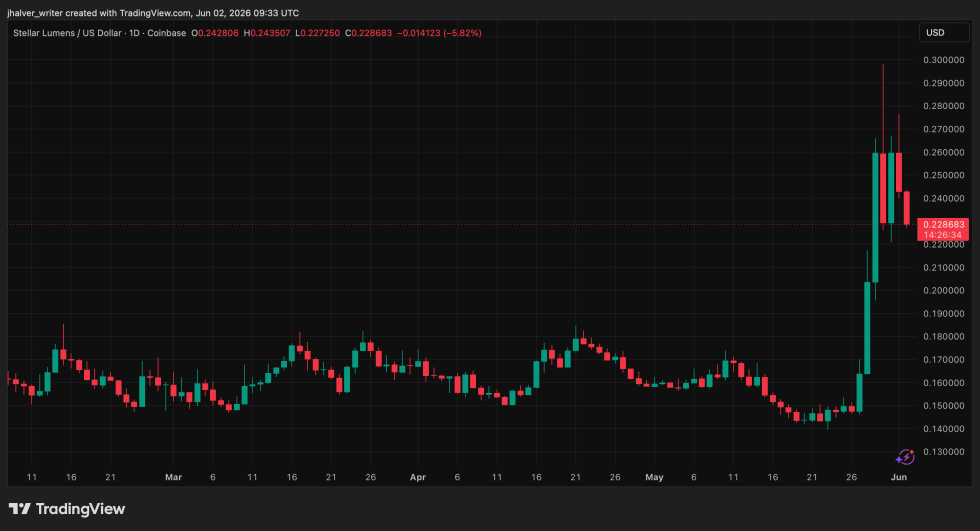
XLM's price trends to the upside on the daily chart. Source: XLMUSD Tradingview

Why This Stablecoin Matters For The Remittance Industry

MoneyGram is not a crypto-native company building a stablecoin for crypto-native users. It is a 85-year-old payments institution operating across more than 200 countries with approximately 500,000 retail locations and over 50 million customers annually — and it just issued its own digital dollar. The distinction is significant. When a company of this scale and regulatory standing launches a native stablecoin, it normalizes the instrument for the exact demographic — remittance-dependent families in Latin America, Africa, and Southeast Asia — that has historically been furthest from crypto adoption.

The timing is deliberate. The GENIUS Act, signed into law earlier in 2026, established the first formal US regulatory framework for stablecoin issuers — a development MoneyGram CEO Anthony Soohoo had publicly described as the guardrails the company needed to scale its digital dollar services confidently. MGUSD is the first major consumer-facing stablecoin launch to arrive squarely within that new regulatory window.

MoneyGram’s infrastructure buildout has been deliberate and sequential — Stellar partnership in 2021, Fireblocks treasury integration in December 2025, Tempo blockchain validator status in May 2026, and now a proprietary stablecoin. Each step has reduced its dependence on external partners and deepened its control over the digital payment stack.

This development marks a pivotal moment for the nascent sector’s convergence with mainstream global finance. A remittance giant issuing its own stablecoin — backed by decades of compliance infrastructure and half a million cash locations worldwide — is the clearest signal yet that the stablecoin economy is no longer a crypto industry story. It is a global payments industry story.

Cover image from Grok, XLM chart from Tradingview

Related Questions

QWhat is MGUSD and which company launched it?

AMGUSD is a native US dollar stablecoin launched by MoneyGram, one of the world's largest cross-border payments networks.

QHow does launching its own stablecoin (MGUSD) change MoneyGram's strategy compared to before?

APreviously, MoneyGram built its digital dollar services on third-party infrastructure like Circle's USDC. Launching its own branded stablecoin, MGUSD, gives MoneyGram direct control over issuance, reserve management, and yield economics, reducing dependence on external partners.

QWhy is MoneyGram's launch of a stablecoin significant for the remittance industry and crypto adoption?

AMoneyGram is an 85-year-old mainstream payments institution with a vast global network. Its launch of a native stablecoin normalizes the instrument for demographics like remittance-dependent families in Latin America, Africa, and Southeast Asia, who have been historically distant from crypto adoption.

QWhat recent US regulatory development is mentioned as enabling MoneyGram's stablecoin launch?

AThe GENIUS Act, signed into law earlier in 2026, established the first formal US regulatory framework for stablecoin issuers. MoneyGram's CEO stated this provided the necessary guardrails to scale its digital dollar services confidently.

QWhat key steps has MoneyGram taken in its infrastructure buildout leading to the MGUSD launch?

AMoneyGram's deliberate steps include: a Stellar partnership in 2021, Fireblocks treasury integration in December 2025, achieving Tempo blockchain validator status in May 2026, and finally launching its proprietary stablecoin, MGUSD.

Related Reads

CPU, Quietly Returning to the Center of the AI Computing Power Stage

Over the past three years, AI computing power narratives have been dominated by GPUs. However, starting in 2026, this story began to shift. While training large models remains GPU-intensive, the rapid growth of inference and AI agent workloads, which require high levels of task orchestration, concurrency, and data flow management, has highlighted a renewed critical role for CPUs. These are tasks GPUs are not designed to handle. Intel's recent launch of the Xeon 6+ processor, built on its Intel 18A process and featuring up to 288 efficiency cores (E-cores), exemplifies this strategic pivot. It is positioned not as a mere companion to GPUs but as the essential "control plane" for AI infrastructure, optimized for high-density, energy-efficient, and high-throughput workloads characteristic of AI agents and inference. This "CPU resurgence" is not about CPUs outperforming GPUs in raw computation. It reflects a systemic bottleneck: as AI scales from training single models to deploying countless intelligent agents, the demand for coordination and data handling surges. Major cloud providers are also developing their own high-density ARM-based server CPUs for similar workloads. However, Intel's success with this strategy faces significant challenges. Competition includes NVIDIA's integrated CPU-GPU solutions, the expanding adoption of cloud vendors' in-house ARM CPUs, and the crucial market test of Intel's 18A manufacturing process against rivals like TSMC's N2. In conclusion, CPUs are indeed reclaiming a central, though redefined, role in AI compute—managing the complex orchestration that enables massive-scale AI deployment. While the trend is clear, which company will ultimately lead this CPU resurgence remains an open question to be decided in the data centers of 2027 and beyond.

marsbit14m ago

CPU, Quietly Returning to the Center of the AI Computing Power Stage

marsbit14m ago

After Collaborating with 35+ DeFi Projects, Pink Brains Discovers the New 2026 KOL Marketing Rules

After collaborating with over 35 leading DeFi projects on marketing over three years, Pink Brains identifies a key shift for effective marketing in 2026: prioritizing the user journey over traditional campaign tactics. The most effective marketing mirrors how users actually behave—starting with discovery on social platforms like X (formerly Twitter), followed by data-driven verification on sites like DefiLlama, and finally, participation with small test funds. Success hinges on genuine, verifiable mechanisms, not just marketing hype. Current user interest centers on several key themes: new DeFi trends (RWA, perps, crypto x AI), meaningful airdrops requiring real contributions, real yield from protocol revenue, and tokens with value capture mechanisms directly tied to product usage. Case studies like Hyperliquid's HYPE (with its aggressive buyback program) and Venice's VVV (linking demand to AI compute) exemplify how strong tokenomics foster user retention. New trading venues like prediction markets, collectibles platforms, and GambleFi are also gaining traction, driven by verifiable activity. The article outlines common mistakes in DeFi KOL marketing, such as using creators unfamiliar with the product, generic messaging, or relying on a few top-tier KOLs. Instead, effective strategies align with different KOL types—educators, content creators, airdrop hunters, and niche experts—for various stages of the user journey. Ultimately, long-term user retention depends on a combination of a genuinely useful product, responsive support, community-aligned tokenomics, and strategic community building. The core takeaway is that sustainable growth stems from products whose value is validated by data and real-world utility, not just promotional efforts.

marsbit32m ago

After Collaborating with 35+ DeFi Projects, Pink Brains Discovers the New 2026 KOL Marketing Rules

marsbit32m ago

Trading

Spot
Futures

Hot Articles

How to Buy ONE

Welcome to HTX.com! We've made purchasing Harmony (ONE) simple and convenient. Follow our step-by-step guide to embark on your crypto journey.Step 1: Create Your HTX AccountUse your email or phone number to sign up for a free account on HTX. Experience a hassle-free registration journey and unlock all features.Get My AccountStep 2: Go to Buy Crypto and Choose Your Payment MethodCredit/Debit Card: Use your Visa or Mastercard to buy Harmony (ONE) instantly.Balance: Use funds from your HTX account balance to trade seamlessly.Third Parties: We've added popular payment methods such as Google Pay and Apple Pay to enhance convenience.P2P: Trade directly with other users on HTX.Over-the-Counter (OTC): We offer tailor-made services and competitive exchange rates for traders.Step 3: Store Your Harmony (ONE)After purchasing your Harmony (ONE), store it in your HTX account. Alternatively, you can send it elsewhere via blockchain transfer or use it to trade other cryptocurrencies.Step 4: Trade Harmony (ONE)Easily trade Harmony (ONE) on HTX's spot market. Simply access your account, select your trading pair, execute your trades, and monitor in real-time. We offer a user-friendly experience for both beginners and seasoned traders.

3.7k Total ViewsPublished 2024.03.29Updated 2026.06.02

How to Buy ONE

Discussions

Welcome to the HTX Community. Here, you can stay informed about the latest platform developments and gain access to professional market insights. Users' opinions on the price of ONE (ONE) are presented below.

活动图片