The Most Bullish Bitcoin Signal That No One Is Talking About Just Arrived

bitcoinistPublished on 2026-03-26Last updated on 2026-03-26

Abstract

A crypto analyst, Crypto Patel, has identified a highly bullish signal for Bitcoin (BTC) that has gone largely unmentioned: Bitcoin has recorded its longest period of negative correlation with the S&P 500 since 2020. This decoupling suggests Bitcoin is no longer trading like a risk asset. Historically, such a divergence has preceded a powerful upward rally. This signal arrives as the market reset with the liquidation of roughly 70,000 BTC in Open Interest, wiping out excess leverage. While another expert, Lyvo, warns against premature bullishness, Patel maintains a highly optimistic long-term outlook. He projects a potential cycle bottom around $35,000-$50,000 in late 2026, followed by a rally to a cycle peak between $500,000 and $600,000 by late 2029.

A crypto market expert has reported that Bitcoin (BTC) has just formed its most bullish signal amid the ongoing bear market trend. According to the analyst, this technical signal could be the catalyst for a major bullish turnaround, potentially propelling Bitcoin’s price to explosive levels.

Analyst Reveals Bitcoin’s Most Bullish Signal Yet

The Bitcoin price has surged back above $71,000 after briefly declining near $68,000 just last week. While the market continues to experience fluctuating prices and short-term relief bounces, which many experts identify as potential fake outs, technical analyst Crypto Patel has shared a new signal that could lead to a full bullish reversal for BTC.

In a Monday X post, the analyst revealed that BTC has formed an incredibly bullish signal that almost no one in the market is talking about. Sharing a price chart, Crypto Patel noted that BTC has recorded its longest negative correlation with the S&P 500 since 2020. He explained the significance of this correlation, suggesting that Bitcoin is no longer trading like a risk asset.

Crypto Patel also revealed that the roughly 70,000 BTC in Open Interest was recently wiped out during a single liquidation event. This reset market positioning back to April 2025 levels, effectively clearing excess leverage from the system.
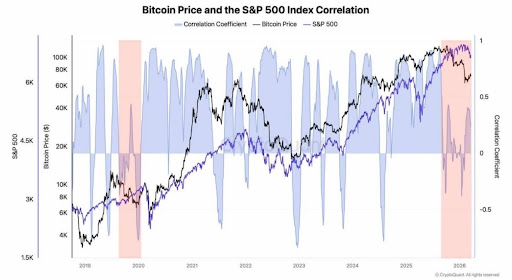
Source: Chart from Crypto Patel on X

Notably, the analyst emphasized that the last time Bitcoin decoupled from the S&P 500, it was followed by a powerful upward rally. Based on this historical trend, his analysis points to a comparable price surge in Bitcoin during this cycle, potentially pushing the cryptocurrency out of its ongoing bear market.

While Crypto Patel maintains a broadly bullish outlook for BTC, other analysts remain significantly bearish. Market expert Lyvo has warned traders and investors on X against turning too quickly bullish after any major Bitcoin-related news.

From a psychological standpoint, he explained that many participants have already accepted the idea that Bitcoin is in a bear market. He attributed this sentiment to the formation of lower highs and continued price declines, which have gradually changed retail sentiment. Despite the cautious outlook, Lyvo acknowledged that the market could still rebound from its current downtrend. However, he also noted that if Bitcoin continues dumping, it could push the market closer to its next bullish phase.

Analyst Shares BTC Long-Term Price Forecast

For his long-term outlook, Crypto Patel has projected that Bitcoin could reach an ambitious price target of $600,000 by 2029. He has shared a potential roadmap for achieving this milestone, using past cycle trends to support his bold forecast.

According to the analyst, BTC surged to an ATH of about $68,991 in the last cycle before crashing roughly 77% to $15,470, marking a final bottom. He believes a similar trend could unfold this cycle, noting that Bitcoin hit a peak above $126,000 in October 2025 and could form its next cycle bottom around the same month in 2026.

He further highlighted that the 0.5-0.618 Fibonacci Retracement level near $50,000-$35,000 on the price chart could be a major accumulation zone once BTC bottoms. Following this potential price floor, the analyst expects Bitcoin to stage a powerful rally and potentially hit a cycle peak between $500,000 and $600,000 sometime between September and October 2029.

BTC trading at $71,427 on the 1D chart | Source: BTCUSDT on Tradingview.com

Related Questions

QWhat is the most bullish Bitcoin signal that the analyst Crypto Patel reported, and why is it significant?

AThe most bullish signal is Bitcoin recording its longest negative correlation with the S&P 500 since 2020. This is significant because it suggests Bitcoin is no longer trading like a risk asset, and historically, such a decoupling has been followed by a powerful upward rally.

QWhat event helped reset the Bitcoin market positioning back to April 2025 levels, according to the article?

AApproximately 70,000 BTC in Open Interest was wiped out during a single liquidation event, which reset market positioning back to April 2025 levels and cleared excess leverage from the system.

QWhat is the long-term price target for Bitcoin projected by Crypto Patel, and by when does he expect it to be reached?

ACrypto Patel projects that Bitcoin could reach a price target of $600,000 by 2029.

QAccording to analyst Lyvo, why have many market participants accepted the idea that Bitcoin is in a bear market?

ALyvo attributes this sentiment to the formation of lower highs and continued price declines, which have gradually changed retail sentiment.

QWhat does Crypto Patel identify as a potential major accumulation zone for Bitcoin after it forms its next cycle bottom?

AHe identifies the 0.5-0.618 Fibonacci Retracement level near $50,000-$35,000 as a major accumulation zone.

Related Reads

The Waged Worker Driven to Poverty by AI Subscriptions

"AI Membership: The Hidden Cost Pushing Workers Toward 'Poverty'" The widespread corporate push for AI adoption is creating a hidden financial burden for employees. Companies, from giants like Alibaba to small firms, are mandating AI use, often tying token consumption to KPIs, but frequently refuse to cover the costs. Workers are forced to pay for subscriptions out of pocket to stay competitive and avoid being replaced. Front-end developer Long Shen spends up to 2000 RMB monthly on tools like Cursor and ChatGPT Plus, seeing it as a necessary 3% salary investment to handle 90% of his coding tasks. While it boosted his performance and led to promotions, he now faces idle time at work, pretending to be busy. Designer Peng Peng navigates strict company firewalls by using personal devices and accounts for AI image generation tools like Midjourney, spending hundreds monthly without reimbursement, while her boss demands faster, more numerous revisions. The pressure creates workplace anxiety and suspicion. Programmer Li Huahua, after a friend's experience of raised KPIs following AI success, fears being branded a "traitor" for using it yet worries about falling behind if she doesn't. The dynamic allows management to demand results without understanding the tools or covering expenses, treating employees like AI "agents." While some, like entrepreneur Jin Tu, find high value in paid AI, building entire systems and winning competitions, for most, it's a trap. Free tools like Kimi and Doubao are introducing fees, closing off alternatives. The initial efficiency gains individual advantage, but as AI becomes ubiquitous, the personal edge disappears, workloads increase, and a cycle of dependency begins. Workers like Long Shen realize they cannot maintain AI-generated code without AI, making stopping harder than continuing to pay. The tool promising liberation is instead becoming a compulsory, costly chain in the modern workplace.

marsbit32m ago

The Waged Worker Driven to Poverty by AI Subscriptions

marsbit32m ago

SK Hynix's Trillion-Won Empire: The Successors

"SK Hynix's Trillion-Won Empire and Its Heirs" explores the unconventional succession narrative within SK Group, South Korea's second-largest conglomerate, following SK Hynix's dramatic market rise. Unlike traditional chaebol scripts prioritizing the eldest son, ownership, and political marriages, Chairman Choi Tae-won's three children from his first marriage are charting distinct paths. The eldest daughter, Choi Yun-jeong, is considered the most visible candidate. With a background in biology, consulting, and a PhD, she holds executive roles at SK Bioscience and SK Inc.'s growth strategy unit, focusing on biopharma and new businesses. Her marriage is to an AI infrastructure entrepreneur, not a traditional chaebol heir. The second daughter, Choi Min-jeong, took a unique route by voluntarily serving as a South Korean naval officer, including a tour in the Gulf of Aden. She later worked on policy and strategy for SK Hynix in Washington D.C. before co-founding an AI-driven healthcare startup in San Francisco. She married a former U.S. Marine Corps officer, connecting the family to U.S. defense and policy networks. The son, Choi In-geun, who has Type 1 diabetes, followed a more classic preparatory path with a physics degree and a stint at SK E&S but left to join McKinsey's Seoul office. He remains publicly silent and holds no SK shares, defying the traditional "crown prince" archetype. Their paths unfold against the backdrop of their parents' high-profile, contentious divorce and a record-setting asset division lawsuit. The article argues that as SK Hynix becomes a geopolitical asset in the AI era, the conventional rules of chaebol inheritance are changing. The heirs are being groomed not simply to take over, but to navigate a complex global landscape defined by AI, biotech, geopolitics, and policy, forging legitimacy through their own expertise and networks rather than birth order alone.

marsbit41m ago

SK Hynix's Trillion-Won Empire: The Successors

marsbit41m ago

BitMart Research Institute Weekly Highlights: A Comprehensive Review of Macro Environment, Crude Oil, AI Tech Stocks, and Crypto Market

**Weekly Market Review: Macro, Oil, AI Tech Stocks & Crypto Market** **Macroeconomic & Traditional Finance** The April U.S. Non-Farm Payrolls report of 115K new jobs exceeded expectations, but the data's quality was questioned. Growth was heavily concentrated in healthcare, while other sectors contracted, and manufacturing employment turned negative. A statistical model accounted for a large portion of the gains, conflicting with household survey data showing a loss of 226K jobs. Meanwhile, AI's impact on jobs is emerging, with information sector roles declining, though overall unemployment remains at ~4.3%. Oil prices hovered near $100 per barrel. Global oil buffer inventories have drawn down significantly, supporting prices, but high costs are suppressing demand. China's recent reduction in crude imports acted as a market stabilizer. Geopolitically, the U.S. and Iran are likely to reach a tentative agreement to keep the Strait of Hormuz open and avoid price spikes. For AI tech stocks, short-term prospects are mixed. A potential SpaceX IPO in June could pressure current index heavyweights like Nvidia, while smaller components might benefit. The mid-term focus shifts to Q2 earnings, emphasizing AI's return on investment. Long-term risks include potential election policy shifts and massive IPOs from companies like OpenAI, which could test the sector's sustainability. **Crypto Market & Ecosystem** Crypto markets rose moderately, with BTC climbing from ~$77K to ~$82K, driven by improved risk sentiment. Spot trading volumes remain low, but buying pressure is evident. ETF inflows continued (~$791M last week). However, institutional purchases of BTC and ETH were more modest than expected. The derivatives market shows lingering bearish bets, particularly on alts and ETH. A key trend is the "dual-track" model where projects pursue public listings for traditional funding while also building their own blockchains/tokens to capture crypto liquidity, as seen with Circle's ARC chain. Stablecoins and institutional chains present significant future opportunities. *Disclaimer: This is market analysis, not investment advice.*

marsbit1h ago

BitMart Research Institute Weekly Highlights: A Comprehensive Review of Macro Environment, Crude Oil, AI Tech Stocks, and Crypto Market

marsbit1h ago

Trading

Spot
Futures

Hot Articles

What is $BITCOIN

DIGITAL GOLD ($BITCOIN): A Comprehensive Analysis Introduction to DIGITAL GOLD ($BITCOIN) DIGITAL GOLD ($BITCOIN) is a blockchain-based project operating on the Solana network, which aims to combine the characteristics of traditional precious metals with the innovation of decentralized technologies. While it shares a name with Bitcoin, often referred to as “digital gold” due to its perception as a store of value, DIGITAL GOLD is a separate token designed to create a unique ecosystem within the Web3 landscape. Its goal is to position itself as a viable alternative digital asset, although specifics regarding its applications and functionalities are still developing. What is DIGITAL GOLD ($BITCOIN)? DIGITAL GOLD ($BITCOIN) is a cryptocurrency token explicitly designed for use on the Solana blockchain. In contrast to Bitcoin, which provides a widely recognized value storage role, this token appears to focus on broader applications and characteristics. Notable aspects include: Blockchain Infrastructure: The token is built on the Solana blockchain, known for its capacity to handle high-speed and low-cost transactions. Supply Dynamics: DIGITAL GOLD has a maximum supply capped at 100 quadrillion tokens (100P $BITCOIN), although details regarding its circulating supply are currently undisclosed. Utility: While precise functionalities are not explicitly outlined, there are indications that the token could be utilized for various applications, potentially involving decentralized applications (dApps) or asset tokenization strategies. Who is the Creator of DIGITAL GOLD ($BITCOIN)? At present, the identity of the creators and development team behind DIGITAL GOLD ($BITCOIN) remains unknown. This situation is typical among many innovative projects within the blockchain space, particularly those aligning with decentralized finance and meme coin phenomena. While such anonymity may foster a community-driven culture, it intensifies concerns about governance and accountability. Who are the Investors of DIGITAL GOLD ($BITCOIN)? The available information indicates that DIGITAL GOLD ($BITCOIN) does not have any known institutional backers or prominent venture capital investments. The project seems to operate on a peer-to-peer model focused on community support and adoption rather than traditional funding routes. Its activity and liquidity are primarily situated on decentralized exchanges (DEXs), such as PumpSwap, rather than established centralized trading platforms, further highlighting its grassroots approach. How DIGITAL GOLD ($BITCOIN) Works The operational mechanics of DIGITAL GOLD ($BITCOIN) can be elaborated on based on its blockchain design and network attributes: Consensus Mechanism: By leveraging Solana’s unique proof-of-history (PoH) combined with a proof-of-stake (PoS) model, the project ensures efficient transaction validation contributing to the network's high performance. Tokenomics: While specific deflationary mechanisms have not been extensively detailed, the vast maximum token supply implies that it may cater to microtransactions or niche use cases that are still to be defined. Interoperability: There exists the potential for integration with Solana’s broader ecosystem, including various decentralized finance (DeFi) platforms. However, the details regarding specific integrations remain unspecified. Timeline of Key Events Here is a timeline that highlights significant milestones concerning DIGITAL GOLD ($BITCOIN): 2023: The initial deployment of the token occurs on the Solana blockchain, marked by its contract address. 2024: DIGITAL GOLD gains visibility as it becomes available for trading on decentralized exchanges like PumpSwap, allowing users to trade it against SOL. 2025: The project witnesses sporadic trading activity and potential interest in community-led engagements, although no noteworthy partnerships or technical advancements have been documented as of yet. Critical Analysis Strengths Scalability: The underlying Solana infrastructure supports high transaction volumes, which could enhance the utility of $BITCOIN in various transaction scenarios. Accessibility: The potential low trading price per token could attract retail investors, facilitating wider participation due to fractional ownership opportunities. Risks Lack of Transparency: The absence of publicly known backers, developers, or an audit process may yield skepticism regarding the project's sustainability and trustworthiness. Market Volatility: The trading activity is heavily reliant on speculative behavior, which can result in significant price volatility and uncertainty for investors. Conclusion DIGITAL GOLD ($BITCOIN) emerges as an intriguing yet ambiguous project within the rapidly evolving Solana ecosystem. While it attempts to leverage the “digital gold” narrative, its departure from Bitcoin's established role as a store of value underscores the need for a clearer differentiation of its intended utility and governance structure. Future acceptance and adoption will likely depend on addressing the current opacity and defining its operational and economic strategies more explicitly. Note: This report encompasses synthesised information available as of October 2023, and developments may have transpired beyond the research period.

363 Total ViewsPublished 2025.05.13Updated 2025.05.13

What is $BITCOIN

Discussions

Welcome to the HTX Community. Here, you can stay informed about the latest platform developments and gain access to professional market insights. Users' opinions on the price of BTC (BTC) are presented below.

活动图片















