The Midlife Crisis of Crypto GPs: No PMF, No Next Check from LPs

marsbitPublished on 2026-06-01Last updated on 2026-06-01

Abstract

The article "The Midlife Crisis of Crypto GPs: No PMF, No Next LP Check" analyzes the shifting crypto fundraising landscape. It argues the era of selling grand visions to LPs is over; GPs must now offer products with clear Product-Market Fit (PMF). The author categorizes crypto fundraising products into three types: Primary (VC funds), Liquid (trading strategies), and CeFi/DeFi Native Yield. This summary focuses on the Primary market. Key points include: * **Market Shift:** LPs are impatient, demand immediate returns, and are skeptical of future promises. The "easy money" narrative has faded. * **GP Value Erosion:** LP learning curves have shortened (aided by AI), reducing the value of a GP's basic "crypto knowledge." Superior judgment is now rare. * **Weakened LP Motivations:** Traditional reasons for LPs to invest in crypto VC funds (capturing industry beta, gaining access, leveraging GP judgment) have weakened due to new products like ETFs and increased LP sophistication. * **Surviving in Primary:** The primary market will likely persist for: 1) large funds in endowment mandates treating it as a lottery ticket, 2) family offices/HNWIs using proprietary capital, 3) a few funds with proven recent outperformance, and 4) funds with strong ecosystem "deal-making" capabilities. * **Conclusion:** For most GPs, rebuilding trust requires starting over in a niche, demonstrating alpha-generating ability, or providing concrete value/services to LPs.

Author: Yi.Pineapple

LPs are no longer buying dreams; GPs must sell products. This article will attempt to categorize current crypto fundraising products into three types: Primary, Liquid, and CeFi / DeFi Native Yield. The first part focuses on Primary: after VC blind pools have lost their appeal, who remains at this table, and who must prove themselves anew? The answer is at the end; you can scroll directly to the bottom.

Note: This article aims to provide a landscape overview of the entire crypto fundraising market. The first part mainly categorizes and explains the current market situation from a product perspective, while the second part will analyze more from the perspective of LPs. As the author is primarily based in the Asian market, this article may have a regional bias.

Market Status

Having lost the grand vision, most Crypto GPs who failed to earn excess returns this cycle must get down to earth and launch a product with PMF. They must either prove they still have the ability to generate excess returns for LPs through some niche market or help LPs/partners solve specific problems in order to survive.

  • For most GPs, this market has long moved from the stage of "buying a future vision" to the stage of "buying a specific product."
  • LPs have lost patience and no longer want to gaze at the stars and the sea; they want to see something that can make money immediately, right away, and with relative certainty.
  • Crypto LPs have lost trust in the market and are no longer willing to easily believe the "next cycle" narrative (this has been discussed too much and will not be elaborated here). Moreover, many did not make easy money this cycle. Once the way to make money becomes difficult, investment actions tend to become more cautious and conservative.
  • Most traditional LPs have also completed a round of learning and moved past the story-listening stage. The 2020/2021 bull market was the time of peak FOMO. Dollar funds were cheap (Treasury yield close to 0), LPs were still making money relatively easily (on the eve of the economic downturn), and Crypto was in an explosive period (there were many wealth creation myths, and there was still a dream to sell). Back then, many people, even with only a vague understanding of crypto, were willing to make impulsive purchases for the dream; or, for strategic reasons, paid to enter and learn.
  • AI and falling labor costs have also changed the positioning of GPs. The costs for LPs to learn, hire, analyze data, trade, and make small direct investments are all declining. The trend of LPs transforming into GPs is significant. If GPs only offer the vague capability of "I understand crypto," their value will become increasingly precarious.
  • As for the storytelling track, unless they are U.S.-based funds with strong brand power, who, based on their past track records, can still tell stories and visions in specific niches (e.g., a16z leveraging its advantage in the AI sector to talk about crypto * AI, Dragonfly leveraging its investments in Ethena/Polymarket to talk about internet capital markets), there is still an opportunity. In Asia, this positioning is already difficult. After all, to some extent, in both crypto projects and funds, the opportunity to tell stories often goes to those with a "white paper" (a play on words implying Western or native English speakers have an advantage).

Product Overview

This article categorizes crypto fundraising products into three major types for discussion: Primary, Liquid, and CeFi / DeFi Native Yield (Note: This categorization is not entirely precise; there are some blurred lines between the three). (*This time, only Primary is covered)

Primary VC:

In terms of transparency, they can be roughly divided into blind pools and those with clear pipelines.

In terms of liquidity, they can be roughly divided into primary and primary-secondary.
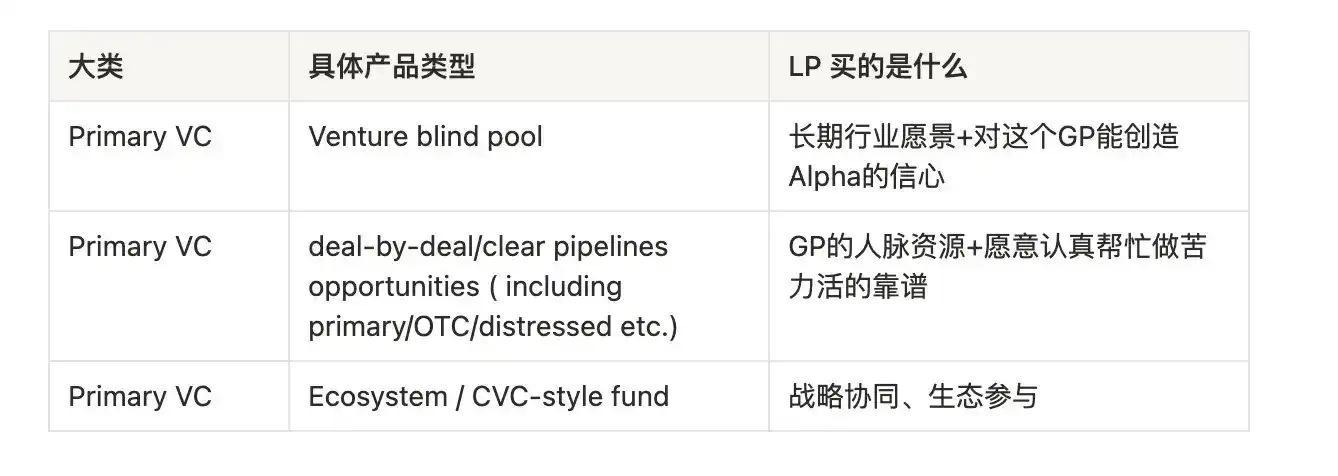
Liquid:

In terms of source of returns, roughly divided into alpha-focused (buying GP's personal ability) and beta-focused (buying industry trends).

In terms of directionality, roughly divided into directional (buying cycle judgments) and market neutral (buying market inefficiencies in immature markets).
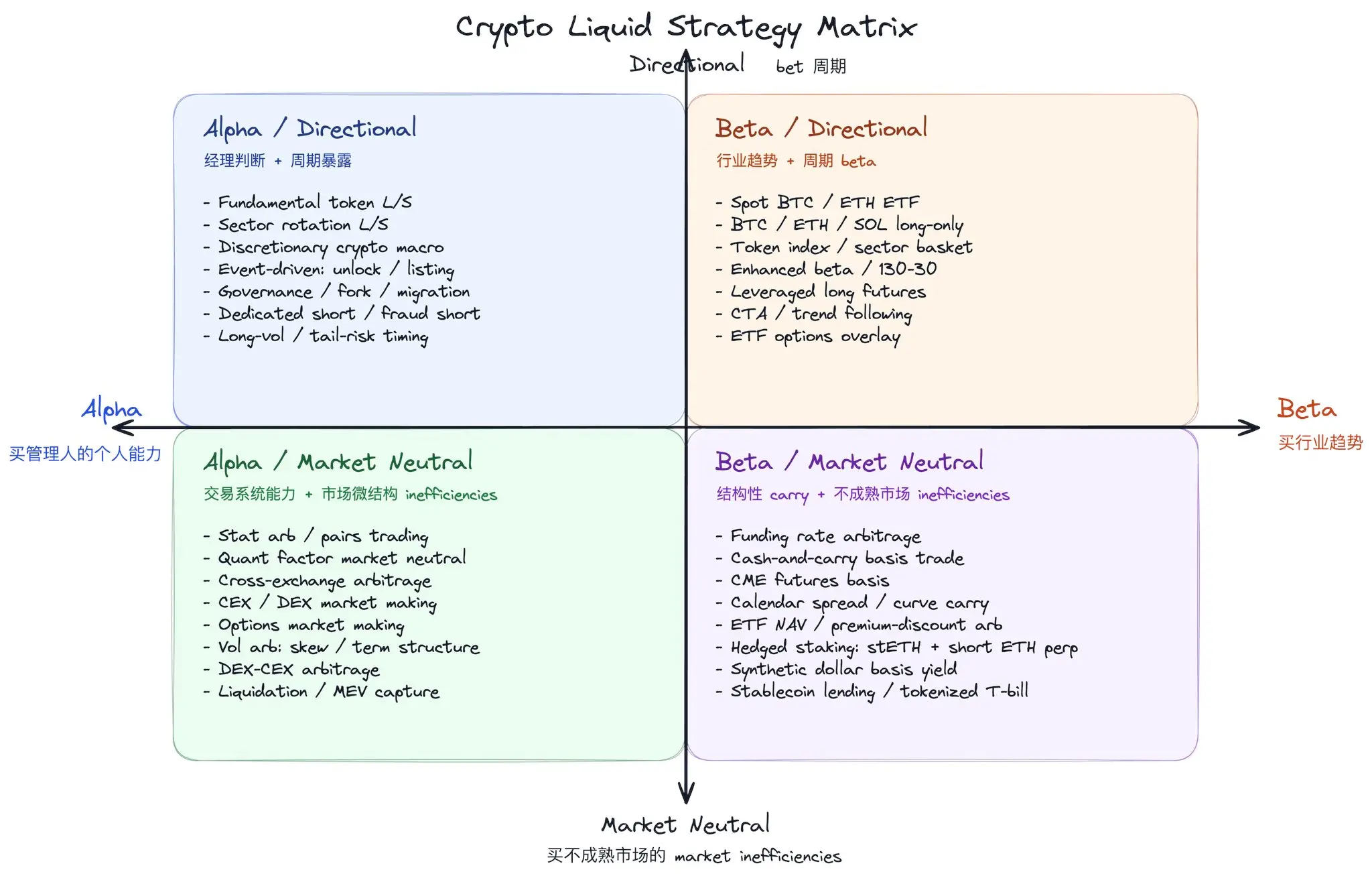
There are many ways to categorize; this is just to provide an idea

CeFi/DeFi Native Yield:

In theory, CeFi/DeFi Native Yield can be viewed as a type of return source within or spanning the crypto primary market and liquid market. The reason for listing it separately is mainly because, from the perspective of TradFi investors, they usually use the framework of traditional financial markets to understand crypto: for example, crypto VC can be understood as a sub-sector under the VC category, and staking/lending yield can be analogized to fixed income or cash management products.

However, crypto indeed contains some玩法 (play/mechanisms) and return mechanisms not entirely corresponding to traditional financial markets, such as mine-trade-sell, points/airdrop farming, protocol incentives, on-chain liquidity mining, etc. These are more like crypto-native issuance, user acquisition, and incentive mechanisms, warranting separate discussion.

Secondly, for many Crypto Native Investors, their earliest entry point and understanding of financial markets were not the traditional equity/bond market, but rather crypto-native scenarios like exchange wealth management products, staking, DeFi lending, LP, points/airdrop farming, basis trade, etc. Therefore, when they look at this part of the yield, they may not necessarily translate it into TradFi's fixed income, cash management, or alternative yield first. Instead, they more naturally understand it from the perspectives of protocol incentives, liquidity provision, token emission, on-chain risk, counterparty risk, and capital efficiency.

For Crypto Native LPs, accessing this part of the yield does not require a GP; at most, they might need a reliable key account manager.

For TradFi LPs, there are now some institutions packaging this part of the yield into fund forms to sell to TradFi LPs.

Primary Market

From the perspective of the entire primary market, crypto VC is just a sub-sector under the VC category. 2021 was a crazy year; whether crypto or non-crypto, the real returns of that vintage are not good. As a cruel fact, LPs have learnt their lessons, tired of any products with ultra-long lock-up periods (traditional VC typically 10 years, crypto VC also often 5-10 years). Because without a hard lock-up, they at least have the chance to withdraw part of their money if circumstances change.

In a sense, crypto is even worse off than traditional VC because the entire vision has collapsed. It is not a new industrial revolution; at most, it's a revolution in financial infrastructure. This judgment is not to disparage crypto—a revolution in financial infrastructure is still very important—but it's not as grand as many imagined in the last bull market. Worse, the market was too immature back then, and many projects were invested in without sufficient due diligence and legal protection. Many failed projects are a combination of investment failure and founders running away. There are already too many articles in the industry discussing the current dire situation; it will not be elaborated here.

Investing in VC is like VC investing in projects—a power-law business, a lottery-like business. As long as there are people willing to buy lottery tickets, this table will not disappear.

Why LPs invested in crypto VC back then, and why these reasons have weakened now

1. Invest to capture the beta of the industry

This reason was especially valid for tradfi LPs. It was true in the early days because market choices were few. For outsiders, on-ramping, buying tokens, going on-chain, using CEXs, and managing wallets were all difficult. They worried about losing private keys and CEXs running away. Investing in VC seemed like a more reliable access point then.

But today, when a traditional LP enters crypto, they have a whole set of choices before them: BTC ETF, ETH ETF, crypto ETP, DAT, custody accounts, SMAs, structured products. More importantly, these products do not require them to learn on-chain operations; they can trade just like they used to buy stocks.

According to CoinShares, the AUM of global digital asset investment products it covered reached about $156.9B in mid-May 2026. This number is not the total industry AUM, only the ETF/ETP/trust/closed-end funds and other listed or quotable products. But it's enough to show that gaining crypto exposure no longer requires investing in VC blind pools.

However, for long-term capital with clear mandates (e.g., endowment, etc.), this reason still applies. For them, to position in an industry often requires allocating to a basket of assets, so there is still likely a 1~2% allocation to Crypto VC.

2. Invest for accessibility

This usually happened to crypto LPs and some tradfi LPs with strategic positioning visions. At that time, many such LPs did not have the energy/time/ability to build their own investment teams, so they gave money to GPs, hoping to get good deal access.

But they later found this reason unstable too. When the market is good, GPs themselves don't have enough allocation, and it's hard for LPs to get truly good access. When the market is bad, competition is not fierce, and if you are willing to engage, getting allocation is not that difficult.

For traditional LPs, access had another meaning: they knew nothing at the time but hoped to enter the ecosystem and gain insider information by investing in crypto-native GPs. This was a strategic investment when there was no clear strategic target. Now the situation has changed. Many traditional LPs have either left for hotter industries like AI or have developed their own internal teams. AI and cheap researchers have narrowed the knowledge gap. New learners still exist, but their learning speed is accelerating, and their paths are multiplying; investing in the primary market with ultra-long lock-ups may not be the optimal choice for them.

3. Invest for judgment

This is the trickiest part. In a market developing extremely fast, unless GPs can continuously self-iterate, the judgment premium will disappear quickly. The rules of the game change every cycle, but it's not easy for people to change themselves (is this another version of "old habits die hard"?).

We must face a cruel reality: most GPs did not prove to LPs in the last cycle that they had superior judgment.

For traditional LPs, part of the purpose of investing in crypto-native GPs back then was to educate themselves and learn the industry through the GP's judgment. This typically happened to two types: one was companies hoping to strategically enter web3, such as large internet companies; the other was sophisticated tradfi investors, such as traditional GPs or family offices, who wanted to do their own web3 direct investment in the future. The learning period is now over, and only a small number of GPs who have truly proven they have superior judgment can remain on their investment lists.
For crypto LPs, they found that rather than betting on a GP's judgment, it's better to lose money themselves. Losing money themselves at least has emotional value, and they don't have to pay management fees.

4. Invest for deal-making ability

From an investment return perspective, deal-making ability mainly manifests as whether it can achieve a good exit for the project ultimately. Ideally, it would be best to help the project achieve healthy growth and ultimately obtain good returns in the secondary market. Otherwise, having the ability to organize the next round of financing is also important (essentially the difference between relying on retail investors or large investors to take over).

However, as a form of financial innovation, Crypto sometimes resembles a large-scale capital game. Sometimes, investment is just a way of exchanging interests, ensuring everyone has aligned interests and can make money together relatively assuredly.

5. Invest for reputation

For some large LPs, the money invested in a single VC is only about 1% of their overall portfolio, negligible. Sometimes they invest in a GP just to be cool (like investing in A16Z). However, most GPs are not in this category.

Who can still stay at the primary table

From a pure capital source perspective, the players most likely to continue staying at the primary table are:

Funds large enough to enter the mandates of endowments/other similar long-term patient capital. These institutions buy crypto VC as lottery tickets, without short-term funding pressure.

FOs, companies, HNW proprietary primary crypto investments using their own money. FOs/HNWs are more likely to do accelerator-like, very early funds; companies are more likely to do direct strategic investments/acquisitions.

The few funds that really made bets/accumulated BTC this cycle and actually generated excess returns for LPs. LPs believe they can win next time.

Funds with clear deal-making ability, possessing ecosystem resources that can be exchanged for interests with LPs.

For other players, if trust has been lost, it might be better to mentally start over and rebuild trust. Prove the ability to generate excess returns for investors again in a niche sector, or provide some specific service/value, and then scale up based on that.


Related Questions

QAccording to the article, what is the main reason why most crypto GPs are now forced to develop a product with Product-Market Fit (PMF)?

AThe main reason is that LPs have lost patience and are no longer willing to invest based on future visions or 'the next cycle' narrative. They now demand immediate, relatively certain profit opportunities or specific problem-solving capabilities. The market has shifted from 'buying a future vision' to 'buying a specific product.'

QInto which three broad categories does the article classify crypto fundraising products?

AThe article classifies crypto fundraising products into three categories: 1. Primary (like VC funds), 2. Liquid (trading-focused products), and 3. CeFi / DeFi Native Yield (products based on staking, lending, airdrop farming, etc.).

QWhat was a key reason for traditional LPs to invest in crypto native GPs in the past that has now significantly weakened?

AA key past reason was 'Invest for accessibility'—LPs lacked the knowledge, team, or operational ability to enter crypto directly and used GPs to access deals and insider information. This has weakened as learning resources improved, internal teams were built, and easier access products (like ETFs) emerged, reducing the necessity of a VC blind pool for exposure.

QWhat does the article identify as 'the most tricky part' regarding the 'Invest for judgement' reason for backing a GP?

AThe most tricky part is that the 'judgement premium' of a GP can disappear quickly in the fast-evolving crypto market unless the GP can continuously self-iterate. The article states the harsh reality that most GPs failed to prove they had superior judgement in the last cycle, eroding LP trust.

QBased on the article, which types of players are most likely to remain at the 'primary' investment table?

A1. Large funds that fit into the mandate of long-term, patient capital like endowments. 2. Family Offices, companies, and High-Net-Worth individuals investing their own money. 3. A few funds that delivered outsized returns in this cycle. 4. Funds with clear ecosystem resources and deal-making ('攒局') capabilities for利益置换 (interest exchange).

Related Reads

SpaceX, OpenAI, Anthropic: The Three AI Giants Racing for IPO, Which One Is Worth Betting On?

SpaceX, OpenAI, and Anthropic are poised for historic IPOs within weeks, potentially raising a combined $180 billion—a sum exceeding the entire internet bubble's fundraising. The hosts of the Limitless Podcast argue this isn't just individual company financing but an unprecedented capital concentration for AI infrastructure, driven by an insatiable need for compute, data centers, power, and chips. SpaceX's IPO is notable for reportedly changing market index rules to allow faster inclusion, potentially funneling trillions in passive retirement funds into its stock, despite its unproven space-based data center business model. In contrast, Anthropic demonstrates explosive growth, with ARR reportedly hitting $45 billion and approaching profitability, fueled by strong enterprise adoption of products like Claude Code. Google's separate $80 billion raise highlights the immense capital pressure, even for giants. The discussion acknowledges bubble risks but leans optimistic. The hosts contend the massive spending is building essential physical infrastructure for the next technological era. A key bottleneck isn't capital but the real-world limits of chip manufacturing and construction speed. As long as demand for AI compute outstrips supply, this investment cycle represents a foundational build-out rather than a purely financial bubble. All three companies are seen as foundational bets on the future, with Anthropic often cited as the most immediately compelling due to its proven revenue trajectory.

marsbit40m ago

SpaceX, OpenAI, Anthropic: The Three AI Giants Racing for IPO, Which One Is Worth Betting On?

marsbit40m ago

From 'Old Guys' to 'New Favorites': How AI Is Revaluing Old Infrastructure from Dell to Nokia?

From "Vintage Tech" to "New AI Darlings": How AI Revalues Old Infrastructure One year ago, tech giants like Dell, Nokia, Cisco, and Western Data were seen as slow-growth, low-valuation stories, far from the AI spotlight dominated by players like Nvidia. Now, these legacy tech stocks are gaining market attention, sparking debate on whether this is genuine industry revaluation or a temporary narrative. As AI moves from model parameters to real-world data centers, the market is recognizing companies with proven delivery and infrastructure capabilities. This shift marks a change in the AI investment thesis: from pure model and GPU focus to the complex systems engineering required for deployment. Companies like Dell, HPE, and Corning are being revalued not for being "sexy" AI innovators, but for their decades of accumulated expertise in supply chains, enterprise delivery, and infrastructure—assets that have become critical in the AI buildout phase. The revaluation is unfolding across three key infrastructure lines: 1. **Servers & System Integration:** Dell and HPE are emerging as crucial system integrators or "general contractors" for AI data centers, translating GPU orders into complete, deployable server racks integrated with power, cooling, and networking. 2. **Networking & Connectivity:** AI's scale demands robust high-speed connections. Corning (fiber optics), Nokia (AI-RAN, 6G), and Cisco (data center switches) are gaining importance for enabling efficient data transfer within and between AI clusters. 3. **Storage:** Beyond high-speed memory (HBM/DRAM), the AI data explosion is driving demand for high-capacity hard drives (HDDs) from companies like Western Digital and Seagate to handle training data, logs, and cold storage cost-effectively. For this revaluation to be substantive and not just a narrative, three criteria are key: 1) Concrete AI-related order and revenue growth (e.g., Dell's AI server sales), 2) Upward revisions to company financial guidance, and 3) Sustainable improvements in profit quality, not just top-line revenue spikes. In essence, AI's transition to a real construction phase is re-pricing "old assets" against "new demand." The opportunity, however, is selective. Only those legacy firms that are demonstrably integrated into the capital expenditure chains of data center and enterprise AI deployment are likely to experience a true "logic re-rating" rather than just a temporary valuation bounce.

marsbit46m ago

From 'Old Guys' to 'New Favorites': How AI Is Revaluing Old Infrastructure from Dell to Nokia?

marsbit46m ago

The Merger of Codex and ChatGPT Marks the Beginning of a Major Reshuffle in Programming Tools

OpenAI is shifting its strategic focus from ChatGPT to Codex, merging them along with the browser tool Atlas into a unified desktop super-app. This move signals an internal belief that Codex, originally a programming tool, represents the next evolution of AI more than conversational models like ChatGPT. Over the past year, Codex's weekly active users have surged past 5 million. The key distinction is that while ChatGPT answers questions, Codex executes tasks. Enterprises increasingly value this ability to get work done over simply receiving advice. Consequently, Codex is attracting professionals beyond developers, including analysts, bankers, marketers, and product managers. OpenAI's reorganization and increased investment in Codex stem from recognizing that the future of AI competition lies in execution capabilities, not just conversation. The company is launching role-specific plugins (e.g., for data analysis, sales, design) to transform Codex into a broad knowledge work platform that automates and redefines white-collar workflows. Beyond being a tool, Codex reflects OpenAI's ambition to redefine software. New features like "Sites"—which generates interactive websites from documents—and collaborative "Annotations" aim to create a paradigm where the AI understands the goal and handles the tools and steps, functioning more like a digital colleague than traditional software. The ultimate goal is a unified experience where the user cares only about the completed task.

marsbit55m ago

The Merger of Codex and ChatGPT Marks the Beginning of a Major Reshuffle in Programming Tools

marsbit55m ago

Interpreting Investment Opportunities in the Age of Great Navigation, Invesco Great Wall Fund Releases '2026 Report on Chinese Enterprises Going Global'

Invesco Great Wall Fund has released its "2026 China Corporate Globalization Report," titled "The 'Great Navigation Era' of Chinese Enterprises." The report analyzes the new trends and investment opportunities as Chinese companies expand globally, moving from simple product exports to comprehensive overseas operations involving services, branding, and local production. Driven by factors like trade friction, the pursuit of higher profit margins abroad, and policy support, globalization is becoming essential for Chinese companies. The report outlines an evolution: from early product export ("Globalization 1.0") to the current "Globalization 2.0," characterized by overseas capacity, capital goods investment, consumer brand expansion, and service exports. Chinese firms' competitive advantages are highlighted, including a vast engineer talent pool, low-cost and robust infrastructure, and complete industrial clusters. Specific sectors with significant出海 potential are identified: * **Capital Goods** (e.g., engineering machinery, power equipment): Benefiting from global demand, especially in Belt & Road markets and the AI-driven power grid upgrade cycle. * **Consumer Brands**: Transitioning from cost to brand advantage, leveraging供应链 efficiency. * **Technology & Innovation**: Including AI applications, optical modules within global tech supply chains, and new energy vehicles focusing on local production. * **Pharmaceuticals**: Chinese biotech firms are becoming preferred partners for global pharma, with potential for breakthrough drugs in areas like oncology and weight loss. The report concludes that corporate globalization represents a sustained, core theme for China's capital markets, though companies must navigate challenges like geopolitics and localization.

marsbit1h ago

Interpreting Investment Opportunities in the Age of Great Navigation, Invesco Great Wall Fund Releases '2026 Report on Chinese Enterprises Going Global'

marsbit1h ago

Trading

Spot
Futures

Hot Articles

How to Buy CHECK

Welcome to HTX.com! We've made purchasing Checkmate (CHECK) simple and convenient. Follow our step-by-step guide to embark on your crypto journey.Step 1: Create Your HTX AccountUse your email or phone number to sign up for a free account on HTX. Experience a hassle-free registration journey and unlock all features.Get My AccountStep 2: Go to Buy Crypto and Choose Your Payment MethodCredit/Debit Card: Use your Visa or Mastercard to buy Checkmate (CHECK) instantly.Balance: Use funds from your HTX account balance to trade seamlessly.Third Parties: We've added popular payment methods such as Google Pay and Apple Pay to enhance convenience.P2P: Trade directly with other users on HTX.Over-the-Counter (OTC): We offer tailor-made services and competitive exchange rates for traders.Step 3: Store Your Checkmate (CHECK)After purchasing your Checkmate (CHECK), store it in your HTX account. Alternatively, you can send it elsewhere via blockchain transfer or use it to trade other cryptocurrencies.Step 4: Trade Checkmate (CHECK)Easily trade Checkmate (CHECK) on HTX's spot market. Simply access your account, select your trading pair, execute your trades, and monitor in real-time. We offer a user-friendly experience for both beginners and seasoned traders.

3.9k Total ViewsPublished 2026.01.19Updated 2026.06.02

How to Buy CHECK

Discussions

Welcome to the HTX Community. Here, you can stay informed about the latest platform developments and gain access to professional market insights. Users' opinions on the price of CHECK (CHECK) are presented below.

活动图片