The Hometown of 'Brokeback Mountain' Is Issuing a New American Dream

比推Published on 2026-01-08Last updated on 2026-01-08

Abstract

Wyoming, the iconic but sparsely populated American West known for Yellowstone National Park and as the setting of "Brokeback Mountain," is pioneering a new financial future. Facing a severe fiscal crisis as its coal industry collapses, the state is leveraging its libertarian business laws to become a crypto hub. In a landmark move, it launched $FRNT, the first U.S. state-backed dollar stablecoin, issued on Solana and EVM-compatible chains. Backed by 102% reserves in U.S. Treasuries and cash managed by Franklin Templeton, the profits are directed to the state's school fund. This initiative aims to replace lost coal revenue and position Wyoming at the forefront of digital finance. However, the benefits are not evenly distributed, highlighting a stark contrast between the wealthy elite in places like Jackson Hole and the struggling local workforce. The move signifies a shift for stablecoins from private ventures to public financial tools, testing whether digital innovation can heal deep economic and social divisions.

On the map of the United States, Wyoming is an easily overlooked "western asset."

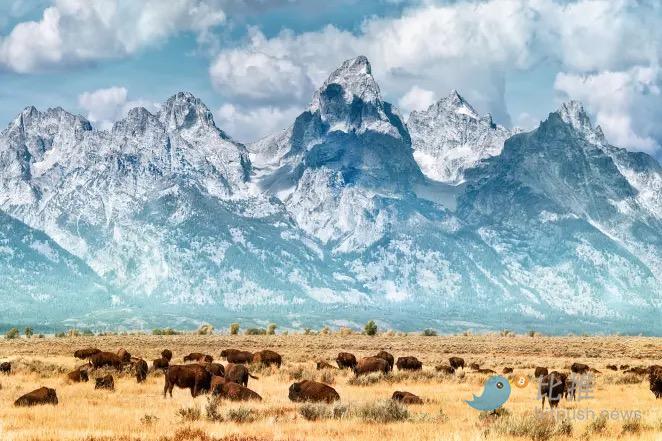
Mention it, and most people's first thought is the erupting Old Faithful geyser in Yellowstone National Park, or the perpetually snow-capped peaks of the Grand Tetons.

This is the least populous state in the U.S. On nearly 260,000 square kilometers of land, fewer than 600,000 people live—a number even smaller than the population of a distant suburban town in Shanghai.

In literary and cinematic memory, this is the cruel wilderness that Annie Proulx described as "unfixable, only to be endured," the mountains that trapped the cowboys for a lifetime in "Brokeback Mountain," and the blood-stained frontier besieged by a blizzard in Quentin Tarantino's "The Hateful Eight."

It is contradictory and distinct: deeply conservative, it is the "deepest red" state in the U.S., where the Republican Party has held a monopoly for forty years. In the 2024 U.S. election, over 70% of voters cast their ballots for Trump. Yet it was also once at the forefront of its time; as early as 1869, it became the "Equality State," the first in the U.S. to grant women the right to vote.

But Wyoming is by no means a financial desert. Every summer, the world's "most powerful" people gather here: at the serene Jackson Hole resort in Wyoming, the Global Central Bankers' Symposium, hosted by the Federal Reserve Bank of Kansas City, is held. From Alan Greenspan (the 13th Chairman of the Federal Reserve) to Jerome Powell, nearly every key turning point in global monetary policy has been set amidst these snow-capped mountains and meadows.

It is this aloof and unique "western spirit" that once again brought Wyoming into the public eye in early 2026.
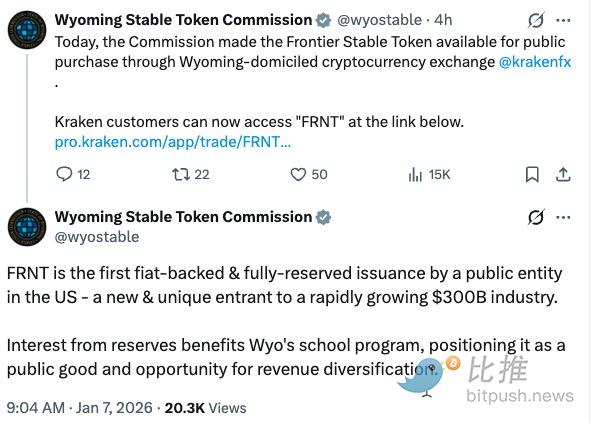
On January 7th local time, the state officially announced the launch of the $FRNT stablecoin, initially issued on the Solana blockchain and supporting six EVM-compatible chains. This is the world's first dollar stablecoin backed by "state government credit."

Finding Light in the Mining Ruins: The Path to Regeneration Through Energy Transition

Wyoming's radical move stems from a deep fiscal anxiety: the "underground wealth" that has supported this land for a century is drying up.

As the energy heartland supplying 40% of the U.S.'s coal, it once created the myth of a "tax-free heaven" through mineral resource taxes: residents pay no personal income tax, and businesses pay no corporate tax.

A key reason is that, thanks to the continuous resource exports from the Powder River Basin, this sparsely populated state created astonishing wealth: its per capita has long ranked among the top ten in the U.S., and in peak energy years, it could even rival New York and California.

This prosperity once gave Wyoming the confidence to refuse to levy personal income tax, corporate tax, and inheritance tax. However, this is a fragile prosperity built on heavy energy.
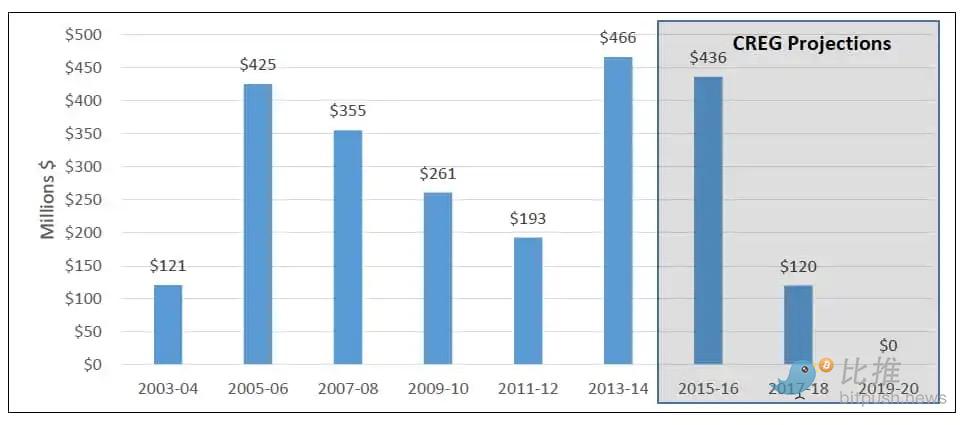
Source: University of Wyoming Center for Energy Economics and Public Policy

Since 2011, Wyoming's pillar industry began a decade-long "avalanche":

  • Ruthless market substitution: The rise of low-cost shale gas and renewable energy delivered a dimensional blow to coal in terms of power generation costs.

  • Tightening environmental constraints: The advancement of U.S. federal carbon emission regulations (such as the Clean Power Plan) led to the closure of coal-fired power plants across the country in batches.

  • A cliff-like fiscal gap: According to CREG official data cited by Wyoming Public Media, the state's coal resource tax plummeted from $290 million in 2011 to $170 million in 2022, with coal production in 2025 expected to fall to the second lowest point in history, only half of the 2008 peak. The "Coal Lease Bonuses," once a crucial source for school infrastructure, have even dropped to zero.
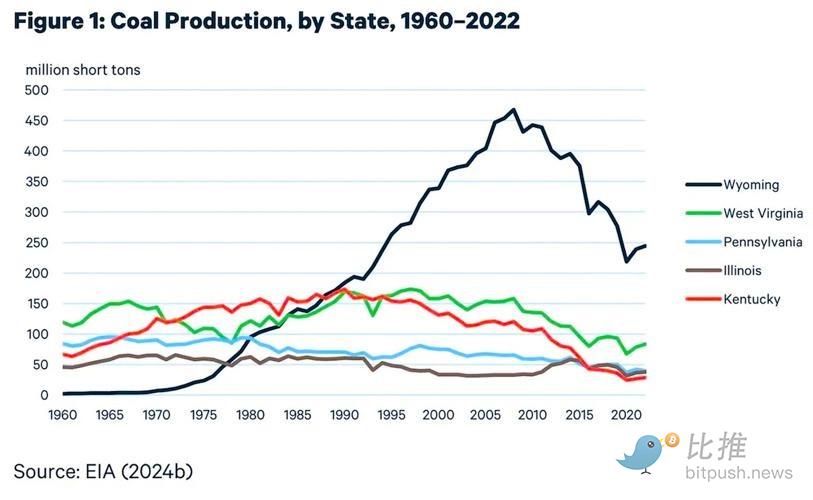
"If we don't stir things up, we'll be the next West Virginia (Note: a traditional mining region in the U.S. that became one of the poorest states after the coal industry declined)." – This visceral pain has created an urgent awareness among the most conservative cowboy politicians locally.

They realized that since they cannot change the trend of energy transition, they must leverage Wyoming's core asset—extremely liberal business legislation. In fact, Wyoming's innovative基因早有先例基因 has precedents. In 1977, it pioneered the LLC (Limited Liability Company), the most popular business entity to this day, nationwide.

Starting in 2018, to save itself, this most "red" conservative state was forced to embark on a long journey of institutional innovation in the crypto world.

In 2019, the Wyoming State Legislature passed House Bill 74 (HB 74), creating a new type of financial entity: the SPDI license (Special Purpose Depository Institution). This is not a traditional bank but an institution that "does not engage in lending业务, only handles custody and settlement." In September 2020, the crypto exchange Kraken obtained the first SPDI license in the U.S. here, establishing Kraken Bank, marking the first time crypto assets received "bank" status加持 under a state legal framework.

In 2021, the state率先 passed the "DAO Act," allowing code-controlled organizations to register as legal LLC entities.

As for the recently launched $FRNT, according to the规划 of the Wyoming Stable Token Commission (WST), the $FRNT stablecoin is over-collateralized by 102% in U.S. Treasury bonds and cash.

Reserve management is handled by investment giant Franklin Templeton, which manages approximately $1.6 trillion in assets, and custody is provided by its affiliate Fiduciary Trust Company International. Its core business logic lies in: the state government absorbs U.S. dollars, buys U.S. Treasury bonds, and the interest generated is directly allocated to the "School Foundation Fund" to support local public education.

Stablecoins: Who Are They Really Serving?

Wyoming's leap actually marks the entry of the stablecoin track into the second half: transitioning from a "credit game" of private companies to a "public good" at the government level.

In the past, discussions about stablecoins focused on the compliance risks of Tether or Circle; but in Wyoming's narrative, stablecoins return to their essence—an extremely efficient, low-cost payment rail (settlement fees are typically below $0.01). They are no longer speculative chips in the hands of geeks but begin to possess public fiscal attributes.

However, this "digital highway" has encountered invisible barriers in the real world.
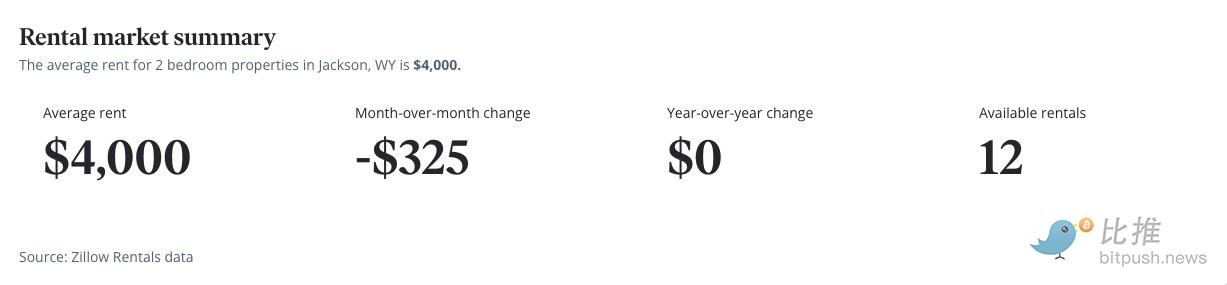
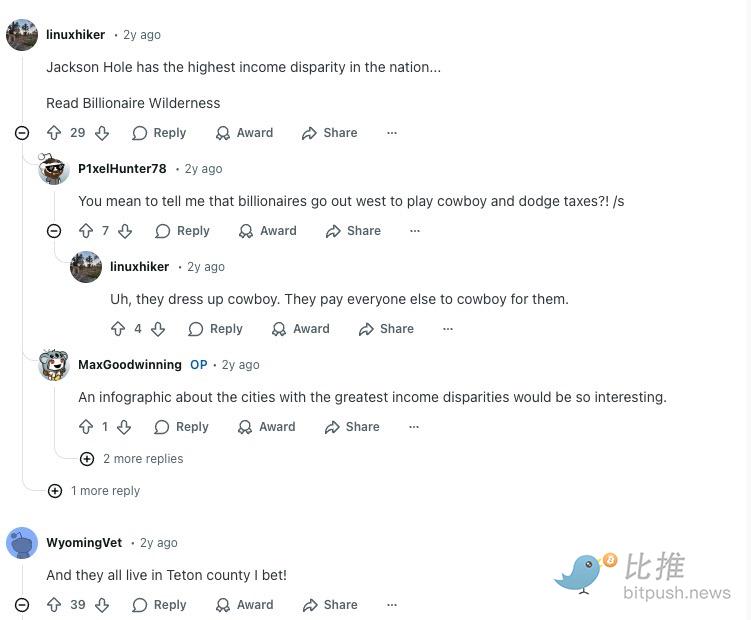
In Wyoming's Jackson Hole resort area, the monthly rent for an ordinary two-bedroom apartment has reached $4,000, 25% higher than in Los Angeles. Although the local per capita GDP ranks among the highest in the U.S., about 10% of residents still face food shortages. For blue-collar workers who catch the early morning commuter bus every day and rely on two or three jobs to make ends meet, "stablecoins" seem more like a distant technological concept.

This divide is somewhat maintained institutionally. A state treasury official told prospect.org that through land acquisition and price thresholds, this resort has been designed to be "invisible to slums." No matter how fast the settlement speed of stablecoins is, their benefits struggle to penetrate the already solidified social structure.

Writer Annie Proulx once described the harshness of the Wyoming land; today, this harshness is folded by technology and capital into two layers of reality that do not penetrate each other. On one side, the wealthy class creates tax havens and pastoral myths amidst the vast mountains and forests; on the other, ordinary Americans who支撑着这一切 but find it difficult to put down roots here—their lives, in both现实 and online narratives, have become the folded side.
It is against this backdrop that the state government is attempting to build fiscal autonomy for the digital age on the gradually沉寂的煤矿废墟, using law and stablecoin收益. Data shows that Wyoming has 348 limited liability companies per 1,000 adults, surpassing Delaware to become the new institutional洼地 in the United States.

But can this "digital rent" flowing into the "Cowboy State" truly bridge the fissures on that land?

References:

  • Consensus Revenue Estimating Group (2025.10)

  • CNBC: Wyoming is pushing crypto payments and trying to beat the Fed to a digital dollar

  • The American Prospect: Down and Out on the Crypto Frontier

  • wyofile: Clean Power Plan may cut Wyo coal revenue 31-63 percent

Author: Bootly


Twitter:https://twitter.com/BitpushNewsCN

Original article link:https://www.bitpush.news/articles/7600841

Related Questions

QWhat is the name of the stablecoin launched by the state of Wyoming, and on which blockchain was it initially issued?

AThe stablecoin is named $FRNT, and it was initially issued on the Solana blockchain with support for six EVM-compatible chains.

QWhat major economic challenge is Wyoming facing that motivated it to launch a state-backed stablecoin?

AWyoming is facing a severe fiscal crisis due to the rapid decline of its coal industry, which has been the state's economic pillar, providing significant tax revenue that previously allowed it to avoid income and corporate taxes.

QHow are the reserves for the $FRNT stablecoin managed and what is their purpose?

AThe reserves for $FRNT are 102% over-collateralized with U.S. Treasuries and cash, managed by the investment giant Franklin Templeton. The interest income generated is directed into the state's 'School Foundation Fund' to support public education.

QWhat significant legal innovation did Wyoming introduce for the crypto industry in 2019?

AIn 2019, Wyoming passed House Bill 74 (HB 74), which created the SPDI (Special Purpose Depository Institution) license, a new type of financial entity for crypto asset custody and settlement, with Kraken becoming the first company to receive this license.

QDespite its economic innovations, what social issue does the article highlight as a challenge within Wyoming, particularly in areas like Jackson Hole?

AThe article highlights a severe wealth gap and social stratification. In places like Jackson Hole, high living costs and rent of $4000 for a two-bedroom apartment create a reality where about 10% of residents face food insecurity, making the benefits of technological innovations like stablecoins inaccessible to many blue-collar workers.

Related Reads

NVIDIA Begins Adding Soap to the Bubble

NVIDIA is taking on a dual role: not just as a leading chip supplier, but as a massive capital allocator across the entire AI supply chain. In 2026, the company has committed over $40 billion in investments within five months, targeting everything from optical fiber manufacturing and data center operations to foundational AI model development. This investment spree, described as a systematic "sprinkler" approach, primarily funds companies that are major buyers of NVIDIA's own GPUs. Critics, including analysts from Goldman Sachs, label this a "circular revenue" loop—comparable to a supplier financing a customer to buy more of its products. A prominent example is NVIDIA's investment in OpenAI, which is expected to generate around $13 billion in revenue for NVIDIA, much of which may be reinvested back into OpenAI. While CEO Jensen Huang dismisses the "circular financing" critique as "absurd," arguing the investments are confidence votes in long-term generational shifts, some analysts express discomfort. They note that while investments in critical supply chain components like optics are strategically sound, funding new cloud providers like CoreWeave feels like "pre-paying for your own GPUs." The strategy carries significant risks. If the AI investment cycle turns, the market may question how much demand is genuine versus artificially sustained by NVIDIA's own balance sheet. Despite posting record-breaking earnings—$215.9 billion in annual revenue and $120 billion in net profit for FY2026—NVIDIA's stock fell after its report, signaling that "beating expectations" may no longer be enough to assure investors about the duration of the AI spending boom. The article concludes that while a bubble isn't necessarily a fraud, NVIDIA's actions resemble adding soap to a bubble—making it appear more robust and durable. This creates a complex scenario requiring extreme冷静 from investors to distinguish between real structural growth and financial engineering.

marsbit11m ago

NVIDIA Begins Adding Soap to the Bubble

marsbit11m ago

Short Positions Have Been Squeezed Out: Will the Next Leg of the U.S. Stock AI Rally Continue in Seoul?

"Short Squeeze Exhausted: Will the Next Leg of the AI Rally Continue in Seoul?" A Nomura report suggests the US AI stock rally, which saw the S&P 500 rise ~16.6% in 28 days largely driven by 10 key stocks, may be pausing. The fuel from short covering, CTA fund positioning, and volatility-control strategies is nearing its limit. For the rally to continue, new momentum from retail and sentiment-driven FOMO (Fear Of Missing Out) is needed. South Korea's market provided a potential answer on the very day the report was published. The KOSPI index surged 4.32%, triggering a buy-side circuit breaker, led by massive gains in chip giants SK Hynix (+11.98%) and Samsung. This surge is characterized by retail "hynix FOMO" and overseas funds precisely buying into AI themes via chip-focused ETFs, shifting from broad Korean market ETFs. The Korean rally is a high-beta extension of the US AI capital expenditure story, as major cloud providers plan massive infrastructure spending, directly benefiting memory chip leaders. However, this linkage also implies vulnerability. The sustainability of this next leg depends on whether US tech stocks correct, the trajectory of US inflation (with upcoming CPI data key), and geopolitical tensions around the Strait of Hormuz. Seoul has emerged as the new epicenter of the AI trade, but its fate remains tied to these broader macro and market dynamics.

marsbit16m ago

Short Positions Have Been Squeezed Out: Will the Next Leg of the U.S. Stock AI Rally Continue in Seoul?

marsbit16m ago

Borrowing Money from a Hundred Years Later, Building Incomprehensible AI

Tech giants like Alphabet, Amazon, Meta, and Microsoft are undergoing a radical financial transformation due to AI. Their traditional "light-asset, high-free-cash-flow" model is being dismantled by staggering capital expenditures on AI infrastructure—data centers, GPUs, and power. Combined 2026 guidance exceeds $700 billion, a 4.5x increase from 2022, causing free cash flow to plummet (e.g., Amazon's fell 95%). To fund this, they are borrowing unprecedented sums through long-dated, multi-currency bonds (e.g., Alphabet's 100-year bond). The world's most conservative capital—pensions, insurers—is now funding Silicon Valley's most speculative bet. This shift makes these companies resemble heavy-asset industrials (railroads, utilities) rather than software firms, threatening their premium valuations. Historically, such infrastructure booms (railroads, fiber optics) followed a pattern: genuine technology, overbuilding fueled by competitive frenzy, aggressive debt financing, and a crash triggered by financial conditions—not technology failure. The infrastructure remained, but many original builders and financiers did not survive. The core gamble is a "time arbitrage": using cheap debt today to build scale and lock in customers before AI capabilities commoditize. They are betting that AI revenue will materialize before debt comes due. Their positions vary: Amazon is under immediate cash pressure; Meta's path to monetization is unclear; Alphabet has a robust core business buffer; Microsoft has the shortest path from infrastructure to revenue. The contract is set: the most risk-averse global capital has lent its time to Silicon Valley, awaiting a future that is promised but uncertain.

marsbit1h ago

Borrowing Money from a Hundred Years Later, Building Incomprehensible AI

marsbit1h ago

Trading

Spot
Futures
活动图片