Trump Rejects Iran Peace Proposal — Bitcoin Breaks $82,000

bitcoinistPublished on 2026-05-12Last updated on 2026-05-12

Abstract

Bitcoin has surged nearly 30% since the US-Iran war began on February 28, outpacing gold and the S&P 500 despite ongoing market turmoil. The rally faces potential catalysts this week, including a Senate vote on the hawkish Kevin Warsh for Fed chair and markup of the significant CLARITY Act, both viewed as bullish for Bitcoin. The conflict, triggered by a US airstrike killing Iran's Supreme Leader, continues with no near-term resolution. After former President Trump rejected Iran's peace proposal demanding reparations and asset unfreezing, Bitcoin initially dipped but quickly rebounded, breaking above $82,000 and liquidating over $60 million in shorts. With Israeli PM Netanyahu insisting on dismantling Iran's uranium sites, hopes for a quick ceasefire have faded, underscoring Bitcoin's divergent performance amid deepening geopolitical strain and rising oil prices.

Bitcoin has now climbed nearly 30% since the US-Iran war began on February 28 — a run that has outpaced both gold and the S&P 500 even as the conflict continues to shake global markets.

A Week Of Potential Catalysts

Two events in the US Senate this week could add more fuel to that rally, according to 10x Research CEO Markus Thielen.

The first is a Monday vote on Kevin Warsh’s nomination as Federal Reserve chair. The second is a Thursday markup session for the CLARITY Act in the Senate Banking Committee.

Thielen described the crypto legislation as the most significant of its kind in years, one that could bring long-awaited regulatory certainty to digital assets.

As for Warsh — widely seen as more hawkish on inflation than current Fed chair Jerome Powell — Thielen said his confirmation would clear away uncertainty rather than create it. Both events, he said, lean bullish for Bitcoin.

The backdrop to all this is a conflict that shows no sign of ending soon. The US-Iran war, which started after a US airstrike killed Iranian Supreme Leader Ayatollah Ali Khamenei, has rattled financial markets for the past 10 weeks.
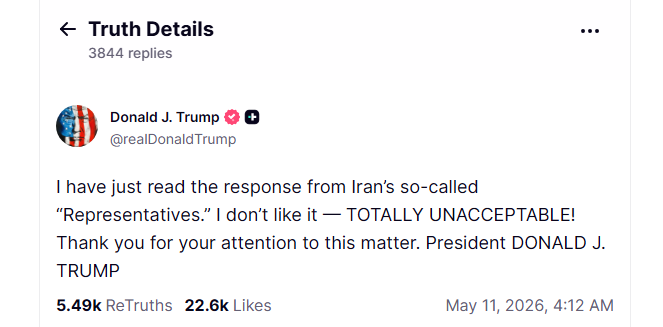
Source: Truth Social

One of the central flashpoints is the Strait of Hormuz, a chokepoint through which roughly one-fifth of global oil trade passes.

Oil climbed another 4.5% to $98.68 per barrel after Trump’s latest statement, adding pressure to an already strained economic picture.

Bitcoin’s Swing After Trump’s Post

On Sunday, Trump took to Truth Social to reject Iran’s counteroffer to a peace deal. Iran had been pushing for war reparations and the unfreezing of blocked financial assets — conditions Trump flatly dismissed.

BTCUSD now trading at $81,013. Chart: TradingView

Bitcoin initially slid on the news, dropping from $81,400 to $80,500 within 45 minutes of the post. But it didn’t stay down. Within three hours, the price had swung back above $82,000, breaking $81,000 on the way up and settling near $82,350.

Data shows that move wiped out over $60 million in short positions over a four-hour window.

Israeli Prime Minister Benjamin Netanyahu added that the war won’t conclude until Iran’s uranium sites are fully dismantled, further dimming prospects of a near-term resolution.

Hopes Fade For Early End To The Conflict

Peace talks had been expected to make progress by Wednesday. Trump’s rejection of Iran’s proposal ended that possibility for now.

The conflict, which began 10 weeks ago, has shown Bitcoin behaving differently from traditional assets — rising even as geopolitical tension deepens, oil surges, and ceasefire talks collapse.

Featured image from The Leaflet, chart from TradingView

Related Questions

QWhat two U.S. Senate events does Markus Thielen identify as potential catalysts for Bitcoin this week?

AThe two events are a Monday vote on Kevin Warsh's nomination as Federal Reserve chair and a Thursday markup session for the CLARITY Act in the Senate Banking Committee.

QHow did Bitcoin's price react in the immediate aftermath of Donald Trump's post rejecting Iran's peace proposal?

ABitcoin's price initially dropped from $81,400 to $80,500 within 45 minutes. However, it then recovered, swinging back above $82,000 within three hours and settling near $82,350.

QAccording to the article, what is the Strait of Hormuz and why is it significant in the current conflict?

AThe Strait of Hormuz is a geographic chokepoint through which roughly one-fifth of global oil trade passes. It is a central flashpoint in the US-Iran conflict, and disruptions there impact global oil prices and markets.

QWhat condition did Israeli Prime Minister Benjamin Netanyahu set for the conclusion of the war?

ABenjamin Netanyahu stated that the war will not conclude until Iran's uranium sites are fully dismantled.

QHow has Bitcoin's performance since the war began compared to gold and the S&P 500?

ABitcoin has climbed nearly 30% since the war began, a run that has outpaced the performance of both gold and the S&P 500 during the same period.

Related Reads

The AI Investment Landscape Is Being Reshaped: Beyond the 'Magnificent Seven', What Opportunities Lie in the Semiconductor Supply Chain?

AI Investment Map is Reshaping: Opportunities Beyond the 'Magnificent Seven' Since ChatGPT ignited the AI wave, investment initially focused on the "Magnificent Seven" tech giants dominating cloud infrastructure. However, the rise of DeepSeek and debates on AI capital expenditure effectiveness are shifting this dynamic. Investors now recognize opportunities deeper in the supply chain—the companies providing the essential "picks and shovels." Early concerns about an AI investment "arms race" and potential low returns were partly alleviated by strong Q1 earnings from cloud providers, validating robust compute demand. This has highlighted a more certain investment thesis: regardless of which AI applications ultimately win, massive capital expenditure will first fuel demand for semiconductors and related components. This "pick-and-shovel" logic has driven semiconductor ETFs to record highs. Key beneficiaries include: * **Memory Chipmakers (e.g., SK Hynix, Samsung, Micron)**: High Bandwidth Memory (HBM) is a critical bottleneck for AI training. * **Photonics Companies**: Crucial for high-speed data transfer within AI data centers. * **The Broader "AI-11" Semiconductor Ecosystem**: This encompasses foundries & lithography (TSMC, ASML), logic & custom chips (AMD, Broadcom, Intel, Marvell), and enterprise storage (SanDisk, Western Digital). Every dollar of AI infrastructure spending flows through this chain. While the "Magnificent Seven" remain dominant in market size, their earnings growth premium over the rest of the S&P 500 ("S&P 493") is narrowing. Market attention and marginal investment are shifting towards the expanding semiconductor supply chain. The investment narrative is evolving from "betting on the ultimate AI winner" to "investing in the certainty of the infrastructure build-out." Understanding this shift from the demand side to the supply side is key to identifying future AI investment opportunities.

marsbit14m ago

The AI Investment Landscape Is Being Reshaped: Beyond the 'Magnificent Seven', What Opportunities Lie in the Semiconductor Supply Chain?

marsbit14m ago

600 People, $66 Billion: The First Major Cash-Out in the Era of Large Models

The first systematic "big cash-out" of the AI era occurred in October 2025, when over 600 current and former OpenAI employees sold a total of $6.6 billion in shares via a secondary market. Approximately 75 individuals maxed out a $30 million per-person sale limit, while around 525 others cashed out an average of $8.3 million each. This event, exceeding the scale of any 2024 US IPO, functioned as a "shadow IPO." It marked a radical departure from the traditional Silicon Valley path of waiting for a public listing, instead allowing employees to convert equity to cash after just two years of tenure—a direct retention tool in a fiercely competitive talent market where rivals like Meta have offered packages worth hundreds of millions. This massive liquidity event presents a dual-edged sword for OpenAI. While it helps retain talent, it also risks triggering a brain drain as newly wealthy employees may depart. Furthermore, it creates a dilemma for those who sold: they forfeited potential future gains as the company's valuation soared from $400 billion to $852 billion within months. In stark contrast, employees at rival Anthropic demonstrated greater reluctance to sell during their own secondary offering. The financial narratives of the two labs also diverge sharply. OpenAI, while achieving over $20 billion in annualized revenue by 2025, faces massive projected losses (up to $14 billion in 2026), a long path to cash flow positivity, and significant revenue-sharing payments to Microsoft. Anthropic reports rapid revenue growth, improving gross margins, and a faster path to profitability. OpenAI's trajectory is thus balanced precariously between skyrocketing valuation based on funding narratives and the pressures of sustained financial losses post-cash-out. The event underscores that the AI race has evolved into a capital and human experiment, where immense wealth crystallizes the complex calculations of greed, fear, and ambition within the industry.

marsbit33m ago

600 People, $66 Billion: The First Major Cash-Out in the Era of Large Models

marsbit33m ago

NVIDIA Begins Adding Soap to the Bubble

NVIDIA is taking on a dual role: not just as a leading chip supplier, but as a massive capital allocator across the entire AI supply chain. In 2026, the company has committed over $40 billion in investments within five months, targeting everything from optical fiber manufacturing and data center operations to foundational AI model development. This investment spree, described as a systematic "sprinkler" approach, primarily funds companies that are major buyers of NVIDIA's own GPUs. Critics, including analysts from Goldman Sachs, label this a "circular revenue" loop—comparable to a supplier financing a customer to buy more of its products. A prominent example is NVIDIA's investment in OpenAI, which is expected to generate around $13 billion in revenue for NVIDIA, much of which may be reinvested back into OpenAI. While CEO Jensen Huang dismisses the "circular financing" critique as "absurd," arguing the investments are confidence votes in long-term generational shifts, some analysts express discomfort. They note that while investments in critical supply chain components like optics are strategically sound, funding new cloud providers like CoreWeave feels like "pre-paying for your own GPUs." The strategy carries significant risks. If the AI investment cycle turns, the market may question how much demand is genuine versus artificially sustained by NVIDIA's own balance sheet. Despite posting record-breaking earnings—$215.9 billion in annual revenue and $120 billion in net profit for FY2026—NVIDIA's stock fell after its report, signaling that "beating expectations" may no longer be enough to assure investors about the duration of the AI spending boom. The article concludes that while a bubble isn't necessarily a fraud, NVIDIA's actions resemble adding soap to a bubble—making it appear more robust and durable. This creates a complex scenario requiring extreme冷静 from investors to distinguish between real structural growth and financial engineering.

marsbit50m ago

NVIDIA Begins Adding Soap to the Bubble

marsbit50m ago

Short Positions Have Been Squeezed Out: Will the Next Leg of the U.S. Stock AI Rally Continue in Seoul?

"Short Squeeze Exhausted: Will the Next Leg of the AI Rally Continue in Seoul?" A Nomura report suggests the US AI stock rally, which saw the S&P 500 rise ~16.6% in 28 days largely driven by 10 key stocks, may be pausing. The fuel from short covering, CTA fund positioning, and volatility-control strategies is nearing its limit. For the rally to continue, new momentum from retail and sentiment-driven FOMO (Fear Of Missing Out) is needed. South Korea's market provided a potential answer on the very day the report was published. The KOSPI index surged 4.32%, triggering a buy-side circuit breaker, led by massive gains in chip giants SK Hynix (+11.98%) and Samsung. This surge is characterized by retail "hynix FOMO" and overseas funds precisely buying into AI themes via chip-focused ETFs, shifting from broad Korean market ETFs. The Korean rally is a high-beta extension of the US AI capital expenditure story, as major cloud providers plan massive infrastructure spending, directly benefiting memory chip leaders. However, this linkage also implies vulnerability. The sustainability of this next leg depends on whether US tech stocks correct, the trajectory of US inflation (with upcoming CPI data key), and geopolitical tensions around the Strait of Hormuz. Seoul has emerged as the new epicenter of the AI trade, but its fate remains tied to these broader macro and market dynamics.

marsbit55m ago

Short Positions Have Been Squeezed Out: Will the Next Leg of the U.S. Stock AI Rally Continue in Seoul?

marsbit55m ago

Trading

Spot
Futures
活动图片