The Guy Who Free-Solo Climbed Taipei 101 Yesterday Is a Spokesperson for a Trading Software

marsbitPublished on 2026-01-26Last updated on 2026-01-26

Abstract

Alex Honnold, a 40-year-old professional rock climber, free-soloed Taipei 101—a 508-meter, 101-story skyscraper—in a live-streamed event watched by millions. Known for his historic free solo ascent of El Capitan documented in the Oscar-winning film *Free Solo*, Honnold is also a brand ambassador for TradingView, a popular financial charting and trading platform. The partnership, which began in 2021 under the slogan “Look first / Then leap,” may seem unusual at first. However, Honnold’s approach to risk aligns closely with prudent trading principles. He avoids uncertainty and emphasizes meticulous preparation, having spent nearly a decade planning his El Capitan climb and rehearsing each move repeatedly. He views fear not as a barrier to overcome, but as a signal that he isn’t yet prepared. His method is defined by extreme risk management: extensive practice, patience for ideal conditions, and eliminating unpredictability. This contrasts sharply with impulsive trading behaviors common in meme stocks and leverage trading, where decisions are often made without analysis or risk calculation. Ultimately, TradingView’s choice of Honnold symbolizes survival—the goal isn’t just to reach the top, but to do so safely and live to continue climbing. Similarly, in trading, long-term success depends on preparation, discipline, and managing risk, not blind courage.

Written by: Curry, Deep Tide TechFlow

Yesterday, millions of people worldwide watched a live stream: a man free-solo climbing Taipei 101.

No ropes, no protection, 508 meters, 101 floors. Netflix streamed it live for 1 hour and 31 minutes, and he successfully reached the top.
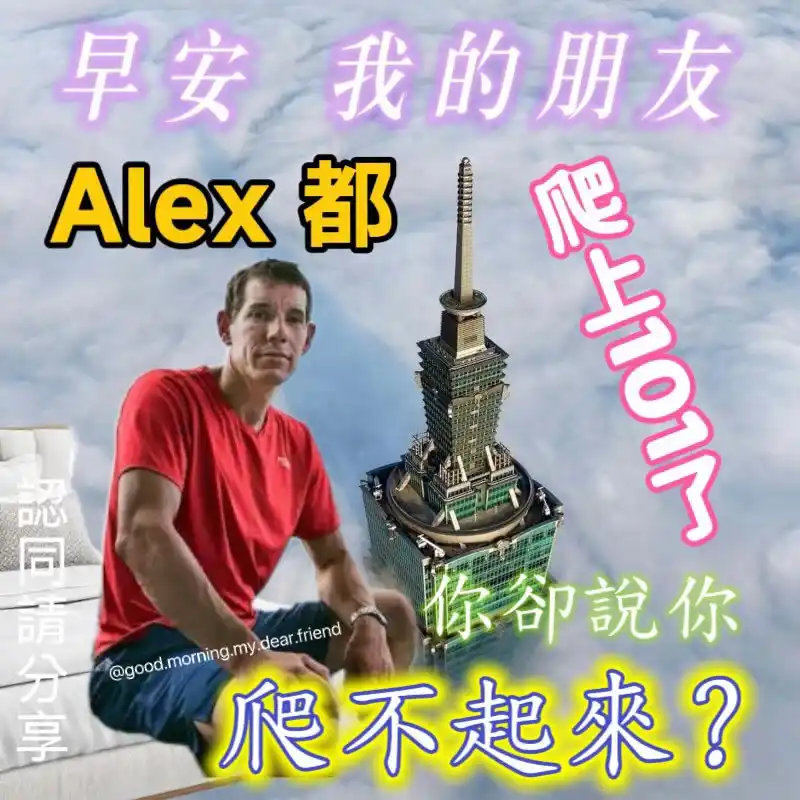
This man is Alex Honnold, 40 years old, a professional rock climber.

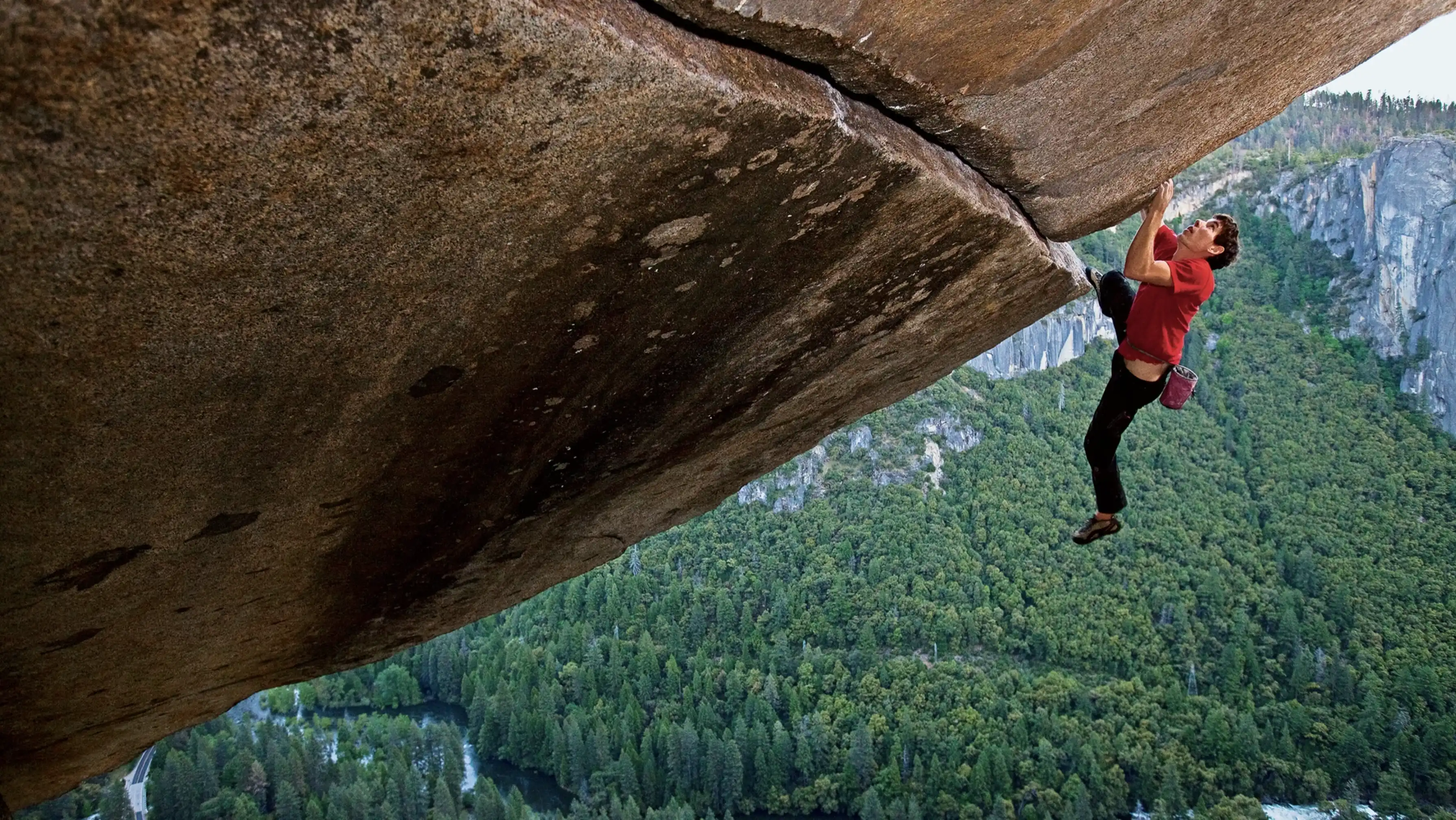
In 2017, he free-solo climbed El Capitan in Yosemite, a 900-meter-high granite rock face, without any protective equipment. The documentary Free Solo recorded this feat and won an Oscar.

The New York Times' review at the time called it: one of the greatest athletic achievements in human history.

But that's not what I want to talk about today.

I don't know if you noticed a detail: Alex Honnold is actually the spokesperson for the famous trading software TradingView, essential for trading stocks and crypto.

TradingView, used for chart analysis by traders in stocks, crypto, and forex, signed Alex in 2021 during a brand upgrade. The slogan at the time was "Look first / Then leap."

Look first, then leap.
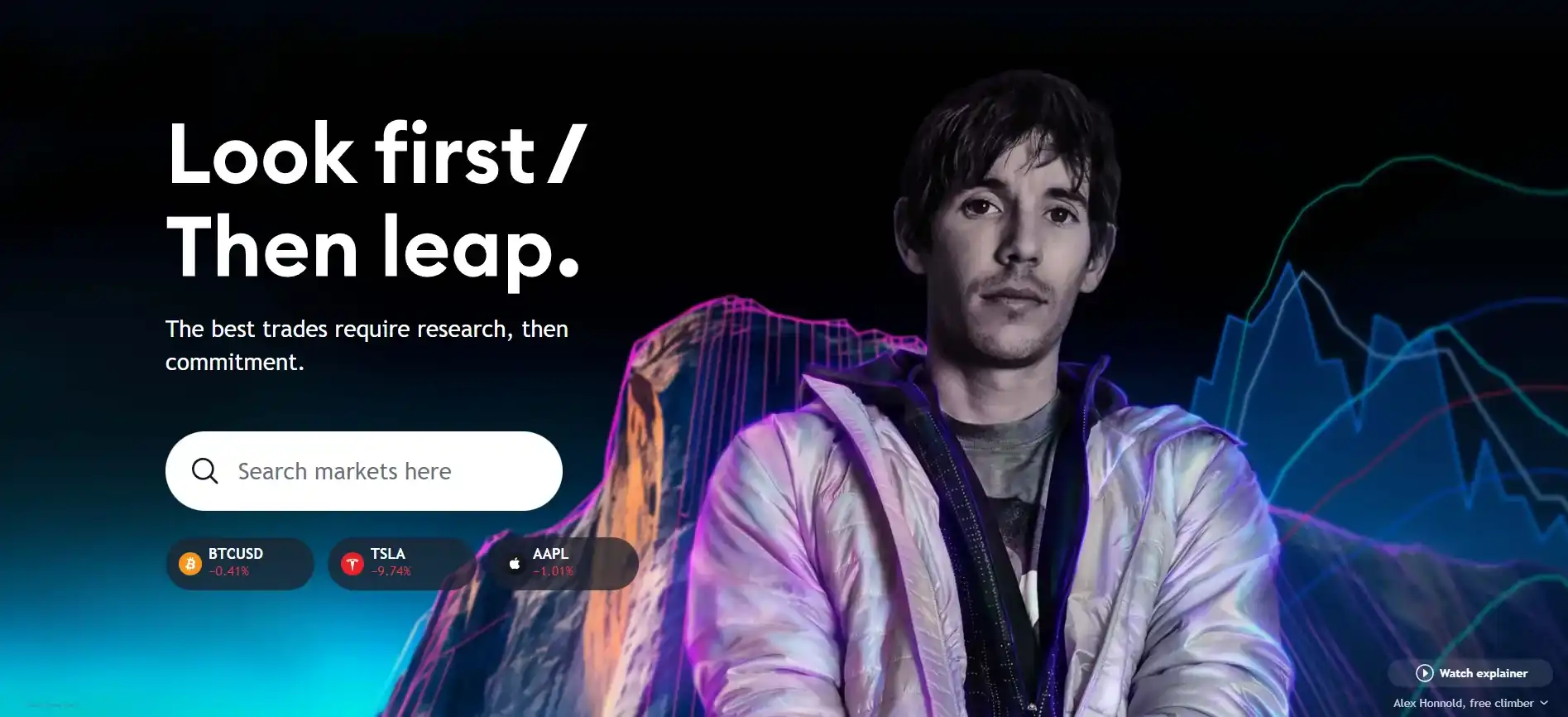
At first glance, it seems strange for a trading software to choose a free solo climber as a spokesperson.

What are they demonstrating—look at the K-line and then jump? But upon closer inspection, this cross-border choice of spokesperson is actually quite accurate.

Alex once discussed his understanding of "risk" in an interview with TradingView. He said:

"Risk to me means uncertainty, means rolling the dice to see the outcome. That's exactly what I try to avoid in climbing."

What Alex does, free solo climbing, more professionally called Free Solo, looks like an extreme sport, like risking his life.

But if you've seen the documentary of him climbing that 900-meter granite rock, you'll find that Alex's methodology is actually extremely conservative.

For that climb, he spent nearly a decade conceptualizing it and a year and a half in actual preparation. He climbed every section of the route dozens of times with ropes until he knew every handhold and foothold by heart, even with his eyes closed.

He carried a notebook with him, recording details of every critical move.
He has a saying that applies not just to climbing but probably to trading as well:

"If the thought of a move makes me feel nauseous, that means the risk is still too high, I'm not ready yet."

Fear is a signal, not an obstacle to overcome.

It was the same with this unprotected climb of Taipei 101. Before the live stream, he did a full rehearsal with ropes, testing every grip on every floor. The live stream, originally scheduled for the 23rd, was postponed to the 24th due to weather, and then from the 24th to the 25th.

Wait for the wind to stop, wait for the right conditions, then act.

What Alex Honnold does seems like one of the most dangerous things in the world—no protection, a fall if he slips—but the methodology behind it is极致 (ultimate) risk control:

Ten years of preparation, repeated rehearsals, waiting for conditions, rejecting uncertainty.

What many people do seems mundane: trading, opening contracts, buying a coin. But the methodology behind it might be much more radical than Alex's: jumping in at the sight of a social media signal, following a whale's purchase.

In the world of meme and contract trading, where gambling is rampant and being a second slow means missing out on gains, waiting seems like the enemy of making money. Let alone preparing for ten years, sometimes we haven't even calculated where our liquidation price is.

Alex says he tries to avoid rolling the dice.

But open any contract trading platform, and you'll find most people are rolling the dice, though we think we're analyzing.
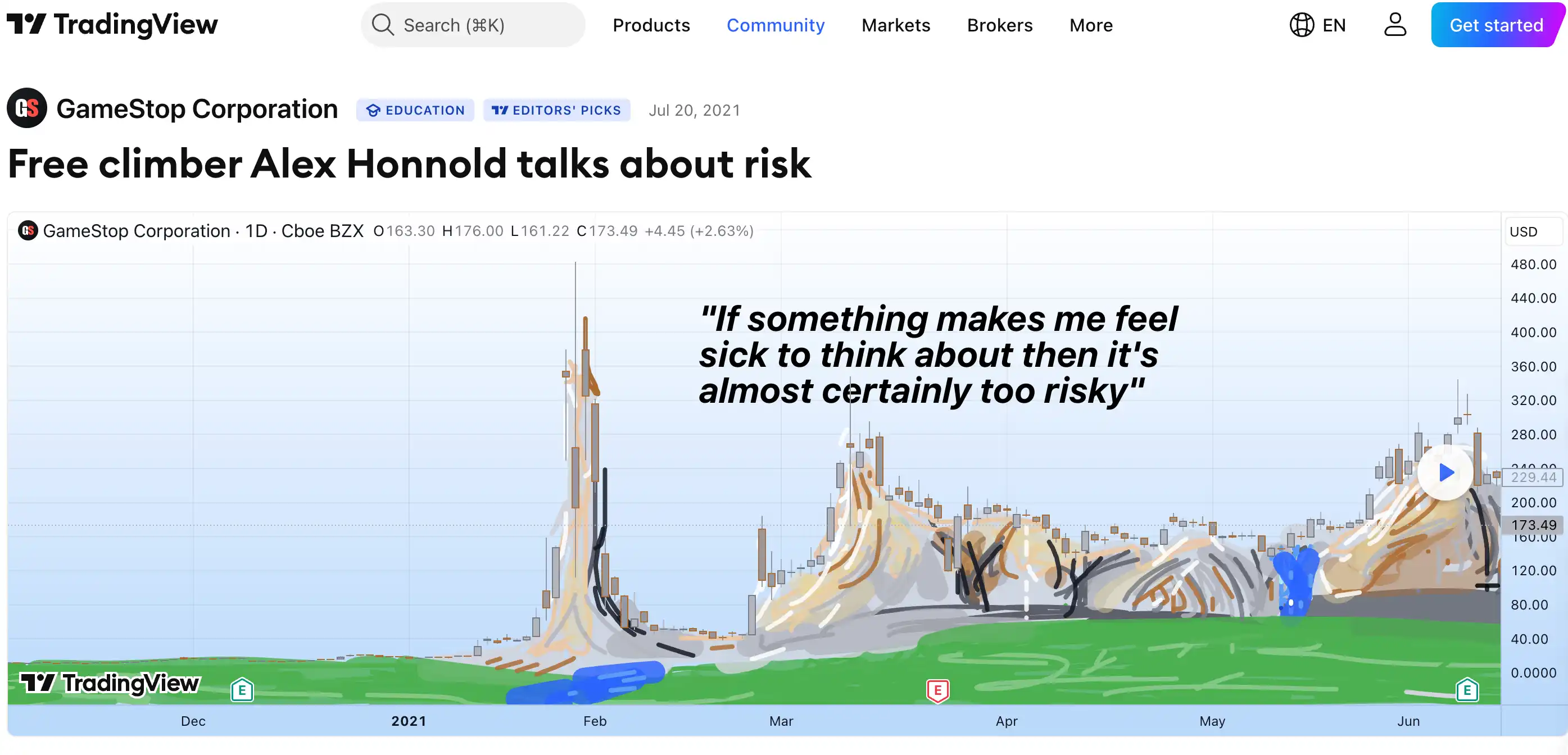
That said, TradingView choosing Alex as a spokesperson might not be because he represents bravery or "extremeness."

But because he represents "surviving."

In an industry with an extremely high liquidation rate, surviving itself is the best advertisement. The ultimate goal of Free Solo is not reaching the summit; it's reaching the summit alive, coming down alive, and being able to climb again tomorrow.

The same goes for trading.

Alex Honnold could free-solo El Capitan not because he's brave, but because he knows more clearly than anyone else where every step lands.

He prepared for ten years.

What about you?

Note: Alex's spokesperson relationship with TradingView began in 2021. "Look first / Then leap" is TradingView's brand slogan. Alex's quote about risk is from an official TV interview.


Related Questions

QWho is Alex Honnold and what is he famous for?

AAlex Honnold is a 40-year-old professional rock climber famous for free solo climbing, notably climbing the 900-meter El Capitan in Yosemite without any protective equipment, as documented in the Oscar-winning film 'Free Solo'.

QWhat is the connection between Alex Honnold and TradingView?

AAlex Honnold is a brand ambassador for TradingView, a popular financial charting and analysis platform. Their partnership began in 2021, with the brand slogan 'Look first / Then leap'.

QAccording to the article, what is Alex Honnold's philosophy on risk?

AAlex Honnold views risk as uncertainty, akin to rolling dice for an outcome, which is precisely what he strives to avoid in his climbing. His methodology is based on extreme risk control: extensive preparation, repeated rehearsals, waiting for ideal conditions, and eliminating uncertainty.

QHow does the article draw a parallel between Alex Honnold's climbing and trading?

AThe article contrasts Alex's methodical, risk-averse approach to climbing with the often reckless, impulsive behavior of many traders. It suggests that successful trading, like free soloing, is not about being fearless but about meticulous preparation and risk management to 'survive' and continue.

QWhat was the ultimate message about trading implied by using Alex Honnold as an endorser?

AThe ultimate message is that in a high-risk industry with a high rate of failure (like trading), the best advertisement is survival. The goal isn't just to make a successful trade ('reach the summit'), but to do so while managing risk so you can 'survive' and continue trading another day.

Related Reads

Jensen Huang's CMU Speech: In the AI Era, Don't Just Watch, Build

Jensen Huang, CEO of NVIDIA and a first-generation immigrant, delivered the commencement address to Carnegie Mellon University's class of 2026. He shared his personal journey from a humble background to founding NVIDIA, emphasizing resilience, learning from failure, and the responsibility that comes with leadership. Huang framed the present moment as the dawn of the AI revolution, a shift he believes is more profound than previous computing waves. He described AI as fundamentally resetting computing—moving from human-written software to machines that understand, reason, and use tools. This will create a new industry for generating intelligence and transform every sector. While acknowledging AI's potential to automate tasks and displace some jobs, Huang distinguished between the *tasks* of a job and its core *purpose*. He argued AI will augment human capability, not replace humans. The real risk, he stated, is not AI itself, but people being left behind by those who effectively use AI. He presented AI as a generational opportunity for massive infrastructure investment—in chip factories, data centers, energy grids, and advanced manufacturing—that could re-industrialize nations like the U.S. and bridge the digital divide by making computing and intelligent tools accessible to all. Huang called for a balanced approach: advancing AI safely and responsibly, establishing prudent policies, ensuring broad access, and encouraging universal participation. He urged the graduates not to fear the future but to engage with optimism and ambition, reminding them of CMU's motto, "My heart is in the work." His core message was clear: this is their moment to actively build and shape the AI-powered future, not merely observe it.

marsbit23m ago

Jensen Huang's CMU Speech: In the AI Era, Don't Just Watch, Build

marsbit23m ago

The Era Has Arrived Where Human Writers Must Prove They Are Not Machines

The article describes an era where AI-generated content is flooding the market, forcing human authors to prove they are not machines. It begins with the example of dozens of AI-written, error-ridden biographies of Henry Kissinger appearing on Amazon within hours of his death, a pattern repeated for other deceased celebrities and even living experts who find fraudulent books under their names. This spam content has exploded, with monthly new book releases on platforms like Amazon reaching 300,000 by late 2025. The issue spans genres, from suspiciously high proportions of AI-written teen romance and self-help books to dangerous, AI-generated foraging guides containing lethal advice. The platforms' automated review systems, designed to catch plagiarism and banned words, are ill-equipped to detect AI-generated text that avoids these pitfalls while being nonsensical or fraudulent. The problem has infiltrated traditional publishing. A major publisher, Hachette, had to recall a bestselling horror novel after AI detection tools suggested 78% of its content was machine-generated. An acclaimed European philosophy book was later revealed to be entirely written by AI under a fake author persona. In response, authors are fighting back. At the 2026 London Book Fair, 10,000 writers published a blank book titled "Don't Steal This Book" containing only their signatures—using emptiness as a protest weapon in an age of AI overproduction. Initiatives like the "Human Author Certification" program have emerged, ironically placing the burden on humans to prove their work is not machine-made. The article warns of a vicious cycle: AI-generated low-quality books pollute the data used to train future AI models, leading to "model collapse" and an ever-worsening flood of digital waste, eroding trust in publishing and devaluing human creativity.

marsbit48m ago

The Era Has Arrived Where Human Writers Must Prove They Are Not Machines

marsbit48m ago

Trading

Spot
Futures
活动图片