The Governance Struggle Behind the Power Play of Aave DAO and Aave Labs

marsbitPublished on 2025-12-15Last updated on 2025-12-15

Abstract

The article details a governance conflict between Aave DAO and Aave Labs, centering on a dispute over revenue generated by the frontend. The controversy began when Aave Labs replaced the integrated ParaSwap with CoW Swap on its frontend and directed the resulting fees to its private address, rather than to the DAO treasury. An anonymous DAO member, EzR3aL, publicly criticized this move, accusing Labs of privatizing protocol value. Aave DAO represents the protocol layer, governed by $AAVE token holders who vote on proposals. Aave Labs is the development team responsible for building and maintaining the frontend, brand, and product partnerships. The core issue is whether Aave is a decentralized protocol owned by the DAO or a project built and controlled by Labs, and how this distinction affects revenue rights. DAO supporters argue that all value generated should benefit token holders, while Labs contends that frontend-related income rightfully belongs to them. The situation highlights a broader industry-wide governance dilemma: the tension between decentralized community control and the need for a centralized, efficient team to drive development and maintain market position. The article suggests that a potential compromise, such as transparent revenue-sharing agreements, may be necessary. It concludes that how Aave resolves this conflict could set a precedent for other DeFi projects facing similar governance challenges.

Author: Chen Mo cmDeFi

The recent heated dispute between Aave DAO and Aave Labs over governance power at the protocol and product layers reflects the broader governance challenges across the industry. Here’s a breakdown of the issue. Who truly owns Aave?

1/6 · The Origin

Aave Labs replaced the frontend integration of ParaSwap with CoW Swap, and the resulting fees were directed to a private address of Labs. An anonymous DAO member, EzR3aL, exposed this on the governance forum, accusing Labs of "privatizing" protocol value. Labs' stance is that this belongs to frontend and product layer revenue, which rightfully belongs to Labs, and is unrelated to the protocol core.

2/6 · First, Let's Break Down Who Aave DAO and Aave Labs Are

  • DAO represents the Protocol (protocol layer)
  • Labs represents the Project (product layer)

The core dispute is whether Aave is a Protocol (managed by the DAO) or a Project (built by Labs)? And the implications for revenue rights.

Aave DAO is straightforward to understand. It is a unique type of governance organization in the Crypto world, composed of $AAVE token holders who exercise power through voting within the DAO. Almost 90%+ of crypto projects follow this structure; the term "governance token" originates from this. Its primary power is to vote on project proposals, deciding whether to implement certain updates and developments, as well as the future direction of the project.

Aave Labs is a development team responsible for building, updating, and maintaining the protocol (e.g., frontend interfaces, mobile apps). Typically, they also maintain the Aave brand and IP, so on social media and in the market, Aave Labs is often defaulted to being Aave. Its founders are also quite influential on social media.

Generally, Aave Labs and Aave DAO need to collaborate. For instance, Labs leads the development of many plans, optimizations of certain features, and even version upgrades like V3 and V4. These proposals are led by Aave Labs but ultimately decided by DAO vote. Usually, when their interests align, they have a mutually supportive relationship, together forming Aave.

3/6 · What Core Resources Do They Respectively Control?

Once conflicts of interest emerge, these two roles can be separated, as they are inherently independent entities. Let’s look at the core resources and power each holds:

Aave DAO controls the underlying core. For example, the smart contracts; treasury control is in the hands of the DAO. Although Labs can propose development plans, they require a DAO vote to be implemented. So it is the Protocol; the upper layer can be any product that operates. Theoretically, multiple frontend products can be built on top of one Protocol—Aave, Bave, Cave, etc.

Aave Labs controls the frontend, brand, product marketing, and partnerships. So it interacts directly with users and represents a quality product.

Therefore, supporters of Labs generally believe that the CoW Swap integration is purely a frontend behavior, unrelated to Aave's underlying architecture. Labs could even unilaterally decide not to integrate it, so any revenue generated should naturally belong to Labs. Conversely, DAO supporters view this as a form of appropriation because, with the existence of the AAVE governance token, all benefits should优先 flow to AAVE holders or remain in the treasury for the DAO to decide. Additionally, previously, ParaSwap revenue consistently flowed into the DAO. The new CoW Swap integration changed this status, further leading the DAO to see this as a grab.

Both sides have their arguments.

4/6 · Governance Dilemma

This highlights a rather awkward governance and power dilemma. From the perspective of $AAVE holders, they typically side with the DAO, because revenue entering the treasury benefits token holders. Although Labs has corresponding annual expenses, these can be reimbursed through the DAO. If a separate channel for profit can be opened, it seems community power is gradually being eroded.

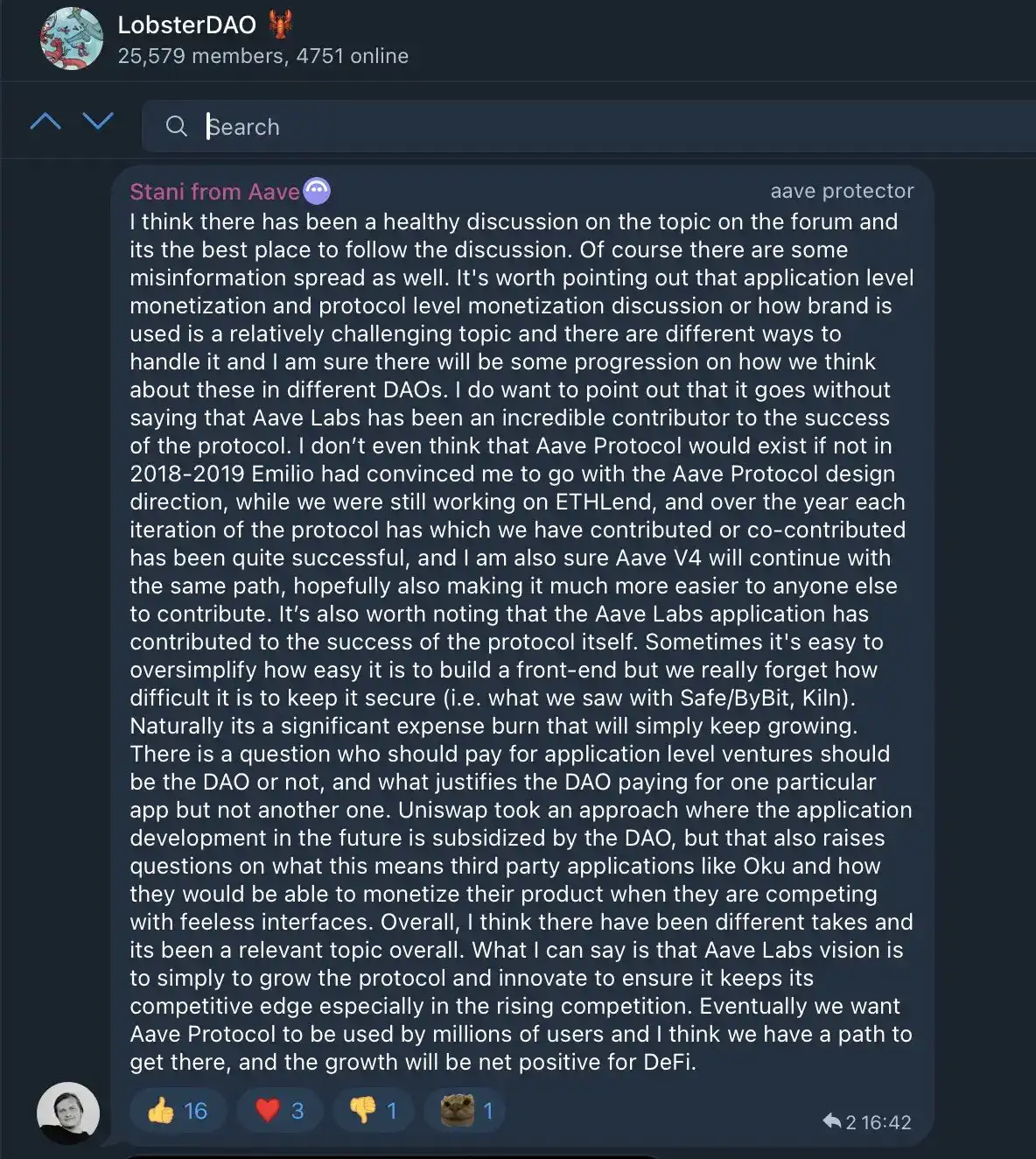
But from Aave Labs' perspective, although the theoretical core control lies with the DAO, and proposals ultimately require a vote to be implemented, from the first version of Aave to now, Labs has played a role in unifying and leading the overall situation, making huge contributions to the project's growth. As Stani said, "If it weren't for Emilio convincing me to adopt the Aave protocol design direction back in 2018-2019, when we were still working on ETHLend, I think the Aave protocol might not have existed at all."

Who is the true owner of Aave?
5/6 · Power Struggle

This governance dilemma exists in most projects. Governance tokens are bought with real money. Ideally, these holders collectively decide the project's future. When the team no longer holds voting power, they could even forcibly replace Labs.

But the reality is far from ideal. Even for projects with a certain market share, when internal team problems and disputes arise, the aftermath often leads to a loss of market position. Sushi is a good example. The DAO can exercise power, and the project can change hands. Although, thanks to smart contract design, even if a project undergoes a major reshuffle, the product functionality can remain perfectly stable. However, judging from past cases, the outcome of splits is usually not good.

The core issue here is that, for now, a DAO is a decentralized organization by nature. Although it has voting power, it struggles to operate efficiently. The community may include independent developers, VCs, and large holders. Once each role begins to exercise its power fully, a proposal can undergo multiple rounds of formulation, modification, and博弈 from the start. The success of a project requires a professional team and continuity. A DAO can hire a new team, but it may be difficult to quickly transition and iterate, easily losing market position. Therefore, the existence of Labs, on the surface,更像 the entity that can "control" the protocol (in collaboration with the DAO).

Personally, I lean towards the two parties eventually reaching a solution to balance the distribution of interests. But currently, everything is under discussion, and no governance vote has appeared. The potential risk behind this is that even if a reconciliation is ultimately reached, this incident has already exposed a divergence in expectations between the founding team and token holders.

Long-term, I remain optimistic about Aave's development because it is one of the few DeFi projects that has been market-verified with a strong moat. The矛盾 of governance power is a problem the entire industry needs to face. How Aave handles this incident may become a benchmark case for the industry in the future.

6/6 · Voices and Discussion

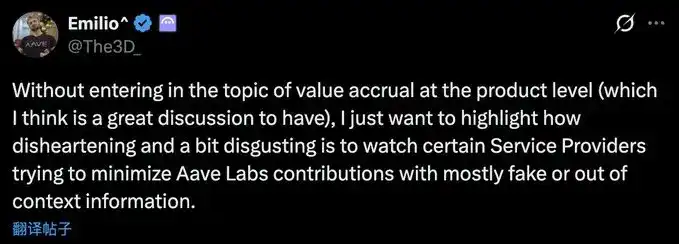
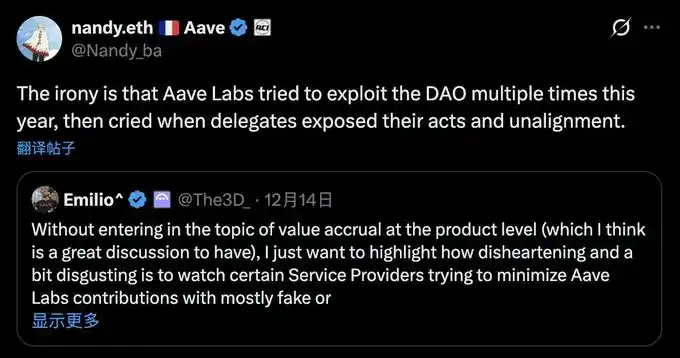
Arguments. Emilio believes someone is maliciously贬低 the contributions and value of Aave Labs. ACI team members pointed out that Aave Labs has repeatedly tried to exploit the DAO and been exposed.
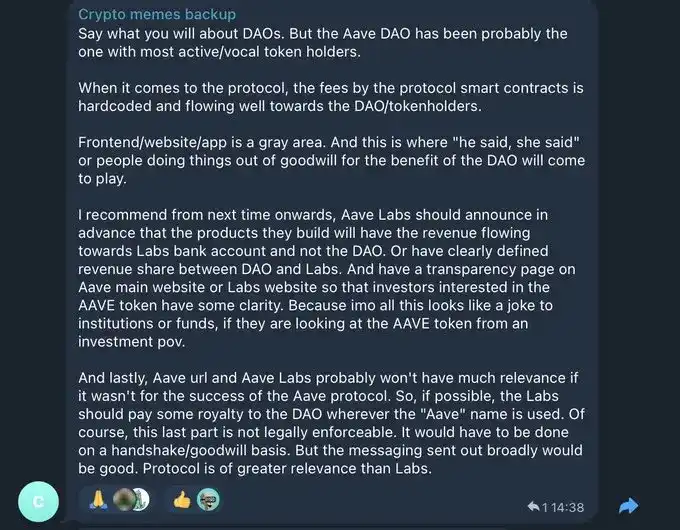
Community suggestions for Labs:

  • Labs should announce in advance that revenue from products they build will flow to Labs, not the DAO.
  • Or clearly define a revenue-sharing ratio between the DAO and Labs.
  • Establish a transparent page on the Aave main website or Labs website providing clear information to help investors interested in the $AAVE token (especially institutions or funds) make judgments.

Although the DAO model is controversial, Aave DAO token holders are among the most active and vocal groups, demonstrating the community's vitality. The frontend, website, and application are focal points of controversy, where "each sticks to their own argument" situations easily arise, lacking clear definition.
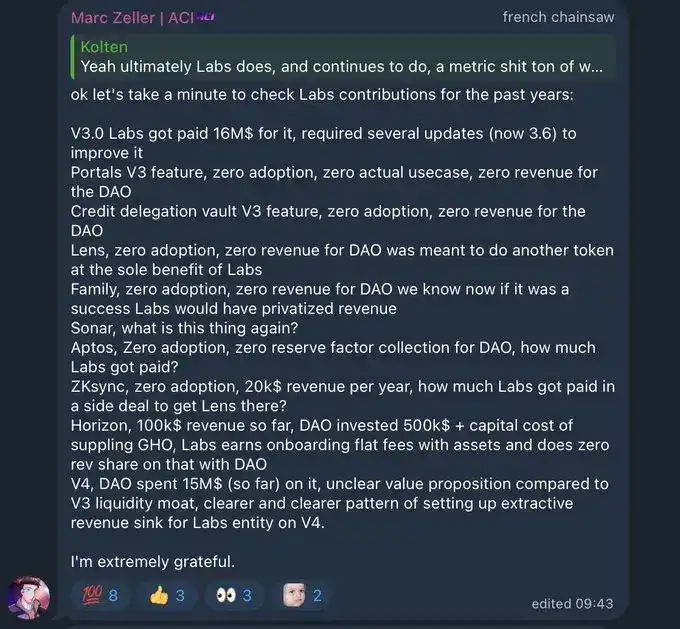
Some of Zeller's accusations against Labs for extracting protocol value:

The listed projects (Portals, Credit Delegation Vault, Lens, etc.) indeed indicate that many of Aave Labs' exploratory initiatives have not directly translated into protocol revenue or significant adoption rates.

It also mentions the V4 version. The DAO has spent $15 million so far. Compared to the liquidity moat of V3, the value proposition is unclear, raising concerns about whether this is a new trap for extracting revenue.

Failure is inevitable in the process of innovation. Not every feature or product can succeed. The DAO is, to some extent, investing in Aave Labs' R&D capability. My understanding is that Zeller is not否定 the contribution but calling for higher standards of accountability, transparency, and value alignment.
Recommended Reading:

Why Isn't Asia's Largest Bitcoin Treasury Company Metaplanet Buying the Dip?

Multicoin Capital: The Era of FinTech 4.0 Has Arrived

a16z's Heavily Funded Web3 Unicorn Farcaster Forced to Pivot, Is Web3 Social a False Proposition?


Related Questions

QWhat was the initial event that sparked the governance conflict between Aave DAO and Aave Labs?

AAave Labs replaced the frontend integration from ParaSwap to CoW Swap, and the fees generated from this new integration were directed to a private address controlled by Labs instead of the DAO treasury.

QWhat is the core dispute regarding the nature of Aave, as described in the article?

AThe core dispute is whether Aave is a Protocol (managed by the DAO) or a Project (built by Labs), and how this definition impacts the rights to revenue generated from its ecosystem.

QAccording to the article, what key resources does Aave DAO control versus Aave Labs?

AAave DAO controls the core protocol layer, including the smart contracts and the treasury. Aave Labs controls the frontend, brand, product marketing, and partnerships.

QWhat is one of the major governance dilemmas highlighted in the Aave case?

AA major dilemma is the tension between the ideal of decentralized governance by token holders (DAO) and the practical need for a centralized, efficient, and continuous development team (Labs) to maintain and grow the project.

QWhat was a community suggestion for Aave Labs to improve transparency and align interests?

AA community suggestion was for Labs to clearly announce in advance when product revenues will flow to Labs instead of the DAO, or to define a clear revenue-sharing ratio between DAO and Labs.

Related Reads

SpaceX, OpenAI, Anthropic: The Three AI Giants Racing for IPO, Which One Is Worth Betting On?

SpaceX, OpenAI, and Anthropic are poised for historic IPOs within weeks, potentially raising a combined $180 billion—a sum exceeding the entire internet bubble's fundraising. The hosts of the Limitless Podcast argue this isn't just individual company financing but an unprecedented capital concentration for AI infrastructure, driven by an insatiable need for compute, data centers, power, and chips. SpaceX's IPO is notable for reportedly changing market index rules to allow faster inclusion, potentially funneling trillions in passive retirement funds into its stock, despite its unproven space-based data center business model. In contrast, Anthropic demonstrates explosive growth, with ARR reportedly hitting $45 billion and approaching profitability, fueled by strong enterprise adoption of products like Claude Code. Google's separate $80 billion raise highlights the immense capital pressure, even for giants. The discussion acknowledges bubble risks but leans optimistic. The hosts contend the massive spending is building essential physical infrastructure for the next technological era. A key bottleneck isn't capital but the real-world limits of chip manufacturing and construction speed. As long as demand for AI compute outstrips supply, this investment cycle represents a foundational build-out rather than a purely financial bubble. All three companies are seen as foundational bets on the future, with Anthropic often cited as the most immediately compelling due to its proven revenue trajectory.

marsbit1h ago

SpaceX, OpenAI, Anthropic: The Three AI Giants Racing for IPO, Which One Is Worth Betting On?

marsbit1h ago

From 'Old Guys' to 'New Favorites': How AI Is Revaluing Old Infrastructure from Dell to Nokia?

From "Vintage Tech" to "New AI Darlings": How AI Revalues Old Infrastructure One year ago, tech giants like Dell, Nokia, Cisco, and Western Data were seen as slow-growth, low-valuation stories, far from the AI spotlight dominated by players like Nvidia. Now, these legacy tech stocks are gaining market attention, sparking debate on whether this is genuine industry revaluation or a temporary narrative. As AI moves from model parameters to real-world data centers, the market is recognizing companies with proven delivery and infrastructure capabilities. This shift marks a change in the AI investment thesis: from pure model and GPU focus to the complex systems engineering required for deployment. Companies like Dell, HPE, and Corning are being revalued not for being "sexy" AI innovators, but for their decades of accumulated expertise in supply chains, enterprise delivery, and infrastructure—assets that have become critical in the AI buildout phase. The revaluation is unfolding across three key infrastructure lines: 1. **Servers & System Integration:** Dell and HPE are emerging as crucial system integrators or "general contractors" for AI data centers, translating GPU orders into complete, deployable server racks integrated with power, cooling, and networking. 2. **Networking & Connectivity:** AI's scale demands robust high-speed connections. Corning (fiber optics), Nokia (AI-RAN, 6G), and Cisco (data center switches) are gaining importance for enabling efficient data transfer within and between AI clusters. 3. **Storage:** Beyond high-speed memory (HBM/DRAM), the AI data explosion is driving demand for high-capacity hard drives (HDDs) from companies like Western Digital and Seagate to handle training data, logs, and cold storage cost-effectively. For this revaluation to be substantive and not just a narrative, three criteria are key: 1) Concrete AI-related order and revenue growth (e.g., Dell's AI server sales), 2) Upward revisions to company financial guidance, and 3) Sustainable improvements in profit quality, not just top-line revenue spikes. In essence, AI's transition to a real construction phase is re-pricing "old assets" against "new demand." The opportunity, however, is selective. Only those legacy firms that are demonstrably integrated into the capital expenditure chains of data center and enterprise AI deployment are likely to experience a true "logic re-rating" rather than just a temporary valuation bounce.

marsbit1h ago

From 'Old Guys' to 'New Favorites': How AI Is Revaluing Old Infrastructure from Dell to Nokia?

marsbit1h ago

The Merger of Codex and ChatGPT Marks the Beginning of a Major Reshuffle in Programming Tools

OpenAI is shifting its strategic focus from ChatGPT to Codex, merging them along with the browser tool Atlas into a unified desktop super-app. This move signals an internal belief that Codex, originally a programming tool, represents the next evolution of AI more than conversational models like ChatGPT. Over the past year, Codex's weekly active users have surged past 5 million. The key distinction is that while ChatGPT answers questions, Codex executes tasks. Enterprises increasingly value this ability to get work done over simply receiving advice. Consequently, Codex is attracting professionals beyond developers, including analysts, bankers, marketers, and product managers. OpenAI's reorganization and increased investment in Codex stem from recognizing that the future of AI competition lies in execution capabilities, not just conversation. The company is launching role-specific plugins (e.g., for data analysis, sales, design) to transform Codex into a broad knowledge work platform that automates and redefines white-collar workflows. Beyond being a tool, Codex reflects OpenAI's ambition to redefine software. New features like "Sites"—which generates interactive websites from documents—and collaborative "Annotations" aim to create a paradigm where the AI understands the goal and handles the tools and steps, functioning more like a digital colleague than traditional software. The ultimate goal is a unified experience where the user cares only about the completed task.

marsbit1h ago

The Merger of Codex and ChatGPT Marks the Beginning of a Major Reshuffle in Programming Tools

marsbit1h ago

Interpreting Investment Opportunities in the Age of Great Navigation, Invesco Great Wall Fund Releases '2026 Report on Chinese Enterprises Going Global'

Invesco Great Wall Fund has released its "2026 China Corporate Globalization Report," titled "The 'Great Navigation Era' of Chinese Enterprises." The report analyzes the new trends and investment opportunities as Chinese companies expand globally, moving from simple product exports to comprehensive overseas operations involving services, branding, and local production. Driven by factors like trade friction, the pursuit of higher profit margins abroad, and policy support, globalization is becoming essential for Chinese companies. The report outlines an evolution: from early product export ("Globalization 1.0") to the current "Globalization 2.0," characterized by overseas capacity, capital goods investment, consumer brand expansion, and service exports. Chinese firms' competitive advantages are highlighted, including a vast engineer talent pool, low-cost and robust infrastructure, and complete industrial clusters. Specific sectors with significant出海 potential are identified: * **Capital Goods** (e.g., engineering machinery, power equipment): Benefiting from global demand, especially in Belt & Road markets and the AI-driven power grid upgrade cycle. * **Consumer Brands**: Transitioning from cost to brand advantage, leveraging供应链 efficiency. * **Technology & Innovation**: Including AI applications, optical modules within global tech supply chains, and new energy vehicles focusing on local production. * **Pharmaceuticals**: Chinese biotech firms are becoming preferred partners for global pharma, with potential for breakthrough drugs in areas like oncology and weight loss. The report concludes that corporate globalization represents a sustained, core theme for China's capital markets, though companies must navigate challenges like geopolitics and localization.

marsbit1h ago

Interpreting Investment Opportunities in the Age of Great Navigation, Invesco Great Wall Fund Releases '2026 Report on Chinese Enterprises Going Global'

marsbit1h ago

Trading

Spot
Futures

Hot Articles

How to Buy DAO

Welcome to HTX.com! We've made purchasing DAO Maker (DAO) simple and convenient. Follow our step-by-step guide to embark on your crypto journey.Step 1: Create Your HTX AccountUse your email or phone number to sign up for a free account on HTX. Experience a hassle-free registration journey and unlock all features.Get My AccountStep 2: Go to Buy Crypto and Choose Your Payment MethodCredit/Debit Card: Use your Visa or Mastercard to buy DAO Maker (DAO) instantly.Balance: Use funds from your HTX account balance to trade seamlessly.Third Parties: We've added popular payment methods such as Google Pay and Apple Pay to enhance convenience.P2P: Trade directly with other users on HTX.Over-the-Counter (OTC): We offer tailor-made services and competitive exchange rates for traders.Step 3: Store Your DAO Maker (DAO)After purchasing your DAO Maker (DAO), store it in your HTX account. Alternatively, you can send it elsewhere via blockchain transfer or use it to trade other cryptocurrencies.Step 4: Trade DAO Maker (DAO)Easily trade DAO Maker (DAO) on HTX's spot market. Simply access your account, select your trading pair, execute your trades, and monitor in real-time. We offer a user-friendly experience for both beginners and seasoned traders.

2.3k Total ViewsPublished 2024.03.29Updated 2026.06.02

How to Buy DAO

Discussions

Welcome to the HTX Community. Here, you can stay informed about the latest platform developments and gain access to professional market insights. Users' opinions on the price of DAO (DAO) are presented below.

活动图片