The Era of Bitcoin Dominating Crypto Is Over

marsbitPublished on 2026-06-01Last updated on 2026-06-01

Abstract

The era of Bitcoin's dominance over the entire crypto market is ending. The crypto economy is now bifurcating into two distinct camps: endogenous assets and exogenous assets. Endogenous assets, like Bitcoin and many traditional cryptocurrencies, derive their value primarily from the broader crypto market's price movements. Their fortunes rise and fall with the market cycle. Exogenous assets, however, are increasingly decoupled from crypto market volatility. These projects, while technically part of the crypto space, have business models and value drivers that operate independently. Examples include Venice, which monetizes private AI inference services; Figure, a fintech firm using blockchain to streamline home equity loans; and stablecoin-related companies like BVNK and Bridge, which see growth unrelated to crypto bull or bear markets. This shift is fundamental. Past narratives of a "blockchain over Bitcoin" focus failed because they lacked sustainable, quantifiable demand and revenue streams that could translate to token value. The current cycle is different: exogenous projects generate real revenue from paying users, and investors are beginning to evaluate them based on fundamentals rather than mere market narrative. While endogenous assets will remain relevant—akin to gold and gold mining stocks in a portfolio—their performance drivers are now distinct from those of exogenous assets. Consequently, analyzing exogenous assets requires a traditional, fundamentals-based app...

Author: Charlie

Compiled by: Luffy, Foresight News

For a long time, the price movements of the entire crypto market have revolved around Bitcoin. Today, that era is coming to an end.

The crypto economy has now diverged into two major camps: endogenous assets and exogenous assets.

The so-called endogenous assets are the traditional crypto categories familiar to the public: the value of these tokens and projects is entirely dependent on the rise and fall of the overall crypto asset market. Exogenous assets, on the other hand, only nominally belong to the crypto track; their value movements are increasingly independent of the crypto market.
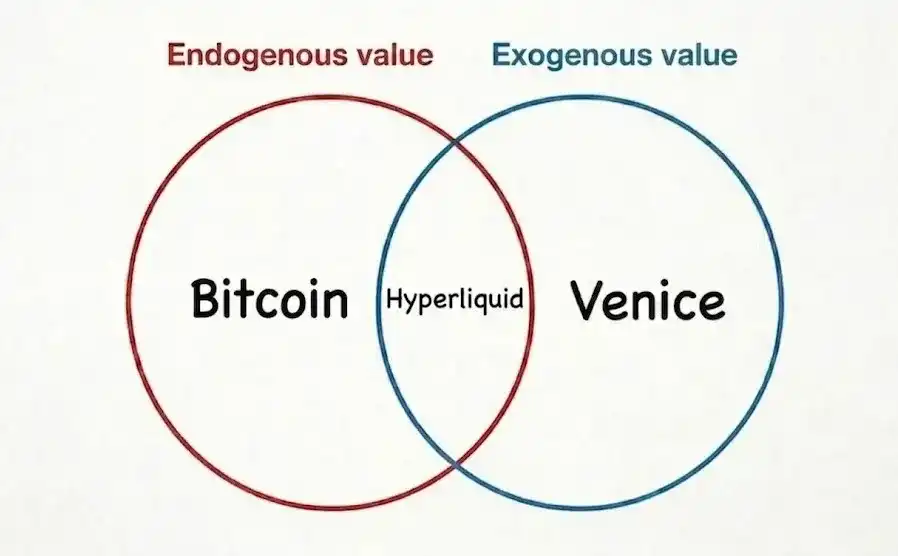
Bitcoin's value stems from its inherent attributes and is reflected in its price. Price increases further reinforce the market's perception of its value attributes. At the peak of a bull market, Bitcoin is hailed as 'interstellar universal currency,' the most scarce digital circulating asset in human hands; at the trough of a bear market, it is disparaged as a digital collectible with no cash flow support.

Hyperliquid sits between the two camps. Most of its business still relies on crypto market conditions, but both supply and demand are continuously expanding. Many on-chain financial infrastructures fall into this category, with underlying assets gradually shifting towards tokenized real-world asset categories.
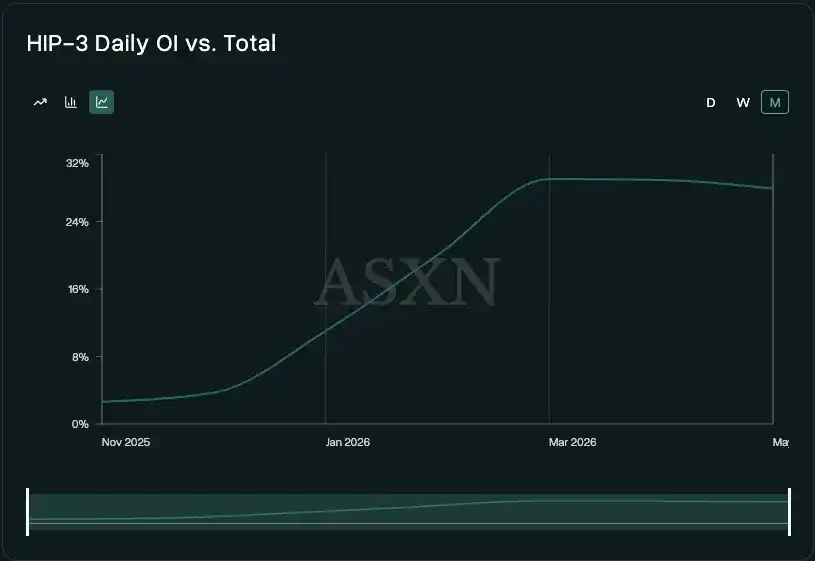
HIP-3 open interest roughly reflects the activity of non-crypto-related trading. Currently, HIP-3 contracts account for about 30% of Hyperliquid's total open interest, whereas in November 2025, this proportion was only 4%. The upcoming HIP-4 prediction market will further drive growth, bringing new trading users and trading targets.

Projects like Venice fall entirely into the exogenous camp; their development logic is completely detached from the crypto market. Although there is some overlap in user base, its business model leans more towards consumer-grade artificial intelligence rather than native crypto products like Uniswap. Uniswap's core business is still users trading various endogenous assets, so its performance naturally fluctuates with asset prices; Venice, however, packages private multimodal inference services and adopts a 'pay-per-use + subscription' fee model.

Venice's only connection to the crypto field is its choice of tokens as a value-carrying medium, and the fact that some of its compute power providers have a crypto industry background. Project lead Erik Voorhees is deeply involved in the crypto industry and believes that, if used properly, tokens can be excellent marketing tools.

Public company Figure is also a typical case. This fintech lending company developed its own blockchain, reducing the approval time for home equity loans to under 5 minutes. For them, blockchain is just supporting technology; the core value lies in the credit business itself.

The large-scale rise of exogenous tracks, whether in the token market or the listed company sector, has profound significance. In the past, because the vast majority of business models were deeply tied to crypto asset prices, pure bottom-up fundamental investing was difficult to implement. The crypto industry has not been without narratives favoring 'blockchain over Bitcoin,' but past cycles always reverted to Bitcoin's performance. The fundamental reason was that these tracks never managed to establish stable demand and generate continuous revenue; even when there was revenue, it couldn't be transmitted to token value. Once token prices stopped rising, the projects lost their support.

This cycle is fundamentally different. Now we can clearly see paying user groups and payment logic. Demand in most tracks is quantifiable and is no longer driven purely by sentiment hype. Simultaneously, the mechanisms for tokens as value carriers are continuously improving. Venice's revenue comes from users genuinely paying for AI inference services; even if the overall crypto market declines, its business won't be significantly impacted because it doesn't rely on token price movements. This cycle possesses two core advantages that previous booms lacked: sustainable real usage demand, and investors beginning to invest based on fundamentals rather than market narratives alone.

The stablecoin track in the private market is similar. In March 2026, Mastercard announced it would acquire BVNK for up to $1.8 billion. This company was valued at just $750 million when it completed its Series B round 15 months prior. Another stablecoin-related company, Bridge, was acquired by Stripe for $1.1 billion in February 2025. According to Stripe's annual report, Bridge's current business is growing at four times per year. The development of these companies is completely decoupled from the crypto industry's bull and bear cycles.

This is not to say we are bearish on endogenous assets. Just as gold and even small gold mining companies have their place in an investment portfolio, Bitcoin and a host of endogenous crypto assets also have their place. But the performance drivers and market correlations of the two asset types have fundamentally diverged, and the data confirms this.
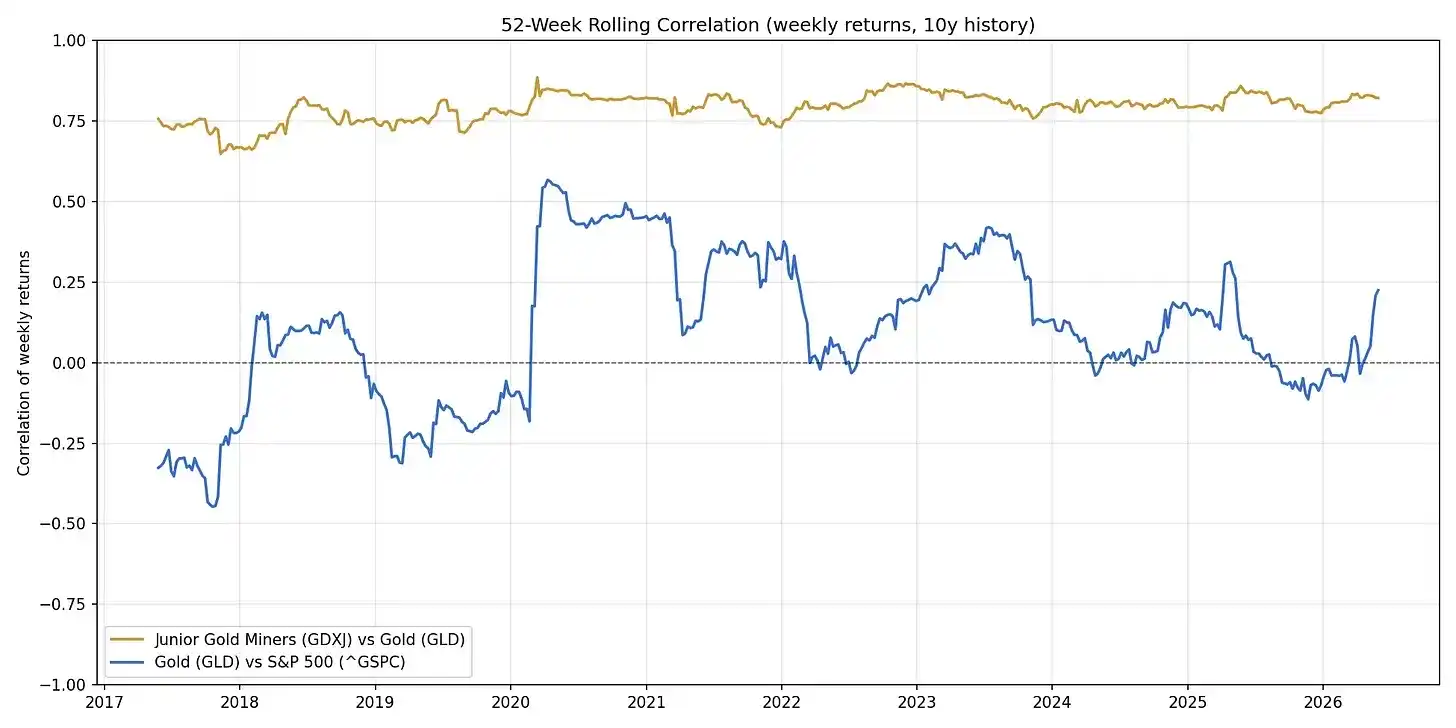
This analogy can be visualized: The correlation coefficient between small gold mining stocks and gold prices remains around 0.75 over the long term. This is precisely the current state of the traditional crypto market — a host of crypto assets are like small gold mines, with Bitcoin corresponding to gold. The entire track is leveraged investment against Bitcoin. The blue curve in the chart represents another relationship: Gold and the S&P 500 index exhibit weak linkage due to macroeconomic influences, but each follows its own independent logic. This is also the future direction for exogenous assets. In the long run, these assets will gradually break free from the 'following Bitcoin's ups and downs' trend.
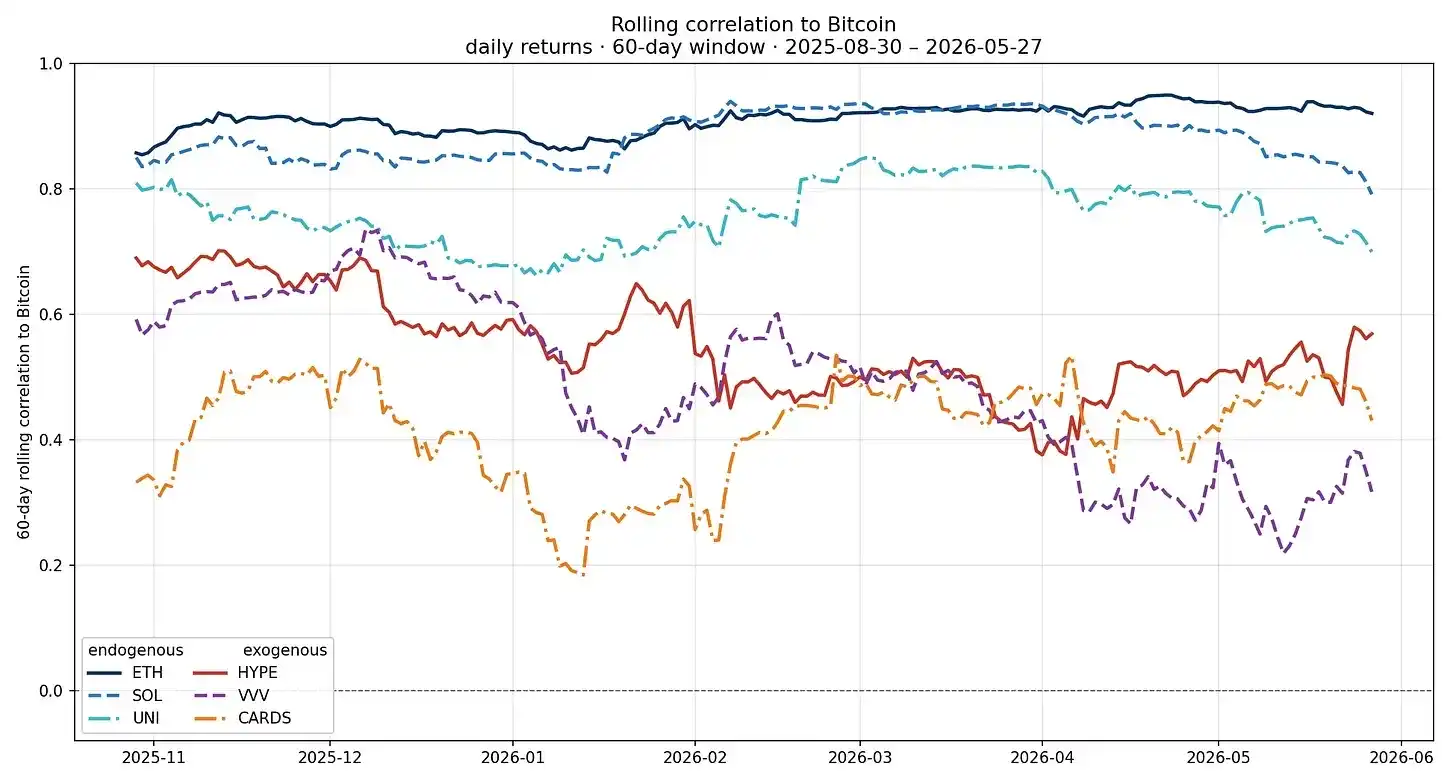
It should be noted that many exogenous assets themselves issue tokens. This phenomenon both confirms the above trend and represents a special case.

Currently, the vast majority of endogenous assets remain highly correlated with Bitcoin's movements. A few exogenous assets show reduced correlation, but due to their short development cycles, they don't yet offer strong reference value. Industry patterns have always been fundamentals first, followed by changes in market relationships.

This change has also completely rewritten the logic of industry analysis. Researching exogenous assets requires fundamental due diligence like analyzing traditional companies: mapping paying user groups, calculating unit economics, and assessing industry moats. Bitcoin price is no longer the primary reference indicator. Analyzing such projects is more akin to fintech investors making judgments, with the extra step of asset custody.

Here are the currently promising exogenous tracks:

  • On-chain exchanges and brokerage service providers
  • Settlement and redemption solutions for long-tail asset tokenization
  • Deep integration of crypto + AI (private inference, distributed open-source model training like Nous Research's Psyche, etc.)
  • New digital banks (Payy and Raycash focusing on privacy protection are worth watching; Aztec and Zama providing programmable privacy infrastructure also have potential)
  • Lending track (Morpho has become mainstream in institutional repo markets; smaller projects like Valinor, 3jane focus on private credit niches)
  • Stablecoin issuers, real-world asset tokenization service providers
  • Payment rails (In general payments, Stripe and Tempo are industry benchmarks; in agent payments, Coinbase currently leads)
  • Non-financial crypto consumer products (Represented by Venice, Collector Crypt; these projects imbue tokens with real-world business value, driving product adoption and marketing empowerment)
  • Agent economy (Core opportunity lies in the access layer for agents, service providers, and creator collaboration ecosystems, which are less replaceable. Cloudflare is ahead in deployment, but whether it will charge for traffic or merely provide basic functional services remains to be seen)

At this stage, investing in equity of related companies remains the safest way to gain exposure to the above tracks; quality token targets are exceptional cases. The role of tokens will only increase as their value-carrying mechanisms continue to optimize, a process requiring joint efforts from regulators and the entire industry. Progress is being made: on the regulatory front, the CLARITY Act is steadily advancing; on the industry side, institutions like Blockworks are promoting market information transparency. The token mechanism still has a long way to go.

But none of these details change a core trend: The driving forces of the crypto market are shifting from a single factor to multiple factors. The focus of industry research is shifting from interpreting Bitcoin price charts to deep-diving into company fundamentals. In the next decade, there will be no need to wonder why the 'crypto market' no longer moves in unison, because the industry landscape has been fundamentally renewed.


Related Questions

QAccording to the article, what is the key difference between endogenous and exogenous assets in the crypto market?

AEndogenous assets are traditional crypto assets whose value is completely dependent on the overall crypto market sentiment and Bitcoin's price movements. Their narratives often shift with market cycles. Exogenous assets, while nominally part of the crypto space, derive their value from independent fundamentals, such as real-world demand for specific services (e.g., AI inference, lending, payments). Their business models and revenue streams are increasingly decoupled from the price of Bitcoin or the general crypto market cycle.

QWhat two core advantages does the current cycle possess that previous crypto booms lacked, according to the author?

AThe current cycle possesses two core advantages previous booms lacked: 1) Sustainable, actual usage demand from paying customers, and 2) Investment decisions based increasingly on fundamental analysis of business models and revenue rather than purely on market narratives and speculation.

QUsing the analogy from the article, how is the relationship between traditional crypto assets and Bitcoin described, and how does it contrast with the future of exogenous assets?

ATraditional crypto assets are likened to small gold mining stocks, which have a high correlation (around 0.75) to the price of gold (Bitcoin). They essentially represent leveraged bets on Bitcoin. In contrast, the future for exogenous assets is compared to the relationship between gold and the S&P 500: they may be weakly linked by macroeconomics but largely follow independent, fundamental-driven logic and will gradually decouple from Bitcoin's price movements.

QWhat shift in analytical approach does the article suggest is necessary for evaluating exogenous crypto assets?

AThe article suggests that analyzing exogenous crypto assets requires a shift to a traditional fundamental due diligence approach, similar to analyzing fintech or tech companies. This involves examining the paying user base, unit economics, competitive moats, and business fundamentals. The price of Bitcoin is no longer the primary reference point, with the main additional consideration being the nuances of digital asset custody.

QName three example sectors or companies mentioned in the article that are categorized as exogenous or hybrid crypto assets.

AThree examples are: 1) Venice (a consumer AI service using tokens for payment/marketing), 2) Figure (a fintech lending company using its own blockchain to streamline loan processes), and 3) Hyperliquid (a hybrid platform where a growing portion of its business, like HIP-3 contracts, is based on non-crypto trading activity). Other examples include stablecoin issuers like BVNK, payment channels like Stripe/Tempo, and privacy-focused digital banks like Payy.

Related Reads

STRC Breaks Below $95: Why Does It Continue to Depeg? Is There Default Risk?

"STRC Falls Below $95: Why the Persistent Depegging and Is There Default Risk?" The article discusses the recent decline in the price of STRC, a perpetual preferred stock issued by Strategy (MSTR) designed to trade around a $100 par value. As of publication, STRC traded at $94.65, raising market concerns. STRC is described as a high-yield cash flow product, offering an 11.50% annual dividend paid monthly. Its "preferred" status grants it priority over common stock for dividends and in liquidation. Key reasons cited for the price depegging include: 1. **Bitcoin's Price Drop:** MSTR's assets are heavily tied to Bitcoin (BTC), which fell over 21% from its recent high, pressuring all Strategy-related products. 2. **Competitive Pressure:** Rival Strive Asset Management's similar product, SATA, offers daily dividends and has maintained its $100 par value with a ~13% yield. In response, Strategy has proposed changing STRC's dividend frequency from monthly to bi-weekly, pending shareholder vote. 3. **Technical Selling:** A break below $100 may have triggered algorithmic selling and stop-losses, exacerbating the decline. Regarding default risk, the analysis suggests it is currently low. Strategy founder Michael Saylor confirmed the June 2026 dividend rate remains at 11.50% with no cuts or suspensions. The company's massive reserve of 843,706 BTC provides a significant backstop for its obligations. Industry opinions are mixed. Some analysts view the BTC holdings as reliable support for dividends, while critics like Peter Schiff warn of potential dividend cuts leading to price crashes and lawsuits. Others highlight inflation risk and the company's ability to reduce dividends without a formal default. In summary, STRC's drop is attributed to BTC volatility, competition, and technical factors. While immediate default risk appears contained, the product faces challenges from market conditions and competitive dynamics.

marsbit44m ago

STRC Breaks Below $95: Why Does It Continue to Depeg? Is There Default Risk?

marsbit44m ago

AI Trading Cools, South Korean Stocks Plunge 1.8%, Spot Gold Rises 1%, Bitcoin Dives

A sell-off in AI-related stocks, triggered by Broadcom's disappointing earnings forecast, sent shockwaves through global markets. South Korea's KOSPI led Asia's decline, plunging 1.8% as the risks from concentrated chip stock gains and surging leveraged investments came to the fore. The tech-heavy Nasdaq 100 futures fell 0.5% following Broadcom's 14% after-hours plunge, which signaled a slower-than-expected transition to AI clients. This pullback extended Wall Street's weakness, halting the S&P 500's nine-day rally amid hawkish Fed signals and renewed Middle East tensions. South Korean authorities convened an emergency meeting, pledging "immediate measures" against market volatility and warning of record-high stock margin debt. The adjustment rippled across assets: Bitcoin fell to around $64,000, its lowest since February, while safe-haven gold rose 1% on bargain hunting. Oil prices dipped on Middle East ceasefire news. Market analysts noted the sell-off was driven by profit-taking after massive gains, particularly in chip stocks like Samsung and SK Hynix, which now dominate the KOSPI. Wall Street banks are divided on Korea's outlook, with Goldman Sachs raising its target while Citigroup and others warn of overvaluation and a potential bubble. Bridgewater's Ray Dalio noted that great technological shifts often create bubbles. Meanwhile, Fed officials' hints at potential future rate hikes added to the cautious mood ahead of key U.S. jobs data.

华尔街日报1h ago

AI Trading Cools, South Korean Stocks Plunge 1.8%, Spot Gold Rises 1%, Bitcoin Dives

华尔街日报1h ago

Seeking Alpha's Hot Article: Why Might the U.S. Stock Market Crash in June?

In a recent Seeking Alpha article, financial professor and analyst Damir Tokic argues that the US stock market may be poised for a significant crash in June 2026. The core thesis centers on a "mega-bubble" in equities, particularly within the technology sector, which has driven the S&P 500 to near-record valuations, with a Shiller P/E ratio exceeding 40—a level comparable to the 2000 dot-com bubble. Tokic identifies two primary catalysts for a potential collapse. First, he points to unsustainable market exuberance fueled by what he terms the "Trump Stimulus"—massive AI capital expenditure by tech giants, which he believes is politically driven and cannot last. Second, and more urgently, he highlights the escalating Iran war as a critical threat. The ongoing closure of the Strait of Hormuz has created a severe global energy supply crunch. Strategic petroleum reserves are projected to hit critically low operational levels by June, potentially causing oil prices to spike above $200 per barrel and triggering a severe, supply-driven inflationary shock. This scenario, Tokic warns, would force the Federal Reserve's hand. Despite currently maintaining a dovish bias, the Fed would likely be compelled to officially pivot to a hawkish stance at its June FOMC meeting to combat soaring inflation and bond yields. He contends that such a shift—or even a failure to act, which would destroy Fed credibility—could be the trigger that punctures the market bubble. The resulting downturn, he concludes, could rival the bear markets of 2000 and 2008, advising investors to prepare for a major correction.

marsbit1h ago

Seeking Alpha's Hot Article: Why Might the U.S. Stock Market Crash in June?

marsbit1h ago

Trading

Spot
Futures

Hot Articles

What is $BITCOIN

DIGITAL GOLD ($BITCOIN): A Comprehensive Analysis Introduction to DIGITAL GOLD ($BITCOIN) DIGITAL GOLD ($BITCOIN) is a blockchain-based project operating on the Solana network, which aims to combine the characteristics of traditional precious metals with the innovation of decentralized technologies. While it shares a name with Bitcoin, often referred to as “digital gold” due to its perception as a store of value, DIGITAL GOLD is a separate token designed to create a unique ecosystem within the Web3 landscape. Its goal is to position itself as a viable alternative digital asset, although specifics regarding its applications and functionalities are still developing. What is DIGITAL GOLD ($BITCOIN)? DIGITAL GOLD ($BITCOIN) is a cryptocurrency token explicitly designed for use on the Solana blockchain. In contrast to Bitcoin, which provides a widely recognized value storage role, this token appears to focus on broader applications and characteristics. Notable aspects include: Blockchain Infrastructure: The token is built on the Solana blockchain, known for its capacity to handle high-speed and low-cost transactions. Supply Dynamics: DIGITAL GOLD has a maximum supply capped at 100 quadrillion tokens (100P $BITCOIN), although details regarding its circulating supply are currently undisclosed. Utility: While precise functionalities are not explicitly outlined, there are indications that the token could be utilized for various applications, potentially involving decentralized applications (dApps) or asset tokenization strategies. Who is the Creator of DIGITAL GOLD ($BITCOIN)? At present, the identity of the creators and development team behind DIGITAL GOLD ($BITCOIN) remains unknown. This situation is typical among many innovative projects within the blockchain space, particularly those aligning with decentralized finance and meme coin phenomena. While such anonymity may foster a community-driven culture, it intensifies concerns about governance and accountability. Who are the Investors of DIGITAL GOLD ($BITCOIN)? The available information indicates that DIGITAL GOLD ($BITCOIN) does not have any known institutional backers or prominent venture capital investments. The project seems to operate on a peer-to-peer model focused on community support and adoption rather than traditional funding routes. Its activity and liquidity are primarily situated on decentralized exchanges (DEXs), such as PumpSwap, rather than established centralized trading platforms, further highlighting its grassroots approach. How DIGITAL GOLD ($BITCOIN) Works The operational mechanics of DIGITAL GOLD ($BITCOIN) can be elaborated on based on its blockchain design and network attributes: Consensus Mechanism: By leveraging Solana’s unique proof-of-history (PoH) combined with a proof-of-stake (PoS) model, the project ensures efficient transaction validation contributing to the network's high performance. Tokenomics: While specific deflationary mechanisms have not been extensively detailed, the vast maximum token supply implies that it may cater to microtransactions or niche use cases that are still to be defined. Interoperability: There exists the potential for integration with Solana’s broader ecosystem, including various decentralized finance (DeFi) platforms. However, the details regarding specific integrations remain unspecified. Timeline of Key Events Here is a timeline that highlights significant milestones concerning DIGITAL GOLD ($BITCOIN): 2023: The initial deployment of the token occurs on the Solana blockchain, marked by its contract address. 2024: DIGITAL GOLD gains visibility as it becomes available for trading on decentralized exchanges like PumpSwap, allowing users to trade it against SOL. 2025: The project witnesses sporadic trading activity and potential interest in community-led engagements, although no noteworthy partnerships or technical advancements have been documented as of yet. Critical Analysis Strengths Scalability: The underlying Solana infrastructure supports high transaction volumes, which could enhance the utility of $BITCOIN in various transaction scenarios. Accessibility: The potential low trading price per token could attract retail investors, facilitating wider participation due to fractional ownership opportunities. Risks Lack of Transparency: The absence of publicly known backers, developers, or an audit process may yield skepticism regarding the project's sustainability and trustworthiness. Market Volatility: The trading activity is heavily reliant on speculative behavior, which can result in significant price volatility and uncertainty for investors. Conclusion DIGITAL GOLD ($BITCOIN) emerges as an intriguing yet ambiguous project within the rapidly evolving Solana ecosystem. While it attempts to leverage the “digital gold” narrative, its departure from Bitcoin's established role as a store of value underscores the need for a clearer differentiation of its intended utility and governance structure. Future acceptance and adoption will likely depend on addressing the current opacity and defining its operational and economic strategies more explicitly. Note: This report encompasses synthesised information available as of October 2023, and developments may have transpired beyond the research period.

363 Total ViewsPublished 2025.05.13Updated 2025.05.13

What is $BITCOIN

Discussions

Welcome to the HTX Community. Here, you can stay informed about the latest platform developments and gain access to professional market insights. Users' opinions on the price of BTC (BTC) are presented below.

活动图片














