The $33 Billion Inundation: Ethereum Inflows Hit a 15-Month High As Price Teeters At $1,955

bitcoinistPublished on 2026-02-24Last updated on 2026-02-24

Abstract

Ethereum is struggling to hold above the key $2,000 level amid broader market weakness, with recent price action subdued and investor sentiment turning cautious. A CryptoQuant report reveals a significant surge in Ethereum inflows to Binance, hitting $33.3 billion over the past 30 days—the highest since last November—as ETH trades near $1,955. While large exchange inflows often signal increased selling supply and potential volatility, they may also reflect strategic repositioning rather than outright bearish intent. If demand absorbs this liquidity, the market could stabilize; if not, downside risks may persist. The reaction to these flows will be critical for near-term direction.

Ethereum is struggling to hold above the $2,000 level as the broader crypto market enters a more fragile phase marked by persistent selling pressure, fading momentum, and elevated uncertainty. Despite several rebound attempts in recent weeks, price action has remained subdued, with liquidity conditions tightening and investor sentiment turning increasingly cautious. The inability to secure sustained acceptance above this psychological threshold has reinforced the perception that the market is still navigating a corrective environment rather than transitioning into a clear recovery phase.

A recent CryptoQuant report provides additional context by highlighting a sharp increase in exchange activity. According to the data, total Ethereum inflows to Binance over the past 30 days reached roughly $33.3 billion — the highest level recorded since last November. This surge comes as ETH trades near $1,955 after a gradual but persistent decline in recent weeks.

Historically, rising inflows to major exchanges tend to indicate a growing supply of assets available for trading. When substantial volumes of Ethereum move onto platforms like Binance, they may be used for spot sales, derivatives collateral, or portfolio rebalancing. Consequently, this spike in inflows signals heightened market activity and potentially increased short-term volatility.

While the recent surge in Ethereum inflows to Binance may initially appear bearish, the report emphasizes that this development should not automatically be interpreted as a negative signal. Elevated exchange inflows can sometimes reflect strategic repositioning rather than immediate selling intent. Investors may be preparing to actively trade, hedge exposure, or adjust portfolio allocations, particularly during periods of heightened volatility when liquidity access becomes more critical.
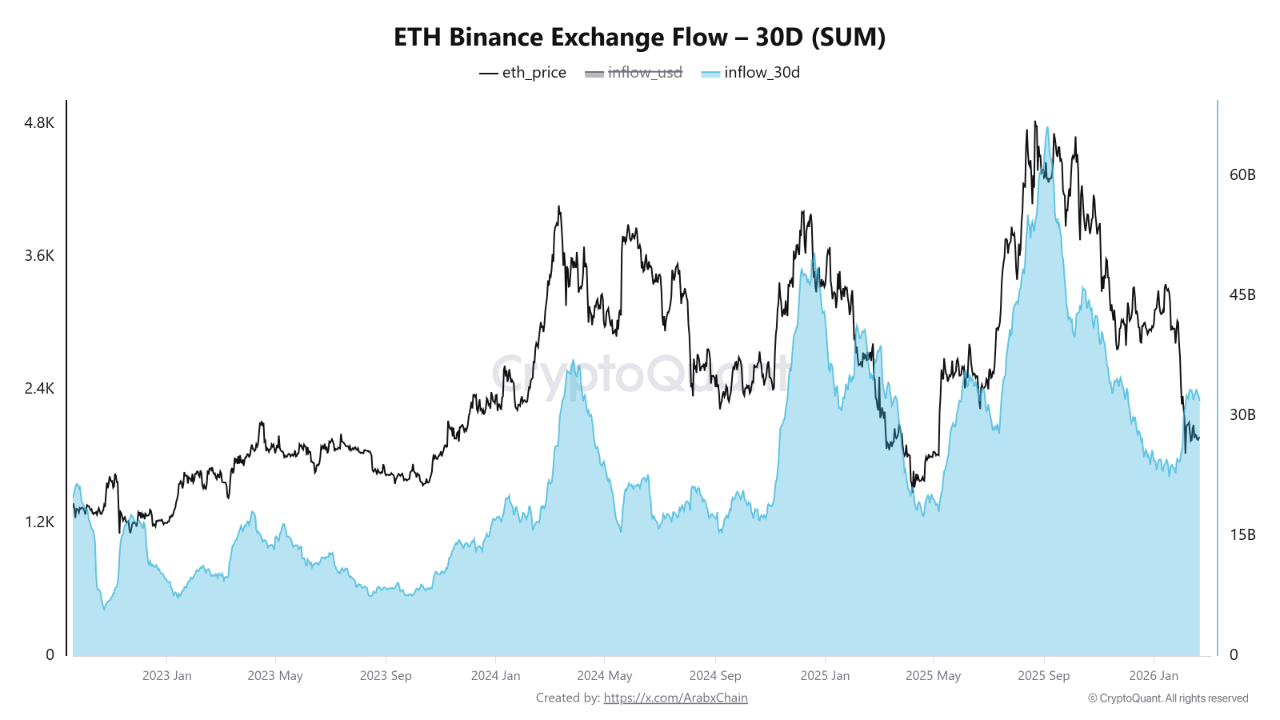
Ethereum Binance Exchange Flow | Source: CryptoQuant

In addition, strong inflow phases have occasionally preceded periods of price stabilization. When additional supply entering exchanges is met by sufficient demand, markets can transition into consolidation rather than extended declines. This dynamic often depends on broader liquidity conditions, derivatives positioning, and macro sentiment rather than inflows alone.

That said, registering the highest inflow level since last November places Ethereum in a structurally sensitive phase. The market’s reaction to these flows will likely provide clearer directional signals in the coming weeks. If the added supply translates into persistent sell-side pressure, downside risks could remain elevated. Conversely, if demand absorbs this liquidity effectively, the current phase may represent redistribution ahead of a more constructive move rather than sustained weakness.


Trending Cryptos

Related Questions

QWhat is the current price of Ethereum mentioned in the article and what key level is it struggling to hold?

AEthereum is currently trading near $1,955 and is struggling to hold above the $2,000 psychological level.

QAccording to the CryptoQuant report, what was the value of Ethereum inflows to Binance over the past 30 days and why is this significant?

AThe value of Ethereum inflows to Binance over the past 30 days was approximately $33.3 billion, which is the highest level recorded since last November, indicating a sharp increase in exchange activity.

QWhat are two possible interpretations of the large Ethereum inflows to exchanges, according to the article?

AThe inflows could indicate either bearish selling intent or a more neutral strategic repositioning, such as investors preparing to trade actively, hedge exposure, or adjust portfolio allocations.

QWhat potential market outcome can occur if the new supply of Ethereum on exchanges is met with sufficient demand?

AIf the additional supply entering exchanges is met by sufficient demand, the market can transition into a period of price stabilization and consolidation rather than extended declines.

QWhat will the market's reaction to the high inflows likely provide in the coming weeks, according to the article?

AThe market's reaction to these high inflows will likely provide clearer directional signals on whether the market will face sustained selling pressure or if demand-driven consolidation will occur.

Related Reads

Bitcoin Withdrawals Continue: 8 Years of Storage in a Coldcard Cold Wallet Ended in Zero

Coldcard Hardware Wallet Hacked: Losses Mount Due to Vulnerable Seed Generation A critical vulnerability in Coldcard hardware wallets has led to a continued wave of fund thefts. According to Galaxy Research, the total stolen has reached 1,367.05 BTC (approx. $88.6 million) from 4,585 addresses, a significant increase from the initial 594.5 BTC reported on July 30, 2026. Most of the stolen funds remain on the attackers' addresses. The issue is not with the current firmware, which Coinkite has updated, but with seed phrases generated on vulnerable devices between March 2021 and the release of fixed firmware versions. Due to a programmer error, devices switched from using a hardware random number generator to the software-based Yasmarang generator, which was initialized with publicly accessible data like the chip's serial number. This made the seed phrases predictable through offline brute-force attacks, meaning wallets remain at risk until funds are moved to a new wallet generated with the patched firmware. Affected devices include Mk2/Mk3 with firmware 4.0.1–4.1.9 (and up to 5.0.3), Mk4/Mk5 up to version 5.6.0, and Q models up to 1.5.0Q. The only exceptions are seeds created with a high-entropy method like at least 50 independent dice rolls or a strong unique BIP-39 passphrase. All other owners must generate a new seed on the fixed firmware and transfer their assets. A case highlighting the human impact involves a 39-year-old long-term investor who lost 2 BTC (approx. $130,000) in minutes. He had accumulated the Bitcoin over eight years through physical labor, viewing it as a financial lifeline and a retirement plan in a country suffering from hyperinflation. His story underscores that even conservative "buy and hold in cold storage" strategies can be compromised by such underlying technical flaws. From a technical perspective, this incident echoes historical failures where weak random number generators undermined cryptographic security, challenging the assumption that offline storage is automatically foolproof.

cryptonews.ru5h ago

Bitcoin Withdrawals Continue: 8 Years of Storage in a Coldcard Cold Wallet Ended in Zero

cryptonews.ru5h ago

Trading

Spot

Hot Articles

Discussions

Welcome to the HTX Community. Here, you can stay informed about the latest platform developments and gain access to professional market insights. Users' opinions on the price of ETH (ETH) are presented below.

活动图片














