The 1.5 Billion Deficit Narrows: XRP Futures Buying Pressure Improves As CVD Hits Four-Month High

bitcoinistPublished on 2026-03-13Last updated on 2026-03-13

Abstract

XRP is trading in a consolidation phase below $1.50 as the broader crypto market lacks clear momentum. Despite relatively quiet spot market activity, derivatives data indicate evolving demand dynamics. The XRP Binance Futures Taker CVD (90D), which measures the difference between aggressive buy and sell orders, shows a net taker delta of approximately 3.36 million XRP in favor of buyers in the latest session. Although the 90-day cumulative volume delta remains negative at around -1.58 billion XRP, it has been trending upward and recently hit its highest level since November 20. This suggests a gradual easing of selling pressure and a potential rebalancing of supply and demand in the futures market.

XRP continues to trade in a consolidation phase below the $1.50 level as the broader cryptocurrency market struggles to establish clear momentum. After experiencing sharp volatility earlier this year, price action has stabilized in recent sessions, with the asset moving sideways as traders reassess market conditions and liquidity flows.

While the spot market appears relatively quiet, derivatives data suggest that underlying demand dynamics may be evolving. Recent analysis based on the XRP Binance Futures Taker CVD (90D) indicator points to noticeable shifts in the structure of buying and selling pressure within the futures market.

The Taker Cumulative Volume Delta measures the cumulative difference between aggressive buy orders and sell orders executed directly in the market over a 90-day period. In practical terms, the indicator tracks whether market participants are predominantly entering positions through buy-side or sell-side market orders.

Because taker orders represent traders willing to cross the spread and execute immediately, this metric provides insight into real-time demand pressure rather than passive liquidity resting in the order book.

For analysts, monitoring changes in the 90-day Taker CVD can reveal whether bullish or bearish sentiment is gaining traction among leveraged traders, offering a deeper perspective on market positioning beyond the price movements observed in the spot market.

XRP Futures Data Shows Gradual Improvement in Buy-Side Pressure

A CryptoQuant report highlights subtle but meaningful changes in the structure of demand within the XRP futures market. According to the latest data from Binance, aggressive buy orders totaled approximately 516.4 million XRP during the most recent session, while sell orders reached around 513.1 million XRP. This produced a net taker delta of roughly 3.36 million XRP in favor of buyers, indicating a slight advantage for market participants entering long positions through market orders.
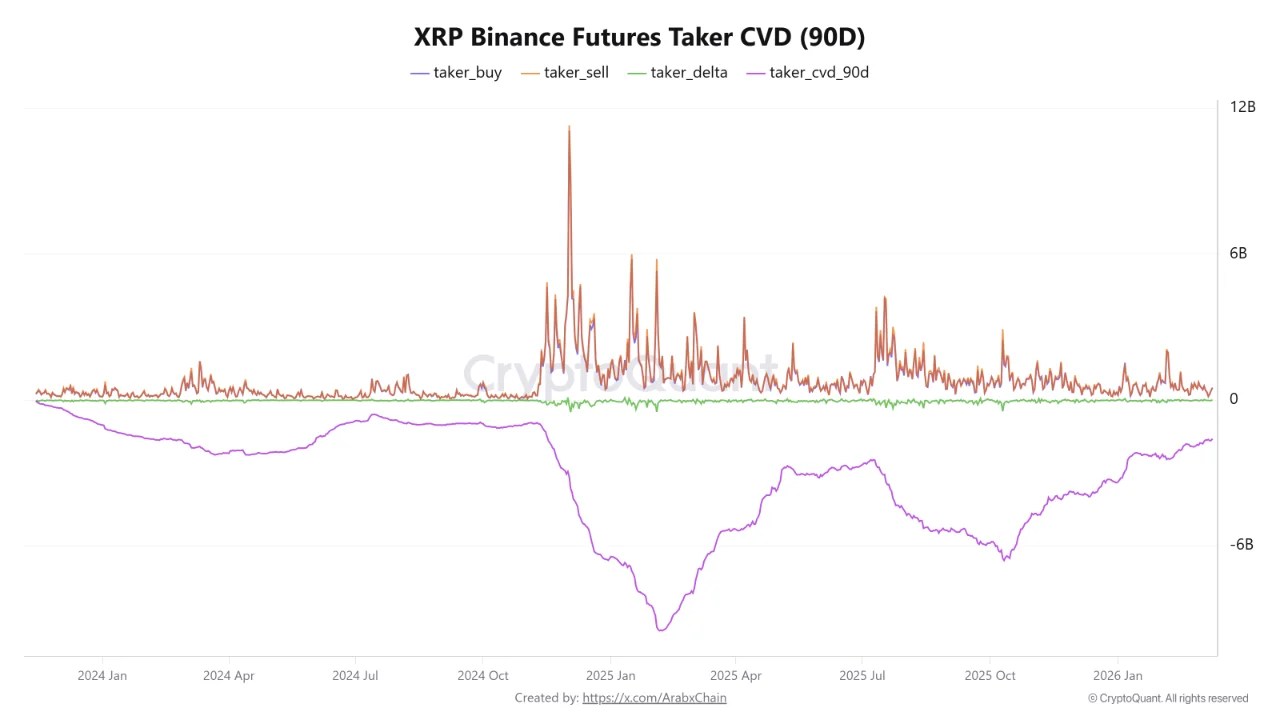
XRP Binance Futures Taker CVD | Source: CryptoQuant

Although the difference between buy and sell activity remains relatively small, the shift suggests that selling pressure in the derivatives market may be gradually easing after dominating for several months.

From a broader perspective, the 90-day cumulative volume delta (CVD) remains negative, currently standing near -1.58 billion XRP. However, the indicator has been trending upward and recently reached its highest level since November 20. This improvement reflects a gradual reduction in the aggressive sell-side flows that previously defined the futures market structure.

At the same time, trading activity remains elevated. Futures markets continue to process hundreds of millions of XRP in daily taker orders, highlighting sustained participation from leveraged traders.

If this upward trajectory in CVD persists, analysts suggest it could mark the early stages of a rebalancing between supply and demand forces within the derivatives market.


Trending Cryptos

Related Questions

QWhat does the XRP Binance Futures Taker CVD (90D) indicator measure?

AThe Taker Cumulative Volume Delta measures the cumulative difference between aggressive buy orders and sell orders executed directly in the market over a 90-day period, indicating whether traders are predominantly entering positions through buy-side or sell-side market orders.

QWhat was the net taker delta for XRP in the most recent session, and what does it indicate?

AThe net taker delta was approximately 3.36 million XRP in favor of buyers, indicating a slight advantage for market participants entering long positions through market orders.

QWhat is the current value of the 90-day cumulative volume delta (CVD) for XRP, and what does this value signify?

AThe 90-day cumulative volume delta (CVD) is currently near -1.58 billion XRP. This negative value signifies that aggressive sell orders have historically outweighed buy orders over this period, though the indicator has been improving recently.

QAccording to the article, what could a persistent upward trajectory in the CVD indicate for the XRP futures market?

AA persistent upward trajectory in the CVD could mark the early stages of a rebalancing between supply and demand forces within the derivatives market, suggesting that selling pressure is easing and bullish sentiment may be gaining traction.

QHow does the taker CVD metric provide insight different from just observing the spot market price?

AThe taker CVD metric provides insight into real-time demand pressure from leveraged traders who are actively executing orders, offering a deeper perspective on market positioning and sentiment that may not be immediately apparent from spot price movements alone.

Related Reads

Can Generative Models Finally Be Trained End-to-End? The Core Is a For Loop

This article introduces a novel training paradigm for generative models called Explorative Modeling (XM), which enables true end-to-end training. Traditionally, powerful generative models like autoregressive and diffusion models are not trained end-to-end. They are trained to predict a single small step but require iterative multi-step sampling for inference. This "exposure bias" leads to error accumulation and limits performance. The core challenge XM addresses is "mode blurring." In generative tasks, a single input (e.g., "generate a dog") corresponds to many valid outputs (multiple modes). Standard training objectives like reconstruction loss force the model to average these modes, producing unrealistic, blurry outputs. To avoid this, existing models break generation into many small, almost deterministic steps, sacrificing end-to-end training. XM tackles this by restructuring the training loop itself. Its key insight is to amplify "generative expressivity." For each training input, instead of generating one sample, the model generates K candidate outputs. Only the candidate closest to the real data is used for computing the loss and updating the model via backpropagation. This simple "best-of-K" mechanism is implemented as a short for-loop. By exploring multiple possibilities, the model learns to distribute its guesses across different modes rather than collapsing to their uninformative average. The paper demonstrates that "exploration" acts as a new, powerful scaling axis. Gains from XM increase with model size, data scale, and compute. Experiments show improvements in FID scores for image generation and significant efficiency gains, sometimes outperforming larger models without exploration. When pushed to the limit, XM enables fully single-step, end-to-end generative models. In robotics tasks, an "Explorative Policy" matched the performance of a 100-step Diffusion Policy with a single forward pass, drastically improving inference speed. While the best-of-K concept is not entirely new, the authors' contribution lies in formally understanding it as a direct method to boost generative expressivity without fragmenting the generation process. This work suggests that as models scale, enhancing exploration during training may become crucial for overcoming fundamental performance bottlenecks.

marsbit10m ago

Can Generative Models Finally Be Trained End-to-End? The Core Is a For Loop

marsbit10m ago

Annual Salary of Millions Competing for Electricians, Meta Rushes to Open Its Own Technical School

The AI boom is facing an unexpected bottleneck: a severe shortage of skilled construction workers and electricians. As tech giants like Meta, OpenAI, and Alphabet race to build massive data centers—such as OpenAI's $16 billion "Stargate" project—they are hitting a critical labor wall. The U.S. needs an estimated 130,000 more electricians, 240,000 construction workers, and 150,000 supervisors by 2030 for AI infrastructure alone, but tens of thousands of electrician jobs go unfilled each year. While AI companies offer high premiums, with electricians earning up to $280,000 annually, worker scarcity still causes massive losses—delays on a single project can cost $14.2 million per month. The complexity of building AI data centers, which require immense power (equivalent to powering hundreds of thousands of homes), sophisticated electrical systems, and advanced liquid cooling solutions, demands highly skilled technicians who are in short supply. To combat this, companies are investing heavily in training. Meta has committed $115 million to a free training school offering tuition, housing, and stipends, targeting 5,000 new workers. OpenAI is partnering with unions to secure skilled labor. These efforts are paying off, with a significant rise in Gen Z interest in trade schools over college. However, the power demands are staggering. AI data centers are driving a rapid surge in electricity consumption, projected to account for up to 12% of U.S. power use by 2028 and raising costs for consumers. Furthermore, the construction boom is project-based, leading to a potential future glut of trained workers once building peaks, which could depress wages industry-wide. The race for AI supremacy now depends as much on skilled hands as on advanced chips.

marsbit1h ago

Annual Salary of Millions Competing for Electricians, Meta Rushes to Open Its Own Technical School

marsbit1h ago

Trading

Spot

Hot Articles

What is XRP 2.0

XRP 2.0: A New Frontier in the Cryptocurrency Landscape Introduction to XRP 2.0 In the ever-evolving realm of cryptocurrency, new projects continuously emerge, vying for attention and adoption. One such promising initiative is XRP 2.0, a novel cryptocurrency project designed to leverage advanced blockchain technology and robust encryption methodologies. While the name draws parallels with Ripple’s XRP, it’s crucial to note that XRP 2.0 operates independently, focusing on enhancing transaction security, privacy, and scalability. As the digital financial landscape increasingly embraces decentralized solutions, XRP 2.0 aims to contribute meaningfully to web3 and the overall expansion of crypto projects. What is XRP 2.0? At its core, XRP 2.0 is a cryptocurrency project that aims to create a secure and decentralized digital currency ecosystem. Its foundational technology integrates sophisticated blockchain principles with cutting-edge encryption techniques. The overarching goal of XRP 2.0 is to establish itself as a reliable and efficient platform enabling swift transaction execution while prioritizing enhanced privacy protections for its users. The project is promoted as a solution to many limitations faced by existing cryptocurrencies, proposing a system that can handle a higher volume of transactions with improved speed and privacy. This versatility positions XRP 2.0 as a significant contender in a marketplace riddled with various digital currencies. Who is the Creator of XRP 2.0? The identity of the creator behind XRP 2.0 has been flagged as ‘Wilbur.’ However, comprehensive details regarding Wilbur or their associated entity remain elusive. The anonymity of many cryptocurrency creators is not an uncommon phenomenon in the industry, often designed to maintain a degree of privacy and security. Who are the Investors of XRP 2.0? As of now, specific information related to the investment foundations or organizations supporting XRP 2.0 is not publicly available. In the cryptocurrency sector, the backing by reputed investors can significantly influence a project's credibility and success, yet the transparency regarding the financial supporters of XRP 2.0 has not been established. How Does XRP 2.0 Work? XRP 2.0 stands out by employing a combination of blockchain technology and advanced encryption algorithms that ensures secure and decentralized transactions. Its innovative structure includes unique features designed to foster user engagement and broaden functionalities beyond conventional cryptocurrency transactions. Among these features, XRP 2.0 incorporates AI-powered capabilities, such as text-to-image and text-to-speech functionalities. These additions are designed to enhance the interactive experience for users, promoting broader applicability across various sectors. By bridging technological advancements with user-centered design, XRP 2.0 aims to capture the attention of a diverse range of individuals and enterprises looking to integrate cryptocurrency solutions into their operational frameworks. Timeline of XRP 2.0 Understanding XRP 2.0 requires examining the milestones that have defined its journey thus far: July 23, 2023: XRP 2.0 is introduced as a novel cryptocurrency project, aiming to revolutionize secure and decentralized transaction capabilities in the blockchain domain. September 8, 2023: The launching of another project, XRP20, occurs, marking the emergence of an ERC-20 token on the Ethereum blockchain that remains unrelated to XRP 2.0. November 13, 2023: The XRP Ledger undergoes a significant update with the release of rippled server software version 2.0.0. It is essential to note that this development is disconnected from the XRP 2.0 cryptocurrency project. Key Points About XRP 2.0 To distill the essence of XRP 2.0, several critical factors emerge: Unique Features: The inclusion of features like AI-powered text-to-image and text-to-speech further diversifies the potential applications of XRP 2.0. Blockchain Technology: The framework utilizes advanced blockchain mechanisms and encryption protocols, ensuring a secure and decentralized environment for transactions. Scalability and Privacy: XRP 2.0 prioritizes enhanced privacy protections in transaction processes and the scalability necessary to accommodate a growing user base. No Affiliation with Ripple: Importantly, despite its name, XRP 2.0 does not have any allegiance or collaboration with Ripple’s XRP, distinguishing its operational framework and objectives within the cryptocurrency ecosystem. Conclusion XRP 2.0 represents an ambitious venture into the cryptocurrency sphere, aiming to offer a combination of security, privacy, and efficiency in digital transactions. By integrating sophisticated technologies and user-friendly features, the project sets out to broaden the horizons of what cryptocurrency can achieve in today's digital economy. While the anonymity of its creator and lack of disclosed investors might raise questions for some, XRP 2.0's focus on advanced functionalities and decentralisation enhances its appeal amidst an increasingly crowded crypto market. As the cryptocurrency landscape continues to evolve, XRP 2.0 may yet emerge as a pivotal player in the expansion of secure and scalable blockchain solutions.

1.3k Total ViewsPublished 2024.04.01Updated 2024.12.03

What is XRP 2.0

Discussions

Welcome to the HTX Community. Here, you can stay informed about the latest platform developments and gain access to professional market insights. Users' opinions on the price of XRP (XRP) are presented below.

活动图片














