Telegram’s Lighter integration fuels HYPE – Breakout toward $42 IF…

ambcryptoPublished on 2026-04-07Last updated on 2026-04-07

Abstract

Telegram's integration with Lighter brought attention to Hyperliquid (HYPE), but a significant whale moved against the trend by selling 12.2K HYPE ($449.1K) and placing an additional 10.4K HYPE sell order ($386K), while withdrawing $1.26M in USDC. This activity, following the whale's exit from large long positions, created a divergence between the bullish narrative and capital flow. HYPE maintained a bullish flag pattern, trading between support at $35.37 and resistance at $38. While the structure remained intact with buyers stepping in at lower levels, failure to break $38 indicated hesitation. A breakout toward $42.10 was possible if resistance was overcome. The RSI showed weakening buying pressure, stabilizing near 49.18. Short liquidations dominated recent activity ($26.58K vs. $4.14K long liquidations), supporting upward pressure and short squeezes. However, the funding rate, though positive at 0.0008%, was declining, signaling reduced conviction among longs. This aligned with whale distribution, suggesting weakened confidence. The overall setup remained constructive but faced headwinds near resistance, leaving a breakout uncertain.

Telegram’s Lighter integration drew attention to Hyperliquid. However, a large whale moved in the opposite direction immediately.
Source: Onchain Lens

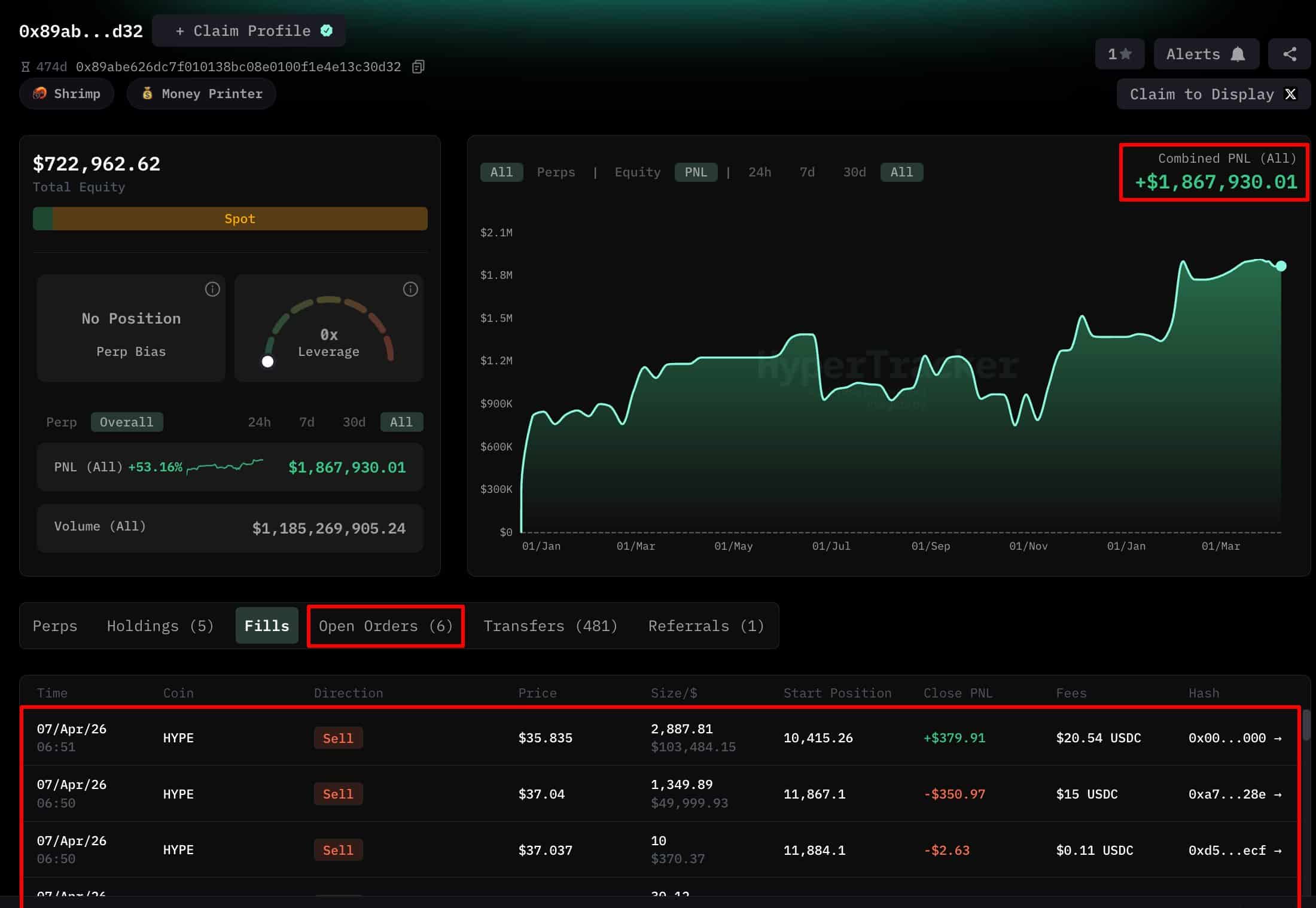
The whale dumped 12.2K HYPE worth $449.1K and placed another 10.4K HYPE sell order worth $386K. He also withdrew $1.26M in USDC, reducing exposure.

That move followed his exit from multi-million dollar HYPE longs after the 3rd of April. His $1.72M+ lifetime PnL suggested calculated positioning.

However, this created a divergence between the bullish narrative and capital flow. That shift raised concerns about distribution in strength.

Bullish flag holds as HYPE compresses

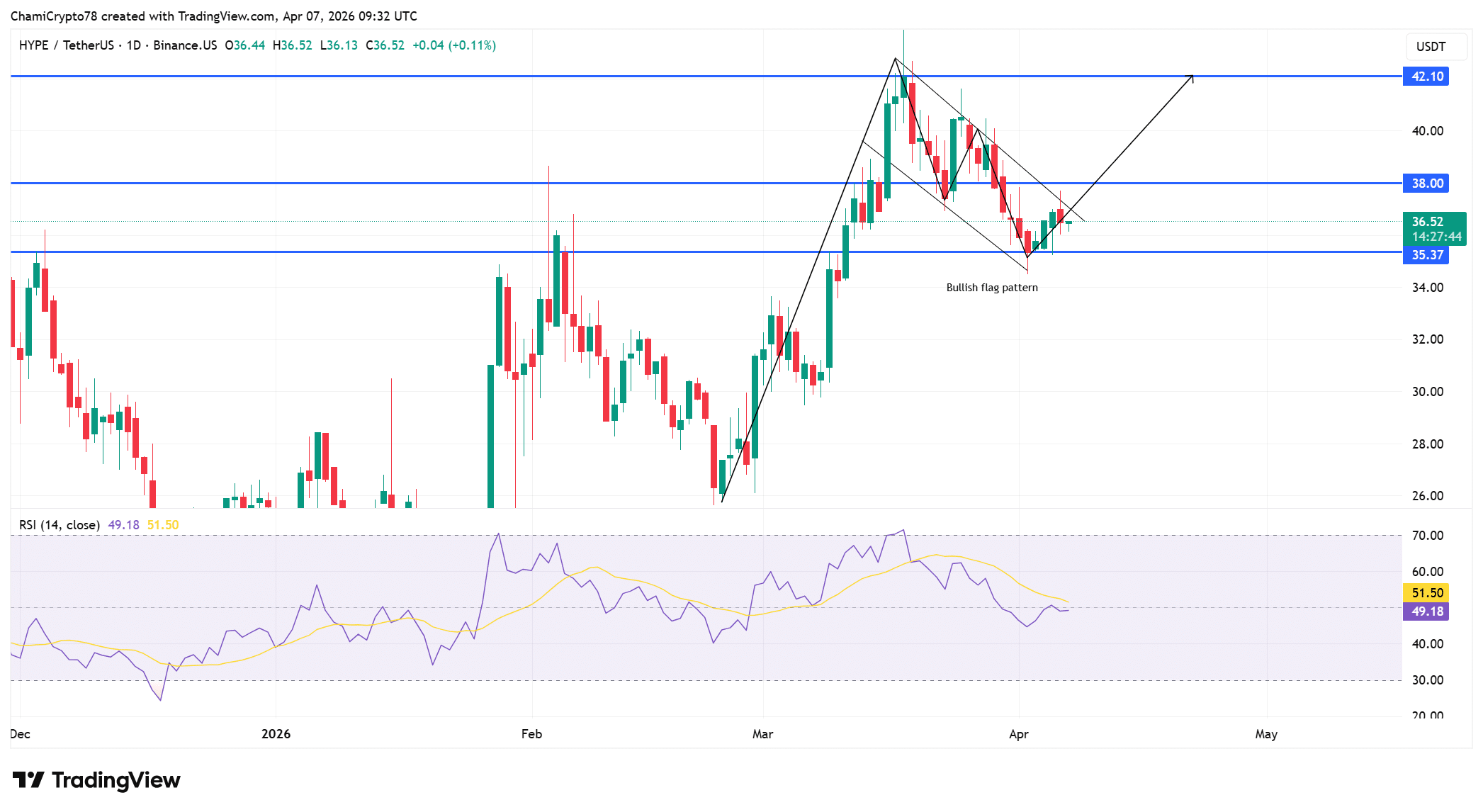
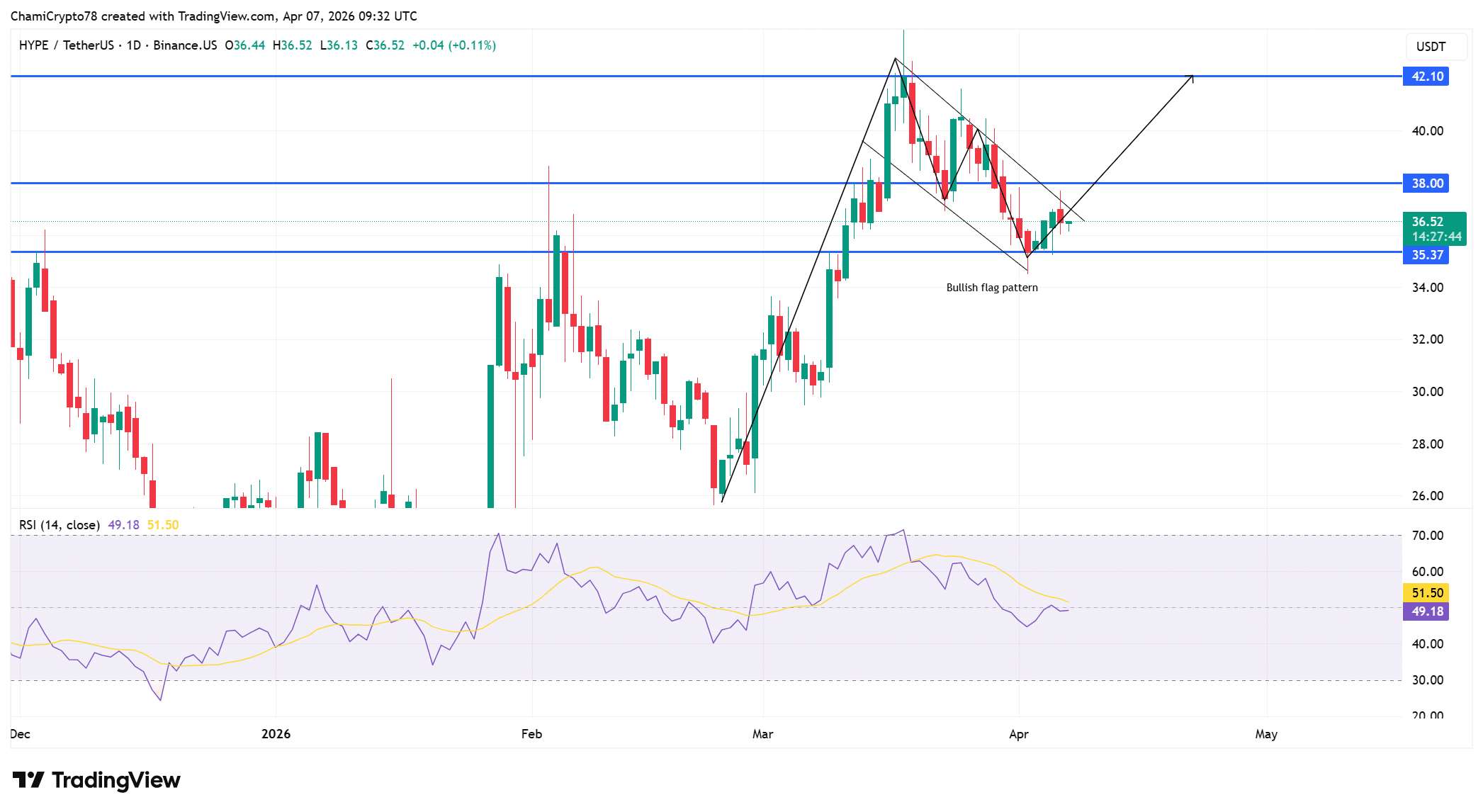
HYPE maintained a bullish flag after rallying toward $42.10. Price pulled back into a descending channel, forming the structure.

The asset traded between $35.37 support and $38 resistance, showing controlled consolidation. Each lower-bound retest attracted buyers, preserving structure.

However, Hyperliquid [HYPE] failed to reclaim $38 decisively, signaling hesitation near resistance. This left the market waiting for a breakout.

A move toward $42.10 remained likely if resistance broke.

RSI stabilized near 49.18, with its moving average near 51.50. The indicator cooled after nearing overbought levels around 70.

Lower highs on RSI suggested weakening buying pressure.
Source: TradingView

HYPE short liquidations dominate recent activity

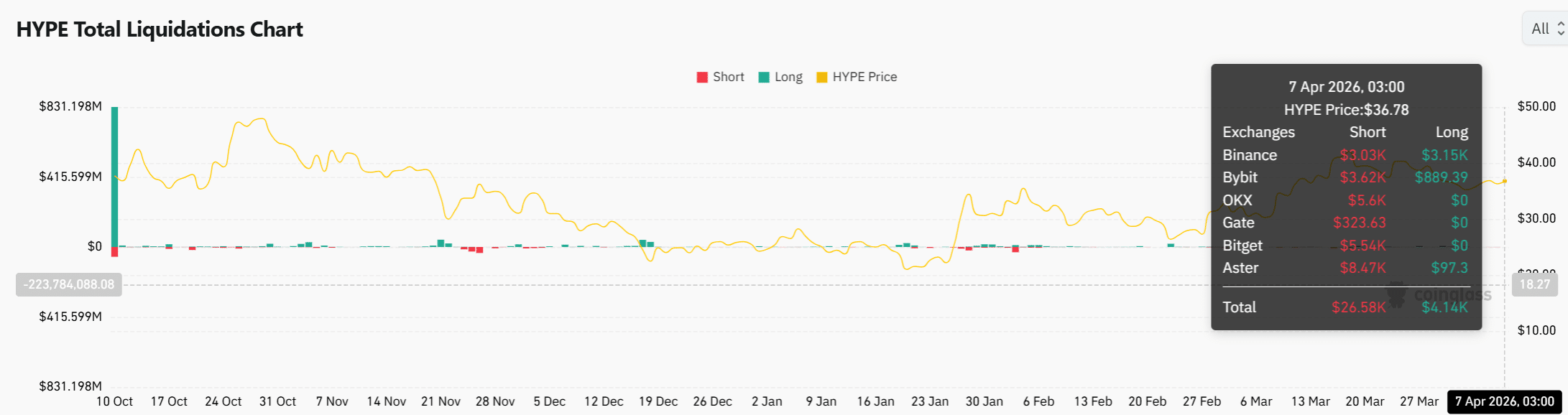
The Liquidation chart had shown that short liquidations had outweighed long liquidations, reinforcing upward pressure in the market.

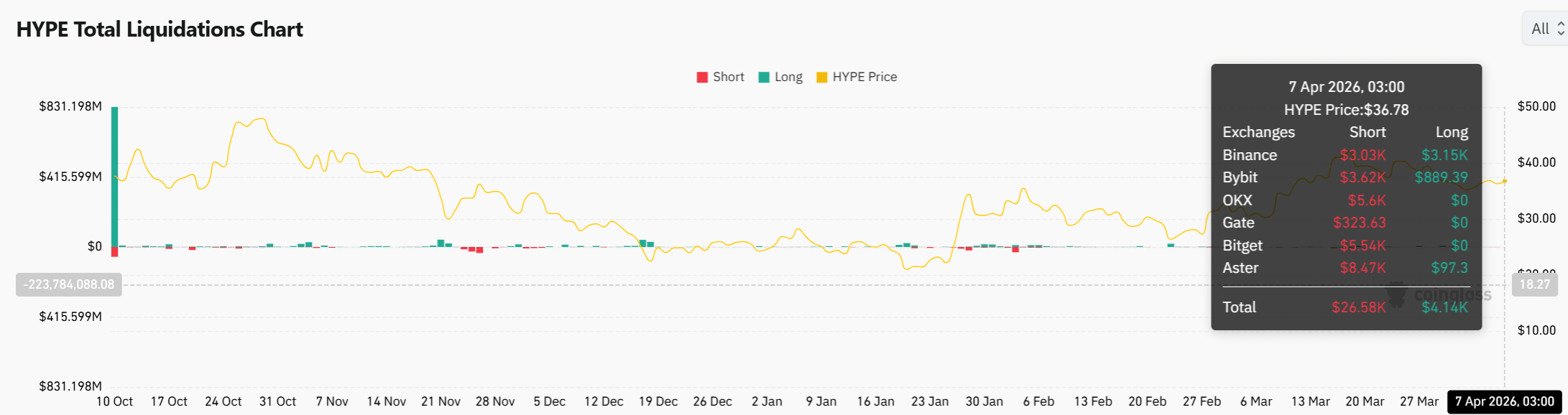
Recent figures had recorded $26.58K in short liquidations compared to $4.14K in long liquidations.

This imbalance had indicated that bearish positions had been forced out as the price held above key levels.

As a result, the market had experienced localized short squeezes, which had supported price stability within the flag.

However, the absence of large liquidation spikes had suggested controlled volatility rather than aggressive expansion.

Liquidity had continued to build around the $35.37 support and $38 resistance zones, leaving the market positioned for a decisive move.
Source: CoinGlass

Funding stays positive but weakens

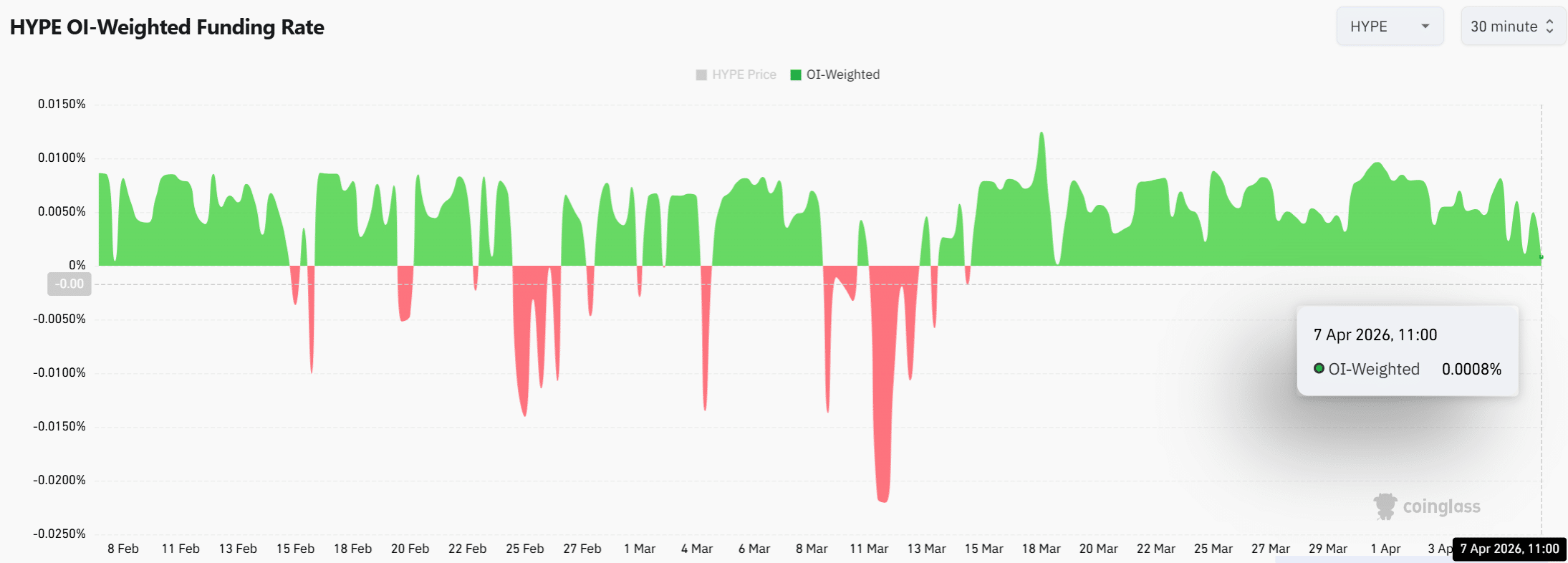
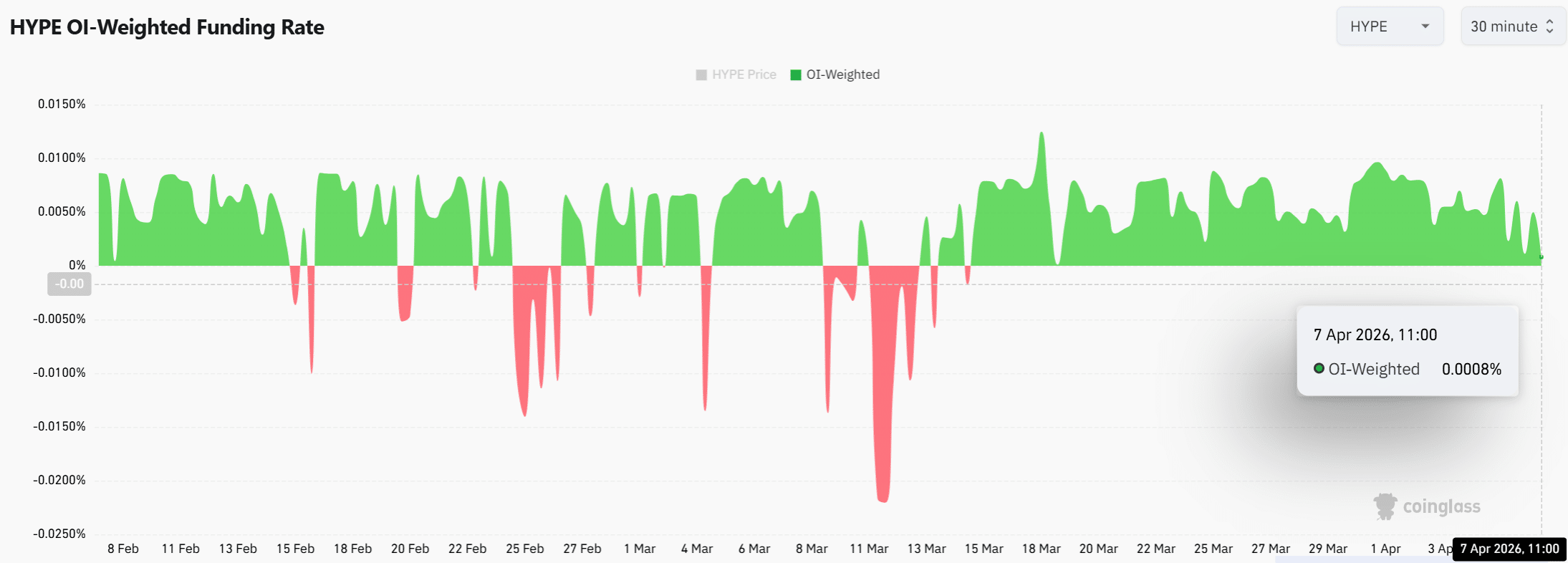
The OI-Weighted Funding Rate remained positive at 0.0008% on the 7th of April, confirming long dominance.

However, Funding Rates trended downward, signaling weakening conviction among longs.

Traders showed less willingness to pay premiums, reflecting caution near resistance.

That decline contrasted with a bullish price structure and short liquidations. It also aligned with whale-selling activity.

This suggested confidence had not fully backed further upside.
Source: CoinGlass

Can HYPE sustain a breakout?

HYPE had retained a bullish structure, supported by short liquidations and stable price action. However, declining funding rates and whale distribution had introduced clear hesitation.

The setup had remained constructive, yet conviction had weakened near resistance.

A breakout had remained possible, though underlying signals had suggested that upside strength might face immediate pressure.


Final Summary

  • HYPE held a bullish flag between $35.37 support and $38 resistance, showing controlled consolidation rather than a breakdown.
  • Repeated rejection near $38 indicated hesitation, with buyers unable to confirm a breakout yet.

Related Questions

QWhat was the impact of Telegram's Lighter integration on Hyperliquid (HYPE)?

ATelegram's Lighter integration drew significant attention to Hyperliquid (HYPE), creating a bullish narrative for the asset.

QWhat significant trading activity did a large whale perform that contradicted the bullish sentiment?

AA large whale dumped 12.2K HYPE worth $449.1K, placed a 10.4K HYPE sell order worth $386K, and withdrew $1.26M in USDC, reducing their exposure and moving in the opposite direction of the bullish trend.

QWhat is the key price range HYPE was trading within, and what does it signify?

AHYPE was trading between the $35.37 support level and the $38 resistance level, which signifies a period of controlled consolidation within a bullish flag pattern.

QWhat did the liquidation data reveal about market pressure for HYPE?

AThe liquidation data showed that short liquidations ($26.58K) significantly outweighed long liquidations ($4.14K), indicating upward pressure as bearish positions were being forced out, supporting price stability.

QWhat was the trend of the Funding Rate, and what does it suggest about trader sentiment?

AThe OI-Weighted Funding Rate remained positive but was trending downward, signaling that while long positions were still dominant, conviction among longs was weakening and traders were showing caution near the resistance level.

Related Reads

The Shutdown of Claude Mythos Revealed the True Cost of Renting AI to Me

The sudden shutdown of Claude Mythos this week starkly highlights a critical, often overlooked risk for founders: when your core capability relies entirely on someone else's platform, your fate is not in your own hands. The key question becomes: who truly owns the intelligence your product depends on? For years, the debate around open-source models focused on cost. Now, the evidence is clear: fine-tuned open-source models can achieve frontier-level quality for specific, mission-critical tasks at a fraction of the cost. However, the deeper issue is control. Relying on a third-party API is like renting; it works until the landlord changes the rules, raises the rent, or asks you to leave—as Mythos experienced. The lesson is not to stop using frontier models—they are incredible infrastructure. The goal is ownership. Ownership means starting with a powerful open-source model and shaping it around what makes your company unique: your data, workflows, domain expertise, and definition of "good." Over time, the model becomes less generic and more reflective of your business, creating durable value. The optimistic conclusion is that AI's future doesn't hinge on one superior model. There is no single frontier. The frontier includes proprietary models, models fine-tuned on company-specific knowledge, specialized models for narrow problems, and intelligent routers orchestrating model ensembles. The most interesting development is not models getting smarter, but intelligence becoming increasingly customizable. The winning companies will be those that transform intelligence into a unique, owned asset. Looking ahead, the vision is not one model dominating all, but many teams owning the part of the frontier that matters most to them.

marsbit10m ago

The Shutdown of Claude Mythos Revealed the True Cost of Renting AI to Me

marsbit10m ago

Tiger Research: U.S. Strategic Bitcoin Reserve - Should the Market Be Happy or Disappointed?

Tiger Research analyzes the evolution of U.S. legislative efforts regarding a strategic Bitcoin reserve, concluding the market impact is limited in the short term but potentially positive long-term. The core event was a March 2025 executive order by former President Trump, which designated confiscated Bitcoin as a strategic reserve and promised not to sell existing holdings (approx. 190k BTC). As it contained no mandate to purchase new Bitcoin, the market reacted negatively, with prices dropping 5.7%. Legislative history shows a significant retreat from initial ambitions. The 2024 "BITCOIN Act" proposed mandatory purchases of 1 million BTC over five years. Reintroduced in 2025, it stalled due to high fiscal costs, concerns over dollar hegemony, and opposition from the Treasury Secretary. The current frontrunner, the 2026 "American Retirement and Monetary Advancement (ARMA) Act," is a compromise. It lacks any purchase requirement, instead focusing on consolidating existing government-held Bitcoin and legally prohibiting its sale for at least 20 years. While ARMA has higher passage odds due to bipartisan support and no purchase mandate, its immediate market effect is neutral. It eliminates potential government selling pressure but creates no new demand. The long-term significance is that formally establishing Bitcoin as a national reserve asset in law could later reignite debates on mandatory purchases. Therefore, the path to a government buyer is longer than initially priced by the market, but the directional narrative remains intact.

marsbit13m ago

Tiger Research: U.S. Strategic Bitcoin Reserve - Should the Market Be Happy or Disappointed?

marsbit13m ago

US Stock Market Trend (June 16): SpaceX Rises 42% in Two Days, New Fed Chairman Takes Office Today

**U.S. Stocks Trend (June 16): SpaceX Soars 42% in Two Days, New Fed Chair Takes Office Today** Markets surged on Monday following former President Trump's social media announcement of a completed U.S.-Iran deal to reopen the Strait of Hormuz, pending a June 19 signing. The news triggered a broad risk-on rally: oil prices crashed, tech stocks soared, bond yields fell, and defensive sectors lagged. **Market Performance:** The Nasdaq jumped 3.07%, led by semiconductor stocks like Micron (+9.2%). The S&P 500 gained 1.65%, and the Dow rose 0.92% to a record high. However, the Russell 2000 small-cap index underperformed (+0.72%). SpaceX continued its hot streak, rising another 5% pre-market after disclosures of large buys by an Australian billionaire and Cathie Wood's ARK. Boeing also rallied on the transportation optimism. Conversely, energy stocks like Chevron fell over 3% on the oil price plunge, with other defensive sectors also selling off. The day's action showed a clear rotation of funds from energy/defensive plays into AI and tech narratives. **Macro & Outlook:** The VIX fear index fell 8.37%. Treasury yields declined, and WTI crude dropped over 5%. Attention now shifts to a packed schedule: the Bank of Japan is widely expected to hike rates to 1.0% on Tuesday. The Fed's June meeting concludes Wednesday, marking new Chair Wash's debut. While rates are expected to hold, his tone on stubborn inflation and the "dot plot" will be crucial for gauging the 2024 rate path. The formal Iran deal signing is set for Friday. **Trend Perspective:** While the peace deal is a genuine positive, Monday's explosive rally may have gotten ahead of itself, pricing in a swift resolution to inflation concerns. The shortened trading week faces a triple test: BoJ tightening, the Fed's policy stance, and deal implementation details. Tech and semiconductors, which led the surge, remain vulnerable to any disappointment from these key events. The real price discovery begins with the central banks' communications this week.

marsbit34m ago

US Stock Market Trend (June 16): SpaceX Rises 42% in Two Days, New Fed Chairman Takes Office Today

marsbit34m ago

Xiaohongshu's Second Great Voyage, This Time Sailing Towards AI

Xiaohongshu's Second Voyage: Navigating Towards AI Since ChatGPT's emergence, Xiaohongshu's founder Mao Wenchao has been acutely aware of AI's potential threat, recognizing that the life advice people seek from chatbots overlaps directly with his platform's core business. Founded in 2013 as a PDF shopping guide for Chinese tourists, Xiaohongshu evolved into a massive community where millions share authentic, personal experiences—from product reviews to travel tips. This vast repository of "I've tried this" human judgment became its most valuable asset. However, the rise of AI, which delivers instant answers, challenges the very need for users to sift through numerous personal notes. Fearing its treasure trove of lived experience could become mere training data for others, Xiaohongshu is proactively adapting. In 2026, it established a dedicated AI division (Dots), launched RED Skill to turn user experiences into usable AI tools, and acquired the AI search product "Diandian." Its investments now extend to AI firms like MiniMax and hardware startups, moving upstream to address needs before they even become search queries. The platform's commercialization strategy is also evolving. With a newly acquired payment license and tools like the AIPS model to track consumer decision journeys, Xiaohongshu aims to seamlessly integrate recommendations with transactions, embedding commerce within AI-generated answers. Yet, a critical tension remains. While building smarter machines to organize and leverage its human experiences, Xiaohongshu must prevent AI from drowning out the authentic, flawed, and trustworthy "I've tried this" voices that built its community. Its core challenge is to harness AI's power without letting the map—the machine's perfect, synthesized answer—replace the territory of genuine human experience. This balance between technological advancement and preserving human trust defines its current journey and its future.

marsbit1h ago

Xiaohongshu's Second Great Voyage, This Time Sailing Towards AI

marsbit1h ago

Trading

Spot
Futures

Hot Articles

How to Buy TON

Welcome to HTX.com! We've made purchasing TONCOIN (TON) simple and convenient. Follow our step-by-step guide to embark on your crypto journey.Step 1: Create Your HTX AccountUse your email or phone number to sign up for a free account on HTX. Experience a hassle-free registration journey and unlock all features.Get My AccountStep 2: Go to Buy Crypto and Choose Your Payment MethodCredit/Debit Card: Use your Visa or Mastercard to buy TONCOIN (TON) instantly.Balance: Use funds from your HTX account balance to trade seamlessly.Third Parties: We've added popular payment methods such as Google Pay and Apple Pay to enhance convenience.P2P: Trade directly with other users on HTX.Over-the-Counter (OTC): We offer tailor-made services and competitive exchange rates for traders.Step 3: Store Your TONCOIN (TON)After purchasing your TONCOIN (TON), store it in your HTX account. Alternatively, you can send it elsewhere via blockchain transfer or use it to trade other cryptocurrencies.Step 4: Trade TONCOIN (TON)Easily trade TONCOIN (TON) on HTX's spot market. Simply access your account, select your trading pair, execute your trades, and monitor in real-time. We offer a user-friendly experience for both beginners and seasoned traders.

14.7k Total ViewsPublished 2024.03.29Updated 2026.06.02

How to Buy TON

Discussions

Welcome to the HTX Community. Here, you can stay informed about the latest platform developments and gain access to professional market insights. Users' opinions on the price of TON (TON) are presented below.

活动图片