Tech Stock Sell-Off Pauses, Nasdaq Futures Up 0.1%, VIX Index Surges 7%, Silver Plunges Another 10%, Bitcoin Falls Below $70,000

华尔街日报Published on 2026-02-05Last updated on 2026-02-05

Abstract

Global markets extended their sell-off on Thursday, with tech stocks and commodities facing significant declines. The Nasdaq 100 recorded its worst two-day drop since October, breaching its 100-day moving average. Losses spread from the U.S. to Asia, with foreign investors selling a record $3.4 billion worth of Korean Kospi shares. Silver plunged over 16%, gold fell more than 3%, and iron ore dropped toward $100 per ton. Bitcoin also declined, falling below $71,000. European stocks opened mixed as investors shifted toward defensive sectors amid concerns over AI-driven valuations, rising capital expenditure, and potential profit erosion in tech business models. Oil prices fell as geopolitical tensions eased slightly.

The global sell-off triggered by concerns over AI spending and tech stock valuations deepened on Thursday, with tech stocks continuing to decline from the US market to Asian markets, while commodities like silver also experienced a historic plunge, putting multiple markets under simultaneous pressure.

European stocks opened mixed, with Maersk down 7%. On Thursday, foreign investors net sold a record 4.99 trillion won ($34 billion) worth of Korean Kospi index constituents. Institutional investors also net sold 2.07 trillion won worth of Kospi index constituents. In after-hours US trading, Alphabet, Qualcomm, and Arm Holdings continued to slide due to平淡的earnings reports, further dampening market sentiment. The Nasdaq 100 index recorded its worst two-day decline since last October and fell below the 100-day moving average.

The precious metals market was also hit hard. Silver plunged up to 17% on Thursday, and gold fell up to 3.5%, as both commodities continued to search for a price bottom after last Friday's historic sell-off. Iron ore prices fell towards $100 per ton on Thursday, affected by seasonal slowdowns, softening market supply-demand balance, and a general decline in metals.

This wave of selling swept through the stocks, bonds, and loans of several Silicon Valley companies, wiping out hundreds of billions of dollars in market value in two days. As the US economy performs strongly, investors are turning to other sectors, with concerns over tech stock valuations, soaring capital expenditures, and the potential for AI to erode existing software business models intensifying.

  • European stocks opened mixed: Euro Stoxx 50 up 0.05%, Germany's DAX down 0.19%, UK's FTSE 100 down 0.3%, France's CAC 40 up 0.2%. Vodafone fell 4.6% as its earnings showed organic service revenue growth missed expectations; wind power giant Vestas fell 4.9%; BNP Paribas rose 4.7% on profits exceeding expectations and raised targets; Maersk fell 7% as the company expects 2026 profits to decline; Volvo Cars fell 14% on Q4 revenue below expectations.
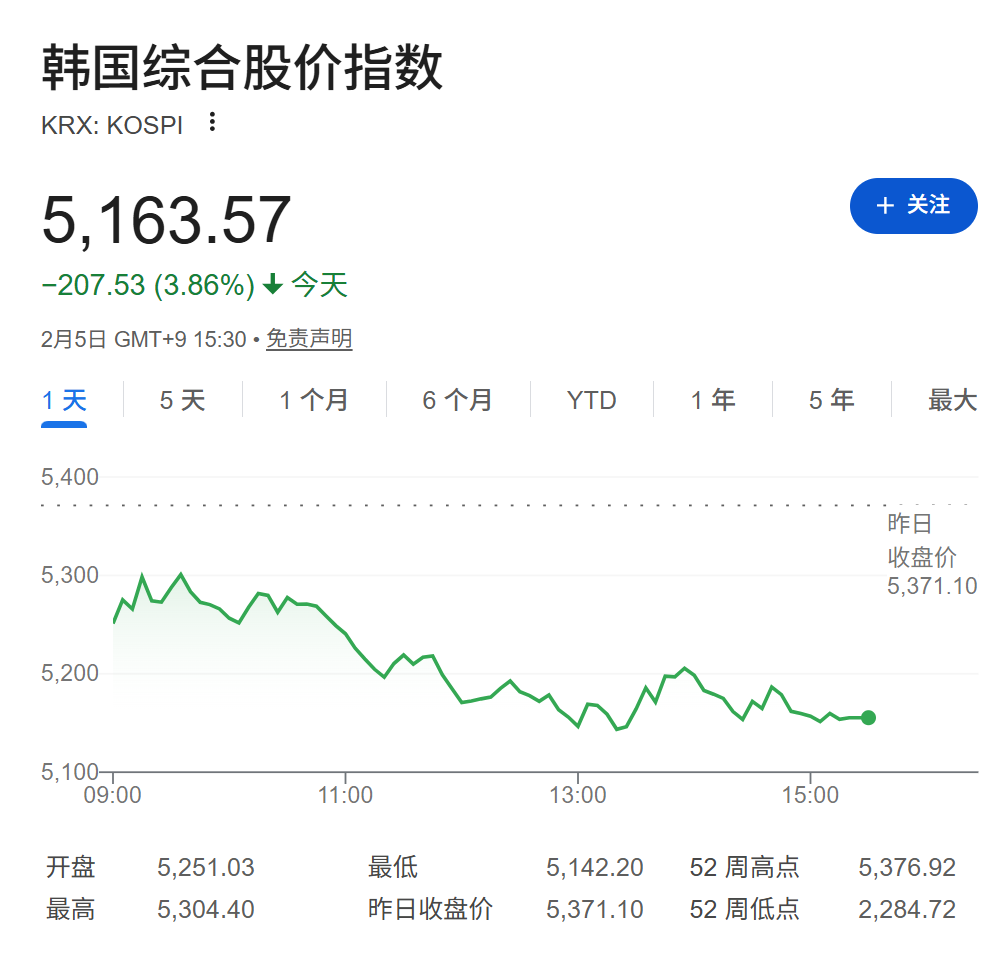
  • Japan's Nikkei 225 closed down 0.9% at 53,818.04 points. Japan's Topix index closed down 0.1% at 3,652.41 points. South Korea's Kospi closed down 3.9% at 5,163.57 points.
  • The US Dollar Spot Index rose 0.1%.
  • The US 10-year Treasury yield fell 1 basis point to 4.26%.
  • Japan's 10-year government bond yield fell 1.5 basis points to 2.235%.
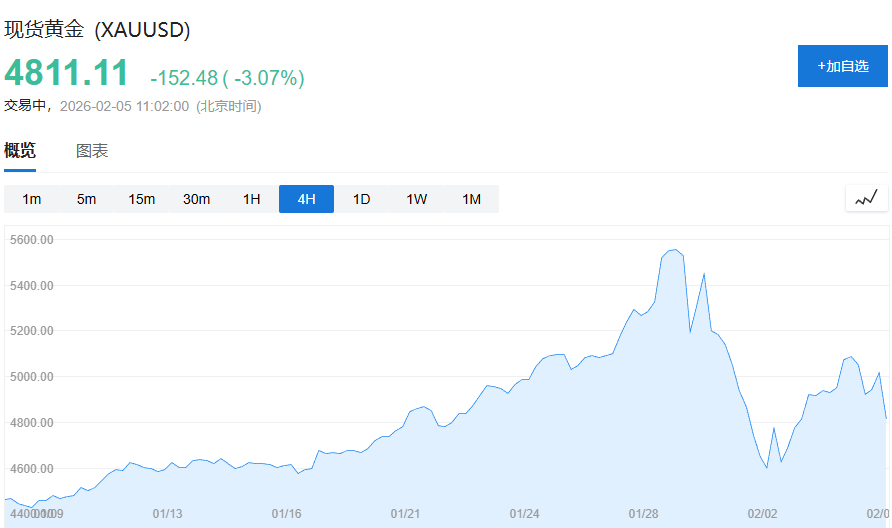
  • Spot gold returned above $4880/oz, narrowing its intraday loss to 1.6%, after earlier falling over 3%.
  • Spot silver fell over 16% intraday, breaking below the $74 mark.
  • London copper futures fell about 1%, breaking below $13,000 per ton.
  • Singapore iron ore futures fell over 2%, touching an intraday low of $100.25.

  • West Texas Intermediate crude fell 2.1% to $63.78 per barrel.
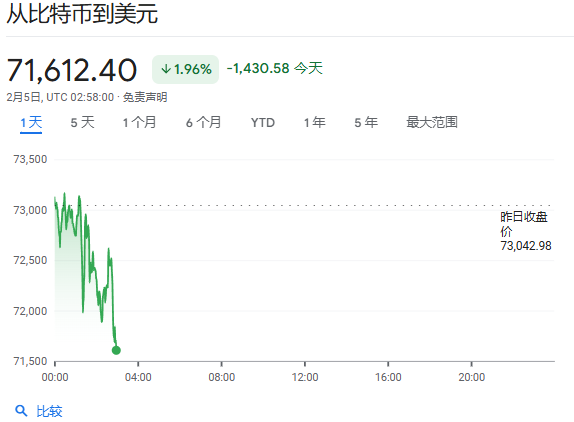
  • Bitcoin fell over 3%, further declining after briefly breaking below the $73,000 mark during the session.

AI Fever Cools, Investors Shift to Defensive Sectors

European stocks opened mixed: Euro Stoxx 50 up 0.05%, Germany's DAX down 0.19%, UK's FTSE 100 down 0.3%, France's CAC 40 up 0.2%. Vodafone fell 4.6% as its earnings showed organic service revenue growth missed expectations; wind power giant Vestas fell 4.9%; BNP Paribas rose 4.7% on profits exceeding expectations and raised targets; Maersk fell 7% as the company expects 2026 profits to decline; Volvo Cars fell 14% on Q4 revenue below expectations.

Asian markets extended the selling momentum from Wall Street overnight. According to data compiled by Bloomberg, foreign investors net sold a record 4.99 trillion won ($34 billion) worth of Korean Kospi index constituents on Thursday. Institutional investors also net sold 2.07 trillion won worth of Kospi index constituents.

Nick Twidale, Chief Market Analyst at AT Global Markets, said: "I don't know if we can say tech stocks have peaked, but I do think there is room for further adjustment in the market. The traditional approach is to sell tech stocks and shift to more defensive sectors."

Japan's Nikkei 225 closed down 0.9% at 53,818.04 points. Japan's Topix index closed down 0.1% at 3,652.41 points. South Korea's Kospi closed down 3.9% at 5,163.57 points.

Silver and Gold Plunge, Precious Metals Seek Bottom

Precious metals became another dominant narrative during the Asian trading session. Silver and gold surged last month, supported by speculative momentum, geopolitical turmoil, and concerns about Fed independence. But this rally stopped abruptly last weekend, with silver posting its largest single-day drop on record last Friday, and gold recording its biggest drop since 2013.

Bloomberg strategist Mark Cranfield pointed out: "Traders will watch to see if silver prices break below the low above $71 this week, but arguably more important is the $70 mark. This precious metal hasn't fallen to the $60 range since last December; a return to that range would deepen the risk-off sentiment across all asset classes." Copper prices also extended their decline, with investors focusing on rising inventories.

Spot silver fell over 16% intraday, breaking below the $74 mark. Spot gold broke below $4800 during the session, falling over 3%.
Iron Ore Nears $100 Mark

Iron ore prices fell towards $100 per ton on Thursday, affected by seasonal slowdowns in China, a softening market supply-demand balance, and a general decline in metals. Singapore futures fell over 2%, touching an intraday low of $100.25, on track for their lowest close since last August.

The latest decline reflects the seasonal slowdown ahead of the Lunar New Year holiday later this month, as steel mills scale back and restocking activities conclude, weakening steel demand. Meanwhile, most base and precious metal prices retreated in volatile trading on Thursday.

Fitch's BMI said in a report earlier this week that iron ore is expected to decline amid high port inventories and healthy mine output. The agency expects prices to average $95 per ton this year.

Other Market Dynamics

In other areas of the market, Bitcoin extended its decline, trading below $71,000. The yen fluctuated ahead of Japan's weekend election. The US dollar index extended its gains.
The pound and euro held steady ahead of interest rate decisions due later on Thursday. The European Central Bank and the Bank of England are expected to keep rates unchanged.

In the commodity market, oil fell for the first time after three consecutive days of gains, after Iran confirmed it would hold talks with the US, easing immediate risks of a military strike against the OPEC producer.

Continually updating......

Related Questions

QWhat was the performance of the Nasdaq 100 index during the recent sell-off, and why is it significant?

AThe Nasdaq 100 index recorded its worst two-day decline since last October and fell below its 100-day moving average. This is a significant technical indicator often watched by traders, suggesting a potential shift in the market's medium-term trend.

QWhich Asian market experienced a record level of foreign investor selling, and what was the amount?

AThe South Korean Kospi index experienced a record level of foreign investor selling, with a net sell-off of 4.99 trillion won (approximately $34 billion).

QWhat were the main factors contributing to the sharp decline in silver and gold prices?

AThe sharp decline in silver and gold prices was driven by a reversal of speculative momentum, following a historic sell-off the previous Friday. The metals were still searching for a price bottom after their rapid previous gains, which had been supported by speculative buying, geopolitical turmoil, and concerns about Federal Reserve independence.

QAccording to the analyst Nick Twidale, what is the traditional market response to a tech sell-off?

AAccording to Nick Twidale, Chief Market Analyst at AT Global Markets, the traditional market response to a tech sell-off is to sell technology stocks and rotate into more defensive sectors.

QWhat key level are traders watching for silver prices, and why is it important?

ATraders are watching to see if silver prices break below the low above $71, but more importantly, the $70 level. A break below $70, a level not seen since last December, would signal a move back into the $60 range and could deepen the risk-off sentiment across various asset classes.

Related Reads

Those Pre-Bitcoin PoW Protocols Have Recently Been Reimplemented

This article details a recent surge in replicating pre-Bitcoin Proof-of-Work (PoW) protocols, specifically focusing on Hal Finney's 2004 RPOW (Reusable Proofs of Work). Within five days in May 2026, multiple independent builders in the Bitcoin/cypherpunk community launched projects inspired by this early electronic cash proposal. The initiative began with Fred Krueger's `rpow2.com`, a centralized but auditable system that replaced RPOW's original IBM 4758 hardware with Ed25519 signatures. Initially a faithful replica, it later adopted Bitcoin-like features (21M supply cap, difficulty adjustment) and a controversial 5.24% founder allocation. This sparked rapid forks, including `rpow4.com` which incorporated full Bitcoin parameters, a prediction market (`rpowmarket.com`), and a DEX (`rpow2swap.com`). Concurrently, Mike In Space created a prototype of Wei Dai's 1998 b-money proposal (`b-money.replit.app`), pushing the historical exploration even further back. The article contrasts these centralized, server-dependent experiments with Bitcoin's core innovation of decentralized, trustless consensus. It also highlights a parallel development: the `HASH` project on Ethereum, which uses smart contract hooks to enable a purely fair-launch, browser-mineable PoW token with 0% allocations to team or VCs. The collective activity is framed as a meme-driven, educational exploration of cypherpunk history rather than a serious financial movement, with all projects heavily disclaiming any investment value.

marsbit3m ago

Those Pre-Bitcoin PoW Protocols Have Recently Been Reimplemented

marsbit3m ago

South Korean Exchanges 'Battle' Regulators, Challenging the Boundaries of Enforcement and Legislation

South Korea's cryptocurrency industry is engaged in a rare, direct confrontation with regulators. The Financial Intelligence Unit (FIU), the primary anti-money laundering (AML) watchdog, has recently imposed heavy penalties on major exchanges like Upbit and Bithumb for alleged violations involving unregistered overseas VASPs and AML procedures. However, exchanges are now actively challenging these actions in court and through industry associations. In a significant shift, the Seoul Administrative Court ruled in favor of Upbit's operator, Dunamu, overturning part of an FIU-ordered business suspension. The court found the FIU's penalty criteria and justification insufficiently clear. Similarly, the court suspended the enforcement of a six-month business suspension against Bithumb pending a final ruling, citing potential irreversible harm to the exchange. Beyond legal battles, the industry is contesting proposed legislative amendments. The Digital Asset eXchange Alliance (DAXA) strongly opposes a draft rule that would mandate Suspicious Transaction Reports (STRs) for all crypto transfers over 10 million KRW (~$6,800). DAXA argues this "poison pill" clause violates legal principles and would overwhelm the STR system, increasing reports from 63,000 to an estimated 5.45 million annually for major exchanges, thereby crippling effective AML monitoring. This conflict highlights a structural tension in South Korea's crypto governance: comprehensive digital asset laws are still developing, while regulators rely heavily on AML enforcement. The industry's move from passive compliance to active legal and legislative challenges signifies a new phase, pressing for clearer rules and more proportionate enforcement. While short-term disputes may intensify, this clash could ultimately lead to a more mature and sustainable regulatory framework for South Korea's vibrant crypto market.

marsbit56m ago

South Korean Exchanges 'Battle' Regulators, Challenging the Boundaries of Enforcement and Legislation

marsbit56m ago

After 50x Storage Surge, Justin Sun Always Looks to the Next Decade

Sun Yuchen, known for his controversial stunts like a $30 million lunch with Warren Buffett (canceled due to a kidney stone) and eating a $6.2 million duct-taped banana, is often overshadowed by a significant fact: his decade-long track record of spotting major investment trends. In 2016, he famously advised young people to invest in Bitcoin, Nvidia, Tesla, and Tencent instead of buying property. A hypothetical $20,000 investment in Nvidia and Tesla from that list would now be worth over 50 million RMB. His latest major call was on November 6, 2025, predicting a "50x storage opportunity" tied to the AI boom, which materialized with Sandisk's stock surging nearly 50-fold by 2026. Looking ahead, Sun now focuses on the next frontier: Physical AI. He identifies four key areas: 1. **Embodied AI/Robotics**: He sees this reaching its "iPhone moment," with companies like UBTech and Galaxy General leading in commercialization. 2. **Drones**: Viewed as the first commercially viable form of Physical AI, revolutionizing sectors from warfare (e.g., AeroVironment's Switchblade) to logistics. 3. **Spatial Computing**: Beyond VR, it's about AI understanding physical space, a foundational technology for robotics and autonomous systems, exemplified by Apple's Vision Pro. 4. **Space Exploration**: After a 2025 suborbital flight with Blue Origin, Sun advocates for space as the ultimate frontier, discussing blockchain's potential role in space asset management and data transactions. His investment philosophy involves betting on entire, inevitable trends rather than single companies. For robotics, he sees Tesla (the body/manufacturer) and Nvidia (the brain/AI platform) as complementary plays. In defense drones, he highlights companies making tanks obsolete (AeroVironment) and those augmenting fighter jets (Kratos). For space, he participated in Blue Origin's flight and anticipates SpaceX's potential IPO to redefine the sector's valuation. Sun Yuchen's vision frames the next two decades not as a revolution in information flow (like the internet), but in the fundamental operation of the physical world through AI-powered robots, autonomous systems, and spatial intelligence, ultimately extending human and AI activity into space. While many still focus on conventional assets, he continues to look toward the next technological horizon.

marsbit1h ago

After 50x Storage Surge, Justin Sun Always Looks to the Next Decade

marsbit1h ago

The Billionaires Behind the Most Expensive Midterm Election in History

"The Most Expensive Midterm Elections and Their Billionaire Backers" This analysis details the unprecedented scale of spending in the 2026 midterm elections, highlighting the key billionaire donors shaping the political landscape. Jeff Yass, founder of Susquehanna International Group, has contributed over $81 million, ranking third among individual donors behind George Soros ($102.6M) and Elon Musk ($84.8M). Yass is a major donor to Trump's MAGA Inc. and supports school choice and various candidates. Overall, federal committees have raised over $4.7 billion this cycle, with political ad spending projected to reach $10.8 billion. Republican-aligned groups are significantly out-raising their Democratic counterparts. "Dark money" from undisclosed sources continues to grow. The core stakes involve control of Congress and policy direction for Trump's final term. Donors are also motivated by specific issues: Sergey Brin and Chris Larsen are funding opposition to a proposed California wealth tax and supporting crypto-friendly policies. Other top donors include OpenAI's Greg Brockman and his wife Anna ($50M total to MAGA Inc. and an AI-focused PAC), Richard Uihlein ($45.3M to conservative causes), venture capitalists Marc Andreessen and Ben Horowitz (each over $44M to crypto/AI PACs and MAGA Inc.), Miriam Adelson ($42.6M to GOP leadership PACs), Paul Singer ($33.9M), and Diane Hendricks ($25.8M to MAGA Inc.). The article notes that the peak fundraising period is still ahead, with major primaries approaching.

marsbit1h ago

The Billionaires Behind the Most Expensive Midterm Election in History

marsbit1h ago

Trading

Spot
Futures

Hot Articles

What is $BITCOIN

DIGITAL GOLD ($BITCOIN): A Comprehensive Analysis Introduction to DIGITAL GOLD ($BITCOIN) DIGITAL GOLD ($BITCOIN) is a blockchain-based project operating on the Solana network, which aims to combine the characteristics of traditional precious metals with the innovation of decentralized technologies. While it shares a name with Bitcoin, often referred to as “digital gold” due to its perception as a store of value, DIGITAL GOLD is a separate token designed to create a unique ecosystem within the Web3 landscape. Its goal is to position itself as a viable alternative digital asset, although specifics regarding its applications and functionalities are still developing. What is DIGITAL GOLD ($BITCOIN)? DIGITAL GOLD ($BITCOIN) is a cryptocurrency token explicitly designed for use on the Solana blockchain. In contrast to Bitcoin, which provides a widely recognized value storage role, this token appears to focus on broader applications and characteristics. Notable aspects include: Blockchain Infrastructure: The token is built on the Solana blockchain, known for its capacity to handle high-speed and low-cost transactions. Supply Dynamics: DIGITAL GOLD has a maximum supply capped at 100 quadrillion tokens (100P $BITCOIN), although details regarding its circulating supply are currently undisclosed. Utility: While precise functionalities are not explicitly outlined, there are indications that the token could be utilized for various applications, potentially involving decentralized applications (dApps) or asset tokenization strategies. Who is the Creator of DIGITAL GOLD ($BITCOIN)? At present, the identity of the creators and development team behind DIGITAL GOLD ($BITCOIN) remains unknown. This situation is typical among many innovative projects within the blockchain space, particularly those aligning with decentralized finance and meme coin phenomena. While such anonymity may foster a community-driven culture, it intensifies concerns about governance and accountability. Who are the Investors of DIGITAL GOLD ($BITCOIN)? The available information indicates that DIGITAL GOLD ($BITCOIN) does not have any known institutional backers or prominent venture capital investments. The project seems to operate on a peer-to-peer model focused on community support and adoption rather than traditional funding routes. Its activity and liquidity are primarily situated on decentralized exchanges (DEXs), such as PumpSwap, rather than established centralized trading platforms, further highlighting its grassroots approach. How DIGITAL GOLD ($BITCOIN) Works The operational mechanics of DIGITAL GOLD ($BITCOIN) can be elaborated on based on its blockchain design and network attributes: Consensus Mechanism: By leveraging Solana’s unique proof-of-history (PoH) combined with a proof-of-stake (PoS) model, the project ensures efficient transaction validation contributing to the network's high performance. Tokenomics: While specific deflationary mechanisms have not been extensively detailed, the vast maximum token supply implies that it may cater to microtransactions or niche use cases that are still to be defined. Interoperability: There exists the potential for integration with Solana’s broader ecosystem, including various decentralized finance (DeFi) platforms. However, the details regarding specific integrations remain unspecified. Timeline of Key Events Here is a timeline that highlights significant milestones concerning DIGITAL GOLD ($BITCOIN): 2023: The initial deployment of the token occurs on the Solana blockchain, marked by its contract address. 2024: DIGITAL GOLD gains visibility as it becomes available for trading on decentralized exchanges like PumpSwap, allowing users to trade it against SOL. 2025: The project witnesses sporadic trading activity and potential interest in community-led engagements, although no noteworthy partnerships or technical advancements have been documented as of yet. Critical Analysis Strengths Scalability: The underlying Solana infrastructure supports high transaction volumes, which could enhance the utility of $BITCOIN in various transaction scenarios. Accessibility: The potential low trading price per token could attract retail investors, facilitating wider participation due to fractional ownership opportunities. Risks Lack of Transparency: The absence of publicly known backers, developers, or an audit process may yield skepticism regarding the project's sustainability and trustworthiness. Market Volatility: The trading activity is heavily reliant on speculative behavior, which can result in significant price volatility and uncertainty for investors. Conclusion DIGITAL GOLD ($BITCOIN) emerges as an intriguing yet ambiguous project within the rapidly evolving Solana ecosystem. While it attempts to leverage the “digital gold” narrative, its departure from Bitcoin's established role as a store of value underscores the need for a clearer differentiation of its intended utility and governance structure. Future acceptance and adoption will likely depend on addressing the current opacity and defining its operational and economic strategies more explicitly. Note: This report encompasses synthesised information available as of October 2023, and developments may have transpired beyond the research period.

363 Total ViewsPublished 2025.05.13Updated 2025.05.13

What is $BITCOIN

Discussions

Welcome to the HTX Community. Here, you can stay informed about the latest platform developments and gain access to professional market insights. Users' opinions on the price of BTC (BTC) are presented below.

活动图片











