# Points Related Articles

HTX News Center provides the latest articles and in-depth analysis on "Points", covering market trends, project updates, tech developments, and regulatory policies in the crypto industry.

Popular Interaction Collection | Interstate Launches Points Event; Flip Early Waitlist Application (June 12)

**Interstate Launches Points Event, Flip Opens Early Waitlist Applications** *Originally published by Odaily Planet Daily, author Asher.* **Interstate**, an infrastructure platform integrating on-chain transactions for assets like Meme tokens, prediction markets, and xStocks, has launched a points event. Each trade on the platform now rewards users with points. The project has completed a $1.5 million seed round from investors including MH Ventures, Alchemy Ventures, and Marshland Capital. Users can visit the official website to connect their wallets and start earning points through trading tasks (note: the site may experience high traffic). **Flip**, an AI-powered financial assistant, has opened applications for its early waitlist. The platform allows users to manage finances via chat, helping with spending tracking, bill management, investment portfolio monitoring (including stocks and crypto), and more. Flip recently raised $1.4 million in a pre-seed round led by The House Fund and participated in a16z's Speedrun accelerator. Interested users can join the waitlist via the official website. **ArcNova**, an AI-native infrastructure platform for short-form video and entertainment, continues to offer tasks for earning points. Users can sign in daily, complete social and app tasks, and refer friends to accumulate points. The project announced a $15 million funding round in May, backed by Adaverse Ventures, Animoca Brands, and others. The task portal is accessible through the ArcNova website. These updates highlight ongoing opportunities for user engagement and potential rewards across emerging crypto and AI projects.

Odaily星球日报06/12 08:49

Popular Interaction Collection | Interstate Launches Points Event; Flip Early Waitlist Application (June 12)

Odaily星球日报06/12 08:49

Over 13% APY, Apyx Is Bringing the 'Killer App for Bitcoin' On-Chain

The article discusses the rise of high-yield stablecoins in DeFi, focusing on the Apyx protocol and its integration of STRC (Strategy's Bitcoin credit instrument) to generate sustainable on-chain yields. Apyx addresses a market need for stablecoins with yields exceeding typical DeFi offerings (often below 5-10%). Its core innovation is bridging STRC—a tradable, dividend-yielding equity instrument backed by Strategy's Bitcoin holdings—from traditional finance to the decentralized ecosystem. STRC offers a floating yield (over 12.3%) by converting Bitcoin's long-term appreciation potential into a "digital credit" product. Apyx employs a dual-token model: `apxUSD`, a stablecoin pegged to $1 for liquidity, and `apyUSD`, an interest-bearing token where yields accumulate (currently ~11% APY, targeting over 13%). The yield is derived from STRC dividends, providing a more sustainable income source compared to token-incentivized models. Since its February launch, Apyx has grown rapidly, with `apxUSD` becoming a top-20 DeFi stablecoin by issuance. The protocol enhances its utility and capital efficiency through deep integrations with major DeFi platforms: Morpho (for collateralized borrowing/lending), Curve (for low-slip liquidity pools), and Pendle (for trading and leveraging future yield via PT/YT tokens). Apyx is also running a multi-season points program leading to a Token Generation Event (TGE) and airdrop on October 13, 2026, incentivizing user engagement through activities like holding tokens or providing liquidity. The main competitor in this niche is Saturn, but Apyx claims advantages in TVL, underlying STRC holdings, higher sustained yields, and a clearer TGE timeline without significant VC selling pressure. Key risks highlighted include dependency on Strategy's Bitcoin-backed credit model (susceptible to Bitcoin market volatility) and compounded smart contract or liquidity risks from its DeFi integrations. The article positions Apyx not as a risk-free asset but as a compelling "medium-risk, high-yield" option for users seeking better risk-adjusted returns in the current stablecoin landscape. The growth of Apyx and the STRC sector reflects a broader market shift where DeFi users are willing to accept calculated risks for substantially higher, sustainable yields.

Odaily星球日报05/26 01:41

Over 13% APY, Apyx Is Bringing the 'Killer App for Bitcoin' On-Chain

Odaily星球日报05/26 01:41

I Tested with $10,000: Zero Wear, 8% APY, and Earn Points (Full Tutorial + Screenshots Included)

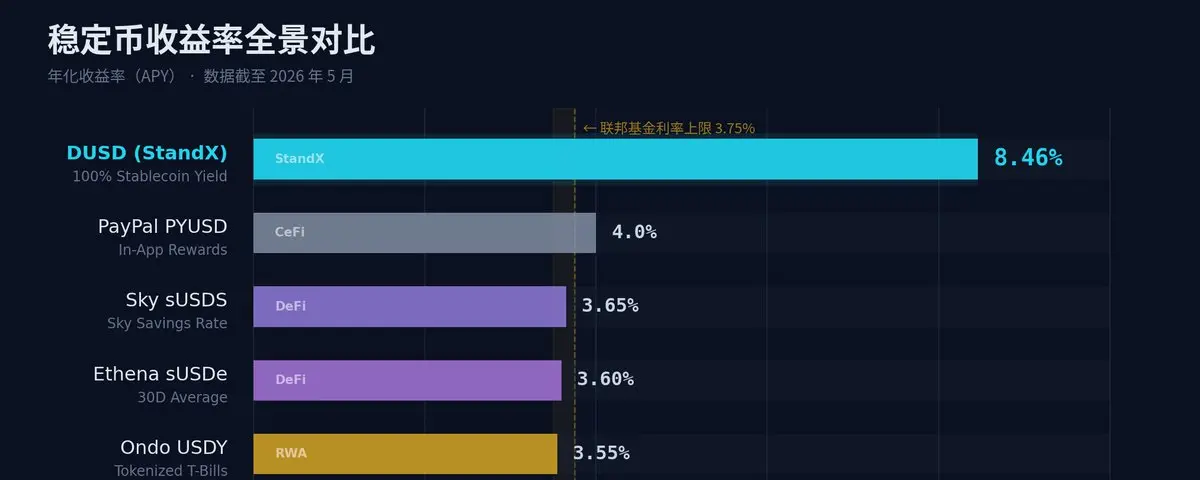
**Title:** My $10,000 Real-World Test: Zero Wear-and-Tear, ~8% APY, Plus Earning Points (Full Guide + Screenshots Included) **Summary:** This article details a personal experiment with $10,000 on the StandX platform to verify its advertised ~8% APY for its stablecoin, DUSD, while earning trading points. The author created two accounts, each depositing $5,000 worth of DUSD, and used StandX's unique "Block Trade" feature to open perfectly offsetting long and short BTC positions (2x leverage each). This neutralized directional market risk. **Key Results (Over 8 Days):** * **Total Profit:** $16.91 (~7.8% annualized). * **Zero Net Directional P&L:** BTC price movements canceled out. * **Zero Wear-and-Tear:** No losses from fees, slippage, or gas from frequent trading. * **Points Earned:** 380+ trading points. **Source of the ~8.46% APY:** The yield is composed of three layers, all paid in DUSD (real USD value, not governance tokens): 1. **DUSD Base (~1.27%):** Derived from funding rates (similar to Ethena's USDe). 2. **SIP-2 Position Boost (~2.27%):** A protocol revenue-sharing mechanism. Users providing liquidity (via open positions) earn a share of platform trading fees. Leverage acts as a multiplier on this yield. 3. **SIP-3 Universal Fee Share (~4.92%):** A portion of all platform trading fees is distributed to *every* DUSD holder, regardless of whether they trade. **Sustainability Claim:** The author argues this yield is more sustainable than pure funding-rate models (e.g., Ethena) because over 7% of it comes from transaction fees (SIP-2 + SIP-3), which are less dependent on market cycles. **Step-by-Step Strategy:** A concise 3-step guide is provided for replicating the zero-risk strategy using two wallets and StandX's Block Trade to create matched long/short positions. **Risk Disclosures:** The article notes standard DeFi risks: smart contract vulnerability and yield fluctuation (Base yield varies with funding rates; SIP-2/3 yields depend on platform trading volume). **Author's Note:** The author discloses their role in Growth at StandX. The piece is presented as personal testing and analysis, not investment advice.

链捕手05/22 09:41

I Tested with $10,000: Zero Wear, 8% APY, and Earn Points (Full Tutorial + Screenshots Included)

链捕手05/22 09:41

$50 Million Funding Ignites Airdrop Anticipation, Variational Becomes New Focus of Perp DEX

Variational, a perpetual decentralized exchange (Perp DEX) on Arbitrum, has become a focal point in the crypto community after announcing a $50 million Series A funding round led by Dragonfly Capital, with participation from Bain Capital Crypto and Coinbase Ventures. This news caused a significant pre-listing price surge and increased predictions of a high fully diluted valuation (FDV) upon launch. A key feature of Variational is its zero-trading-fee model. It differentiates itself by aggregating multi-source liquidity, including traditional and crypto-native market makers, to address on-chain liquidity challenges. According to DefiLlama, it ranks fourth among Perp DEXs by open interest and is notable as the only top-five platform yet to issue a token. The primary way for users to engage is through its "Trade-to-Earn" Omni Points program. Points are awarded weekly based on trading activity, with bonuses for early users and a tiered reward system that incentivizes higher trading volumes. The program also includes a referral system offering USDC rewards and extra points. The design emphasizes organic trading over mere volume farming. While an exact Token Generation Event (TGE) date for the VAR token is not confirmed, official documentation states the points program will run at least until the end of Q3 2026. Community and prediction market sentiment generally expects the TGE to occur in Q3 or Q4 of this year.

Odaily星球日报05/21 02:01

$50 Million Funding Ignites Airdrop Anticipation, Variational Becomes New Focus of Perp DEX

Odaily星球日报05/21 02:01

A Brief History of Web3 Airdrops: A Review of Twelve Iconic 'Rug Pull' Projects

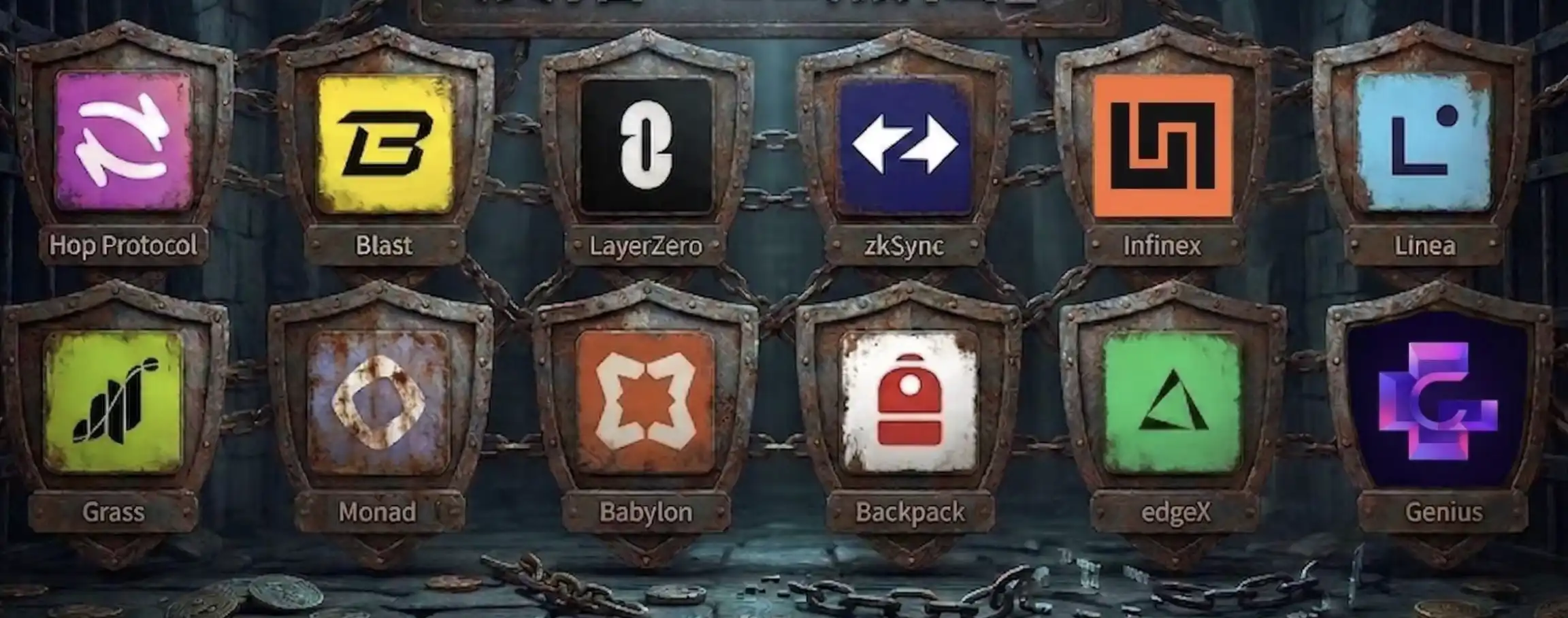
**Summary: A History of Web3 Airdrop "Rug Pulls" – 12 Iconic Cases** The era of Web3 airdrops has shifted from a golden age of mutual benefit between early users and projects to a landscape dominated by systematic exploitation. This article reviews 12 infamous "anti-airdrop" projects that eroded user trust: 1. **Hop Protocol (HOP):** Pioneered a "community witch-hunt" model, encouraging users to report Sybil addresses to claim their rewards, fostering a toxic environment of mutual harm. 2. **Blast:** Introduced the exploitative "points system," locking user funds for meager returns that often underperformed risk-free yields, turning airdrop hunting into a rigged casino. 3. **LayerZero (ZRO):** After 18 months of user-funded gas fees, it implemented a harsh "guilty until proven innocent" Sybil filter, forcing users to "self-confess" or face zero rewards, destroying multi-chain interaction narratives. 4. **zkSync (ZK):** Prioritized "funds held at a specific time" over long-term activity, betraying early contributors who spent significant gas and rewarding insiders, crushing L2 airdrop expectations. 5. **Infinex:** Lured users with NFT and point systems, only to announce a high FDV, a mandatory 1-year lockup, and chaotic rules at its public sale, betraying its community. 6. **Linea:** Perfected user exploitation with endless, grueling Galxe Odyssey tasks and KYC requirements, reducing airdrop hunting to a low-wage, full-time job. 7. **Grass:** Exploited users' physical resources (bandwidth/IP) for DePIN data, rewarding them with tokens worth less than the electricity and proxy costs incurred. 8. **Monad:** Allocated a mere ~3.3% of its airdrop to the community after extensive testnet participation, favoring KOLs and insiders and dampening enthusiasm for new L1s. 9. **Babylon:** Forced Ethereum-style staking onto Bitcoin, causing users massive losses from failed transactions due to high fees and network congestion, damaging trust in L2s. 10. **Backpack:** Encouraged massive trading volume for points, then applied strict KYC and Sybil rules last minute, resulting in massive losses for users and cementing a negative stereotype for projects with Chinese founders. 11. **EdgeX:** Perpetual DEX users lost significant fees for minimal rewards, while "insider" addresses received enormous allocations, exposing blatant corruption and killing the Perp DEX airdrop narrative. 12. **Genius:** The final straw: users were forced to choose between immediately claiming only 30% of their airdrop, locking tokens for a year for 100%, or a 100% burn for a gas fee refund, shattering trust in "elite-backed" narratives. **Conclusion** marks the painful end of the airdrop era. This collective "rug pull" was a co-created disaster of speculation and greed. The collapse, while brutal, forces a return to fundamentals: sustainable products with real product-market fit are paramount. This is not just the end of airdrops but a potential rebirth for Web3, weeding out exploitative projects and rewarding those that build genuine community value.

marsbit04/14 03:14

A Brief History of Web3 Airdrops: A Review of Twelve Iconic 'Rug Pull' Projects

marsbit04/14 03:14

Six-Year Evolution of Web3 Airdrops: From Uniswap to Monad, How Should Ordinary People Properly 'Farm Airdrops' in 2026?

Web3 airdrops have evolved significantly from Uniswap's 2020 genesis event, where early users were simply rewarded for protocol usage, to complex systems emphasizing genuine participation, identity verification, and attention economics. Key phases include: - **Phase 1 (2020)**: DeFi airdrops like Uniswap, with no Sybil resistance or tasks—pure reward for usage. - **Phase 2 (2021)**: ENS introduced the concept of "users as shareholders," focusing on governance and contribution. - **Phase 3 (2022-2023)**: Airdrops became growth hacking tools (e.g., Aptos, Arbitrum, Celestia), using multi-tier scoring and cross-ecosystem criteria. - **Phase 4 (2024-2026)**: Points systems (e.g., Blast, EigenLayer) prioritize TVL, duration, and liquidity locking over transaction volume. Future trends indicate: - Chain-level airdrops are declining; ecosystem-level airdrops (e.g., restaking, lending) will dominate. - Rising capital requirements and AI-driven allocation using on-chain reputation and behavior analysis. - A shift from rewards to attention economics, where community influence and identity matter most. For 2026, focus on: - Technical contributions (e.g., testnet nodes). - Completed quests and points systems. - Active community engagement (Discord, social media). - Long-term participation and identity building. Airdrops are no longer just token distributions but tools for user acquisition, governance, and community building. Success requires strategy升级: avoid meaningless farming, contribute value, and maintain a persistent, authentic presence.

marsbit04/09 03:13

Six-Year Evolution of Web3 Airdrops: From Uniswap to Monad, How Should Ordinary People Properly 'Farm Airdrops' in 2026?

marsbit04/09 03:13

活动图片