A $50 Million Funding Round Ignites Airdrop Expectations, Making Variational the New Focus in Perp DEX

marsbitPublished on 2026-05-21Last updated on 2026-05-21

Abstract

Perp DEX Variational has become a focal point in the airdrop community following its announcement of a $50 million Series A funding round led by Dragonfly Capital, with participation from Bain Capital Crypto and CoinBase Ventures. The news caused a significant pre-market price surge. Variational is a zero-fee perpetual decentralized exchange built on Arbitrum, notable for its "brokerage-style" model that aggregates liquidity from various sources. It currently ranks fourth in open interest among Perp DEXs and is the only top-five platform yet to issue a token. The primary way for users to participate is through its "Trade to Earn" points program, designed to reward organic trading activity. The system includes benefits for early users, a tiered rewards structure based on trading volume, and a referral program. The platform has committed to allocating approximately 50% of its token supply to the community. While an exact Token Generation Event (TGE) date has not been announced, official documentation indicates the points program will run at least until the end of Q3 2026. Prediction markets currently suggest a TGE is more likely in Q4 2026.

Author | Asher(@Asher_ 0210)
A funding announcement has made the Perp DEX Variational the hottest topic in the airdrop hunting community.

Last night, Variational announced the completion of a $50 million Series A funding round, led by Dragonfly Capital, with participation from Bain Capital Crypto and Coinbase Ventures. Following the news, Variational's pre-market price surged over 36% in a short period, once touching $6.9 (corresponding to an FDV of $690 million), and has since retraced, currently quoted at $6.1 (corresponding to an FDV of $610 million).
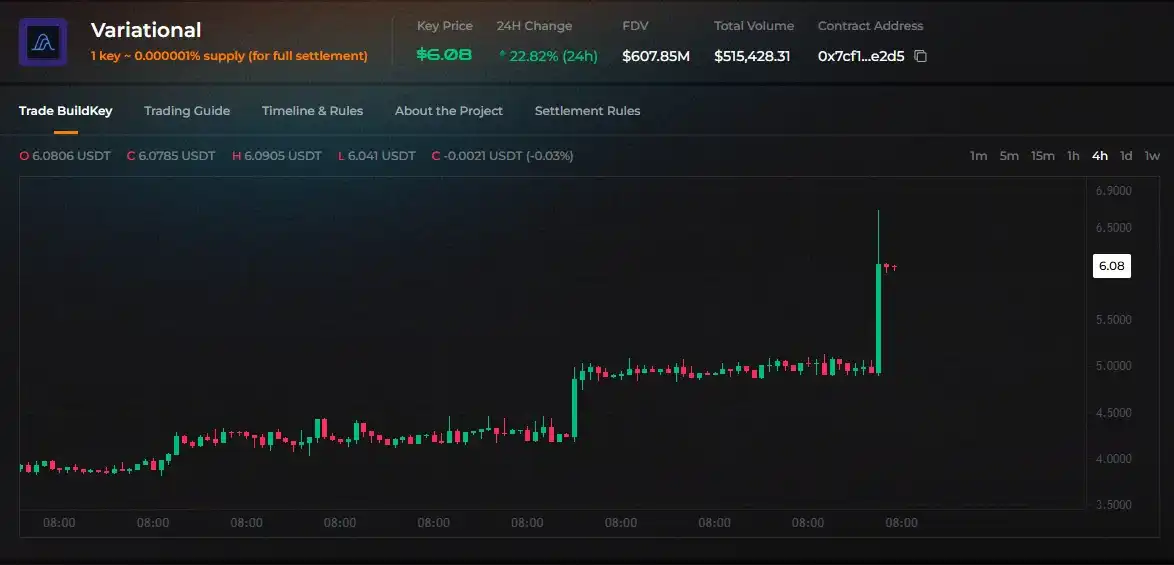
Variational Pre-market Price Movement

Furthermore, the probability of the event "Variational's FDV exceeds $500 million one day after listing" on the prediction platform predict.fun has risen to 57%; the probability for "Variational's FDV exceeds $1 billion one day after listing" has risen to 27%.
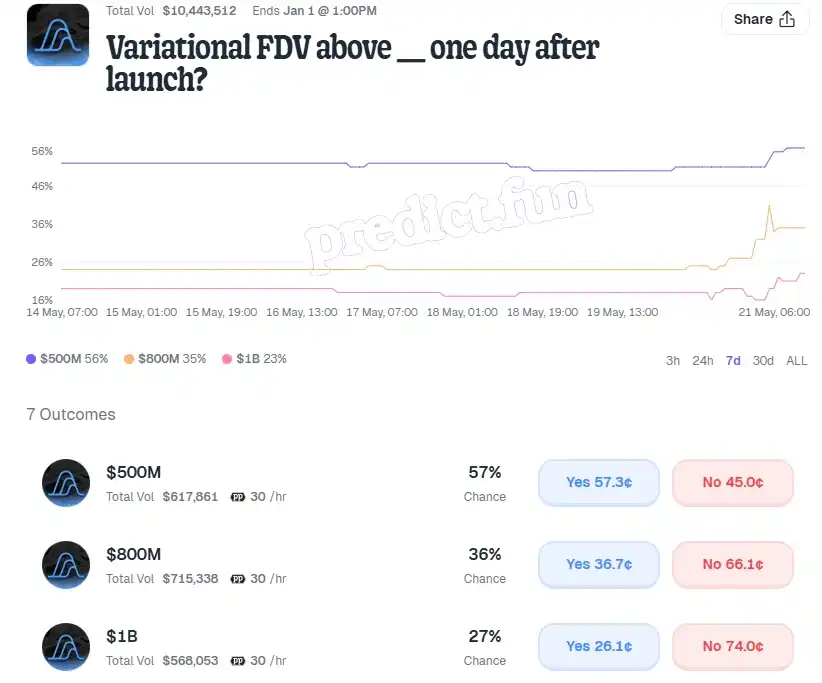
"Variational FDV After One Day of Listing" Prediction Event on predict.fun

Next, Odaily Planet Daily takes you to understand Variational, the rules for trading to earn points, and when the TGE will occur.

Variational: A Zero-Fee Perp DEX Deployed on Arbitrum
Variational is a Perp DEX platform deployed on Arbitrum, with its company headquartered in the Cayman Islands. Its core product is Omni. Simply put, users can trade perpetual contracts for mainstream crypto assets like BTC, ETH, and SOL on Variational, as well as long-tail assets, stocks, commodities, volatility indices, and more types of markets.

Compared to most Perp DEXs, the most intuitive feature of Variational is its zero trading fees. When trading on Omni, the platform does not charge regular transaction fees; the main costs come from spreads, slippage, funding rates, and deposit/withdrawal fees.

Additionally, the underlying design of Variational differs from traditional Perp DEXs. It does not rely solely on internal platform matching or a single liquidity pool to handle trades. Instead, it operates on a "brokerage-like" model connecting to multi-source liquidity, including traditional financial market makers, crypto-native market makers, and major trading platforms, aiming to solve the "cold start liquidity" problem in on-chain markets.

According to DefiLlama data, Variational's trading volume over the past month has exceeded $16 billion, with current open interest exceeding $800 million, ranking fourth in the Perp DEX sector. Notably, among the top five Perp DEXs by open interest, Variational is the only one that has not yet issued a token.
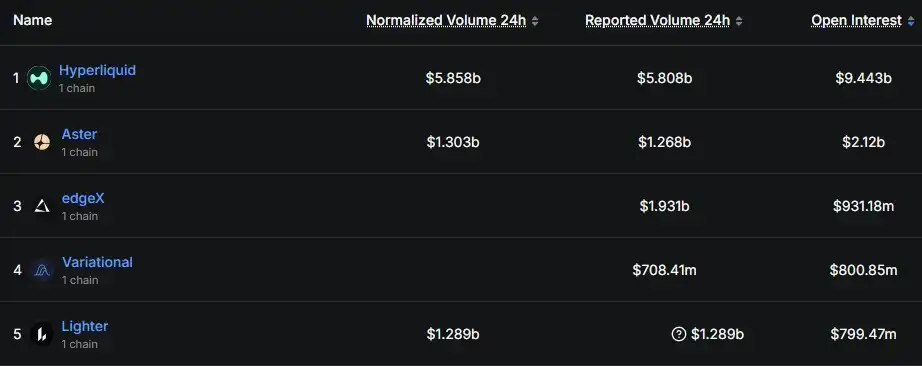
Open Interest Ranking for Perp DEXs

Trading to Earn Points: Detailed Rules for Variational

For regular users, the most direct way to participate in Variational currently is still trading to earn points.

Variational officially launched the Omni Points Program on December 17, 2025, and issued a one-time retrospective airdrop of 3 million points to historical trading users at launch, covering activity up to December 11, 2025. Since then, points are distributed every Friday at 00:00 UTC, counting platform activity from the previous cycle ending at 00:00 UTC on Thursday.

Furthermore, according to the documentation, the project promises that approximately 50% of the token supply will be allocated to the community (through various mechanisms like points, revenue sharing, not just a single airdrop), with plans to use at least 30% of protocol revenue for VAR token buybacks and burns.

The core of Variational's points system is not complex: the more active the trading, the more opportunities to earn points. However, Variational does not simply distribute based on trading volume; it incorporates designs that favor trading quality, specifically including:

  • Points are directly related to user trading activity: The platform rewards page indicates that the points program is designed to reward protocol users, who can earn points through platform activity. The official team reserves the right to adjust points and handle inorganic behavior, meaning that obvious meaningless volume trading or arbitrage-like point farming may be penalized or excluded later;
  • Extra bonus for early users: Accounts that traded before the points program launch enjoy a 10% points boost for points earned subsequently;
  • Introduction of the Reward Tiers system: A user's total trading volume over the past 30 days affects their tier, calculated as personal volume plus 0.2 times the volume from invited users. Different tiers correspond to different point multipliers: Iron at 0%, Bronze at 0.5%, Silver at 1%, Gold at 2%, Platinum at 3%, Diamond at 4%, Infinity at 5%. Among them, Bronze requires a past 30-day Total Volume of $1 million, Silver $5 million, Gold $25 million, Platinum $100 million, Diamond $750 million, Infinity $2.5 billion;
  • Inviting others also brings points and USDC rewards: Inviters receive 5% of the spreads paid by their invitees as USDC rewards. Additionally, every time an invitee earns 10 points, the inviter receives 1 point.

Judging from the rules, Variational's points design leans more towards organic trading rather than pure volume farming. For airdrop hunters, the focus isn't just on completing a single trade, but also on considering whether their trading frequency, capital efficiency, position risk, and point acquisition costs are well-matched.

When Will Variational Conduct Its TGE?

Currently, Variational has not announced a specific TGE date for VAR. However, based on information disclosed in the official documentation, points distribution will continue at least until the end of Q3 2026. Therefore, the community generally expects the TGE to occur in Q3 to Q4 of this year.

Data Source: Variational Official Documentation

Additionally, prediction market pricing leans more towards Q4. Polymarket data shows the probability of the event "Variational will launch its token before September 30th this year" is only 26%, while the probability for "Variational will launch its token before December 31st this year" is 78%.
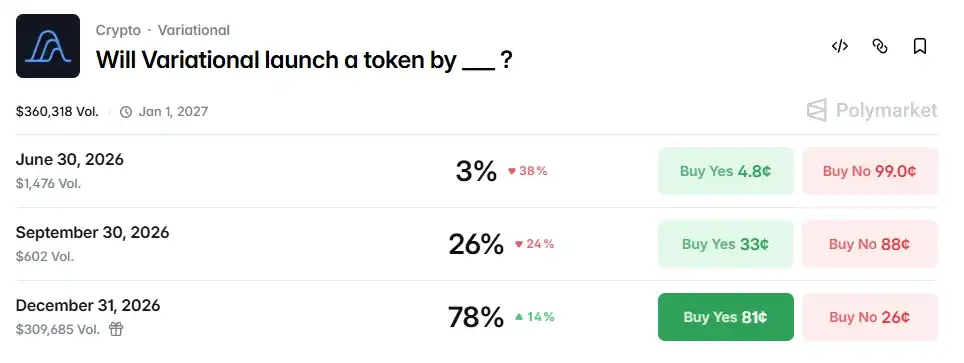
"When Will Variational TGE" Prediction Event on Polymarket


Related Questions

QWhat is the key news about the Perp DEX platform Variational discussed in the article?

AThe article discusses that Variational announced the completion of a $50 million Series A funding round, led by Dragonfly Capital, with participation from Bain Capital Crypto and CoinBase Ventures.

QWhat is the most direct way for ordinary users to participate in Variational according to the article?

AAccording to the article, the most direct way for ordinary users to participate in Variational is through its 'Trade-to-Earn' points program.

QWhat is a distinctive feature of Variational's Omni platform compared to most other Perp DEXs?

AA distinctive feature of Variational's Omni platform is zero trading fees for users. The main costs come from the bid-ask spread, slippage, funding rates, and deposit/withdrawal fees.

QWhat is the community's general expectation for Variational's TGE (Token Generation Event) date based on the article?

ABased on the article, the community generally expects the TGE to occur in Q3 to Q4 of this year, as points distribution is scheduled to last until at least the end of Q3 2026. Prediction markets also lean towards a Q4 date.

QHow does Variational's points system differ from a simple volume-based reward model?

AVariational's points system incorporates elements that reward trading quality, not just volume. It includes a Reward Tiers system based on 30-day trading volume (with referral volume factored in), which grants bonus multipliers. It also penalizes inorganic behavior like meaningless wash trading and offers a 10% bonus for early users who traded before the points program launch.

Related Reads

When Hyperliquid Takes Away Solana's "Internet Capital Markets" Script

The article discusses how Solana's vision of becoming the "Internet Capital Markets" is being challenged, primarily by the rise of Hyperliquid. While Solana positioned itself as a high-performance blockchain for tokenizing all global assets, its native token SOL has significantly underperformed, and its core narrative faces pressure. Hyperliquid, initially a perpetual contracts platform, has evolved into a specialized Layer 1 financial network. Its focused, trading-optimized design is attracting users and capital, suggesting a vertical L1 may be better suited for a core capital market than a general-purpose chain like Solana. This external competition was compounded by an internal $200M+ exploit on Solana's key derivatives protocol, Drift, creating a strategic vacuum. In response, Solana founder Anatoly Yakovenko heavily promoted the Phoenix protocol as a decentralized, composable alternative. However, Phoenix's trading volume remains far behind leading platforms. Solana supporters also launched critiques against Hyperliquid's decentralization, citing its limited validators and closed-source code. Critics countered that Solana's own decentralization metrics have weakened, and the foundation's overt backing of Phoenix caused friction with other ecosystem builders. The piece concludes that Solana risks losing the "Internet Capital Markets" race if it cannot regain dominance in derivatives, potentially remaining a meme coin hub rather than achieving its grand ambition of hosting all global assets.

marsbit1h ago

When Hyperliquid Takes Away Solana's "Internet Capital Markets" Script

marsbit1h ago

Trump Signs Executive Order, Kraken, Coinbase and Others May Gain Access to Fed Payment Channels

President Trump has signed an executive order, "Incorporating Financial Technology Innovation into the Regulatory Framework," pressuring the Federal Reserve to reassess its rules on granting non-bank financial companies—including crypto and fintech firms—access to its payment systems, specifically master accounts that connect to the Fedwire settlement system. Currently, such accounts are primarily reserved for depository institutions. The order mandates a review to determine if broader access is permissible and to establish an application process. This move, supported by figures like Senator Cynthia Lummis, aims to reduce barriers to innovation and lower public payment costs by fostering fairer competition. It does not grant immediate access but could pave the way for companies like Kraken, Coinbase, Ripple, and Circle to reduce reliance on intermediary banks, lowering costs and speeding up settlements. A key precedent is the Kansas City Fed granting Kraken's parent company a restricted master account in March, offering limited payment services without interest or credit privileges. This model is seen as a potential template for allowing controlled access while mitigating systemic risk. Other firms like Anchorage, Paxos, and BitGo, which hold specialized banking charters, are also well-positioned to apply. The banking industry, represented by the American Bankers Association, opposes easing access, arguing any institution handling bank-like payments must meet the same stringent regulatory, consumer protection, and risk-management standards as traditional banks. Their core concerns include potential systemic risks, compliance gaps in areas like anti-money laundering, and the diversion of liquidity from the traditional banking system. The outcome of the Fed's review will be crucial in determining whether and how crypto and fintech firms can integrate more directly into the core U.S. financial infrastructure, balancing innovation with financial stability.

marsbit1h ago

Trump Signs Executive Order, Kraken, Coinbase and Others May Gain Access to Fed Payment Channels

marsbit1h ago

The First Large-Scale Strike in the AI Era Comes from the Factories That Build AI

The article describes a potential large-scale strike at Samsung Electronics, narrowly averted in May 2026 after a temporary agreement. The strike, planned by the company's union, would have been the first major labor action in the AI era targeting a core AI supply chain player. Samsung, alongside SK Hynix, produces roughly two-thirds of the world's memory chips, critical components for AI training and data centers like HBM. An 18-day strike could have disrupted global supply, affecting prices and production for tech companies and cloud providers. For South Korea, where semiconductors constitute about 35% of exports and Samsung represents a quarter of the stock market's value, such an action threatens national economic stability. The union's demands include a 7% base wage increase and, crucially, a clear, substantial profit-sharing model. They want 15% of annual operating profit as an employee bonus pool and the removal of the existing cap (about 50% of annual salary). This frustration is amplified by seeing rival SK Hynix successfully negotiate a deal granting employees 10% of operating profit as bonuses, with reports suggesting some workers could receive bonuses equivalent to hundreds of thousands of dollars. The conflict stems from deeper issues in South Korea's chaebol (conglomerate) system, where rapid national industrialization often prioritized corporate growth over labor rights. Samsung long maintained a "no union" policy until a 2020 apology from its leader. The article argues this strike highlights a fundamental tension in the AI age: as technology advances and corporate profits soar—often driven by AI—the workers who build the infrastructure are demanding a fair share and dignity, rejecting the notion that they are mere expendable components in a machine that "must not stop." The piece concludes that the true test of the AI era isn't just computational power, but whether the people who build the future can secure a stable and valued place within it.

marsbit2h ago

The First Large-Scale Strike in the AI Era Comes from the Factories That Build AI

marsbit2h ago

Ripple’s Fed Master Account Bid Gains Momentum After Trump Order

President Donald Trump has signed an executive order directing financial regulators and the Federal Reserve to review expanding fintech and crypto firms' access to core payment infrastructure. This order significantly advances the industry's push for direct Fed connectivity, a central issue for Ripple. The company has been seeking a Federal Reserve master account as part of its strategy for its RLUSD stablecoin, which would allow it to hold reserves directly with the central bank and access its payment rails. The order, titled "Integrating Financial Technology Innovation into Regulatory Frameworks," mandates a Fed review within 120 days on allowing access for entities like uninsured depository institutions and non-bank financial companies, including those in digital assets. This creates a formal policy timeline for resolving whether crypto payment firms must rely on traditional bank intermediaries. Ripple's application for a national bank charter and a master account is part of this broader landscape. The issue gained precedent when Kraken Financial received a limited-purpose master account, while Custodia Bank's application was denied after a legal battle. The Fed has also proposed a more restricted "payment account" option. Trump's order does not guarantee approval for Ripple but forces a high-level examination of the regulatory barriers, bringing the company's long-running effort to the forefront of Washington's financial policy agenda.

bitcoinist2h ago

Ripple’s Fed Master Account Bid Gains Momentum After Trump Order

bitcoinist2h ago

Trading

Spot
Futures
活动图片