# DeepSeek Related Articles

HTX News Center provides the latest articles and in-depth analysis on "DeepSeek", covering market trends, project updates, tech developments, and regulatory policies in the crypto industry.

DeepSeek Announces Permanent Price Cut, But Liang Wenfeng Is Not Trying to Be a "Cyber Bodhisattva"

DeepSeek has announced a permanent 75% discount on its V4-Pro API, significantly reducing its token prices. This move stands out as a major industry-wide price cut while competitors like Anthropic, OpenAI, and Google have been quietly raising theirs. The article contrasts this strategy with the broader trend of AI becoming more expensive, citing examples of companies like Microsoft and Uber struggling with high token costs as usage soars. While CEO Liang Wenfeng is hailed by some as a "Cyber Bodhisattva" for this普惠 approach, the article argues this is a strategic business choice, not mere altruism. DeepSeek's ability to maintain low prices is attributed to several structural advantages: lower-cost AI talent in China, the impending use of domestic昇腾 hardware for further cost reductions, and, most critically, access to China's cheaper and more abundant energy infrastructure, which drastically reduces the electricity costs dominating AI operations. The analysis suggests that for many commercial applications, a "good enough" model that is radically cheaper (e.g., 1% to 11% of GPT-5.5's cost) is more valuable than the absolute top-tier model. This allows for vastly more experimentation and iteration within a budget. Therefore, as AI generally becomes more expensive, DeepSeek's cost-competitiveness—rooted in China's energy and talent advantages—becomes its core strategic value and differentiator in the global market.

marsbit20h ago

DeepSeek Announces Permanent Price Cut, But Liang Wenfeng Is Not Trying to Be a "Cyber Bodhisattva"

marsbit20h ago

Insider: DeepSeek Is Forming a Harness Team to Benchmark Against Claude Code

DeepSeek is reportedly forming a dedicated "Harness" team to develop a code agent product, directly targeting Anthropic's Claude Code. According to internal sources and a social media post by DeepSeek senior researcher Chen Deli, the team will focus on building "DeepSeek Code Harness." The initiative involves recruiting for key roles like Harness Product Manager and Harness R&D Engineer in Beijing. DeepSeek defines its approach with the core formula: Model + Harness = Agent. This signifies a strategic shift from merely offering a powerful coding model to creating the essential middleware that connects the model to real-world developer workflows. The Harness will handle context management, tool calls, task planning, file operations, code editing, terminal execution, and feedback loops. The move highlights that competition in AI-assisted coding is evolving from pure model capability to ownership of the developer workflow entry point. While DeepSeek has strong foundational models (e.g., DeepSeek-Coder series), it has lacked an integrated, productized agent experience. The popularity of a community-built project, DeepSeek-TUI, demonstrated developer demand for a Claude Code-like tool using DeepSeek's models, but also revealed the limitations of unofficial solutions. By building its official Code Harness, DeepSeek aims to leverage its unique advantages: direct collaboration with its model training team, control over APIs and design, the ability to create a data feedback loop for model improvement, and access to real internal task scenarios. This step is seen as crucial for DeepSeek to transform its advanced models into a leading agent product that can deeply integrate into and enhance the actual software development process.

链捕手05/22 02:14

Insider: DeepSeek Is Forming a Harness Team to Benchmark Against Claude Code

链捕手05/22 02:14

Musk vs. Altman: Who Will Be the 'Fisherman'?

Elon Musk and Sam Altman are locked in a fierce legal and commercial battle. Musk, a co-founder of OpenAI, has sued the company and Altman, alleging they betrayed its original non-profit, open-source mission by transforming into a for-profit entity with significant Microsoft backing, now valued at $852 billion. He demands damages, a return to a non-profit structure, and management changes. The lawsuit hinges on whether OpenAI's founding charter was a legally binding charitable trust or merely an idealistic statement. OpenAI counters that Musk himself pushed for a for-profit model in 2017 but left when he couldn't gain full control, and now acts as a commercial rival with his xAI venture. Despite the high-profile feud, the article suggests the real winners (the "fishermen") may be others in the AI race. While Musk has folded xAI into SpaceX to pursue a "space-based computing" vision, his Grok chatbot lags in market share and user growth compared to leaders. OpenAI faces its own challenges, notably from rival Anthropic, which is rapidly catching up in revenue and enterprise adoption. Musk is reportedly leasing significant computing power to Anthropic, creating an "enemy of my enemy" dynamic. Furthermore, Chinese AI models like DeepSeek are quickly closing the capability gap. Ultimately, the lawsuit is seen as setting a precedent for AI governance, but the intense competition between Musk and Altman may primarily benefit other players, infrastructure providers like Nvidia, and emerging third forces in the global AI landscape.

marsbit05/09 04:27

Musk vs. Altman: Who Will Be the 'Fisherman'?

marsbit05/09 04:27

How Many Tokens Away Is Yang Zhilin from the 'Moon Chasing the Light'?

The article explores the intense competition between two leading Chinese AI companies, DeepSeek and Kimi (Moon Dark Side), and the mounting pressure on Yang Zhilin, the founder of Kimi. While DeepSeek re-emerged after 15 months of silence with its powerful V4 model—boasting 1.6 trillion parameters and low-cost, long-context capabilities—Kimi has been focusing on long-context processing and multi-agent systems with its K2.6 model. Yang faces a threefold challenge: technological rivalry, commercialization pressure, and investor expectations. Despite Kimi’s high valuation (reaching $18 billion), its revenue heavily relies on a single product with low paid conversion rates, while DeepSeek’s strategic silence and open-source influence have strengthened its market position and valuation prospects, now targeting over $20 billion. Both companies reflect broader trends in China’s AI ecosystem: Kimi aims for global influence through open-source contributions and agent-based advancements, while DeepSeek prioritizes foundational innovation and hardware independence, notably shifting to Huawei’s chips. Their competition is seen as vital for China’s AI progress, with the gap between top Chinese and U.S. models narrowing to just 2.7% on the Elo rating scale. Ultimately, the article argues that this rivalry, though anxiety-inducing for leaders like Zhilin, is essential for driving innovation and solidifying China’s role in the global AI landscape.

marsbit04/26 11:25

How Many Tokens Away Is Yang Zhilin from the 'Moon Chasing the Light'?

marsbit04/26 11:25

Computing Power Constrained, Why Did DeepSeek-V4 Open Source?

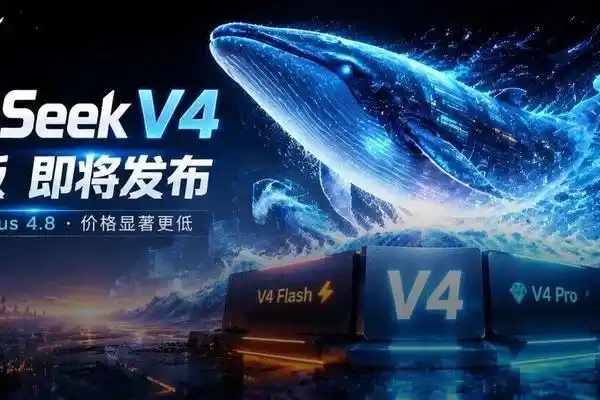
DeepSeek-V4 has been released as a preview open-source model, featuring 1 million tokens of context length as a baseline capability—previously a premium feature locked behind enterprise paywalls by major overseas AI firms. The official announcement, however, openly acknowledges computational constraints, particularly limited service throughput for the high-end DeepSeek-V4-Pro version due to restricted high-end computing power. Rather than competing on pure scale, DeepSeek adopts a pragmatic approach that balances algorithmic innovation with hardware realities in China’s AI ecosystem. The V4-Pro model uses a highly sparse architecture with 1.6T total parameters but only activates 49B during inference. It performs strongly in agentic coding, knowledge-intensive tasks, and STEM reasoning, competing closely with top-tier closed models like Gemini Pro 3.1 and Claude Opus 4.6 in certain scenarios. A key strategic product is the Flash edition, with 284B total parameters but only 13B activated—making it cost-effective and accessible for mid- and low-tier hardware, including domestic AI chips from Huawei (Ascend), Cambricon, and Hygon. This design supports broader adoption across developers and SMEs while stimulating China's domestic semiconductor ecosystem. Despite facing talent outflow and intense competition in user traffic—with rivals like Doubao and Qianwen leading in monthly active users—DeepSeek has maintained technical momentum. The release also comes amid reports of a new funding round targeting a valuation exceeding $10 billion, potentially setting a new record in China’s LLM sector. Ultimately, DeepSeek-V4 represents a shift toward open yet realistic infrastructure development in the constrained compute landscape of Chinese AI, emphasizing engineering efficiency and domestic hardware compatibility over pure model scale.

marsbit04/26 00:27

Computing Power Constrained, Why Did DeepSeek-V4 Open Source?

marsbit04/26 00:27

DeepSeek No Longer Wants to Focus Only on Large Models

DeepSeek, a leading Chinese AI company, has released its new model series DeepSeek-V4, featuring two versions: the high-performance V4-Pro with 1.6 trillion parameters and the cost-efficient V4-Flash. Both support 1 million token context windows and use Mixture-of-Experts (MoE) architecture to improve efficiency. The company continues its strategy of offering competitive pricing, with input tokens priced as low as ¥0.2 per million tokens. A key revelation is DeepSeek’s explicit link between future price reductions and the mass availability of Huawei’s Ascend 950 AI chips in the second half of the year. This signals a strategic shift from relying solely on algorithmic and engineering optimizations to integrating domestic computing power into its core cost structure. DeepSeek has adapted its inference system to run efficiently on both NVIDIA GPUs and Huawei NPUs, potentially challenging NVIDIA's CUDA ecosystem dominance. Concurrently, DeepSeek is reportedly seeking significant external investment, with a pre-money valuation of around ¥300 billion. This move highlights growing pressures in scaling compute infrastructure, retaining top talent—amid recent departures of key researchers—and accelerating commercialization efforts. The company has also updated its consumer app with tiered model access, indicating a stronger product focus. The V4 release underscores that China's AI competition is evolving beyond pure model capability into a broader contest involving compute supply chains, engineering systems, financing, and talent strategy.

marsbit04/25 01:45

DeepSeek No Longer Wants to Focus Only on Large Models

marsbit04/25 01:45

活动图片