# APY Related Articles

HTX News Center provides the latest articles and in-depth analysis on "APY", covering market trends, project updates, tech developments, and regulatory policies in the crypto industry.

Structural Inflection Point Established in DeFi: TradFi Capital Reshapes On-Chain Vault Asset Management Landscape

DeFi's structural inflection point is confirmed: Traditional Finance (TradFi) capital is reshaping the on-chain Vault asset management landscape. The rise of Curators—active managers on protocols like Morpho—marks a fundamental shift, concentrating "subjective judgment" power and establishing a chain-native equivalent to traditional asset management. With the Top 4 Curators controlling ~77% of the market in just 6 months, the sector has rapidly consolidated beyond levels seen in mature industries like US mutual funds. The competition logic has pivoted. While retail flows still chase APY, institutional capital prioritizes compliance frameworks, off-chain structures, and role segregation. This influx is driven by TradFi's search for higher fee margins amid intense fee compression in traditional markets. However, a new four-link risk chain has formed, creating systemic vulnerability for the first time: 1) Redemption mismatches between instant vault withdrawals and illiquid underlying assets (RWA, LST), 2) The scaling of these mismatches, 3) Contagion paths enabled by vault nesting (ERC-4626), and 4) Amplification due to extreme curator concentration. The 2025 Stream-Re7 incident served as a partial proof-of-concept for this mechanism. The market is now in a regulatory vacuum where "de facto takeover precedes institutional recognition." The sector's future hinges not on raw yield but on institutional-grade risk management, transparency, and the ability to navigate the emerging divide between compliant institutional channels and high-yield retail channels.

marsbit06/10 14:02

Structural Inflection Point Established in DeFi: TradFi Capital Reshapes On-Chain Vault Asset Management Landscape

marsbit06/10 14:02

Over 13% APY, Apyx Is Bringing the 'Killer App for Bitcoin' On-Chain

The article discusses the rise of high-yield stablecoins in DeFi, focusing on the Apyx protocol and its integration of STRC (Strategy's Bitcoin credit instrument) to generate sustainable on-chain yields. Apyx addresses a market need for stablecoins with yields exceeding typical DeFi offerings (often below 5-10%). Its core innovation is bridging STRC—a tradable, dividend-yielding equity instrument backed by Strategy's Bitcoin holdings—from traditional finance to the decentralized ecosystem. STRC offers a floating yield (over 12.3%) by converting Bitcoin's long-term appreciation potential into a "digital credit" product. Apyx employs a dual-token model: `apxUSD`, a stablecoin pegged to $1 for liquidity, and `apyUSD`, an interest-bearing token where yields accumulate (currently ~11% APY, targeting over 13%). The yield is derived from STRC dividends, providing a more sustainable income source compared to token-incentivized models. Since its February launch, Apyx has grown rapidly, with `apxUSD` becoming a top-20 DeFi stablecoin by issuance. The protocol enhances its utility and capital efficiency through deep integrations with major DeFi platforms: Morpho (for collateralized borrowing/lending), Curve (for low-slip liquidity pools), and Pendle (for trading and leveraging future yield via PT/YT tokens). Apyx is also running a multi-season points program leading to a Token Generation Event (TGE) and airdrop on October 13, 2026, incentivizing user engagement through activities like holding tokens or providing liquidity. The main competitor in this niche is Saturn, but Apyx claims advantages in TVL, underlying STRC holdings, higher sustained yields, and a clearer TGE timeline without significant VC selling pressure. Key risks highlighted include dependency on Strategy's Bitcoin-backed credit model (susceptible to Bitcoin market volatility) and compounded smart contract or liquidity risks from its DeFi integrations. The article positions Apyx not as a risk-free asset but as a compelling "medium-risk, high-yield" option for users seeking better risk-adjusted returns in the current stablecoin landscape. The growth of Apyx and the STRC sector reflects a broader market shift where DeFi users are willing to accept calculated risks for substantially higher, sustainable yields.

Odaily星球日报05/26 01:41

Over 13% APY, Apyx Is Bringing the 'Killer App for Bitcoin' On-Chain

Odaily星球日报05/26 01:41

I Tested with $10,000: Zero Wear, 8% APY, and Earn Points (Full Tutorial + Screenshots Included)

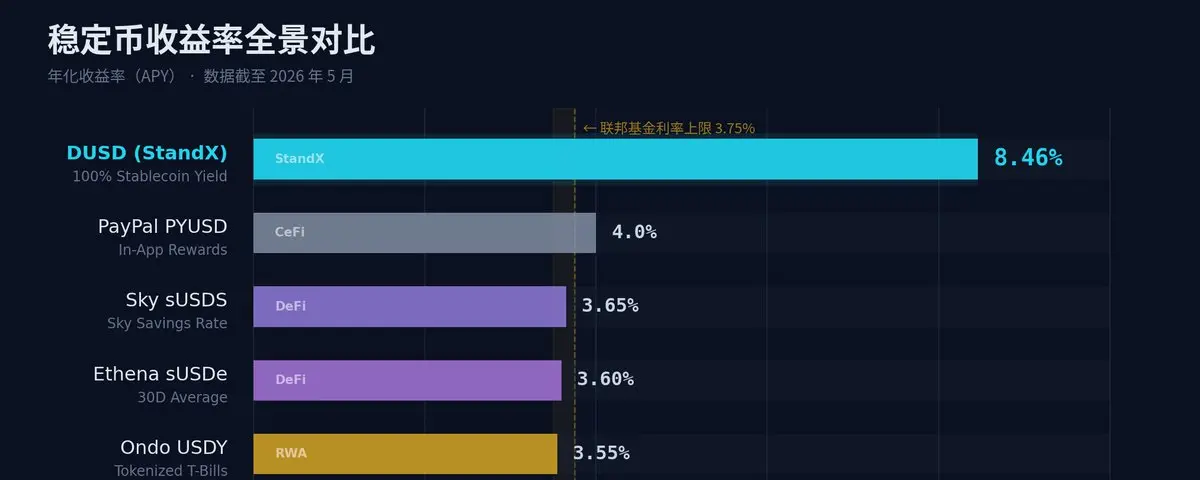
**Title:** My $10,000 Real-World Test: Zero Wear-and-Tear, ~8% APY, Plus Earning Points (Full Guide + Screenshots Included) **Summary:** This article details a personal experiment with $10,000 on the StandX platform to verify its advertised ~8% APY for its stablecoin, DUSD, while earning trading points. The author created two accounts, each depositing $5,000 worth of DUSD, and used StandX's unique "Block Trade" feature to open perfectly offsetting long and short BTC positions (2x leverage each). This neutralized directional market risk. **Key Results (Over 8 Days):** * **Total Profit:** $16.91 (~7.8% annualized). * **Zero Net Directional P&L:** BTC price movements canceled out. * **Zero Wear-and-Tear:** No losses from fees, slippage, or gas from frequent trading. * **Points Earned:** 380+ trading points. **Source of the ~8.46% APY:** The yield is composed of three layers, all paid in DUSD (real USD value, not governance tokens): 1. **DUSD Base (~1.27%):** Derived from funding rates (similar to Ethena's USDe). 2. **SIP-2 Position Boost (~2.27%):** A protocol revenue-sharing mechanism. Users providing liquidity (via open positions) earn a share of platform trading fees. Leverage acts as a multiplier on this yield. 3. **SIP-3 Universal Fee Share (~4.92%):** A portion of all platform trading fees is distributed to *every* DUSD holder, regardless of whether they trade. **Sustainability Claim:** The author argues this yield is more sustainable than pure funding-rate models (e.g., Ethena) because over 7% of it comes from transaction fees (SIP-2 + SIP-3), which are less dependent on market cycles. **Step-by-Step Strategy:** A concise 3-step guide is provided for replicating the zero-risk strategy using two wallets and StandX's Block Trade to create matched long/short positions. **Risk Disclosures:** The article notes standard DeFi risks: smart contract vulnerability and yield fluctuation (Base yield varies with funding rates; SIP-2/3 yields depend on platform trading volume). **Author's Note:** The author discloses their role in Growth at StandX. The piece is presented as personal testing and analysis, not investment advice.

链捕手05/22 09:41

I Tested with $10,000: Zero Wear, 8% APY, and Earn Points (Full Tutorial + Screenshots Included)

链捕手05/22 09:41

活动图片