Synthetix returns to Ethereum mainnet after 3 years: ‘We can run it back’

cointelegraphPublished on 2025-12-18Last updated on 2025-12-18

Abstract

Synthetix, a perpetuals trading platform, is returning to Ethereum's mainnet after three years, citing significantly improved network conditions. Founder Kain Warwick stated that high gas fees and congestion previously made it impractical to run complex trading infrastructure on Ethereum, leading many platforms, including Synthetix, to migrate to Layer-2 solutions. However, reduced demand and ongoing scaling improvements have now made Ethereum Layer-1 viable again. Warwick emphasized that Ethereum mainnet hosts most of crypto's liquidity, assets, and margin, making it the most efficient onchain market. He expects other perpetual DEXs to follow suit, leveraging Ethereum's enhanced capacity and lower transaction costs.

Perpetuals trading platform Synthetix is returning to Ethereum’s mainnet, with its founder arguing the network is now more than capable of supporting high-frequency financial applications after years of network congestion drove derivatives activity elsewhere.

“By the time perp DEXs became a thing, the mainnet was too congested, but now we can run it back,” Synthetix founder Kain Warwick told Cointelegraph during an interview on Wednesday.

“It’s kind of crazy that there really hasn’t been a Perp DEX on mainnet,” he added, explaining that reduced demand after the perp DEX exodus, combined with ongoing scaling improvements, has made Ethereum layer 1 more viable again.

“It’s definitely the best place to run a perp DEX,” he said.
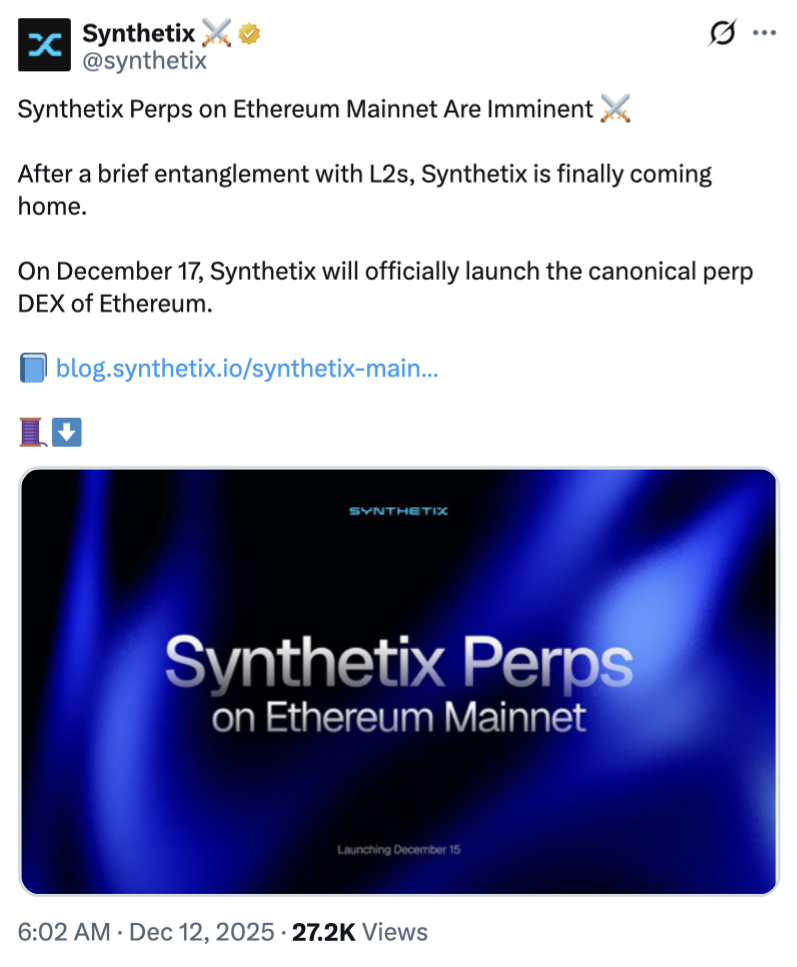
Source: Synthetix

Warwick said that high gas fees and network congestion previously made it impractical to operate complex trading infrastructure on the network.

For several years, many perpetual platforms migrated to layer-2 networks or alternative blockchains, and Synthetix followed a similar path, he said, moving to the Ethereum layer-2 network Optimism in 2022 and later expanding to Arbitrum and Base.

Around the same time, decentralized derivatives exchange dYdX transitioned from mainnet to StarkWare layer-2 solution StarkEx.

Warwick says fees were “just too high” to make it feasible

Warwick said it wasn’t feasible to run critical infrastructure because the costs were “just too high.”

“The cost per transaction and therefore the efficiency of the markets on the chain really degraded,” Warwick said. On Wednesday, Ethereum’s average gas fee stood at approximately 0.71 gwei, nearly 26 times lower than on the same day twelve months ago, when it averaged 18.85 gwei, according to Etherscan.
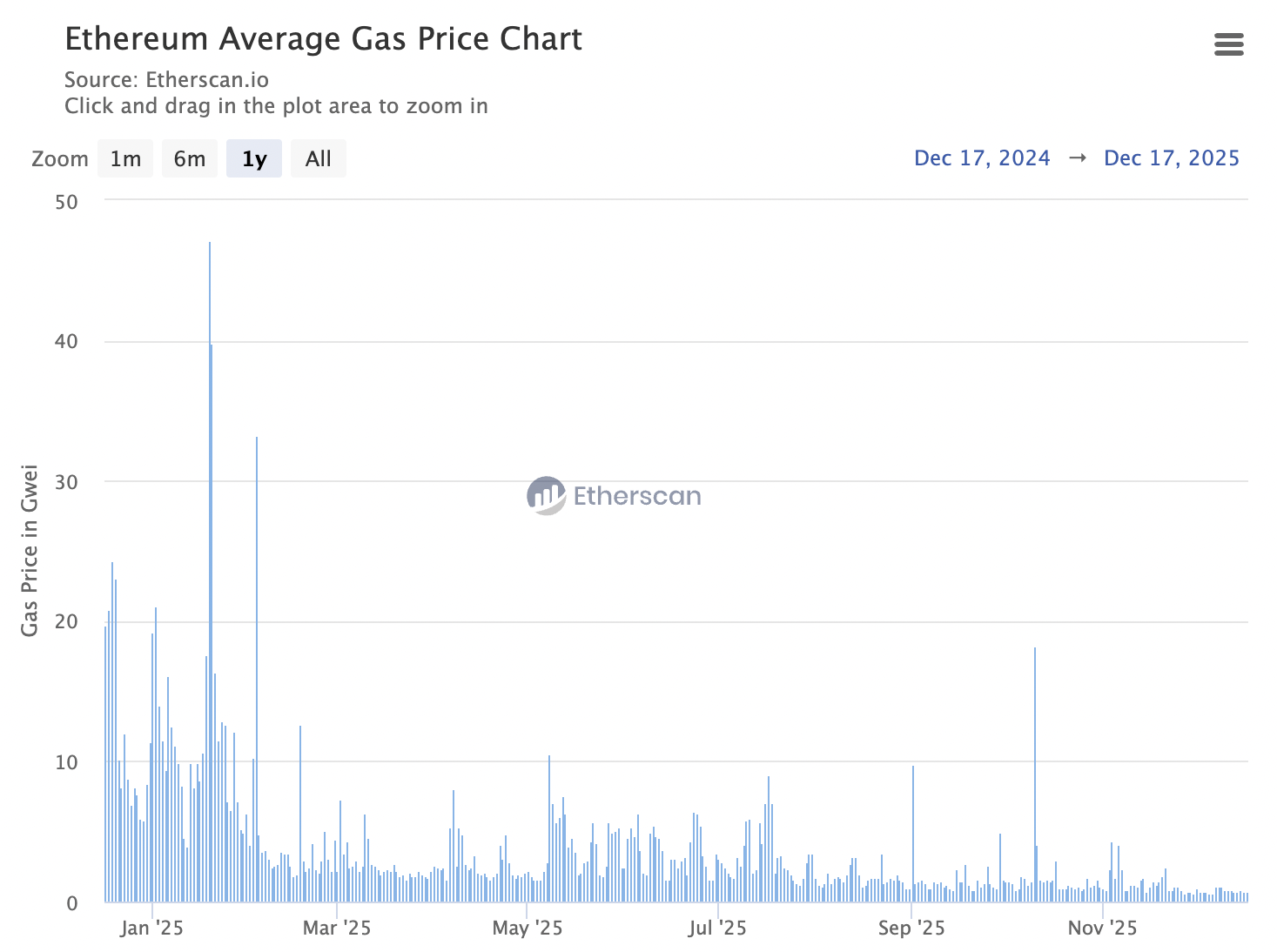
Ethereum gas fees are significantly lower than they were twelve months ago. Source: Ether Scan

Warwick said that the combination of layer-2 and layer-1 scaling means that ”you can actually run critical infrastructure on mainnet again.”

Some Ethereum proponents have predicted further improvements toward network capacity in 2026. Ethereum educator Anthony Sassano recently said the goal to significantly increase Ethereum’s gas limit to 180 million next year is a baseline rather than a best-case scenario.

Warwick expects other perpetual exchanges to follow Synthetix

Warwick expects other perpetual DEXs to follow Synthetix back to mainnet, arguing Ethereum now has the capacity to support multiple perp DEXs simultaneously.

Related: Ripple pilots RLUSD on Ethereum L2s in multichain push

“It wouldn’t be a Synthetix launch if someone didn’t try and, you know, follow us within 20 minutes,” Warwick said.

“The main advantage is most of the liquidity in the crypto world is on Ethereum mainnet; most of the assets, most of the margin, most liquidity, almost everything is there. It is the most efficient onchain market,” he said.

Warwick added that Ethereum’s development has improved significantly in 2025, and it has potentially been the best year for the network since the Merge in September 2022.

“There’s been a renewed kind of focus on, like, the needs of builders, in a way that I think in the past, maybe it was much more focused on the network itself,” he said.

Magazine: Big questions: Would Bitcoin survive a 10-year power outage?

Trending Cryptos

Related Questions

QWhy is Synthetix returning to the Ethereum mainnet after three years?

ASynthetix is returning to the Ethereum mainnet because the network is now more capable of supporting high-frequency financial applications, with significantly lower gas fees and reduced congestion compared to the past.

QWhat was the main reason that originally drove Synthetix and other perpetual DEXs away from the Ethereum mainnet?

AHigh gas fees and network congestion made it impractical and too costly to operate complex trading infrastructure on the Ethereum mainnet, leading many platforms to migrate to layer-2 networks or alternative blockchains.

QAccording to the founder, what is the current state of Ethereum gas fees compared to a year ago?

AAs of the interview, the average Ethereum gas fee was approximately 0.71 gwei, which is nearly 26 times lower than the average of 18.85 gwei on the same day twelve months prior.

QWhat does Kain Warwick predict will happen after Synthetix moves back to the mainnet?

AKain Warwick predicts that other perpetual DEXs will follow Synthetix back to the Ethereum mainnet, as the network now has the capability to support multiple perp DEXs simultaneously.

QWhat does Warwick cite as the main advantage of running a perp DEX on Ethereum mainnet?

AThe main advantage is that most of the liquidity, assets, and margin in the crypto world are on the Ethereum mainnet, making it the most efficient onchain market.

Related Reads

The Verdict in Choi Tae-won's Divorce Case: Revealing the Inheritance Undercurrent Behind SK Hynix's Trillion-Won Empire

SK Group Chairman Chey Tae-won's high-profile divorce case, involving a record 1.38 trillion won settlement, has drawn attention to the succession plans for Korea's second-largest conglomerate, especially its crown jewel, SK hynix. Unlike traditional chaebol scripts centered on the eldest son, Chey's three children from his marriage to former President Roh Tae-woo's daughter, Roh Soh-yeong, are carving distinct, non-traditional paths. Eldest daughter Chey Yun-jung (b. 1989) is seen as the most evident successor. With a scientific and consulting background, she holds executive roles at SK bioscience and SK Inc.'s growth support department, focusing on future strategy and biopharma. Her marriage is to an AI infrastructure entrepreneur, not a traditional business alliance. Second daughter Chey Min-jung (b. 1991) took a unique route, voluntarily serving as a South Korean naval officer, including an anti-piracy deployment. She later worked on policy and strategy for SK hynix in Washington D.C. before co-founding an AI-driven healthcare startup. She married a former U.S. Marine Corps officer, connecting her to U.S. defense and policy circles—networks crucial for a global semiconductor giant. The only son, Chey In-geun (b. 1995), who studied physics like his father, worked briefly at SK E&S before joining McKinsey. Despite fitting the traditional "heir" profile as the eldest son, he remains silent and holds no public position or shares in SK, suggesting the old succession playbook is obsolete. As SK hynix's valuation soars, becoming a geopolitical asset in the AI era, the heirs' legitimacy is no longer automatic. They must prove themselves in fields like AI biotech, global policy, and strategic consulting. Their marriages also reflect new elite networks in tech and defense, not old political alliances. Their inheritance is the complex challenge of navigating a globalized, tech-driven world, not just a corporate throne.

marsbitYesterday 09:06

The Verdict in Choi Tae-won's Divorce Case: Revealing the Inheritance Undercurrent Behind SK Hynix's Trillion-Won Empire

marsbitYesterday 09:06

From OpenSea to OpenRouter: Is Alex Atallah Repeating His 'Exit at the Peak' Playbook?

From OpenSea to OpenRouter: Is Alex Atallah Repeating His "Exit at the Peak" Playbook? According to the Wall Street Journal, payments giant Stripe is in talks to acquire the AI model aggregation platform OpenRouter in a potential deal valuing the company near $100 billion. This would mark founder Alex Atallah's second creation of a company reaching a $100 billion valuation, following his co-founding of NFT marketplace OpenSea. OpenRouter, founded just over three years ago, has grown rapidly by acting as a unified gateway for developers to access over 400 AI models. It currently has about 10 million users and processes over 200 trillion tokens monthly. While the platform's annualized revenue is around $50 million, its valuation has skyrocketed from $1.3 billion in March 2026. The potential acquisition by Stripe, a company OpenRouter's founder once likened it to, represents a major expansion into AI infrastructure for the payments leader. This move echoes Atallah's previous timing with OpenSea, where he departed before the NFT market's significant downturn. For OpenRouter, selling now may be strategic. Despite its scale, its business model—charging a 5-5.5% fee on AI inference calls—faces pressure from competition, open-source models, and potential price wars among model providers, limiting its profitability narrative for an IPO. A key asset for potential acquirers like Stripe is OpenRouter's vast repository of real-world AI usage data, which offers unique insights into model performance and developer preferences that are difficult to replicate. Whether this potential deal signifies a new valuation benchmark for AI infrastructure or another market peak signal remains to be seen.

链捕手Yesterday 08:42

From OpenSea to OpenRouter: Is Alex Atallah Repeating His 'Exit at the Peak' Playbook?

链捕手Yesterday 08:42

Trading

Spot

Hot Articles

Discussions

Welcome to the HTX Community. Here, you can stay informed about the latest platform developments and gain access to professional market insights. Users' opinions on the price of ETH (ETH) are presented below.

活动图片