Swooping to Third Place, Rothera Disrupts Prediction Market Landscape

Odaily星球日报Published on 2026-06-22Last updated on 2026-06-22

Abstract

The article "Rothera Shakes Up Prediction Market Landscape, Debuts at No. 3" details the rapid rise of Rothera, Robinhood's newly launched in-house prediction market platform. Originally, Robinhood acted as a major distribution channel for Kalshi, routing 25-35% of its user orders to Kalshi for execution, which involved revenue sharing. Rothera allows Robinhood to capture this value internally by migrating orders, particularly for events like the World Cup, to its own platform. This has led to explosive growth for Rothera, with weekly trading volume soaring from $21.9 million to $559 million in just two weeks, making it the third-largest prediction market behind Kalshi and Polymarket. Analysts estimate Robinhood's prediction market business could generate $10 billion in annual revenue, surpassing its crypto revenue peak. This growth represents a direct challenge to Kalshi, which is now seeking new distribution channels, including talks with investment banks for a potential IPO, to integrate its platform with institutional client networks. The key takeaway is a shift in the competitive landscape: success is increasingly defined not just by product offerings but by controlling the user distribution channels and value capture, as demonstrated by Rothera's swift ascent.

Original | Odaily Planet Daily (@OdailyChina)

Author | Azuma (@azuma_eth)

Last week, Odaily Planet Daily published an article titled "The First Prediction Market Concept Stock Has Emerged!", which mainly discussed how Robinhood is intercepting orders, which previously needed to be executed via Kalshi, by building its own prediction market, Rothera. This allows Robinhood to reduce revenue sharing with Kalshi and retain profits within its own ecosystem.

Although we anticipated that Rothera wouldn't face the cold start problems common among other competitors, its data performance over the past week still far exceeded our initial expectations. It's hard to imagine that a platform launched just half a month ago could directly soar to third place in the highly competitive prediction market sector, trailing only behind the two giants, Kalshi and Polymarket.
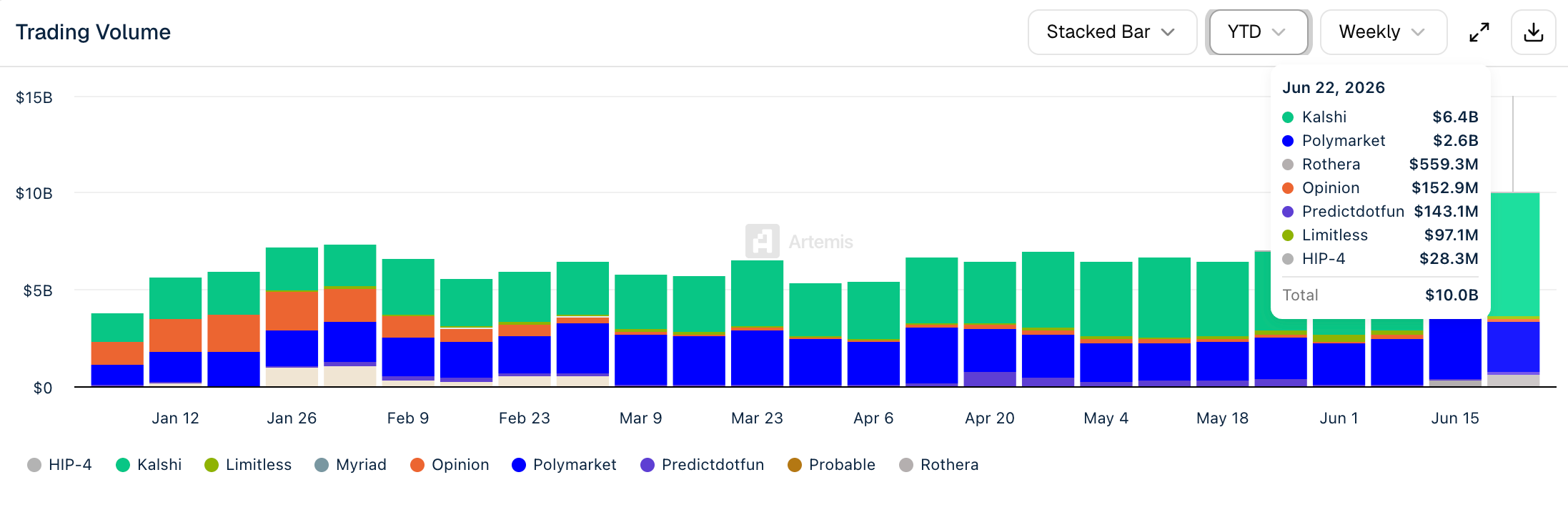
Data from Artemis shows that for the week ending June 8th, Rothera, as a new platform, had a weekly trading volume of only $21.9 million, still lagging significantly behind second-tier platforms like Opinion, Predict, and Limitless. However, for the week ending June 15th, Rothera's weekly trading volume directly jumped to third place in the industry, reaching $276 million. In the latest week ending June 22nd, Rothera's weekly trading volume increased to $559 million, nearly one-fifth of Polymarket's volume.

A Case of Atypical Growth (Can skip if you read the previous article)

It's important to clarify that Rothera's rise is essentially not driven by creating new incremental users (though some users may have joined due to the World Cup), but rather by the migration of existing orders, not the creation of new users.

Over the past year or so, Robinhood has been one of the most important distribution channels for Kalshi. Leveraging tens of millions of retail users and established stock, options, and cryptocurrency trading gateways, Robinhood directed a large volume of orders to Kalshi. Piper Sandler analysts previously estimated that trades completed through the Robinhood channel accounted for about 25%-35% of Kalshi's total trading volume.

The issue was that while these orders originated from Robinhood users, they didn't belong to Robinhood itself. Under the previous partnership model, Robinhood functioned more as a front-end traffic portal, while Kalshi was the infrastructure provider responsible for order matching, clearing, and settlement. Revenue generated from each trade needed to be shared between the two parties.

Rothera is Robinhood's weapon to break this revenue-sharing model. Since early this month, Robinhood has begun migrating some World Cup-related event contracts to be executed internally on Rothera. This means that a significant number of orders that might have previously flowed to Kalshi are now retained within Robinhood's own ecosystem.

Therefore, in a sense, the surge in Rothera's trading volume is less of a threat to other prediction markets like Polymarket, Predict, or Limitless, and more of a direct "siphon" of volume from Kalshi.

Robinhood's Value Capture

The most direct impact of Rothera's rapid growth is the strengthening of Robinhood's ability to capture value from prediction market-related orders on its platform.

According to Hood House, an investment research media outlet that has long tracked Robinhood, statistics based on public data show that as of June 20th, Robinhood's prediction market business collectively traded 34,700 contracts in a single day, corresponding to an estimated daily revenue of about $4.9 million.
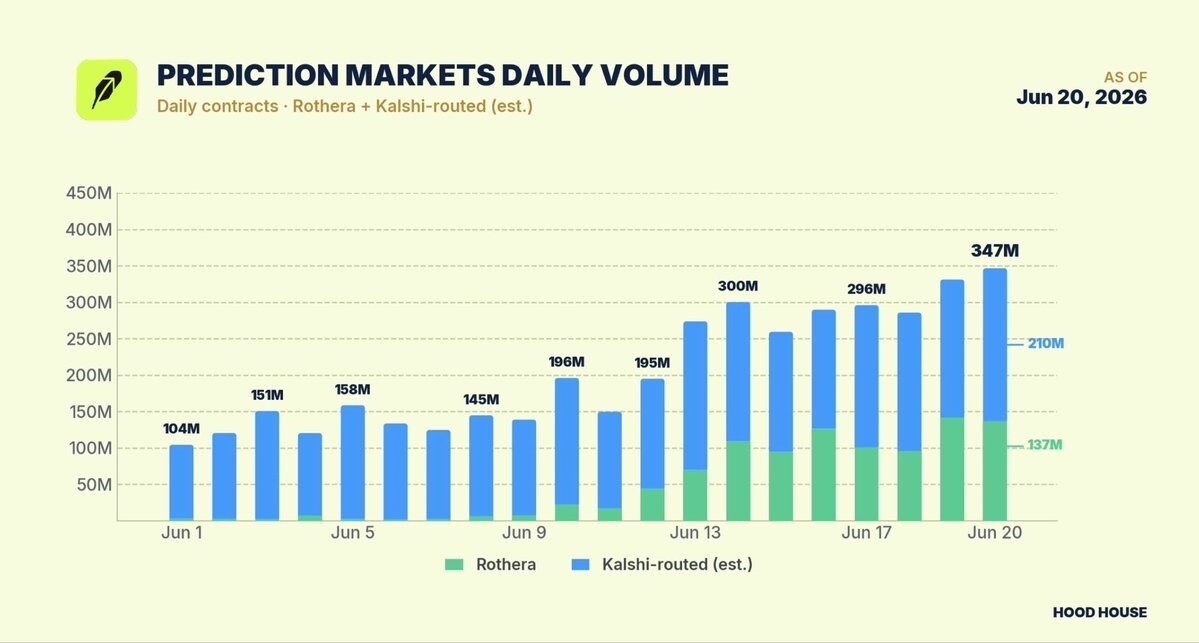
Hood House subsequently disclosed their calculation logic:

  • Rothera (primarily hosting World Cup-related markets) achieved a daily trading volume of 137 million contracts, corresponding to a trading value of approximately $47 million.
  • As a comparison, Kalshi's total daily trading volume was about 1.5 billion contracts, corresponding to a trading value of approximately $416 million. Excluding World Cup-related markets, Kalshi's trading volume was about 1 billion contracts, corresponding to a trading value of about $260 million.
  • Considering that Robinhood users are still estimated to contribute around 20% of Kalshi's non-World Cup market trading volume (conservative estimate), this means that approximately 210 million contracts and $52 million in trading volume from Kalshi's non-World Cup event contracts were completed through Robinhood.

Based on this, Hood House further made an aggressive projection, stating that if this growth rate continues, Robinhood's prediction market business has the potential to achieve revenue on the scale of billions of dollars this year. This figure even surpasses the historical peak of Robinhood's cryptocurrency-related revenue, which was approximately $900 million in 2025.

Kalshi's Counter Strategy: Finding New Channels

Faced with Rothera's rapid rise, Kalshi has clearly recognized the problem.

For Kalshi, Robinhood was both a partner and one of its most important sources of traffic. However, as Robinhood begins migrating more and more orders to its own platform, the relationship between the two has shifted to direct competition.

Recent news disclosed by The Information might reveal Kalshi's response strategy. Sources familiar with the matter revealed that Kalshi has begun early, informal discussions with several investment banks regarding a potential future IPO. More notably, Kalshi has made a specific demand in its communications with these banks: to be prioritized for underwriting roles in the future IPO, these institutions need to prioritize completing technical integration of their systems with Kalshi. This would enable their institutional clients to directly participate in trading event contracts on Kalshi's platform.

In other words, Kalshi is using the prospect of an IPO as an opportunity to seek new distribution channels, aiming to integrate prediction markets into the client networks of banks, brokerages, and other financial institutions. This might also represent a subtle shift in the competitive dynamics of the prediction market industry. In the past, the focus was on who could offer more contracts or design better products. Now, as prediction markets gradually integrate into the mainstream financial system, the focus of competition is shifting to another dimension: those who control the user gateway can more effectively control value.

The rise of Rothera has already demonstrated the significance of distribution capabilities. Swooping to third place seems effortless, and challenging Kalshi and Polymarket in the future might not seem like such a difficult task.


Related Questions

QWhat is the main reason behind the rapid growth of Rothera's trading volume, according to the article?

AThe rapid growth of Rothera's trading volume is primarily attributed to a migration of existing orders rather than the creation of new users. Specifically, Robinhood has begun directing orders related to World Cup contracts, which previously would have been executed on Kalshi, to its own platform, Rothera.

QWhich two prediction market platforms are currently ranked ahead of Rothera in terms of trading volume?

AAccording to the article, the two prediction market platforms currently ranked ahead of Rothera are Kalshi and Polymarket.

QWhat strategy is Kalshi reportedly employing to counter the threat from Rothera?

AKalshi is reportedly seeking new distribution channels by engaging with investment banks for a potential future IPO. A key requirement in these discussions is that the banks must first integrate their systems with Kalshi's platform to allow their institutional clients direct access to trade event contracts on Kalshi.

QWhat significant change in the focus of competition within the prediction market industry does the article highlight?

AThe article highlights that the focus of competition is shifting from merely providing more contracts or better product design to controlling user access points. It emphasizes that whoever masters distribution channels and user entry points can more effectively capture value.

QWhat potential annual revenue for Robinhood's prediction market business is mentioned in the article, and how does it compare to its historical crypto revenue?

AThe article mentions an aggressive estimate that Robinhood's prediction market business has the opportunity to reach an annual revenue scale in the billions of dollars this year. This figure is suggested to potentially exceed the historical peak of Robinhood's crypto-related revenue, which was approximately $900 million in 2025.

Related Reads

2026 Altcoin Season Guide: Current Values & Market Signals, Is It Time to Prepare for Altcoin Season?

Altcoin Season Guide 2026: Signals & Timing Analysis This guide explores the dynamics of an "altcoin season," defined as a 90-day period where at least 75% of the top 50 cryptocurrencies outperform Bitcoin (BTC). Historically signaling capital rotation from BTC to alternative assets ("alts"), these periods have evolved. Key differences for the 2026 market cycle include the "ETF Wall," where institutional capital via spot Bitcoin ETFs may remain concentrated in BTC, potentially slowing a broad altseason. A genuine, sustainable altseason now likely requires BTC profit-taking combined with new retail and on-chain liquidity entering the wider market. Analysts use tools like the Altseason Index (values >75 indicate an altseason) but also monitor key pairs like ETH/BTC and SOL/BTC for confirmation. Additional signals include a declining Bitcoin Dominance rate (ideally below 40-50%), accelerating altcoin total market cap growth, and surges in trading volume and social sentiment for alts. Modern altseasons are increasingly narrative-driven and selective, not uniform across all coins. Capital typically rotates in stages: from BTC to major altcoins (like ETH), then into leading narratives (e.g., AI, RWA, DePIN), and finally into mid/small-cap projects and meme coins. The peak phase is often marked by extreme greed, parabolic rises, and high leverage, serving as a cautionary signal. For preparation, investors are advised to build a quality watchlist based on fundamentals, product traction, and team strength. Strategies should include portfolio diversification, disciplined risk management (position sizing, stop-losses, stablecoin reserves), and capitalizing on sector rotations rather than chasing past winners. While precise timing is uncertain, historical patterns suggest strong altcoin rallies often follow Bitcoin halvings by 12-30 months. For the 2024 halving cycle, 2026-2027 could present favorable conditions if supported by macro liquidity, technological narratives, and a sustained drop in Bitcoin Dominance. A true, broad altseason is unlikely if Bitcoin experiences a sharp crash (>20%), as capital tends to flee the entire crypto market.

Foresight News50m ago

2026 Altcoin Season Guide: Current Values & Market Signals, Is It Time to Prepare for Altcoin Season?

Foresight News50m ago

This Might Be the Most Stunning Image at This Year's WAIC!

This article introduces Shangtang's newly released multimodal AI model, **SenseNova U1 Pro**, unveiled at WAIC 2026. The model is highlighted for its ability to generate **native 8K-resolution images** with exceptional detail and coherence, even in extremely wide-format compositions. It goes beyond simple image generation by employing a **"图文交错思维" (interleaved image-text reasoning)** workflow, where it can plan, sketch, refine, check, and correct its outputs to achieve a final, deliverable result. Key capabilities demonstrated include generating a long 8K scroll depicting the 9-year history of WAIC, a detailed 24 solar terms illustration, a complex academic poster, a琉璃 (colored glaze)-style landscape, and a ready-to-use movie poster. The model handles intricate prompts involving layout, text clarity, material textures, and stylistic consistency. The article draws a parallel between this evolution in image generation and the progression seen in AI coding—from simple code completion to autonomous project delivery. U1 Pro represents a shift from generating single images to providing **complete content delivery systems** for professional scenarios like infographics, urban planning, and commercial design. While challenges like generation time and professional workflow integration remain, the model signifies a move towards multimodal AI agents that are accountable for producing usable, high-quality outputs.

marsbit2h ago

This Might Be the Most Stunning Image at This Year's WAIC!

marsbit2h ago

How Did This Round of Deleveraging in the Korean Stock Market Occur?

This article details the timeline and mechanisms behind the deleveraging event in the South Korean stock market, focusing on the KOSPI index from late June to mid-July. The core trigger was the market's structure, heavily concentrated in Samsung Electronics and SK Hynix, which comprised over half of the KOSPI. The situation was amplified by the May 27th launch of single-stock double-leveraged ETFs on these two companies, which attracted massive retail investment and concentrated risk. The process unfolded in eight stages: 1. Initial price collapse on June 23rd after regulatory warnings, but without significant debt reduction. 2. A rebound from June 24-25 fueled by retail buying and ETF rebalancing, which actually increased leverage. 3. Foreign and institutional investors selling from June 26-30, with domestic retail investors becoming the marginal buyers, transferring risk to household balance sheets. 4. A shift in global semiconductor sentiment from July 1-3, causing leveraged ETFs to systematically sell during declines. 5. The market failing to rally on strong earnings (July 6-8), signaling a turn from technical correction to concerns over peak profitability. 6. A rise in forced liquidations and the cross-listing of SK Hynix ADRs, spreading leverage risks to US and Hong Kong markets (July 9-10). 7. A cascade of synchronized selling from various players on July 13th, followed by a mechanical, ETF-driven rebound. 8. Institutionalization of deleveraging on July 16th, marked by an interest rate hike and new regulatory restrictions on single-stock leveraged products. The author concludes this was not a simple semiconductor correction but a negative feedback loop involving foreign capital rebalancing, retail margin trading, daily ETF rebalancing, forced liquidations, shifting industry expectations, and tightening monetary and regulatory policy. Leveraged ETFs acted as a critical amplifier, not the initial spark. The price decline (-25%) far exceeded the reduction in margin debt (-11%), indicating the deleveraging was primarily expressed through asset prices rather than immediate balance sheet repair.

marsbit2h ago

How Did This Round of Deleveraging in the Korean Stock Market Occur?

marsbit2h ago

Trading

Spot
活动图片