Superstate brings stablecoin-settled stock offerings to Ethereum and Solana

cointelegraphPublished on 2025-12-10Last updated on 2025-12-10

Abstract

Superstate has launched Direct Issuance Programs (DIPs), enabling SEC-registered public companies to raise capital directly on Ethereum and Solana. Investors can pay in stablecoins and receive tokenized shares instantly at real-time market prices. This onchain model uses Superstate’s SEC-registered transfer-agent infrastructure to update shareholder registries automatically, ensuring compliance with securities laws. The system allows companies to reduce financing costs and reach global investors, while providing instant settlement and regulatory safeguards. Superstate’s initiative builds on its growing onchain infrastructure, which has already attracted firms like SharpLink Gaming and Galaxy Digital. The tokenized real-world asset market has surpassed $24 billion, with Ethereum and Solana leading much of the activity.

Financial technology firm Superstate has rolled out a new way for US Securities and Exchange Commission (SEC)-registered public companies to raise capital directly onchain.

Through its Direct Issuance Programs (DIPs), any issuer registered with the SEC can now offer new shares on Ethereum and Solana, with investors paying in stablecoins and receiving tokenized shares instantly at real‐time market prices, according to a Wednesday announcement from Superstate shared with Cointelegraph.

Jim Hiltner, co-founder and head of business development at Superstate, told Cointelegraph, “The regulatory ability to directly issue registered shares isn’t new. What is new is that issuers can now conduct these offerings onchain, which changes what’s possible operationally and economically.”

The launch of DIPs is part of Superstate’s mission to bring compliant public‐market infrastructure onchain. The model uses Superstate’s SEC‐registered transfer‐agent infrastructure to update shareholder registries automatically as tokenized shares move between verified wallets, ensuring issuances comply with existing securities laws.

“Any SEC‐registered public company is able to run an issuer‐led primary offering onchain using this structure,” said Hiltner. “Our infrastructure is live now. Issuers can begin preparing and filing their programs immediately. The first public company offerings are expected to go live in 2026.”

Related: Spark marks first major rotation from US Treasurys into regulated DeFi

Expanding Superstate’s onchain ambitions

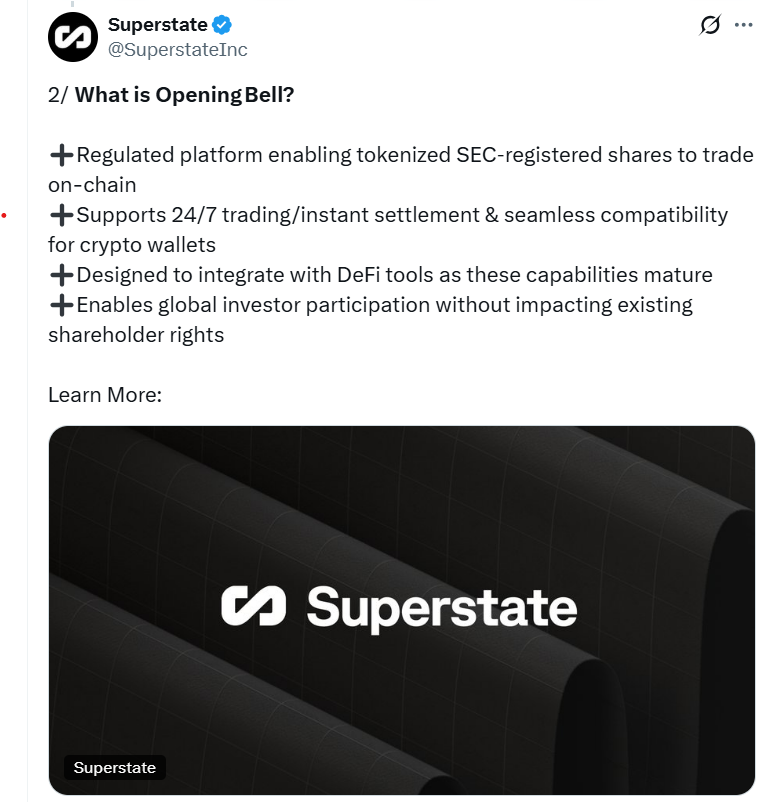
DIPs build on a year of onchain expansion for the fintech startup. In May, Superstate launched Opening Bell, a platform designed to tokenize and enable compliant onchain activity for SEC‐registered equities.
Source: Superstate

In September, SharpLink Gaming, one of the world’s biggest public holders of Ether (ETH), revealed plans to tokenize its common stock through Superstate’s platform. In the same month, Galaxy Digital announced its tokenized public shares on Solana using Superstate’s transfer-agent infrastructure.

The launch of DIPs also lands in a year when other tokenization initiatives are expanding across Ethereum and Solana, such as Franklin Templeton’s move from tokenized money funds to multi‐asset real‐world‐asset (RWA) platforms.

The tokenized real‐world asset market had surged to over $24 billion on public blockchains by Q3, 2025, with Ethereum and Solana accounting for well over half of all RWA activity.

Related: US Treasurys lead tokenization wave as CoinShares predicts 2026 growth

A new channel for issuers and investors

Hiltner said that DIPs allow companies to structure their offerings under standard SEC registrations, receive stablecoin proceeds directly into their wallets, and distribute tokenized shares instantly to verified investors.

Each transaction updates the issuer’s shareholder registry in real time, preserving the integrity of ownership records while enabling instant settlement. According to Hiltner, issuers can achieve lower financing costs through reduced underwriting and distribution fees and broader global reach to eligible investors.

For investors, the system allows retail and institutional participants to purchase newly issued stock directly from companies (sometimes below exchange prices), with shares settling to their wallets immediately.

“This combines regulatory compliance with onchain execution,” said Hiltner. “If an investor meets all requirements, they can participate; if not, the system blocks the transaction.”

Superstate’s model blends established securities law with crypto’s instant settlement rails and aims to bring traditional financial regulation to onchain capital markets infrastructure.

Magazine: Solana vs Ethereum ETFs, Facebook’s influence on Bitwise — Hunter Horsley

Trending Cryptos

Related Reads

L2 'Recalibration': When L1 Becomes Its Own Rollup, What Is Ethereum's Endgame?

The article discusses the evolving relationship between Ethereum's Layer 1 (L1) and Layer 2 (L2) solutions, moving beyond the initial "L2 for scaling" model. As Ethereum L1 itself scales (increasing Gas Limit, statelessness, zkEVM), the unique value proposition of L2s shifts from merely providing cheap execution to offering differentiated features like application-specific optimization, privacy, and flexible governance. The piece explores three key themes: 1. **L2's New Role:** L2s are transitioning from a pure scaling technology to a spectrum of execution environments with varying degrees of security inheritance from Ethereum L1. 2. **Interoperability as State Trust:** Solving L2 fragmentation is less about cross-chain bridges and more about enabling faster, trust-minimized state verification between environments. This involves initiatives like faster L1 finality, intent-based architectures (Open Intents Framework), and native account abstraction. 3. **Blurring Layers:** With the potential integration of zk-proofs into L1 validation (making L1 akin to its own "Rollup") and the concept of "Native Rollups," the rigid boundary between L1 and L2 may fade. The future could be a unified system with multiple execution domains (for DeFi, gaming, privacy, etc.) sharing a common security, settlement, and state framework. In conclusion, Ethereum's goal is not to abandon L2s or re-centralize everything on L1, but to re-integrate the fragmented user experience—liquidity, accounts, applications—while preserving the scaling benefits of a multi-environment ecosystem. The endgame is a cohesive "one chain" feeling for users, powered by diverse but securely interconnected execution layers.

marsbit22m ago

L2 'Recalibration': When L1 Becomes Its Own Rollup, What Is Ethereum's Endgame?

marsbit22m ago

The Encryption Bill Clarity's Challenge: A Thorny Path of Bipartisan Compromise in the U.S.

U.S. lawmakers are attempting to advance the Clarity Act, a significant crypto market structure bill, but its path is fraught with partisan hurdles. The process has been rocky since January, when a prior bipartisan deal in the Senate Banking Committee was upended. A key compromise in May on "yield" issues allowed the bill to move forward in committee, but only with the conditional support of two Democratic senators, Angela Alsobrooks and Ruben Gallego. They emphasized that their final vote depends on reaching an agreement on ethics provisions for elected officials. Ultimately, the Senate Agriculture Committee passed its version along party lines without Democratic support. As Republicans push for a full Senate vote in July, the demand for strong ethics language has expanded beyond Democrats. Additional controversies surround provisions related to yields (aligning some Republicans with large banks) and developer protections (opposed by enforcement agencies). Core concerns about illicit finance and consumer protection remain central to the debate. Despite consensus on the need for legislation, achieving the necessary bipartisan compromise is proving difficult. While momentum exists—including recent meetings between senators and White House officials—a reconciled bill text faces skepticism. Senator Gallego has stated that without ethics terms acceptable to Democrats, they will not provide the needed votes. The immediate goals for the crypto community in Congress are unclear: a symbolic Senate vote before the August recess, eventual passage into law by 2026, or forging a final compromise framework. The arduous, vote-by-vote effort to build bipartisan support continues, mirroring the traditional legislative grind the industry must now navigate.

Foresight News1h ago

The Encryption Bill Clarity's Challenge: A Thorny Path of Bipartisan Compromise in the U.S.

Foresight News1h ago

Trading

Spot

Hot Articles

Discussions

Welcome to the HTX Community. Here, you can stay informed about the latest platform developments and gain access to professional market insights. Users' opinions on the price of SOL (SOL) are presented below.

活动图片