Superstate brings stablecoin-settled stock offerings to Ethereum and Solana

cointelegraphPublished on 2025-12-10Last updated on 2025-12-10

Abstract

Superstate has launched Direct Issuance Programs (DIPs), enabling SEC-registered public companies to raise capital directly on Ethereum and Solana. Investors can pay in stablecoins and receive tokenized shares instantly at real-time market prices. This onchain model uses Superstate’s SEC-registered transfer-agent infrastructure to update shareholder registries automatically, ensuring compliance with securities laws. The system allows companies to reduce financing costs and reach global investors, while providing instant settlement and regulatory safeguards. Superstate’s initiative builds on its growing onchain infrastructure, which has already attracted firms like SharpLink Gaming and Galaxy Digital. The tokenized real-world asset market has surpassed $24 billion, with Ethereum and Solana leading much of the activity.

Financial technology firm Superstate has rolled out a new way for US Securities and Exchange Commission (SEC)-registered public companies to raise capital directly onchain.

Through its Direct Issuance Programs (DIPs), any issuer registered with the SEC can now offer new shares on Ethereum and Solana, with investors paying in stablecoins and receiving tokenized shares instantly at real‐time market prices, according to a Wednesday announcement from Superstate shared with Cointelegraph.

Jim Hiltner, co-founder and head of business development at Superstate, told Cointelegraph, “The regulatory ability to directly issue registered shares isn’t new. What is new is that issuers can now conduct these offerings onchain, which changes what’s possible operationally and economically.”

The launch of DIPs is part of Superstate’s mission to bring compliant public‐market infrastructure onchain. The model uses Superstate’s SEC‐registered transfer‐agent infrastructure to update shareholder registries automatically as tokenized shares move between verified wallets, ensuring issuances comply with existing securities laws.

“Any SEC‐registered public company is able to run an issuer‐led primary offering onchain using this structure,” said Hiltner. “Our infrastructure is live now. Issuers can begin preparing and filing their programs immediately. The first public company offerings are expected to go live in 2026.”

Related: Spark marks first major rotation from US Treasurys into regulated DeFi

Expanding Superstate’s onchain ambitions

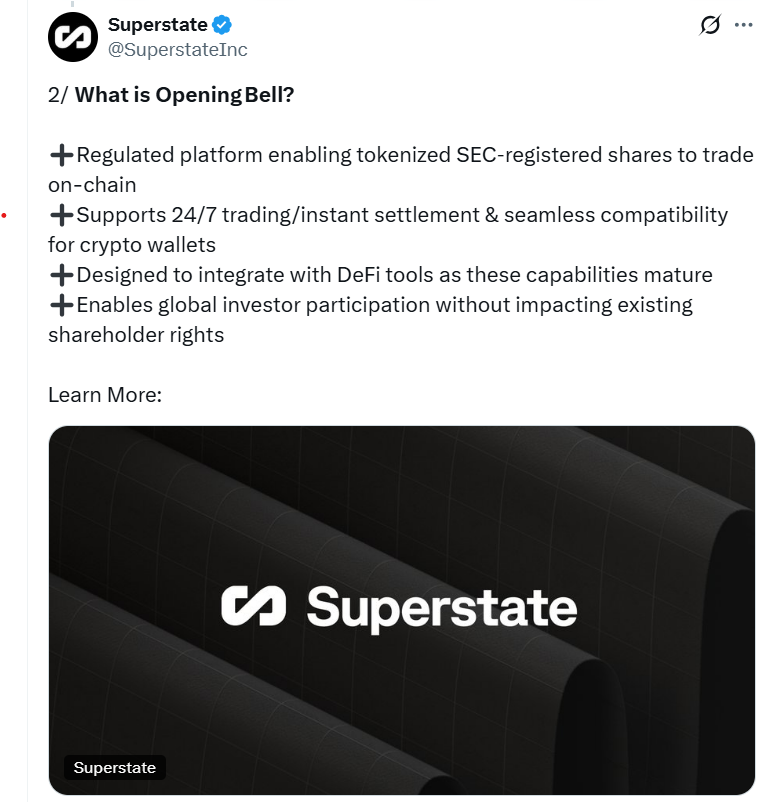
DIPs build on a year of onchain expansion for the fintech startup. In May, Superstate launched Opening Bell, a platform designed to tokenize and enable compliant onchain activity for SEC‐registered equities.
Source: Superstate

In September, SharpLink Gaming, one of the world’s biggest public holders of Ether (ETH), revealed plans to tokenize its common stock through Superstate’s platform. In the same month, Galaxy Digital announced its tokenized public shares on Solana using Superstate’s transfer-agent infrastructure.

The launch of DIPs also lands in a year when other tokenization initiatives are expanding across Ethereum and Solana, such as Franklin Templeton’s move from tokenized money funds to multi‐asset real‐world‐asset (RWA) platforms.

The tokenized real‐world asset market had surged to over $24 billion on public blockchains by Q3, 2025, with Ethereum and Solana accounting for well over half of all RWA activity.

Related: US Treasurys lead tokenization wave as CoinShares predicts 2026 growth

A new channel for issuers and investors

Hiltner said that DIPs allow companies to structure their offerings under standard SEC registrations, receive stablecoin proceeds directly into their wallets, and distribute tokenized shares instantly to verified investors.

Each transaction updates the issuer’s shareholder registry in real time, preserving the integrity of ownership records while enabling instant settlement. According to Hiltner, issuers can achieve lower financing costs through reduced underwriting and distribution fees and broader global reach to eligible investors.

For investors, the system allows retail and institutional participants to purchase newly issued stock directly from companies (sometimes below exchange prices), with shares settling to their wallets immediately.

“This combines regulatory compliance with onchain execution,” said Hiltner. “If an investor meets all requirements, they can participate; if not, the system blocks the transaction.”

Superstate’s model blends established securities law with crypto’s instant settlement rails and aims to bring traditional financial regulation to onchain capital markets infrastructure.

Magazine: Solana vs Ethereum ETFs, Facebook’s influence on Bitwise — Hunter Horsley

Trending Cryptos

Related Reads

The "Impossible Triad" Is Fundamentally a Pseudo-Problem

The article argues that blockchain's fundamental limitation is not the scalability trilemma (decentralization, scalability, security), which has been largely solved, but the lack of **privacy** and, until recently, clear **legitimacy**. Blockchain is described as a slow, expensive, globally shared computer whose core value is censorship resistance and verifiability. While ideal for native digital assets like money (e.g., stablecoins), its default transparency acts as a **tax**, exposing all transactions and enabling MEV extraction, which deters serious institutional capital. Simultaneously, its permissionless nature created regulatory ambiguity. The piece contends that **privacy** is the missing critical feature. It rejects the false choice between total transparency and complete anonymity. Modern cryptography (like zero-knowledge proofs) enables **compliant privacy**: users can prove facts (solvency, KYC status, compliance) without revealing the underlying sensitive data (specific holdings, identities). This preserves auditability for regulators and eliminates the leak of financial information. With recent regulatory progress (e.g., the GENIUS Act) addressing legitimacy, adding default, provably compliant privacy becomes a pure upgrade. It transforms blockchain from a costly, public ledger into a confidential settlement layer, finally bridging the gap to mainstream institutional and individual adoption of on-chain finance.

链捕手11h ago

The "Impossible Triad" Is Fundamentally a Pseudo-Problem

链捕手11h ago

Optical Chips: Collective Capacity Expansion

The global optical chip industry is experiencing a massive wave of expansion driven by surging AI data center demand. Major players across the US, Japan, Europe, and China are aggressively investing to ramp up production capacity. In the US, Coherent is expanding its 6-inch Indium Phosphide (InP) semiconductor fab in Texas, supported by CHIPS Act funding and a $2 billion strategic investment from NVIDIA. Lumentum is building a new factory for InP optical devices, and Nokia is scaling its advanced photonic chip packaging and testing capabilities. NVIDIA's investments aim to secure future supply of critical lasers and optical interconnect products for AI infrastructure. Japan's JX Advanced Metals, a leading InP substrate supplier, plans a multi-billion yen investment to increase its capacity 7-10 times, strengthening its grip on the crucial upstream materials market. In Europe, IQE and Tower Semiconductor settled a patent dispute and signed a multi-year InP epitaxial wafer supply agreement, highlighting that next-generation silicon photonics platforms will integrate high-performance InP components. STMicroelectronics and Sivers Semiconductors are also expanding silicon photonics production and partnerships. China is rapidly building out its domestic supply chain. Dongshan Precision's subsidiary, Source Photonics, announced a $12 billion project to expand optical chip and module production. Companies like Sanan Optoelectronics and Yunnan Germanium are scaling up InP chip manufacturing and substrate production, moving towards vertical integration from materials to modules. While debate continues around the exact future architecture—whether CPO (Co-Packaged Optics), NPO, or pluggables will dominate—analysts like Morgan Stanley argue the underlying driver is unchangeable: the explosive growth in bandwidth demand. This will inevitably increase the volume of optical engines, lasers, and related content per GPU, regardless of the final technical path. The competition for "more light" in the AI era has intensified into a global, full-chain capacity race.

marsbit14h ago

Optical Chips: Collective Capacity Expansion

marsbit14h ago

Trading

Spot
Futures

Hot Articles

Discussions

Welcome to the HTX Community. Here, you can stay informed about the latest platform developments and gain access to professional market insights. Users' opinions on the price of SOL (SOL) are presented below.

活动图片