Stop Grinding Mindlessly, the Best Airdrops Are Often 'Unexpected Encounters'

marsbitPublished on 2026-01-20Last updated on 2026-01-20

Abstract

The article argues that the most valuable crypto airdrops are often "unexpected" and not the result of grinding tedious, predefined tasks. Instead, the best strategy is to build a genuine on-chain footprint by actively using protocols you believe in. Past examples like TIA, DYM, and Monad rewarded active users on various chains and in top protocols, not just those who farmed points. Publicized criteria for points programs are often exploited by Sybil attackers, diluting rewards and leading to burnout and disappointment when expectations aren't met. In contrast, retroactive airdrops with hidden criteria have less competition, as incentive-chasers avoid uncertain rewards. The core logic is that projects value real, high-value on-chain activity over low-value, repetitive Sybil behavior. By focusing on authentic engagement rather than farming, users can build a strong on-chain reputation, avoid being filtered out as a Sybil, and be pleasantly surprised by future airdrops.

Author: FIP Crypto

Compiled by: Deep Tide TechFlow

Deep Tide Intro: In the current landscape of airdrop frenzy and rampant points systems, many investors are experiencing "grinding fatigue." This article proposes a counterintuitive airdrop strategy: the best airdrops aren't "grinded" for; they are encountered unexpectedly through genuine on-chain interactions.

By analyzing cases like Monad, ZKsync, and Base, the author reveals the core logic behind retrospective airdrops—project teams value on-chain footprints that generate real value more than mechanical Sybil behavior. If you feel your airdrop returns are being diluted, this article will teach you how to build a genuine on-chain reputation for efficient, low-pressure earning.

Main Text:

Not all airdrops require endless "grinding," and the ones that don't are often the highest quality.

I've tried various types of airdrops, and many left me utterly exhausted.

But I realized the smartest way to get airdrops is actually not to deliberately "farm" them.

Here is the strategy I currently employ, aimed at "accidentally" getting the highest rewards with minimal effort:

We Get Rewarded for Being Active On-Chain

Not every project does this, but some projects distribute airdrops to active on-chain users.

Here are some examples of past retrospective airdrops:

  • TIA and DYM: Rewarded stakers in the Cosmos ecosystem and active L2 users.
  • AVAIL: Rewarded active L2 users, including Starknet users.
  • PENGU: Rewarded wallets with strong activity records on Ethereum and Solana.
  • MegaETH: SBT eligibility was based on our on-chain contributions.
  • Monad: Rewarded significant traders and depositors in top Ethereum and Solana protocols (they defined this as users who provided substantial value on-chain).

Following @Zeneca's airdrop philosophy, as long as we keep an open mind and explore new things on-chain, airdrops will come naturally.
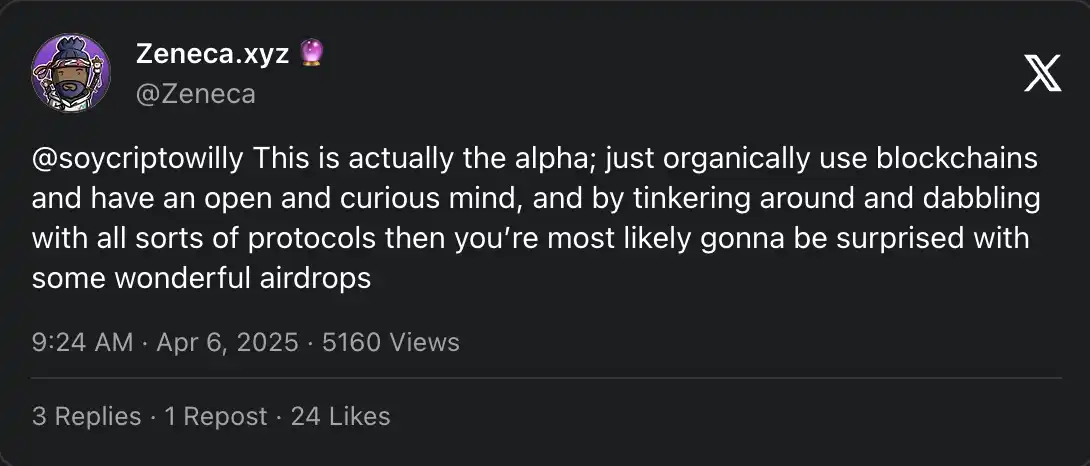
Our footprint makes us eligible for various airdrops simply by interacting with protocols we like.
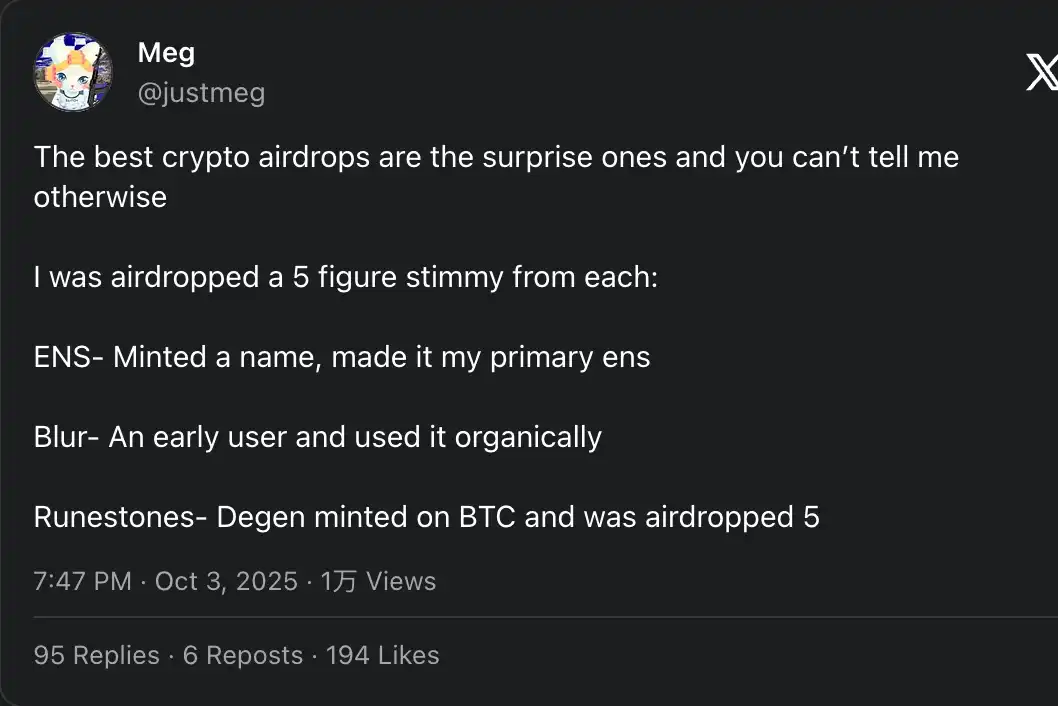
No One Knows the Criteria

Points programs with clear criteria are boring because the project team directly tells you how to grind them.

One of the most "notorious" projects is MarginFi, which ran a points program for months (or even years?) without ever revealing any token details.

But this is the trap of any points program:

No one promises you anything, and the activity can go on forever.

They can change the rules at any time; that's the game we're playing.

If the sole purpose is to hard-grind a project for an airdrop, many people get frustrated.

When our expectations for airdrop returns are too high:

We are setting ourselves up for massive disappointment.

These programs are also heavily manipulated by Sybils, which further dilutes the allocation.

Meanwhile, retrospective airdrops do not publicly share their criteria.

We can compare the criteria used by two different L2s:

  • ZKsync used Time-Weighted Average Balance (TWAB), but only announced it after the snapshot.
  • Scroll used Marks points across multiple campaigns.

Both used similar factors (liquidity) to determine eligibility.

But Scroll didn't perform well except for favoring whales, while ZKsync was quite lucrative if you had the right strategy.

Many are still angry about missing ZKsync eligibility, but in reality, we could have qualified even with a small amount of capital.

We Have Less Competition

When there's so much uncertainty, no one likes to farm airdrops.

The ideal scenario is like Base or Arbitrum:

Actively denying they will issue a token, until they change their minds and decide to issue one.
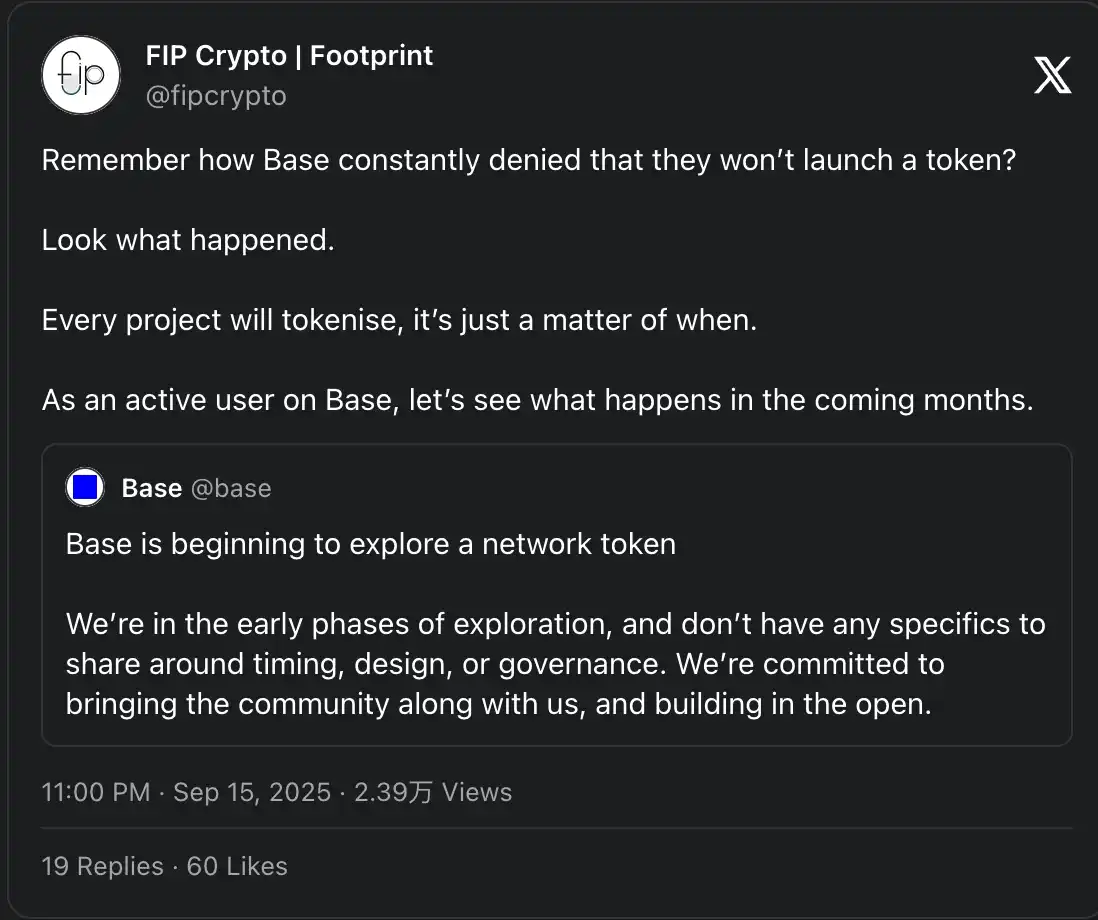
Therefore, fewer wallets actively participate because those solely chasing incentives won't join.

Or they might drop out halfway, as it doesn't make sense from a Return on Investment (ROI) perspective to farm this project.

Optimism's 5th airdrop was a huge surprise for me; it turned out only 54,723 wallets were eligible.
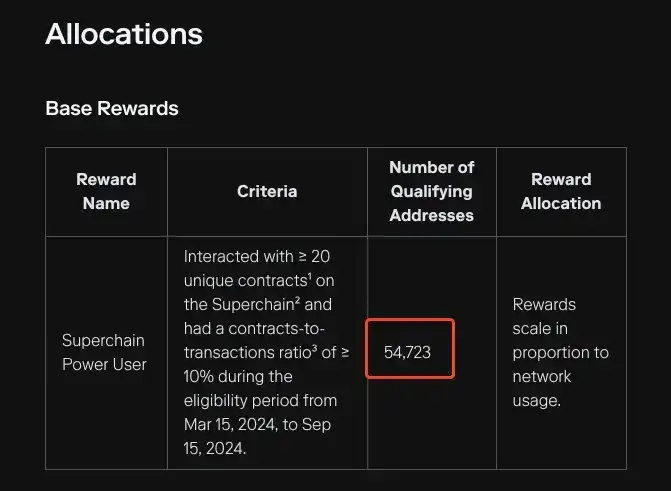
Many will adopt a wait-and-see attitude, questioning if it's worth interacting without guarantees.

But the real reward comes from uncertainty:

We risk our time and capital based on our convictions, which could be a failure or a highly rewarding investment.

Even if we fail, it helps us further optimize our strategy and understand what to avoid in the future.

We Don't Get Burned Out

I've been asked countless times which are the best projects to farm.

We are always looking for the next farm, and after the token dump, the next one.

But sometimes, the best way to play airdrops is to use products you enjoy.

Who would have thought that staying active on Aave or Uniswap would make us eligible for a Monad airdrop?
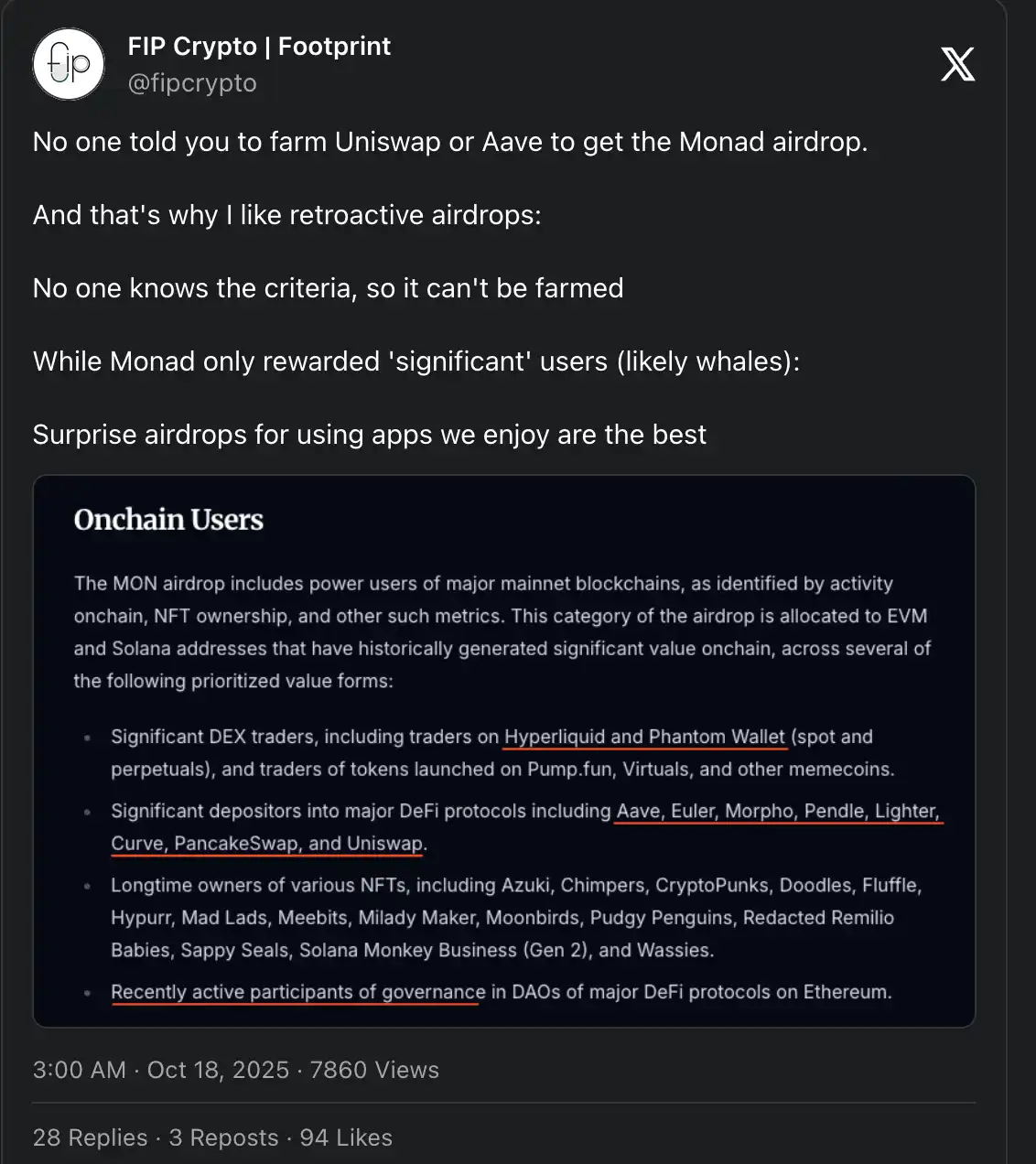
I've been burned out multiple times from constantly searching for the next Alpha.

But if we can get rewarded based on our on-chain footprint:

The real Alpha is interacting with protocols we enjoy using and profiting from in the process.
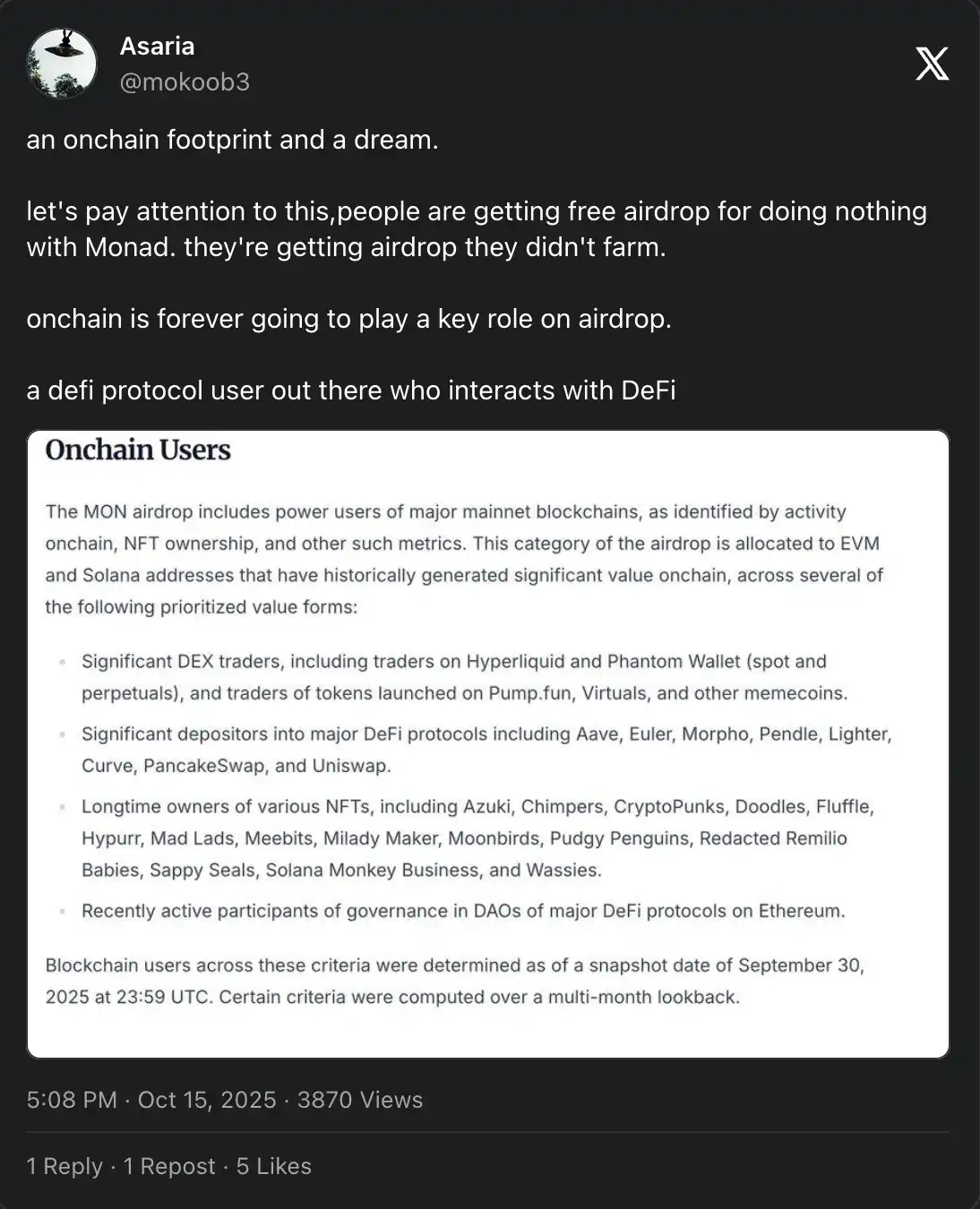
Focusing too much on the end result leads to disappointment.

Receiving surprise airdrops keeps us motivated to continue exploring on-chain.

Sybil Attacks Can't Game the System

Sybil farms mimic real users by performing the most basic operations to gain eligibility.

There will always be Sybils trying to extract value from projects.

But projects using retrospective criteria can adjust rules to filter out Sybils.

Of course, these are never perfect:

  • Real users get falsely filtered out.
  • Some Sybils get allocations.

It's hard to balance between the two; someone always gets left out.

On our end, we can try our best not to be filtered out as Sybils.

It all starts with this principle:

Value is the Primary Criterion

Retrospective airdrops are distributed based on the value your wallet provides.

Monad described it as "addresses that have historically generated significant value on-chain across different forms of value."

If we do the same low-value tasks as Sybils:

We get flagged and lose eligibility.

Project teams don't want to reward farmers who repeatedly make the same low-value swaps.

Instead, they reward high-value contributions.

But there are no strict rules for this; project teams decide which behaviors they want to reward.

So, to be eligible, we just need to find applications we like and use them consistently.

Our footprint will be recognized by other projects, and we'll get rewarded for using applications we enjoy.

Building a Strong On-Chain Social Footprint

The on-chain footprint has been declared dead by many, but I still believe it plays a key role in future airdrops.
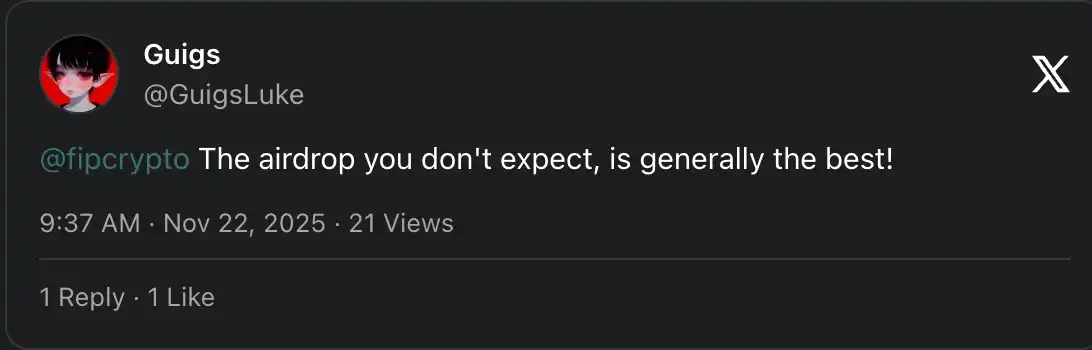
Even though airdrops now heavily lean towards social distributions:

The on-chain footprint still forms the foundation of trust for your social reputation.

Others can easily tell if you're faking it or genuinely participating, so there's no point in trying to lie.

You just need to talk about what you've done on-chain to increase your "surface area for luck."

Related Questions

QWhat is the core argument of the article regarding the best strategy to receive airdrops?

AThe article argues that the best airdrops are not obtained through deliberate, repetitive 'farming' but are instead 'unexpectedly' received through genuine, valuable on-chain activity and interaction with protocols one genuinely likes and uses.

QAccording to the author, what is a key advantage of public points programs for airdrops?

AA key disadvantage of public points programs is that they are heavily manipulated by Sybil attacks, which dilutes the rewards for genuine users, and the projects can change the rules at any time with no guarantee of a token distribution.

QHow do retrospective airdrops, like the one from Monad, differ from public points programs?

ARetrospective airdrops do not publicly share their criteria beforehand. They are distributed based on the value a wallet's historical on-chain activity provided, rewarding genuine users rather than low-value, repetitive actions common in Sybil farming.

QWhy does the author suggest that having less competition is beneficial for receiving airdrops?

ALess competition arises when a project's token distribution is uncertain (e.g., Base, Arbitrum initially denying a token). This discourages users who are only motivated by guaranteed incentives, leaving more rewards for those who interact with the protocol based on genuine belief.

QWhat is the recommended way to build a strong on-chain reputation to qualify for future airdrops?

AThe recommended way is to establish a genuine on-chain footprint by actively exploring and consistently using new protocols and applications that you genuinely like, as this valuable activity is what project teams look to reward.

Related Reads

How Many Tokens Away Is Yang Zhilin from the 'Moon Chasing the Light'?

The article explores the intense competition between two leading Chinese AI companies, DeepSeek and Kimi (Moon Dark Side), and the mounting pressure on Yang Zhilin, the founder of Kimi. While DeepSeek re-emerged after 15 months of silence with its powerful V4 model—boasting 1.6 trillion parameters and low-cost, long-context capabilities—Kimi has been focusing on long-context processing and multi-agent systems with its K2.6 model. Yang faces a threefold challenge: technological rivalry, commercialization pressure, and investor expectations. Despite Kimi’s high valuation (reaching $18 billion), its revenue heavily relies on a single product with low paid conversion rates, while DeepSeek’s strategic silence and open-source influence have strengthened its market position and valuation prospects, now targeting over $20 billion. Both companies reflect broader trends in China’s AI ecosystem: Kimi aims for global influence through open-source contributions and agent-based advancements, while DeepSeek prioritizes foundational innovation and hardware independence, notably shifting to Huawei’s chips. Their competition is seen as vital for China’s AI progress, with the gap between top Chinese and U.S. models narrowing to just 2.7% on the Elo rating scale. Ultimately, the article argues that this rivalry, though anxiety-inducing for leaders like Zhilin, is essential for driving innovation and solidifying China’s role in the global AI landscape.

marsbit6h ago

How Many Tokens Away Is Yang Zhilin from the 'Moon Chasing the Light'?

marsbit6h ago

TechFlow Intelligence Bureau: ChatGPT Helps Amateur Mathematician Crack 60-Year-Old Problem, CFTC Sues New York Regulator Over Coinbase and Gemini

An amateur mathematician, with the assistance of ChatGPT, has solved a combinatorial mathematics puzzle originally proposed by Hungarian mathematician Paul Erdős in the 1960s. This marks another milestone in AI-aided mathematical research, demonstrating the evolving capabilities of large language models in formal reasoning. In other AI developments, OpenAI introduced a new privacy filter tool for enterprise API usage, automatically screening sensitive data. Meanwhile, the Qwen3.6-27B model achieved 100 tokens per second on a single RTX 5090 GPU using quantization, significantly lowering the cost barrier for local AI deployment. In crypto and Web3, the U.S. CFTC sued New York’s financial regulator, challenging its oversight of Coinbase and Gemini—a first-of-its-kind federal-state regulatory clash. Following a vulnerability, KelpDAO and major DeFi protocols established a recovery fund. Tether froze $344 million in assets linked to Iran’s central bank upon U.S. Treasury request, highlighting the centralized control risks in stablecoins. Separately, Litecoin underwent a 3-hour chain reorganization to undo a privacy-layer exploit. In the U.S., former President Trump invoked the Defense Production Act to address power grid bottlenecks affecting AI data centers and dismissed the entire National Science Board, raising concerns over research independence. A retail trader gained 250% on a $600k Intel options bet amid AI-related speculation. Xiaomi announced its first performance electric vehicle, targeting rivals like Tesla. Meanwhile, iPhone users reported devices automatically reinstalling a hidden app daily, suspected to be MDM-related. A Chinese securities report noted that A-share institutional crowding has reached its second-longest streak since 2007, signaling high valuations and potential style rotation. The day’s developments reflect a dual narrative: AI is enabling unprecedented individual breakthroughs, while centralized power structures—whether governmental or corporate—are becoming more assertive, underscoring that decentralization is as much a political-economic challenge as a technical one.

marsbit6h ago

TechFlow Intelligence Bureau: ChatGPT Helps Amateur Mathematician Crack 60-Year-Old Problem, CFTC Sues New York Regulator Over Coinbase and Gemini

marsbit6h ago

Trading

Spot
Futures
活动图片