State Street, Galaxy and Ondo join tokenized cash race with 24/7 sweep fund

cointelegraphPublished on 2025-12-11Last updated on 2025-12-11

Abstract

State Street Investment Management, Galaxy Asset Management, and Ondo Finance are launching a tokenized liquidity fund called the State Street Galaxy Onchain Liquidity Sweep Fund (SWEEP). The fund will use PayPal’s PYUSD stablecoin to allow accredited investors to move cash "sweep" balances onto public blockchains, enabling 24/7 onchain liquidity. Ondo will seed the fund with $200 million. State Street will serve as custodian, while Galaxy provides digital asset infrastructure. The fund is set to launch on Solana in early 2026, with plans to expand to Stellar and Ethereum using Chainlink’s CCIP. This move places SWEEP in a growing race among institutions like BlackRock and Franklin Templeton to define onchain cash and tokenized real-world assets (RWA). The partnership highlights the convergence of traditional finance and crypto, with each firm contributing regulatory oversight, infrastructure, and distribution networks. Solana was chosen for its low fees and fast settlement, appealing to large institutions adopting blockchain for digital assets.

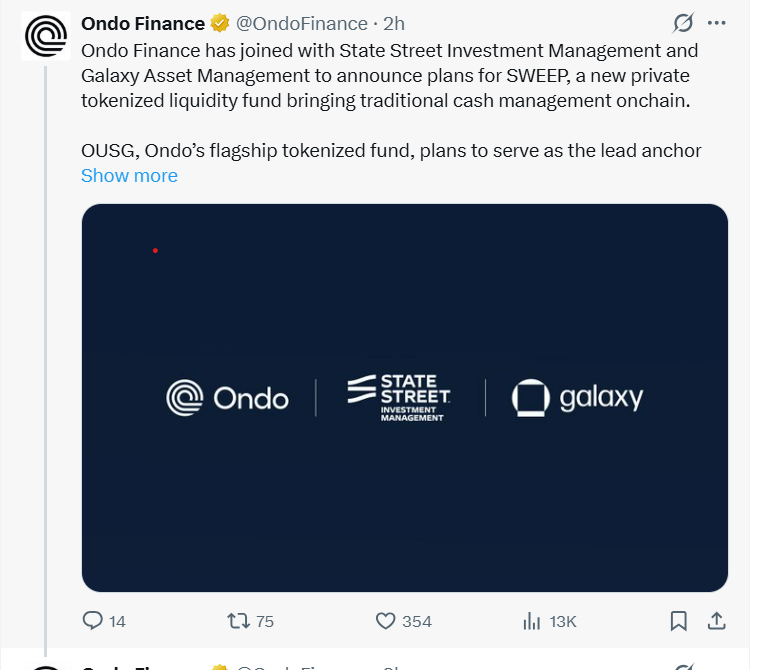
State Street Investment Management and Galaxy Asset Management are joining forces with Ondo Finance on a tokenized liquidity fund that pushes cash “sweep” balances directly onto public blockchains, opening up a source of potential 24/7 onchain liquidity.

The planned State Street Galaxy Onchain Liquidity Sweep Fund, or SWEEP, is designed to take in and pay out PayPal’s (PYUSD) stablecoin for accredited investors, the companies said Tuesday.

Ondo is expected to seed the fund with $200 million, tying a major tokenized real-world asset (RWA) issuer directly into State Street’s tokenization stack. The fund will be powered by Galaxy Digital infrastructure, and State Street Bank and Trust Company, an affiliate of State Street Investment Management, will act as custodian.

SWEEP is set to launch on Solana in early 2026, with rollouts on other networks, including Stellar and Ethereum, to follow, using Chainlink’s Cross-Chain Interoperability Protocol (CCIP).

Related: Solana and Coinbase’s Base connect together using Chainlink

Race to define onchain cash

The move drops another heavyweight into an increasingly crowded race to define what “onchain cash” looks like for institutions. BlackRock and Franklin Templeton already run tokenized cash‐management vehicles, including money‐market and other short‐term fixed‐income funds, on public blockchains. For its part, Ondo has built a business around wrapping Treasurys and other credit exposures into onchain vehicles that can plug into crypto markets.

“By partnering with Galaxy, we will push the envelope together and drive the evolution of the TradFi landscape onchain,” said Kim Hochfeld, global head of cash and digital assets for State Street Investment Management.

“Tokenization is rapidly becoming the connective tissue between traditional finance and the onchain economy,” said Ian De Bode, president of Ondo Finance. “Our planned investment would not only anchor this innovative fund – but also supports the continued growth of Ondo’s fund that offers institutional investors exposure to short-term US Treasuries with 24/7 instant mints and redemptions.”
Source: Ondo Finance

Related: Blockchain trial on Canton Network tests collateral reuse with tokenized US Treasurys

Building an onchain capital markets stack

The launch comes as tokenized funds and tokenized equities are starting to resemble components of an emerging onchain capital markets stack more than isolated pilots.

Superstate opened up onchain capital raising for US Securities and Exchange Commission‐registered public companies via its Direct Issuance Programs on Ethereum and Solana Wednesday, targeting the equity side of that stack by letting issuers sell new stock directly for stablecoins and settle immediately to investor wallets.

State Street’s partnership with Galaxy and Ondo also highlights how the roles are shaping up as traditional finance and crypto firms share the same products. State Street brings Big Four regulatory cover and custody, Galaxy contributes digital‐asset infrastructure and tokenization expertise, and Ondo provides both capital and an existing RWA distribution network.

Related: Galaxy expands into UAE as part of Middle East push

Solana’s role in the tokenization race

Solana’s role as the initial venue highlights a second competitive race unfolding beneath the product arms race. The chain has become a favored home for tokenized assets and high‐throughput trading, from tokenized public shares to experiments in onchain liquidity funds, as issuers look for lower fees and fast settlement.
Source: Solana

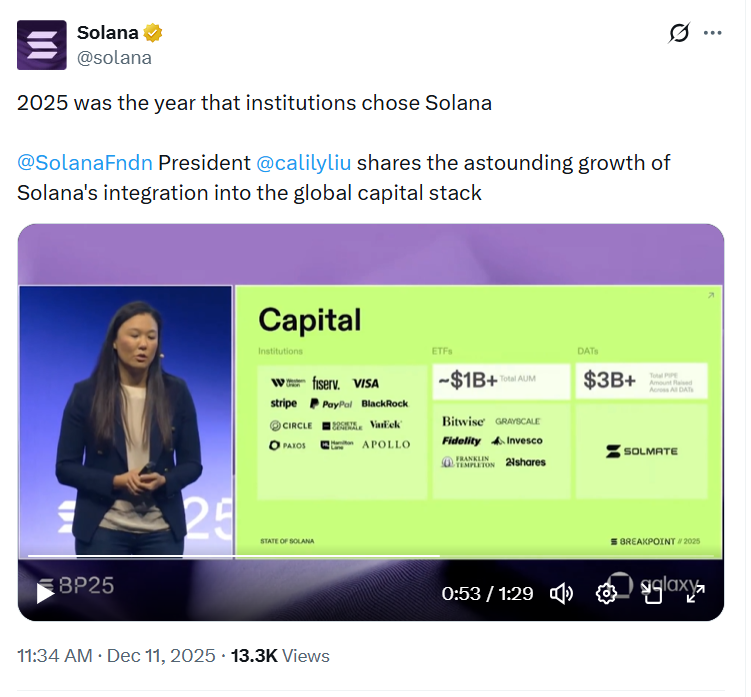
Some of the largest institutions in the world have chosen the Solana blockchain for their digital assets play, including Western Union, which processes over $100 billion in remittance volume every year, and Pfizer, which processes $2 trillion of merchant payment volume annually. Physical staked exchange-traded funds (ETFs) on Solana have also almost reached $1 billion in assets under management.

Launching on Solana first, with plans to expand to Stellar and Ethereum, allows SWEEP to tap into multiple ecosystems where stablecoins and RWA tokens are already part of the infrastructure.


Trending Cryptos

Related Reads

Can Generative Models Finally Be Trained End-to-End? The Core Is a For Loop

This article introduces a novel training paradigm for generative models called Explorative Modeling (XM), which enables true end-to-end training. Traditionally, powerful generative models like autoregressive and diffusion models are not trained end-to-end. They are trained to predict a single small step but require iterative multi-step sampling for inference. This "exposure bias" leads to error accumulation and limits performance. The core challenge XM addresses is "mode blurring." In generative tasks, a single input (e.g., "generate a dog") corresponds to many valid outputs (multiple modes). Standard training objectives like reconstruction loss force the model to average these modes, producing unrealistic, blurry outputs. To avoid this, existing models break generation into many small, almost deterministic steps, sacrificing end-to-end training. XM tackles this by restructuring the training loop itself. Its key insight is to amplify "generative expressivity." For each training input, instead of generating one sample, the model generates K candidate outputs. Only the candidate closest to the real data is used for computing the loss and updating the model via backpropagation. This simple "best-of-K" mechanism is implemented as a short for-loop. By exploring multiple possibilities, the model learns to distribute its guesses across different modes rather than collapsing to their uninformative average. The paper demonstrates that "exploration" acts as a new, powerful scaling axis. Gains from XM increase with model size, data scale, and compute. Experiments show improvements in FID scores for image generation and significant efficiency gains, sometimes outperforming larger models without exploration. When pushed to the limit, XM enables fully single-step, end-to-end generative models. In robotics tasks, an "Explorative Policy" matched the performance of a 100-step Diffusion Policy with a single forward pass, drastically improving inference speed. While the best-of-K concept is not entirely new, the authors' contribution lies in formally understanding it as a direct method to boost generative expressivity without fragmenting the generation process. This work suggests that as models scale, enhancing exploration during training may become crucial for overcoming fundamental performance bottlenecks.

marsbit10m ago

Can Generative Models Finally Be Trained End-to-End? The Core Is a For Loop

marsbit10m ago

Annual Salary of Millions Competing for Electricians, Meta Rushes to Open Its Own Technical School

The AI boom is facing an unexpected bottleneck: a severe shortage of skilled construction workers and electricians. As tech giants like Meta, OpenAI, and Alphabet race to build massive data centers—such as OpenAI's $16 billion "Stargate" project—they are hitting a critical labor wall. The U.S. needs an estimated 130,000 more electricians, 240,000 construction workers, and 150,000 supervisors by 2030 for AI infrastructure alone, but tens of thousands of electrician jobs go unfilled each year. While AI companies offer high premiums, with electricians earning up to $280,000 annually, worker scarcity still causes massive losses—delays on a single project can cost $14.2 million per month. The complexity of building AI data centers, which require immense power (equivalent to powering hundreds of thousands of homes), sophisticated electrical systems, and advanced liquid cooling solutions, demands highly skilled technicians who are in short supply. To combat this, companies are investing heavily in training. Meta has committed $115 million to a free training school offering tuition, housing, and stipends, targeting 5,000 new workers. OpenAI is partnering with unions to secure skilled labor. These efforts are paying off, with a significant rise in Gen Z interest in trade schools over college. However, the power demands are staggering. AI data centers are driving a rapid surge in electricity consumption, projected to account for up to 12% of U.S. power use by 2028 and raising costs for consumers. Furthermore, the construction boom is project-based, leading to a potential future glut of trained workers once building peaks, which could depress wages industry-wide. The race for AI supremacy now depends as much on skilled hands as on advanced chips.

marsbit1h ago

Annual Salary of Millions Competing for Electricians, Meta Rushes to Open Its Own Technical School

marsbit1h ago

Trading

Spot

Hot Articles

How to Buy ONDO

Welcome to HTX.com! We've made purchasing OndoFinance (ONDO) simple and convenient. Follow our step-by-step guide to embark on your crypto journey.Step 1: Create Your HTX AccountUse your email or phone number to sign up for a free account on HTX. Experience a hassle-free registration journey and unlock all features.Get My AccountStep 2: Go to Buy Crypto and Choose Your Payment MethodCredit/Debit Card: Use your Visa or Mastercard to buy OndoFinance (ONDO) instantly.Balance: Use funds from your HTX account balance to trade seamlessly.Third Parties: We've added popular payment methods such as Google Pay and Apple Pay to enhance convenience.P2P: Trade directly with other users on HTX.Over-the-Counter (OTC): We offer tailor-made services and competitive exchange rates for traders.Step 3: Store Your OndoFinance (ONDO)After purchasing your OndoFinance (ONDO), store it in your HTX account. Alternatively, you can send it elsewhere via blockchain transfer or use it to trade other cryptocurrencies.Step 4: Trade OndoFinance (ONDO)Easily trade OndoFinance (ONDO) on HTX's spot market. Simply access your account, select your trading pair, execute your trades, and monitor in real-time. We offer a user-friendly experience for both beginners and seasoned traders.

6.0k Total ViewsPublished 2024.03.29Updated 2026.06.02

How to Buy ONDO

Discussions

Welcome to the HTX Community. Here, you can stay informed about the latest platform developments and gain access to professional market insights. Users' opinions on the price of ONDO (ONDO) are presented below.

活动图片