Standard Chartered, AirAsia parent to test ringgit stablecoin in Malaysia

cointelegraphPublished on 2025-12-12Last updated on 2025-12-12

Abstract

Standard Chartered Bank Malaysia and Capital A, the parent company of AirAsia, have signed a letter of intent to jointly explore a ringgit-pegged stablecoin. The initiative falls under Malaysia’s Digital Asset Innovation Hub, a regulatory framework introduced by the central bank. Standard Chartered will serve as the issuer, while Capital A and its ecosystem partners will develop and pilot wholesale use cases. This move aligns with Malaysia’s broader effort to modernize its financial system with digital assets, supported by recent regulatory developments including a central bank roadmap for asset tokenization and the formation of an industry working group.

Standard Chartered Bank Malaysia and Capital A, the parent company of AirAsia, plan to jointly explore a stablecoin pegged to Malaysia’s local currency, the ringgit.

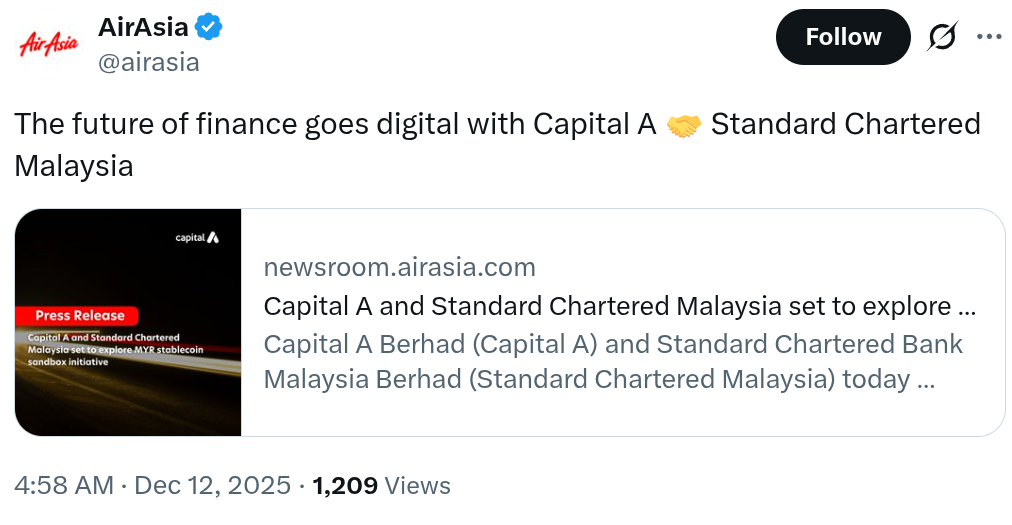
In a statement Friday, the bank’s Malaysian arm and Capital A said they signed a letter of intent to explore a ringgit-pegged stablecoin under the country’s Digital Asset Innovation Hub, an initiative announced by Bank Negara Malaysia (BNM) in June.

This is Capital A’s first interaction with the regulated digital asset space. The initiative will rely on Standard Chartered’s infrastructure and financial expertise, as well as Capital A’s ecosystem, to pilot the stablecoin in a wholesale fashion, rather than focusing on the retail market.

Standard Chartered Malaysia will serve as the issuer of the stablecoin, while Capital A and companies within its ecosystem will be tasked with developing, testing, and piloting wholesale use cases.
Source: Air Asia

Related: Malaysian regulator proposes easing crypto asset listing process

Malaysia is not getting left behind

Malaysia is moving to ensure it is not left behind as more countries weave crypto and stablecoins into mainstream finance. Capital A’s announcement said the effort “supports the aspirations of Malaysia,” positioning the stablecoin work as part of a broader national push to modernize payments and capital markets with digital asset technology.

That direction appears to have backing at the highest levels. The eldest son of Malaysia’s billionaire king recently launched a stablecoin pegged to the national currency. The Digital Asset Innovation Hub allows fintech and digital asset firms to test new technologies under BNM oversight.

Related: Illegal crypto mining surges in Malaysia amid unclear policies

Last month, BNM also unveiled a three-year roadmap to explore and test asset tokenization across the financial sector while building on the regulatory sandbox framework. The roadmap anticipates that the institution will launch proof-of-concept projects and conduct live pilots.

The central bank also decided to create an Asset Tokenization Industry Working Group to coordinate industry-wide exploration, share knowledge and identify regulatory and legal challenges in the country.

Malaysia has been considering a change in its approach to the digital asset industry since the beginning of 2025. In mid-January, the local government reportedly began exploring the possibility of establishing a cryptocurrency policy that could recognize the industry and modernize the nation’s financial system.

Related Reads

How Many Tokens Away Is Yang Zhilin from the 'Moon Chasing the Light'?

The article explores the intense competition between two leading Chinese AI companies, DeepSeek and Kimi (Moon Dark Side), and the mounting pressure on Yang Zhilin, the founder of Kimi. While DeepSeek re-emerged after 15 months of silence with its powerful V4 model—boasting 1.6 trillion parameters and low-cost, long-context capabilities—Kimi has been focusing on long-context processing and multi-agent systems with its K2.6 model. Yang faces a threefold challenge: technological rivalry, commercialization pressure, and investor expectations. Despite Kimi’s high valuation (reaching $18 billion), its revenue heavily relies on a single product with low paid conversion rates, while DeepSeek’s strategic silence and open-source influence have strengthened its market position and valuation prospects, now targeting over $20 billion. Both companies reflect broader trends in China’s AI ecosystem: Kimi aims for global influence through open-source contributions and agent-based advancements, while DeepSeek prioritizes foundational innovation and hardware independence, notably shifting to Huawei’s chips. Their competition is seen as vital for China’s AI progress, with the gap between top Chinese and U.S. models narrowing to just 2.7% on the Elo rating scale. Ultimately, the article argues that this rivalry, though anxiety-inducing for leaders like Zhilin, is essential for driving innovation and solidifying China’s role in the global AI landscape.

marsbit2h ago

How Many Tokens Away Is Yang Zhilin from the 'Moon Chasing the Light'?

marsbit2h ago

TechFlow Intelligence Bureau: ChatGPT Helps Amateur Mathematician Crack 60-Year-Old Problem, CFTC Sues New York Regulator Over Coinbase and Gemini

An amateur mathematician, with the assistance of ChatGPT, has solved a combinatorial mathematics puzzle originally proposed by Hungarian mathematician Paul Erdős in the 1960s. This marks another milestone in AI-aided mathematical research, demonstrating the evolving capabilities of large language models in formal reasoning. In other AI developments, OpenAI introduced a new privacy filter tool for enterprise API usage, automatically screening sensitive data. Meanwhile, the Qwen3.6-27B model achieved 100 tokens per second on a single RTX 5090 GPU using quantization, significantly lowering the cost barrier for local AI deployment. In crypto and Web3, the U.S. CFTC sued New York’s financial regulator, challenging its oversight of Coinbase and Gemini—a first-of-its-kind federal-state regulatory clash. Following a vulnerability, KelpDAO and major DeFi protocols established a recovery fund. Tether froze $344 million in assets linked to Iran’s central bank upon U.S. Treasury request, highlighting the centralized control risks in stablecoins. Separately, Litecoin underwent a 3-hour chain reorganization to undo a privacy-layer exploit. In the U.S., former President Trump invoked the Defense Production Act to address power grid bottlenecks affecting AI data centers and dismissed the entire National Science Board, raising concerns over research independence. A retail trader gained 250% on a $600k Intel options bet amid AI-related speculation. Xiaomi announced its first performance electric vehicle, targeting rivals like Tesla. Meanwhile, iPhone users reported devices automatically reinstalling a hidden app daily, suspected to be MDM-related. A Chinese securities report noted that A-share institutional crowding has reached its second-longest streak since 2007, signaling high valuations and potential style rotation. The day’s developments reflect a dual narrative: AI is enabling unprecedented individual breakthroughs, while centralized power structures—whether governmental or corporate—are becoming more assertive, underscoring that decentralization is as much a political-economic challenge as a technical one.

marsbit3h ago

TechFlow Intelligence Bureau: ChatGPT Helps Amateur Mathematician Crack 60-Year-Old Problem, CFTC Sues New York Regulator Over Coinbase and Gemini

marsbit3h ago

Trading

Spot
Futures
活动图片