Stablecoin supply nears $318B: Fresh inflows or just capital rotation?

ambcryptoPublished on 2026-03-20Last updated on 2026-03-20

Abstract

Stablecoin supply is approaching $318 billion, signaling a period of controlled expansion. While fresh capital is entering through fiat on-ramps, a significant portion of this growth reflects internal capital rotation into yield-bearing and regulated assets rather than entirely new inflows. Tether (USDT) continues to dominate the market, though its growth has slowed, while others like USDC and USDS are expanding more rapidly. This liquidity is increasingly being actively deployed, evidenced by rising DEX volumes and exchange inflows. However, the market remains split between genuine capital inflows and internal redistribution, with a large share of stablecoins still held on exchanges.

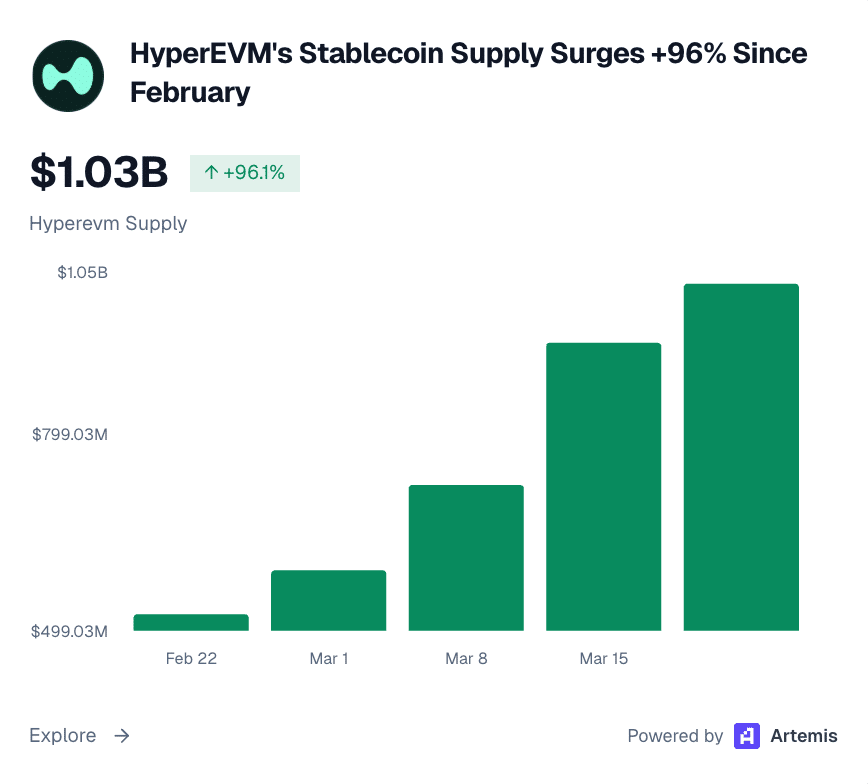
HyperEVM is emerging as a strong liquidity hub, with stablecoin supply and TVL both surpassing $1 billion soon after launch. At the same time, Hyperliquid [HYPE] L1 holds over $5 billion in stablecoins, which reinforces broader ecosystem momentum.

However, bridges such as HyperCore receive the majority of inflows, which transfer USDHL, USDe, and feUSD across chains, indicating a reallocation of liquidity rather than its creation.
Source: Artemis/ X

USDhl minting adds treasury-backed supply while supporting demand through HYPE-linked incentives, which sustains short-term activity. As these flows continue, unique active wallets steadily increase, reflecting growing participation.

Simultaneously, platforms like Hyperlend, DEXs, and perpetual venues absorb this capital and drive usage. Still, this growth leans on incentives and yield opportunities, which may fade. For now, HyperEVM shows traction, although lasting expansion depends on steady organic demand.

Stablecoin supply near $318B reflects growth

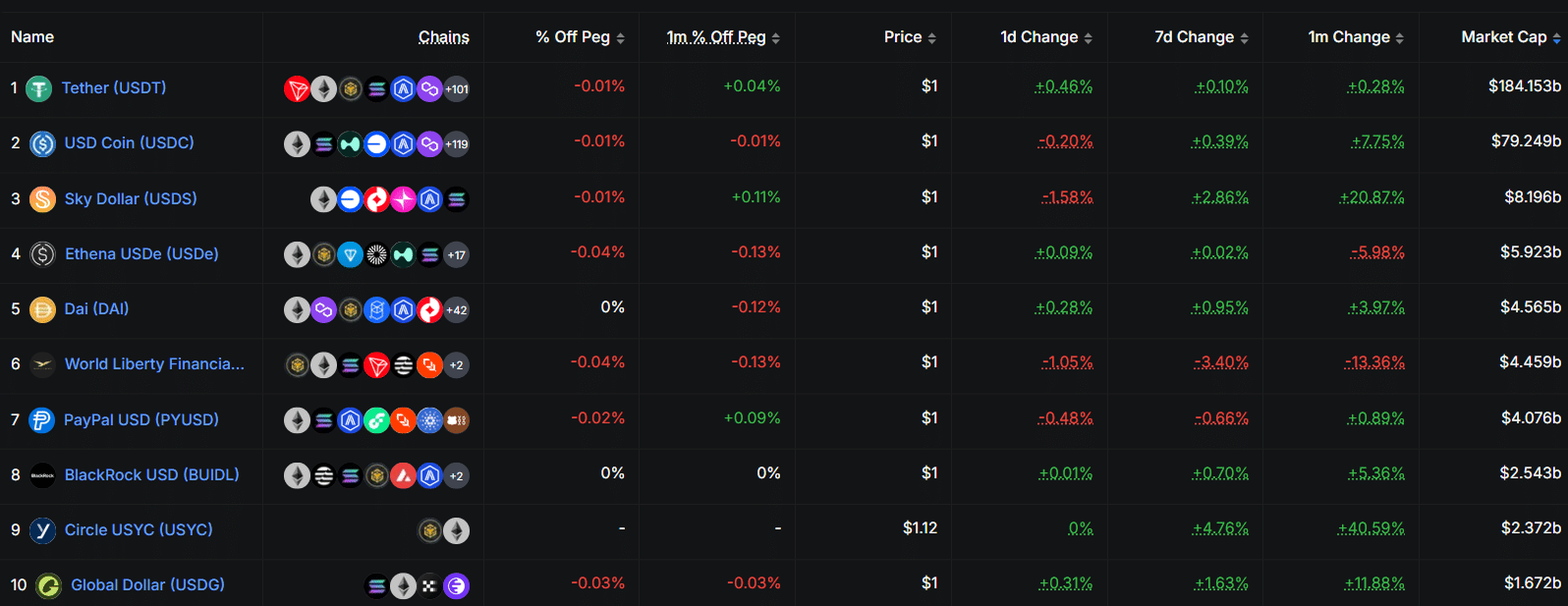
Stablecoin supply is approaching $318 billion, rising 0.47% weekly and 2.86% monthly, which reflects controlled expansion rather than aggressive inflows. Building on this trend, Tether [USDT] still dominates at $184 billion, although its 0.10% weekly growth shows slowing momentum.

Meanwhile, USDC at $79.24 billion expands faster with 7.75% monthly gains, while USDS and USYC surge by 20.87% and 40.59%, highlighting shifting demand. As these changes unfold, minting continues to exceed burns, suggesting fresh capital entering through fiat on-ramps.
Source: DeFiLlama

However, part of this rise also reflects capital rotating into yield-bearing and regulated assets. In parallel, the stablecoin ratio holds near 9–10% of the $2.5 trillion crypto market cap, showing relative balance.

This steady structure suggests liquidity is gradually expanding, yet not accelerating sharply, leaving the market split between real inflows and internal redistribution.

Stablecoins move from storage to utilization across crypto markets

Stablecoin growth is increasingly translating into active deployment, as DEX volume reaches $7.65 billion and rises 8.91% weekly. Building on this, Uniswap [UNI] processes $1.289 billion, while PancakeSwap [CAKE] sustains steady stablecoin-pair activity, reinforcing spot demand.

Perpetual Open Interest holds near $48–51 billion, showing sustained positioning without sharp liquidations. As flows deepen, stablecoin netflows turn positive, with ERC-20 inflows around $484 million moving toward exchanges.

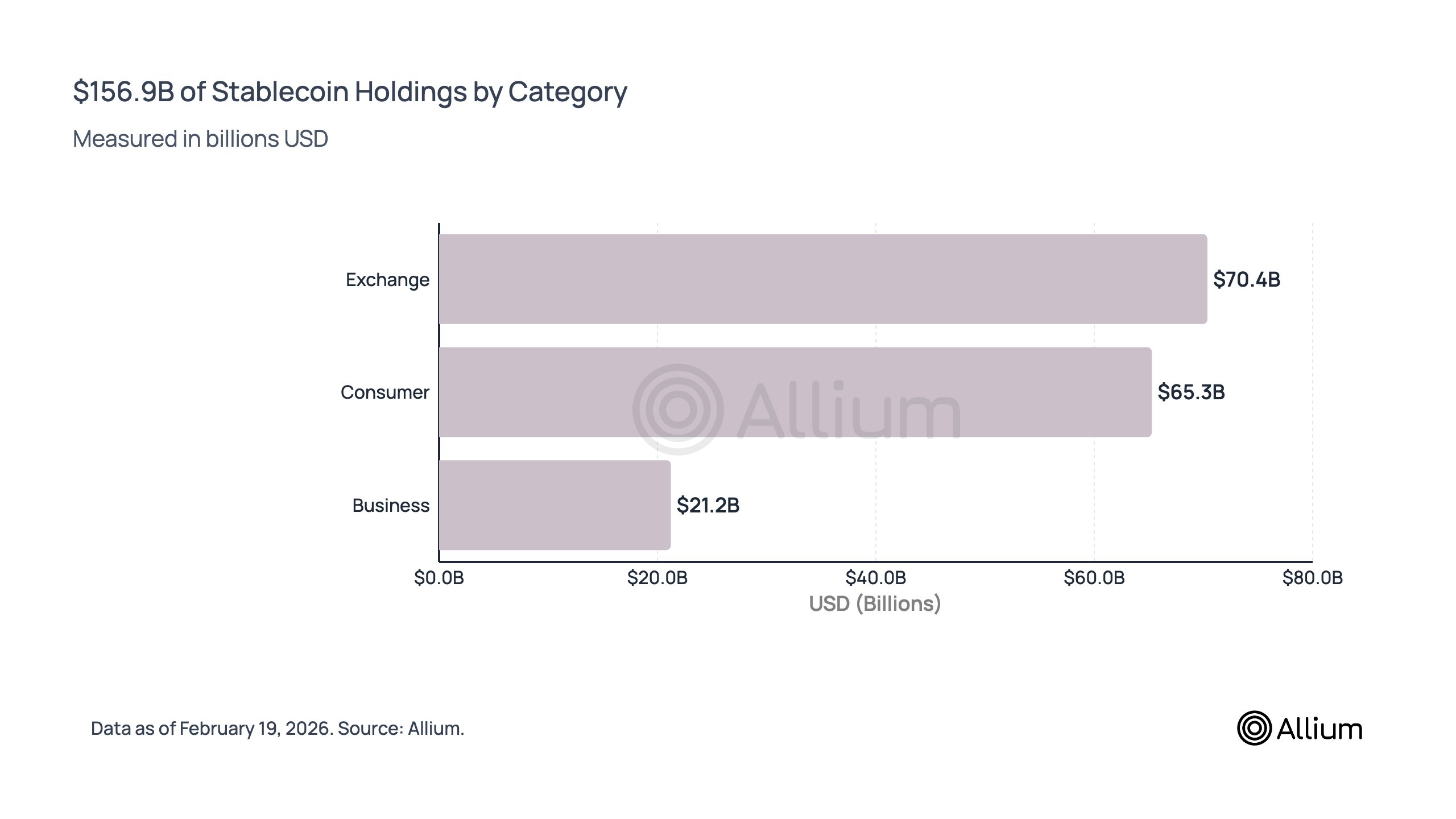
This shift aligns with holdings data, where exchanges control $70.4 billion, or 45%, anchoring liquidity concentration. From here, consumer balances reach $65.3 billion, or 41%, reflecting growing retail usage.
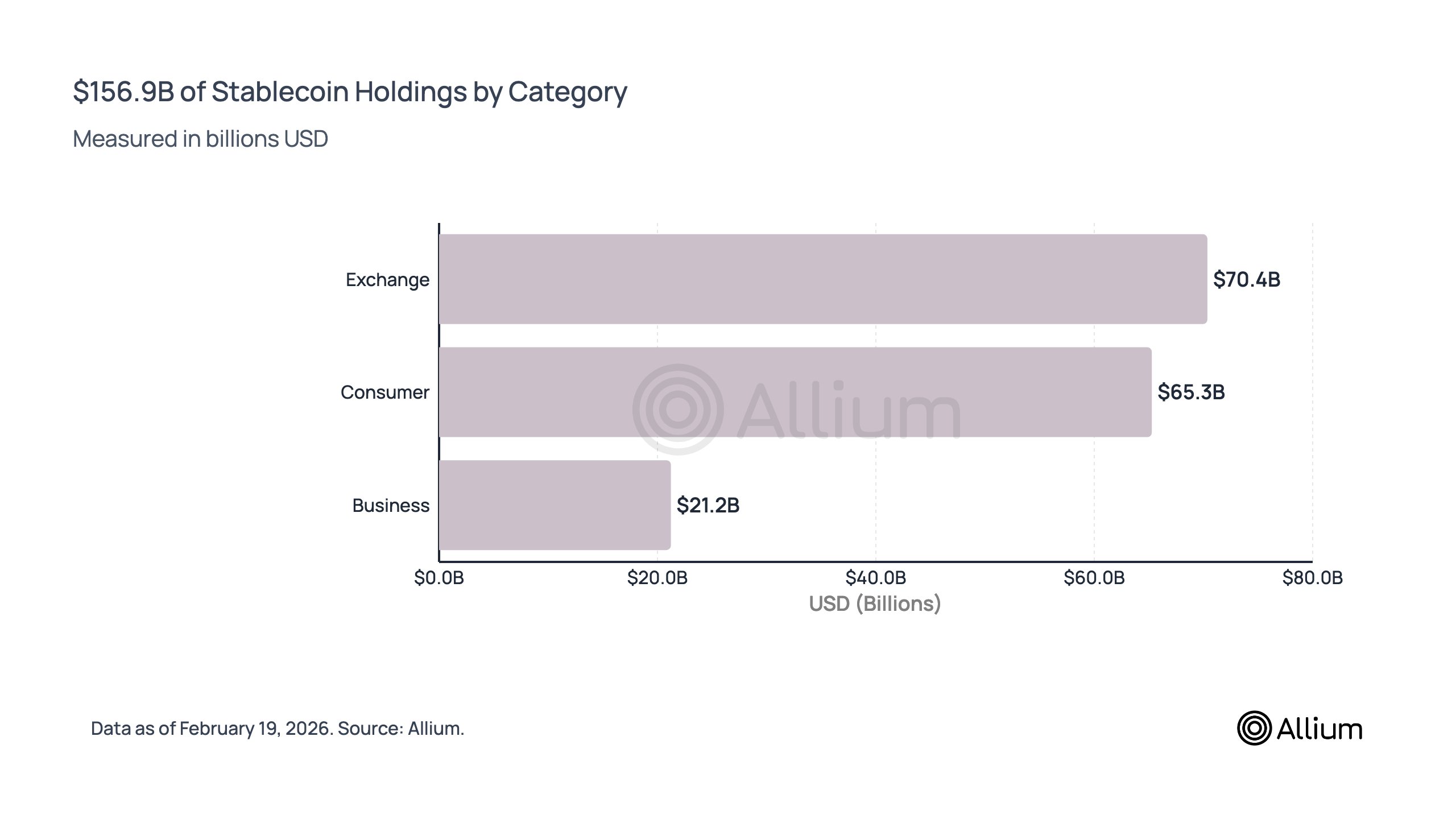
Source: Allium/ X

Business holdings at $21.2 billion support payment flows tied to $374.5 billion in volume. As distribution broadens, capital appears actively deployed, although exchange dominance suggests part of liquidity remains positioned rather than fully utilized.


Final Summary

  • Hyperliquid ecosystem growth reflects rising liquidity and user activity, yet heavy reliance on bridged inflows and incentives questions sustainability.
  • Stablecoins, led by Tether [USDT], show gradual expansion and active deployment, although a portion of liquidity still rotates internally across exchanges and DeFi.


Related Questions

QWhat is the total stablecoin supply approaching according to the article, and what does this growth reflect?

AThe total stablecoin supply is approaching $318 billion, reflecting controlled expansion rather than aggressive inflows, with a 0.47% weekly and 2.86% monthly increase.

QWhich stablecoin dominates the market in terms of supply, and what is its current growth trend?

ATether [USDT] dominates the market with a supply of $184 billion, but its weekly increase of only 0.10% shows a deceleration in its growth momentum.

QWhat does the majority of inflows into bridges like HyperCore indicate about the nature of the liquidity?

AThe majority of inflows into bridges like HyperCore, which transfer assets such as USDHL, USDe, and feUSD across chains, indicate a reallocation or rotation of existing liquidity rather than the creation of new capital.

QHow is the growing stablecoin supply being actively utilized in the crypto markets?

AThe growing stablecoin supply is being actively utilized, as evidenced by a DEX volume of $7.65 billion (an 8.91% weekly rise) and Perpetual Open Interest holding near $48-51 billion, showing capital is moving from storage to active deployment in trading and yield opportunities.

QWhat is a key factor questioning the sustainability of the HyperEVM ecosystem's current growth?

AA key factor questioning the sustainability of HyperEVM's growth is its heavy reliance on bridged inflows and incentive programs, as lasting expansion depends on steady organic demand rather than these potentially temporary drivers.

Related Reads

Within Strategy's Framework, STRC's Dividend Yield Remains at 12% as Share Price Stays Below Par Value

Michael Saylor, Executive Chairman of Strategy (MSTR), confirmed that the dividend rate for its STRC perpetual preferred shares will remain at 12.00% through August 2026. The rate has increased from 9% at its July 2025 launch to the current high via a "ratchet" mechanism, which permanently raises the rate by 0.5% whenever the share price falls below $95. This mechanism is intended to push the price back toward its $100 par value and support Strategy's "at-the-market" (ATM) program for issuing new shares to fund Bitcoin purchases. However, the mechanism has not worked as intended. STRC shares closed at $89.46 on July 31, remaining about 10-11% below par value despite the record-high dividend. Competition from rival Strive's higher-yielding SATA securities has pressured demand. The persistent discount has forced Strategy to suspend new STRC issuances via its ATM program, limiting this funding channel for Bitcoin acquisitions. STRC's struggles reflect Bitcoin's own volatility, as the preferred shares historically move in tandem. Analysts have warned the ratchet structure carries long-term, one-way risk. A law firm is investigating Strategy's ability to maintain dividend payments if Bitcoin's price stays low. Retail investors own roughly 83% of outstanding STRC shares, a group seen as prone to panic selling during downturns. In response, Strategy has established financial reserves, including a liquidity cushion covering about 26 months of dividend/interest obligations, and a $2 billion share buyback program alongside a Bitcoin monetization framework, though the company emphasized it is not obligated to sell any Bitcoin.

cryptonews.ru13m ago

Within Strategy's Framework, STRC's Dividend Yield Remains at 12% as Share Price Stays Below Par Value

cryptonews.ru13m ago

Analyst: Bitcoin's Price Will Drop to $60k in August, Then Rebound to $70k

Financial analyst Andrey Poroshin has provided a new forecast for Bitcoin's price dynamics in August. Poroshin, an analyst at the Bitbanker exchange, expects the cryptocurrency market to experience a downturn this month, with prices retesting the $60,000 level due to a lack of supportive macroeconomic catalysts. He noted that the recent US Federal Reserve decision to hold interest rates did not significantly impact the market, while inflation remains above the 2% target. Poroshin stated that Bitcoin is ending July under pressure from moderate volatility and a lack of new macroeconomic stimuli, leading to continued market caution. According to his base scenario, Bitcoin will drop to a range of $60,000 to $62,000 before recovering to $70,000. He pointed out that even $70,000 remains below the cost of mining in the US, which has prompted some miners to shift towards AI data center operations. Poroshin cited the winding down of BitMEX's operations as a potential catalyst for a price rebound, suggesting the exit of weaker players often coincides with market reversals and reduced short-term selling pressure. He believes Bitcoin is currently less susceptible to geopolitical shocks, such as the Iran-US conflict, and does not expect significant market changes in August related to the pending CLARITY Act. Looking ahead, Poroshin forecasts that September will bring more active price fluctuations driven by potential Fed rate decisions and possible discussions or approval of the CLARITY Act.

cryptonews.ru13m ago

Analyst: Bitcoin's Price Will Drop to $60k in August, Then Rebound to $70k

cryptonews.ru13m ago

Trading

Spot
活动图片




