Solana’s Low Fees Create Strong Competition for Base, BNB, and Polygon and Fuel SUBBD Token

bitcoinistPublished on 2026-02-10Last updated on 2026-02-10

Abstract

Solana's consistently low transaction fees, often below $0.001, are creating intense competitive pressure on rival blockchains like Base, BNB Chain, and Polygon. This cost efficiency is driving retail liquidity toward Solana and shifting market demand toward low-friction utility platforms. A key beneficiary of this trend is SUBBD Token ($SUBBD), which leverages AI and Web3 infrastructure to disrupt the $191 billion creator economy. SUBBD addresses the high commission fees (up to 70%) on Web2 platforms by offering AI-driven tools for content creators, including voice cloning and automated assistants, enabling better monetization and workflow efficiency. The project has raised over $1.47 million in its ongoing presale, signaling strong interest in the convergence of AI and crypto for content monetization.

Trusted Editorial content, reviewed by leading industry experts and seasoned editors. Ad Disclosure

Quick Facts:

  • ➡️ Solana’s sub-cent transaction fees are forcing competitors like Base and Polygon to accelerate efficiency upgrades to retain retail liquidity.
  • ➡️ The market demand for low friction is shifting from DeFi trading to the $191B creator economy, where Web2 platforms charge up to 70% fees.
  • ➡️ SUBBD Token leverages AI and Web3 infrastructure to minimize platform fees and automate creator workflows, having raised over $1.47M in its ongoing presale.
  • ➡️ The convergence of AI tools (voice cloning, assistants) with crypto payments represents the next evolution of digital content monetization.

The battle for blockchain dominance isn’t just about theoretical throughput anymore; it’s about the tangible reality of user costs. And right now, Solana is dictating the pace.

Recent on-chain data shows that Solana’s average transaction fee remains consistently below $0.001, often hovering near $0.00025 for non-priority transactions. That creates immense pressure on competing ecosystems like Base, BNB Chain, and Polygon. It’s essentially forcing a ‘race to the bottom’ regarding cost efficiency.

Sure, Base (Coinbase’s Layer-2) saw fees drop significantly following the Ethereum Dencun upgrade. But network congestion can still spike costs to $0.05 or higher during peak retail activity.

Similarly, while BNB Chain and Polygon are cheap compared to Ethereum mainnet, they often struggle to match the sub-cent consistency of Solana’s monolithic architecture. Why does this matter? Because retail liquidity flows where friction is lowest. If a user can swap a token for a fraction of a penny on Solana versus paying five to ten cents elsewhere, those aggregate savings drive volume.

But the demand for reduced friction extends beyond simple token swaps. We’re seeing a capital rotation toward utility-driven platforms that solve ‘fee fatigue’ in other sectors, particularly the digital content economy. Just as traders flock to Solana to escape DeFi gas fees, content creators are hunting for alternatives to Web2 platforms that charge exorbitant commission rates.

This search for economic efficiency is driving interest toward decentralized apps merging AI utility with better monetization. That’s creating a serious tailwind for new entrants like SUBBD Token ($SUBBD).

Read more about $SUBBD here.

AI-Driven Monetization And The Fight Against 70% Fees

The disconnect between creator output and income retention has hit a wall. Legacy Web2 platforms frequently deduct between 20% and 70% of a creator’s earnings.

That’s a ‘platform tax’ making blockchain gas fees look negligible by comparison. SUBBD Token ($SUBBD) aims to disrupt this $191B industry by applying crypto’s low-friction philosophy to content monetization.

Operating as an ERC-20 token on Ethereum, SUBBD uses EVM-compatible smart contracts to replace intermediaries with code. But it’s not just a payment rail. The platform integrates proprietary AI models, including automated personal assistants, voice cloning, and object recognition, to streamline workflows.

The project offers a tech stack allowing influencers to create ‘AI versions’ of themselves to interact with fans 24/7. It effectively solves the scalability problem for humans (who, unlike bots, need sleep).

From a tokenomics perspective, integrating AI represents a major shift. By allowing creators to token-gate exclusive content and use AI tools for optimization, SUBBD lowers the barrier to entry while raising the revenue ceiling. Of course, the risk is execution; the platform must ensure its AI tools are intuitive enough for non-crypto natives.

But the value proposition is clear: creators keep more of what they earn, mirroring the efficiency users seek in high-performance blockchains.

Check out the $SUBBD presale here.

Presale Data Signals Appetite For Creator Economy Disruption

Traders are watching the SUBBD Token presale as a gauge for sentiment on the AI-Web3 convergence.

According to live data, the project has raised exactly $1.47M, a sign of steady accumulation despite broader market volatility. With tokens priced at $0.057495, early participants are positioning themselves before the platform fully deploys its mainnet features.
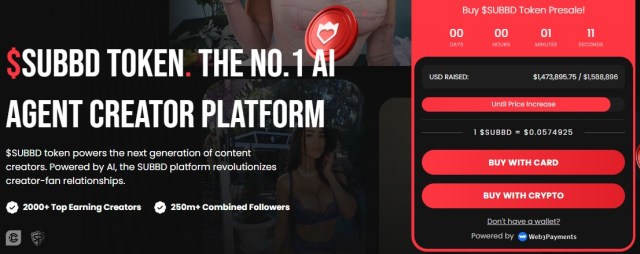
The staking architecture seems designed to encourage long-term holding rather than mercenary capital rotation. SUBBD offers a fixed 20% APY for the first year to users who lock their tokens. But it’s not just about yield.

Staking unlocks tangible utility: access to exclusive livestreams, ‘behind the scenes’ (BTS) drops, and XP multipliers that enhance platform standing. This gamified approach to liquidity retention suggests the team is prioritizing community stability over short-term hype.

In previous market cycles, utility tokens launching with functional ecosystems, rather than just roadmap promises, have tended to outperform during recovery phases. With the presale progressing, the focus shifts to the rollout of the ‘HoneyHive’ governance features and onboarding the first cohort of AI-driven influencers.

For investors tired of high-fee structures in both DeFi and Web2, SUBBD presents a logic-driven alternative.

Buy $SUBBD here.

This article is for informational purposes only and does not constitute financial advice. Cryptocurrencies are high-risk assets. Always perform your own due diligence before investing. The views expressed here are those of the author and do not necessarily reflect the official policy of any financial institution.

Editorial Process for bitcoinist is centered on delivering thoroughly researched, accurate, and unbiased content. We uphold strict sourcing standards, and each page undergoes diligent review by our team of top technology experts and seasoned editors. This process ensures the integrity, relevance, and value of our content for our readers.

patrubogdan

Follow

Full Profile

Related Posts

AI Can’t Save the Market Alone, But It Can Transform It: How SUBBD Token Redefines Content Economics

Russian Lawmaker Predicts Bitcoin Collapse While Smart Money Rotates into Layer 2 Utility

Chainlink Founder Sergey Nazarov Identifies 3 Trends That Will Define the Cryptosphere as Hyper Token Soars

Bitcoin Demand Plunges Per CryptoQuant, Yet Maxi Doge Endures

Crypto Markets Catch A Breather As Outflows Begin To Slow: Analysts

SUBBD Token’s Massive Projected Impact on the Content Creation Market in 2026

Trending Cryptos

Related Questions

QWhat is the average transaction fee on the Solana network, and how does it compare to competitors like Base and Polygon?

ASolana's average transaction fee remains consistently below $0.001, often near $0.00025 for non-priority transactions. This is significantly lower than competitors; Base can see fees spike to $0.05 or higher during congestion, and while BNB Chain and Polygon are cheaper than Ethereum, they struggle to match Solana's sub-cent consistency.

QWhat problem does SUBBD Token aim to solve in the digital content economy?

ASUBBD Token aims to disrupt the $191B digital content economy by addressing the exorbitant commission fees (20-70%) charged by legacy Web2 platforms. It uses crypto's low-friction philosophy and AI tools to allow creators to keep more of their earnings and automate workflows.

QWhat are some of the AI features integrated into the SUBBD platform?

AThe SUBBD platform integrates proprietary AI models, including automated personal assistants, voice cloning, and object recognition. It allows creators to make 'AI versions' of themselves to interact with fans 24/7, solving the scalability problem for human creators.

QHow much capital has the SUBBD Token presale raised, and what is the current token price?

AThe SUBBD Token presale has raised $1.47 million. The tokens are currently priced at $0.057495 in its ongoing presale.

QWhat staking rewards does SUBBD offer, and what utility do stakers gain?

ASUBBT offers a fixed 20% APY for the first year to users who lock their tokens. Staking also unlocks tangible utility, including access to exclusive livestreams, 'behind the scenes' content drops, and XP multipliers that enhance a user's standing on the platform.

Related Reads

As Consensus Accelerates, What Are Young Investors Betting On?

Title: As Consensus Forms Faster, What Are Young Investors Betting On? In the rapid evolution of tech investment, a new generation of young investors is navigating a landscape where AI, robotics, commercial aerospace, and quantum computing are advancing simultaneously. Traditional investment logic based on financial models is giving way to a need for deep technical understanding and the ability to act before industry consensus forms. An analysis of trends from the "WAIC FUTURE TECH" list of young investment leaders reveals key shifts in focus. The first major trend is the movement of AI from the digital screen into the physical world. Investment is shifting from large language models and chatbots towards embodied AI, robotics, AI hardware, and edge computing. While demonstrations generate excitement, the real challenge lies in achieving scalable, reliable, and cost-effective delivery in complex real-world environments like factories and logistics. Success depends not just on algorithms but on the integration of sensors, actuators, and control systems. Second, the competitive focus for large models is moving beyond raw capability toward building an "intelligence flywheel." The goal is to create self-reinforcing systems where user interaction generates data, improving the model, which in turn enhances the user experience and attracts more engagement. Companies that successfully embed AI into workflows to create these closed-loop systems can build lasting value that isn't easily erased by the next model upgrade. Third, facing a potential bottleneck in high-quality human-generated data, investors are looking at new underlying technologies. Reinforcement learning and self-play, as demonstrated by AlphaGo Zero, offer paths for AI to generate its own experience. Scientific foundation models, which aim to build general AI capabilities for fields like life sciences and materials discovery, represent a non-consensus direction that could unlock new frontiers of knowledge and data. Finally, in deep-tech areas like quantum computing, commercial aerospace, and space-based infrastructure, patient capital is essential. These fields have long, uncertain development and validation cycles involving complex engineering, supply chains, and regulations. Investment here requires a long-term view, focusing on foundational team capabilities and the eventual emergence of market demand, even if commercial returns are distant. Collectively, these trends illustrate how young investors are adapting to a new era. They are learning to make earlier, technically-informed judgments, balance hype with real-world viability, and provide the patient capital needed to build the deep-tech foundations of the future.

marsbit21m ago

As Consensus Accelerates, What Are Young Investors Betting On?

marsbit21m ago

Can Japan Buy Growth with AI? Will the Bond Market Believe It?

Japan's cabinet has introduced the 2026 Basic Policy on Economic and Fiscal Management and Reform, shifting its primary fiscal target. The new framework moves away from the traditional annual primary balance goal and instead prioritizes a stable reduction of the debt-to-GDP ratio. This change is tied to a strategy of increased "responsible proactive fiscal" spending, aiming to boost long-term growth through investments in strategic sectors like AI, semiconductors, energy, and robotics. The government estimates total public and private investment in 62 key technologies could exceed 370 trillion yen by 2040. The market reaction has been mixed and cautious. While equity markets may respond to policy signals, bond markets are focused on fiscal credibility. Concerns center on whether the weakening of the clear primary balance anchor could lead to looser fiscal discipline. If investors doubt that these strategic investments will generate sufficient productivity gains, tax revenue, and nominal growth to outpace rising interest costs, they may demand higher yields on Japanese Government Bonds (JGBs). Recent volatility in the yen and JGB yields, with the 10-year yield briefly reaching 2.9%, reflects this skepticism. The success of this new framework hinges on two factors: whether Japan can achieve a nominal growth rate consistently higher than its long-term interest rates, and whether future budgets demonstrate disciplined control over bond issuance. The government's narrative is that strategic investment is essential to break Japan's cycle of low growth, aging, and labor shortages. However, the bond market will continuously assess the credibility of this plan, pricing the risk that it may represent fiscal expansion rather than a viable growth strategy.

marsbit58m ago

Can Japan Buy Growth with AI? Will the Bond Market Believe It?

marsbit58m ago

Misjudged A-Shares: Resilience, Expectations, and Confidence

China's A-share market recently faced selling pressure, especially in tech sectors, initially triggered by a global tech sell-off that began in South Korea. However, the article argues this is a case of "mistaken injury" and highlights the market's underlying resilience. This resilience stems from three main pillars: **1) Tech Sector Fundamentals:** Unlike Korea's market dominated by a few memory chip stocks, China's tech sector is diversified across computing, communications, electronics, and semiconductors, supported by dual narratives of global AI supply chains and domestic substitution. Core areas like optical modules and fiber optics continue to show strong earnings growth. **2) "National Team" Support:** State-backed institutions and large corporations have made significant market purchases and announced buybacks, providing liquidity and signaling confidence. This is seen as a stabilizing policy signal, often associated with market bottoms. **3) Broader Market Pillars:** Other major sectors are showing endogenous recovery momentum. Consumer stocks benefit from stabilizing CPI and signs of sector recovery (e.g., liquor price hikes). Cyclical sectors like aluminum have high earnings, potential price increases due to tight supply, and low valuations. The financial sector offers stable dividends and low valuations. The conclusion is that the sell-off was driven by external contagion, not a collapse in fundamentals. With strong policy support and recovering momentum across key sectors, the A-share market possesses the toughness to regain stability.

marsbit1h ago

Misjudged A-Shares: Resilience, Expectations, and Confidence

marsbit1h ago

Trading

Spot

Hot Articles

Discussions

Welcome to the HTX Community. Here, you can stay informed about the latest platform developments and gain access to professional market insights. Users' opinions on the price of SOL (SOL) are presented below.

活动图片















