Solana vs. Ethereum: Assessing if SOL/ETH could reclaim 0.05 in Q2

ambcryptoPublished on 2026-03-29Last updated on 2026-03-29

Abstract

Solana has surpassed Ethereum in all-time unique developers, with 10,864 developers—nearly 20% more than Ethereum. This strong developer engagement is driving on-chain activity, as reflected in Solana’s leading DEX volumes across all timeframes. Stablecoin adoption is also accelerating, with USD1 supply surging from $160 million to $850 million in 60 days. Technically, the SOL/ETH ratio has held key consolidation around 0.04, maintaining a critical support level on weekly timeframes. With Solana’s expanding network fundamentals—including high liquidity and developer growth—a breakout above the 0.05 resistance could position SOL to outperform ETH in Q2.

A blockchain network’s long-term growth is closely tied to the size of its developer ecosystem.

The logic is simple: the more developers building on a network, the faster it churns out infrastructure upgrades. That, in turn, brings more users to the L1, boosts on-chain activity, and drives up the network’s overall value. In other words, developer engagement is the engine that powers sustainable growth.

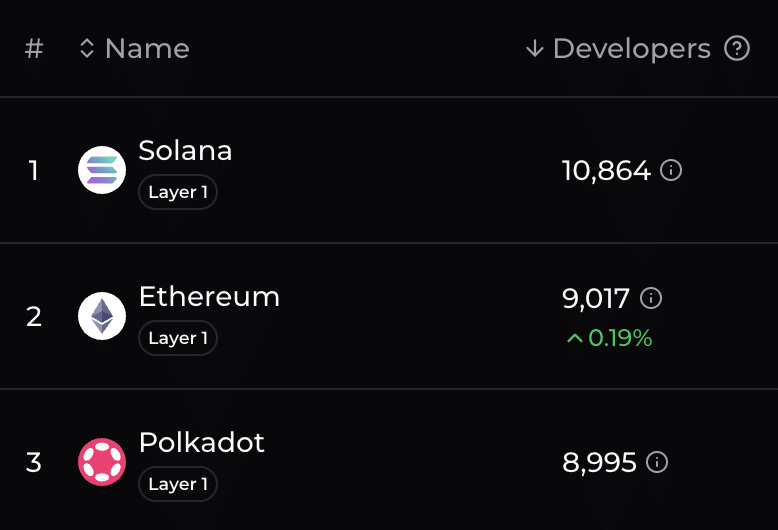
In this context, Solana’s [SOL] recent milestone is noteworthy. As the chart below shows, Solana has now surpassed Ethereum [ETH] in all-time unique developers, leading all chains with 10,864 developers, almost 20% more than Ethereum. Notably, the effects of this growth seem to be playing out in real time.
Source: Chainspect

One way to see this is through decentralized exchange (DEX) volume, a key indicator of on-chain activity. For context, DEX volume measures how actively users are transacting within the network, giving a direct view of adoption and liquidity. Higher volumes, therefore, signal that the network is being actively used.

According to DeFiLlama, Solana’s DEX volume now outpaces all other blockchains across every timeframe. When you combine this with the surge in developer activity, it’s clear that this isn’t happening by chance. Strong developer engagement reflects solid network fundamentals, which in turn drives more on-chain usage, creating a reinforcing cycle of growth and adoption.

Against this backdrop, stablecoin adoption on Solana is starting to carry real weight. USD1 supply on the network jumped from $160 million to $850 million in just 60 days, consistently seeing $200-$300 million in daily volume. At the same time, USDC continues its minting spree on the network, fueling on-chain activity and directly complementing Solana’s rising developer engagement.

SOL/ETH under the spotlight

A high stablecoin supply and strong DEX volume together reinforce Solana’s network fundamentals.

The logic is straightforward: High on-chain liquidity enables smoother transactions, supports new applications, and attracts both developers and users, creating a feedback loop that strengthens the overall ecosystem. In this context, SOL’s undervaluation versus ETH comes back into focus.

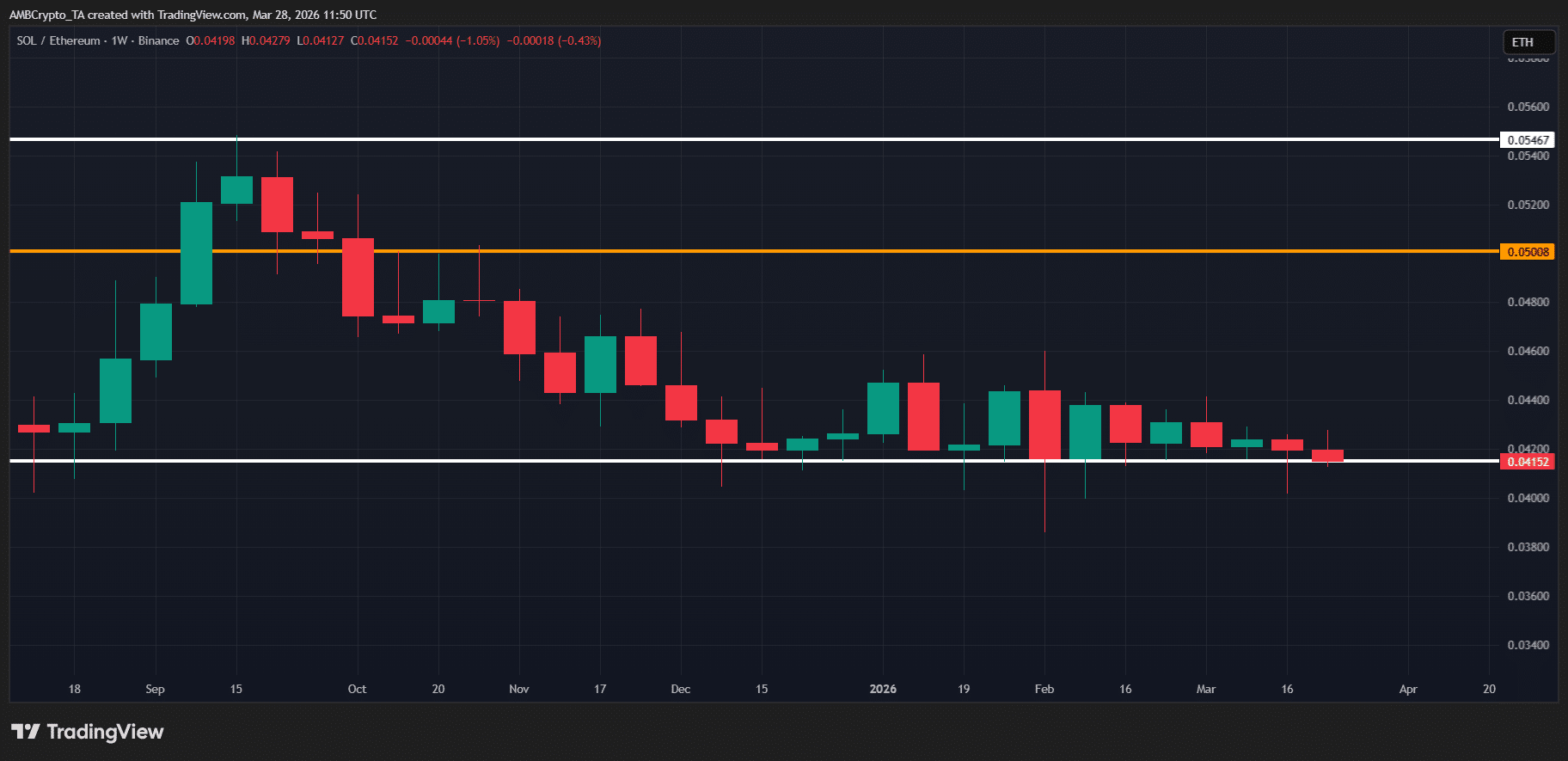
From a technical perspective, this aligns with price action. Since dropping below 0.05 after last October’s crash, the SOL/ETH ratio has struggled to reclaim that level. With network activity continuing to expand, a breakout past this key resistance zone could set the stage for Solana’s technical outperformance.
Source: TradingView (SOL/ETH)

On the bullish note, the ratio has been consolidating around 0.04.

Why does this matter? On the weekly timeframe, the SOL/ETH ratio hasn’t once closed below this range, reinforcing the strength of this support zone. According to AMBCrypto, this is where Solana’s edge over Ethereum in developer count comes into play, as this advantage is directly feeding into SOL’s network strength relative to ETH.

If this trend holds, it could pave the way for a breakout, positioning SOL to outperform ETH in Q2.


Final Summary

  • Solana now leads Ethereum in all-time unique developers, driving on-chain activity, DEX volume, and stablecoin adoption.
  • The SOL/ETH ratio is holding key support around 0.40, and combined with Solana’s growing network activity, a breakout could position SOL to outperform ETH.


Trending Cryptos

Related Questions

QWhat key metric does Solana now lead Ethereum in, according to the article?

ASolana now leads Ethereum in all-time unique developers, with 10,864 developers, which is almost 20% more than Ethereum.

QWhat is the significance of high DEX volume and stablecoin supply for a blockchain network?

AHigh DEX volume indicates active user transactions and on-chain activity, while a high stablecoin supply provides liquidity. Together, they reinforce network fundamentals by enabling smoother transactions, supporting new applications, and attracting developers and users, creating a positive feedback loop for ecosystem growth.

QWhat is the critical support level for the SOL/ETH ratio mentioned in the analysis?

AThe critical support level for the SOL/ETH ratio is around 0.04, as it has not closed below this range on the weekly timeframe, indicating a strong support zone.

QWhat recent milestone in stablecoin adoption on Solana is highlighted as evidence of its growing network strength?

AThe supply of USD1 on Solana jumped from $160 million to $850 million in just 60 days, with daily volumes consistently ranging between $200-$300 million, demonstrating significant growth in stablecoin adoption.

QBased on the article's analysis, what could a breakout above the key resistance zone mean for SOL's performance against ETH?

AA breakout past the key resistance zone (reclaiming the 0.05 level) could set the stage for Solana's technical outperformance, potentially positioning SOL to outperform ETH in Q2, especially given its strong developer engagement and network activity.

Related Reads

In Jinjiang, Fujian, a Storage Super Unicorn Lies Quiet

In Fujian's Jinjiang, a city known for sportswear, lies a quiet semiconductor giant: Fujian Jinhua Integrated Circuit Co. (JHICC). Once a promising domestic DRAM manufacturer alongside Yangtze Memory and ChangXin Memory Technologies (CXMT), its journey was derailed in 2018 when the U.S. placed it on an Entity List and filed criminal charges for alleged trade secret theft. This halted production for years. A turning point came in February 2024 when a U.S. federal court found JHICC not guilty. However, it had lost crucial time. While CXMT soared to become a top-valued A-share company in 2024, JHICC, with an estimated valuation of 80 billion RMB, was just restarting. Its current output is primarily customized DDR4 chips, not the advanced DDR5/HBM demanded for AI, but it still benefits from the broader memory chip upcycle. JHICC's story is tied to Chen Zhengkun, a veteran engineer who left Micron to lead the venture. Founded in 2016 with state-backed funding, JHICC partnered with Taiwan's UMC to develop DRAM technology. Rapid progress was cut short by the U.S. actions, which Micron initiated, partly due to its heavy reliance on the Chinese market. Post-sanctions, Chen's team worked to rebuild the production line with reduced reliance on U.S. technology. According to its records, JHICC achieved small-scale production and revenue growth under immense pressure. It now focuses on the stable "niche" DRAM market (e.g., TVs, routers) with a monthly capacity of ~40,000 wafers, aiming for 60,000 by 2026. It holds over 1,000 patents but remains on the Entity List. For Jinjiang, investing in JHICC was a bold industrial leap. The local government provided unwavering financial and logistical support during the crisis, helping the company survive. JHICC has become the anchor for a growing local semiconductor cluster. Though its scale lags behind domestic peers, JHICC's persistence symbolizes a hard-won foothold in a global market long dominated by Samsung, SK Hynix, and Micron. Having missed one boom, it seeks a place in the new AI-driven memory supercycle.

marsbit32m ago

In Jinjiang, Fujian, a Storage Super Unicorn Lies Quiet

marsbit32m ago

Must-Watch Events Next Week|CLARITY Act Could Face Senate Vote; SpaceX, Circle to Report Earnings (8.3-8.9)

**Summary: Key Events and Developments to Watch (August 3-9)** The upcoming week is marked by significant financial disclosures, key legislative deadlines, and notable product updates. **Major Financial Events:** Several companies are scheduled to release their Q2 2026 earnings. American Bitcoin (ABTC) will report on August 3, followed by SpaceX and Hut 8 Mining Corp. on August 4, and Circle on August 5. Notably, a significant portion of SpaceX shares (up to 12% of total shares) will be unlocked on August 6 following their earnings release. **Key Legislative Deadline:** The U.S. Senate faces an August 7 deadline to secure 60 votes for the CLARITY Act, a bipartisan bill aiming to establish a federal regulatory framework for cryptocurrencies. The Senate may hold a full vote on the bill during the week. **Economic Data:** The U.S. July Non-Farm Payrolls report will be released on August 7, providing crucial labor market data. **Technology & Product Updates:** * **Shutdowns:** DeFi portfolio tracker Zapper and wallet app Ctrl Wallet will cease operations on August 3. * **Upgrades:** LayerZero will deprecate its v1 relayers on August 3. XRP Ledger's new version 3.3.0, featuring five new functions, is expected next week. * **AI:** Elon Musk announced that the advanced Grok 4.6 AI model is set for release around August 7. * **Bitcoin:** The BIP-110 forced signaling for a potential Bitcoin network change is scheduled to begin around August 8. **Other Notable Events:** Chinese robotics firm Unitree Tech has set its preliminary price inquiry for its IPO for August 5. South Korean exchange Upbit will delist AQT and AERGO tokens on August 3.

marsbit2h ago

Must-Watch Events Next Week|CLARITY Act Could Face Senate Vote; SpaceX, Circle to Report Earnings (8.3-8.9)

marsbit2h ago

Trading

Spot

Hot Articles

Discussions

Welcome to the HTX Community. Here, you can stay informed about the latest platform developments and gain access to professional market insights. Users' opinions on the price of ETH (ETH) are presented below.

活动图片














