Solana TVL hits $8.6B six-month lows: Is $80 SOL price next?

cointelegraphPublished on 2025-12-17Last updated on 2025-12-17

Abstract

Solana's native token SOL has declined 52% from mid-September to late November, breaking key long-term support levels and signaling a potential drop below $100. The Total Value Locked (TVL) on Solana fell to a six-month low of $8.67 billion, down 34% from its September peak. Major DeFi protocols like Jito, Jupiter, and Raydium saw significant decreases in activity. On-chain metrics further indicate weakening demand, with network fees down 23% monthly and active addresses declining. Memecoin trading volume on Solana network collapsed by 95% from its peak, reflecting reduced ecosystem engagement. Technically, SOL is trading within a bear pennant pattern, with a breakdown projecting a potential 32% decline toward $86. While the 200-week EMA at $118 may provide temporary support, analysts suggest SOL could soon test the $90-$100 range.

Solana’s native token SOL (SOL) fell 52% between Sept. 18 and Nov. 21, following the broader altcoin market crash that saw Bitcoin hit a seven-month low of $80,000. As a result, SOL price has lost key long-term support levels, with onchain and technical data suggesting a deeper correction below $100.

Key takeaways:

  • Solana's total value dropped to a six-month low of $8.67 billion.

  • Solana’s memecoin weekly trading volume has collapsed by 95% in 2025.

  • A bear pennant projects SOL price to drop toward $86.

Solana’s TVL drops to June levels

The total value locked (TVL) on the Solana blockchain has dropped by over 34% to a six-month low $8.67 billion on Wednesday from its peak of $13.22 billion reached on Sept. 14. Solana’s TVL has remained below $10 billion over the last 30 days.
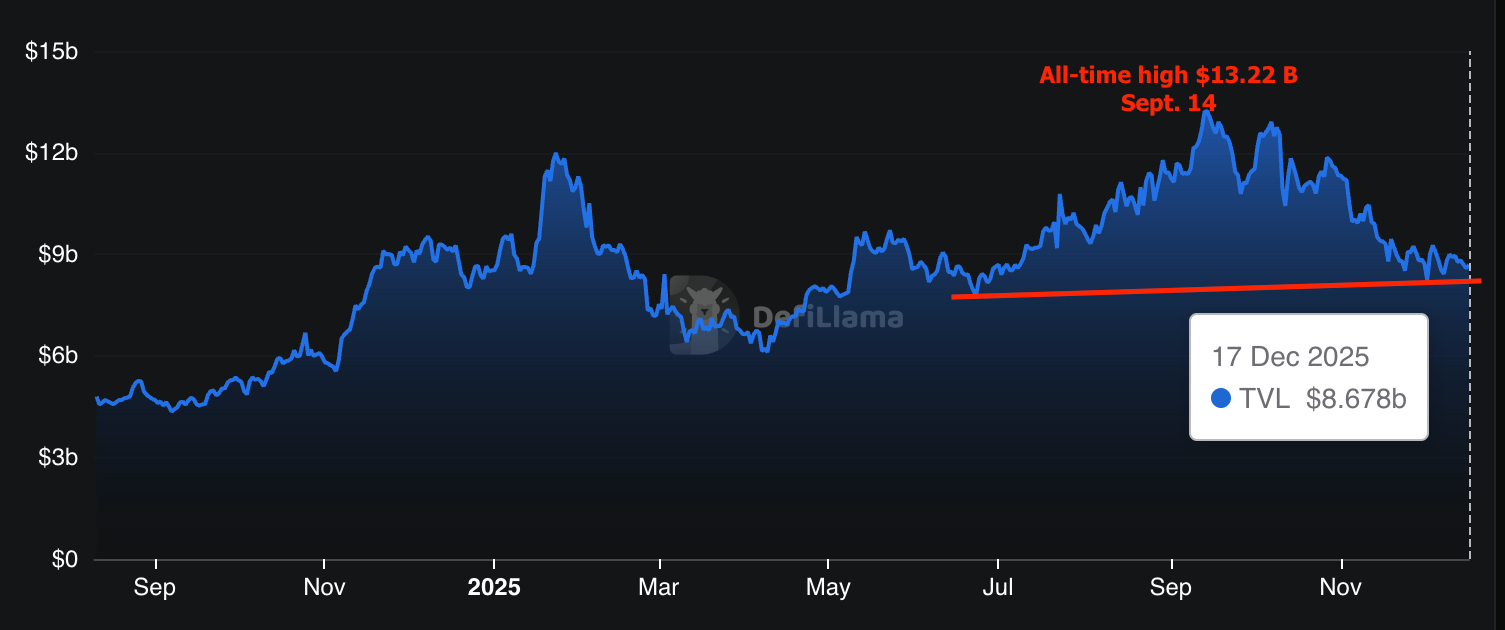
Solana TVL. Source: DefiLlama

Data from DefiLlama shows that the subsequent drop in TVL was led by Jito liquid staking, with a 53% decrease since mid-September. Other major decentralized applications, such as Jupiter DEX, Raydium and Sanctum protocol, registered 30%, 46% and 46% declines, respectively.

Related: Solana ETFs record 7-day inflow streak despite price slump

SOL’s potential to drop below $100 is supported by the decline in Solana’s network fees, active addresses and transaction count over the last seven days.
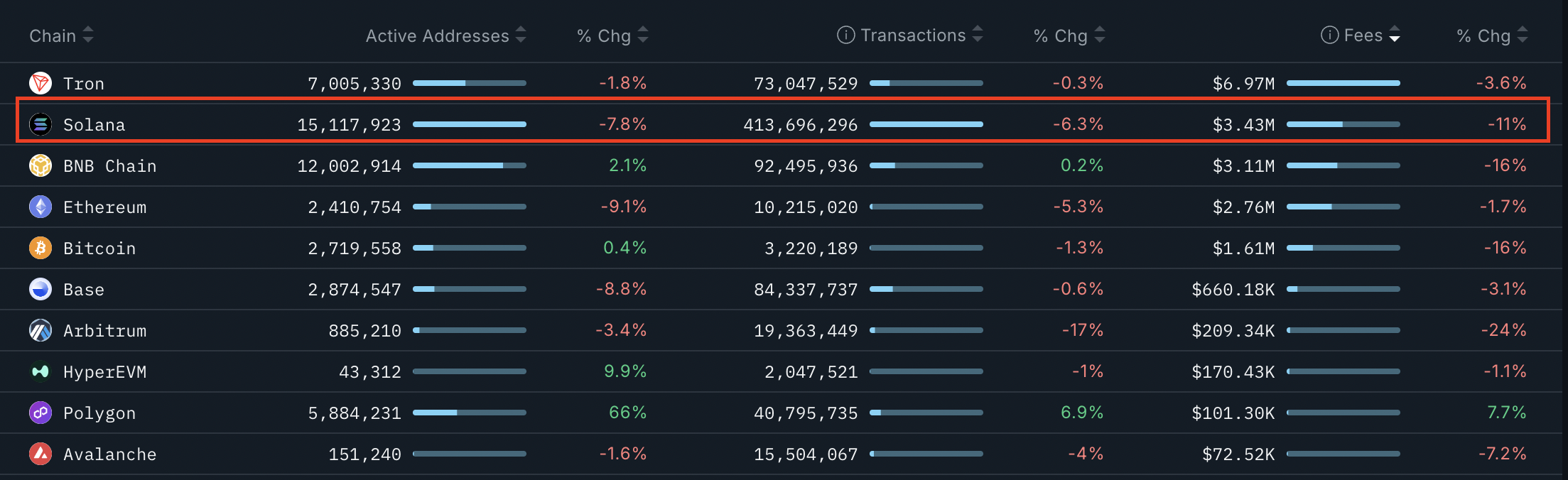
Blockchains ranked by 30-day fees, USD. Source: Nansen

Solana’s chain fees totaled $3.43 million over the past week, representing an 11% decrease from the previous week and a 23% drop from last month.

Similarly, the number of active addresses (AAs) on Solana’s base layer decreased by 7.8% over the same period, while the number of transactions decreased by 6.3% over seven days.

The drops in AAs, transaction count and network fees suggest reduced onchain demand for SOL, adding to the overhead pressure.

Solana memecoin volume collapses

The fall in Solana’s TVL mirrors the bearishness in Solana-based memecoins as these flashed red across the board.

Solana-based memecoins have posted double-digit losses on the weekly and monthly time frames, as shown in the figure below. A majority of these tokens are down 10% to 25% from local highs.
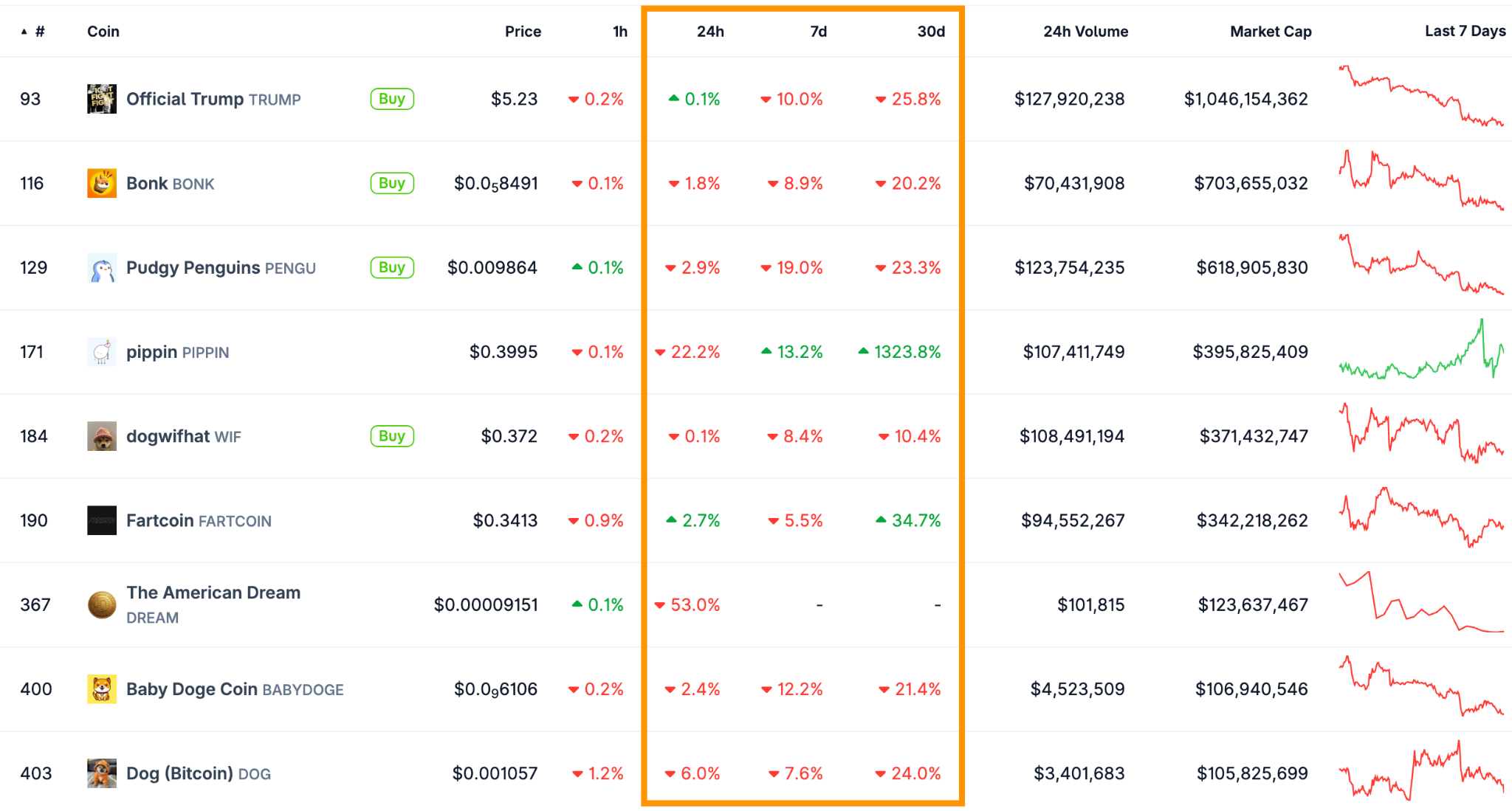
Solana-based memecoins performance. Source: CoinGecko

This drop in the prices of Solana-based memecoins was accompanied by a decrease in DEX activity on the layer-1 blockchain. The weekly DEX volume on Solana attributed to memecoins remains muted, having dropped 95% to $2.7 billion from its peak of $56 billion recorded in January, according to data from Blockworks Research.
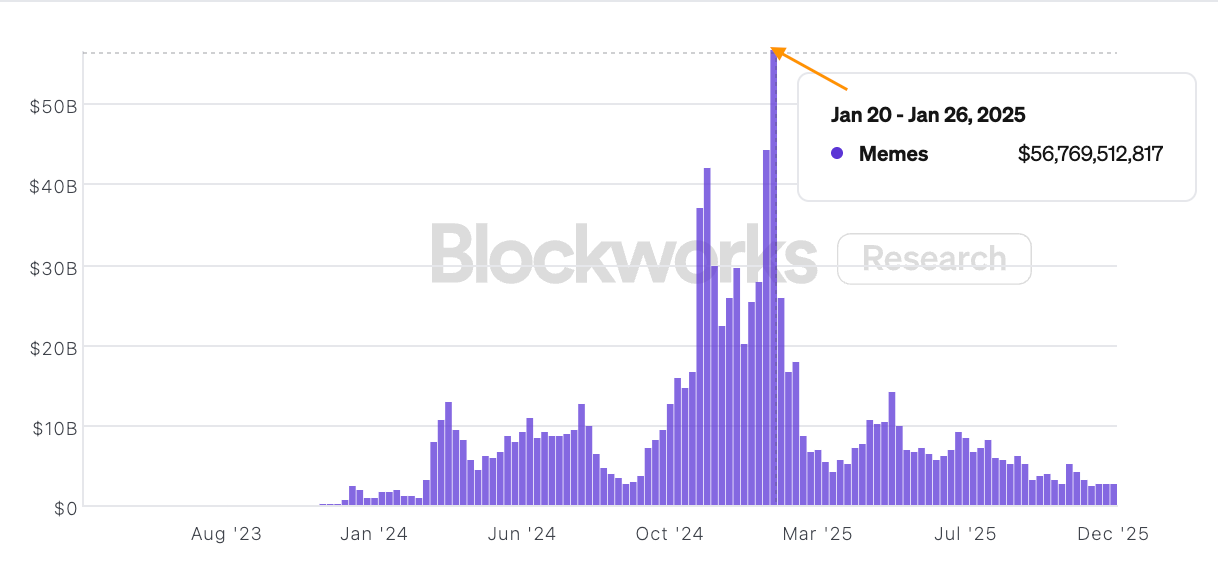
Memecoin trading volume on Solana. Source: Blockworks Research

The decline in memecoin activity on Solana indicates low network activity and waning usage, which negatively impacts demand and the SOL price.

SOL’s “bear pennant” targets $90,000

Data from Cointelegraph Markets Pro and TradingView indicate that SOL is trading below a bearish pennant, suggesting a risk of further downside.

A bear pennant is a downward continuation pattern that occurs after a significant drop, followed by a consolidation period at the lower end of the price range.

A break below the pennant’s support line at $135 last week cleared the path for the next leg down for the altcoin. The measured target of the bear pennant is at $86, or a 32% decline from its current price level.
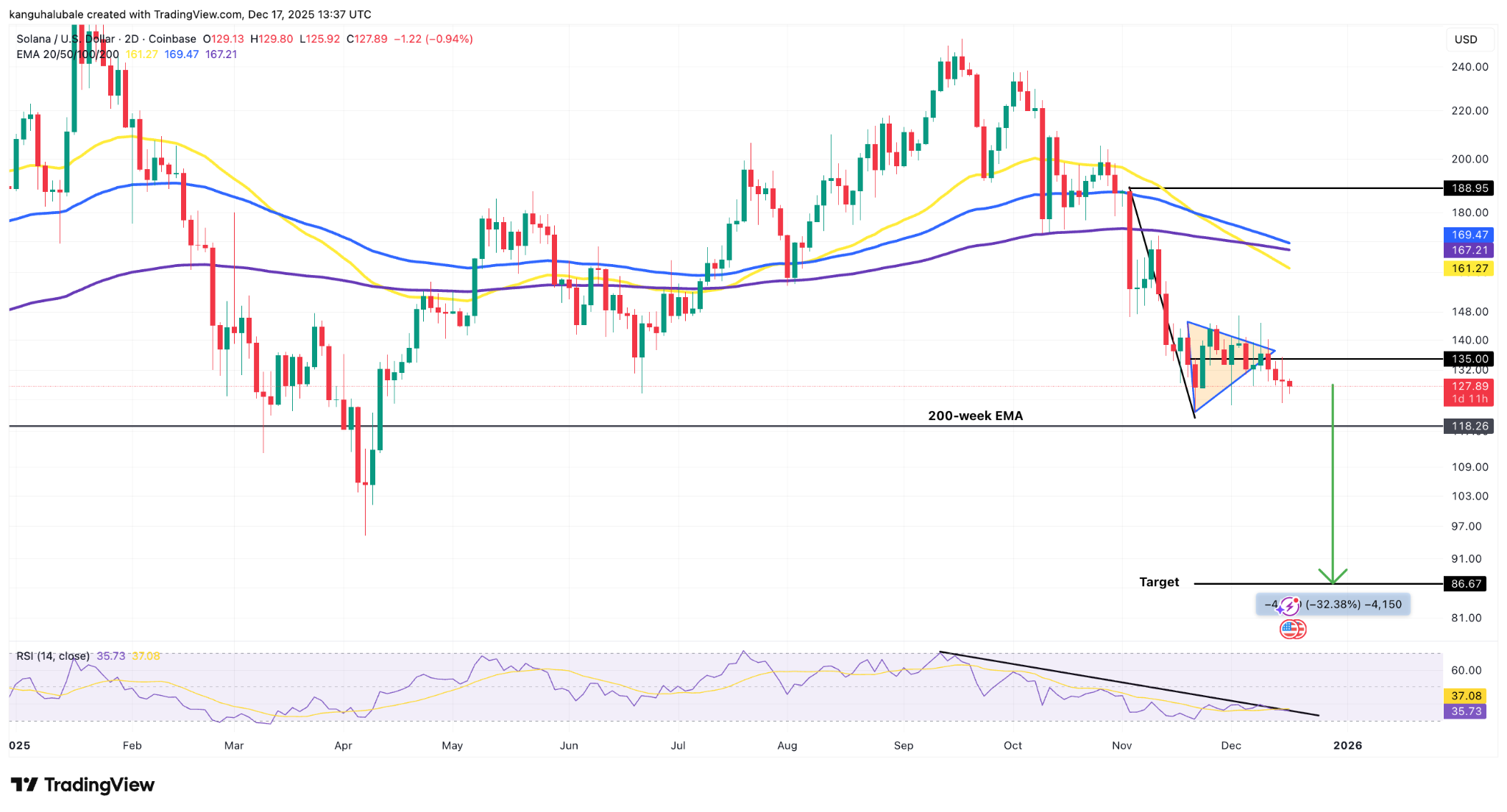
SOL/USD two-day chart. Source: Cointelegraph/TradingView

Before reaching this level, SOL could find support from the 200-week EMA at $118, where bulls are expected to mount aggressive defense.

“A bear pennant is forming on Solana’s four-hour chart,” said pseudonymous leverage trader Grim in an X post on Wednesday, adding:

“I would not be surprised to see Solana between $90 and $100 soon.”

As Cointelegraph reported, SOL price breaking below the support line of the symmetrical triangle at $126 would signal that the bears are in control, leading to a deeper correction toward $95.

This article does not contain investment advice or recommendations. Every investment and trading move involves risk, and readers should conduct their own research when making a decision. While we strive to provide accurate and timely information, Cointelegraph does not guarantee the accuracy, completeness, or reliability of any information in this article. This article may contain forward-looking statements that are subject to risks and uncertainties. Cointelegraph will not be liable for any loss or damage arising from your reliance on this information.


Trending Cryptos

Related Reads

Bitcoin Mining Farms Are Becoming AI Factories

Bitcoin mines are transforming into AI factories. This shift is driven by the convergence of three key assets from the previous crypto cycle: infrastructure, talent, and capital. Crypto mining companies like Crusoe, CoreWeave, and Bitdeer are repurposing their core competency—securing power, land, and grid connections in remote locations—to build data centers for AI clients. These firms are signing multi-billion dollar, long-term contracts with companies like Anthropic, AWS, and Microsoft, as AI's demand for reliable, high-capacity compute surpasses the profitability of Bitcoin mining. Simultaneously, crypto entrepreneurs and engineers are applying their skills to new AI ventures. Examples include OpenSea's co-founder launching OpenRouter (an AI model aggregator), and former Coinbase engineers building Fal.ai (a generative media infrastructure platform). Their experience in building scalable, global software networks translates effectively to the AI space. Furthermore, capital accumulated during the crypto boom is now fueling AI. Figures like Jed McCaleb (co-founder of Ripple) funded Voltage Park, a large-scale GPU cloud provider. Notably, some crypto investments, like FTX's early bets on Anthropic and Cursor, have generated astronomical paper returns, demonstrating how high-risk crypto capital flowed into AI before it became mainstream. The transition is not just about repurposing hardware, but about redirecting critical resources—power infrastructure, distributed systems expertise, and venture funding—to the next technological frontier: artificial intelligence.

链捕手37m ago

Bitcoin Mining Farms Are Becoming AI Factories

链捕手37m ago

Morpho Launches Fixed-Rate Product Midnight: Lenders and Borrowers Set Their Own Rates, Ending the Era of Interest Rate Models

Morpho Launches Fixed-Rate Product Midnight: Lenders and Borrowers Set Their Own Rates, Ending the Era of Algorithmic Interest Models On-chain lending has grown to $60 billion but remains minuscule compared to traditional finance's $200 trillion annual credit volume. Morpho identifies the lack of fixed rates and maturity dates as key bottlenecks. Institutions need predictability, not the passive floating rates set by algorithmic models. Midnight allows lenders and borrowers to directly quote rates, set terms, and become price makers, not takers. Fixed-rate lending is now viable due to cheaper, faster blockchains and the entry of institutions demanding control and certainty over returns, costs, and duration. Morpho Blue previously gave users control over risk; Midnight adds control over interest rates. Past attempts at on-chain fixed-rate lending failed primarily because they were built on top of floating-rate pools (creating unpredictability) or lacked sufficient active participants. Midnight avoids these pitfalls as a standalone primitive with fixed rates at its core, built upon Morpho Blue's existing large and active user base. Midnight offers distinct value: institutions gain predictable term structures and full control; fintech companies can offer tailored fixed-rate products; lenders/borrowers achieve predictability and efficiency; and curators can now differentiate by configuring both risk and interest rates. Morpho Midnight is not a replacement for Morpho Blue. The Morpho network will now feature two complementary market structures: floating-rate/open-term (Blue) for flexibility and fixed-rate/fixed-term (Midnight) for predictability. Liquidity can flow between them. The launch will be gradual, prioritizing security. Initially, it will support direct lending on Base network with one trading pair (cbBTC/USDC) and limited maturity dates. Advanced features like auto-rollovers will be introduced later.

marsbit37m ago

Morpho Launches Fixed-Rate Product Midnight: Lenders and Borrowers Set Their Own Rates, Ending the Era of Interest Rate Models

marsbit37m ago

Trading

Spot

Hot Articles

Discussions

Welcome to the HTX Community. Here, you can stay informed about the latest platform developments and gain access to professional market insights. Users' opinions on the price of SOL (SOL) are presented below.

活动图片