Solana Tries To Turn Fear Into FOMO — Can STRIDE Really Stop The Next $300M Rug?

bitcoinistPublished on 2026-04-07Last updated on 2026-04-07

Abstract

The Solana Foundation has launched a new security initiative called STRIDE (Solana Trust, Resilience and Infrastructure for DeFi Enterprises) in collaboration with Asymmetric Research. This framework is designed to continuously assess and oversee the security of projects built on Solana through an eight-pillar system, with results made public. Alongside STRIDE, the Solana Incident Response Network (SIRN) was introduced—a coalition of security firms focused on threat intelligence and coordinated responses to hacks. These efforts follow a recent $286 million exploit on the Drift Protocol and represent a shift toward continuous, foundation-funded security monitoring rather than one-time audits. While these measures may help restore trust, new exploits on unaudited protocols could still face severe market reactions.

The Solana Foundation has unveiled new security initiatives framed as a “new wave” of ecosystem security.

Solana Attempts To Rebuild The Trust

This Monday, the Solana Foundation announced on a blog post the launching, in collaboration with Asymmetric Research, of the STRIDE (Solana Trust, Resilience and Infrastructure for DeFi Enterprises) program. STRIDE is an organized framework designed to continuously assess and oversee the security of projects built on the ecosystem.

According to Assymetric Research’s own blog post, STRIDE works as an eight‐pillar security framework that will carry out independent reviews of ecosystem protocols to verify they comply with it. The results of these assessments will be released publicly, giving users and investors clear visibility into the safety of the platforms they use.

In parallel to STRIDE, the foundation also released the Solana Incident Response Network (SIRN), a member‐driven coalition of security companies and researchers focused exclusively on the Solana ecosystem. According to the blog post, founding participants of the membership-based network include Asymmetric Research, OtterSec, Neodyme, Squads, and ZeroShadow. SIRN is the “war room”, sharing threat intel and coordinating live hack responses across the ecosystem.

The new initiatives sit on top of existing tools like Hypernative, Range, Riverguard, Sec3, and AuditWare, which are offered free to builders to harden code from day one. This is a core shift away from one‐off audits toward continuous, foundation‐funded monitoring, public security reports and coordinated incident response.

A Shift In Security Protocols, But A Shift In Sentiment?

These moves directly follow the April 1st $286 million attack on the Solana-based Drift Protocol that ended up being attributed to North Korean hackers.

The blog post, however, makes no mention of the attack. Despite that, it does spell out the need to strengthen the security services the foundation offers.

Solana was built for security. And as the ecosystem scales, the stakes scale with it (...) Solana Foundation has a long history of dedicating resources to ensure that security services and tools are available to the ecosystem.

While it is true that security headlines and follow‐through on STRIDE/SIRN may help repair sentiment after the Drift shock, any new exploit on an unevaluated protocol could be punished harder.
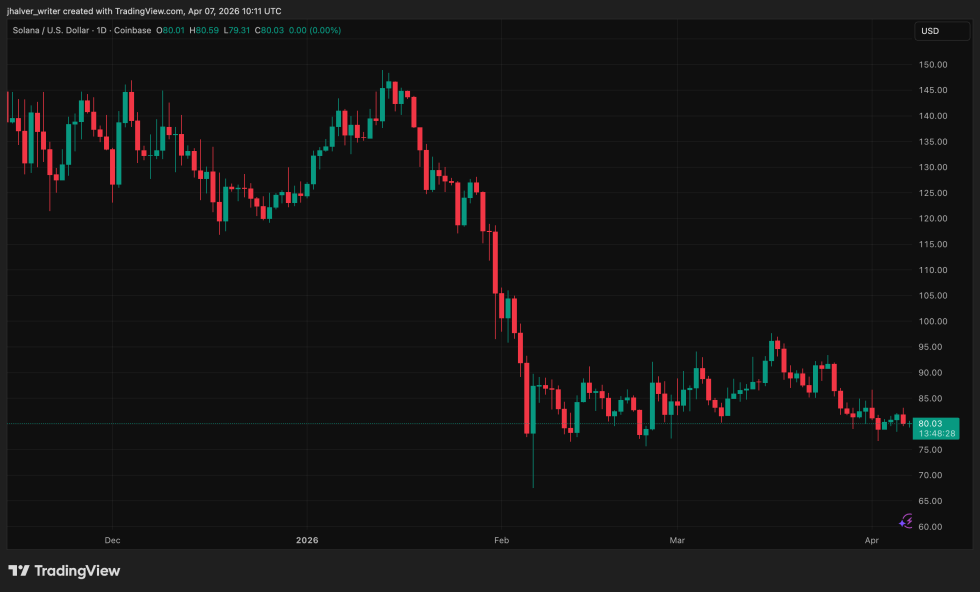
At the moment of writing, SOL trades for exactly $80 on the daily chart. Source: SOLUSD on Tradingview.

Cover image from Perplexity. SOLUSD chart from Tradingview.

Trending Cryptos

Related Questions

QWhat is the name of the new security program launched by the Solana Foundation and Asymmetric Research?

AThe new security program is called STRIDE, which stands for Solana Trust, Resilience and Infrastructure for DeFi Enterprises.

QWhat is the primary function of the Solana Incident Response Network (SIRN)?

ASIRN is a member-driven coalition of security companies and researchers that acts as a 'war room', sharing threat intelligence and coordinating live hack responses across the Solana ecosystem.

QWhich major security incident on the Solana ecosystem preceded the announcement of these new security initiatives?

AThe initiatives directly follow the April 1st $286 million attack on the Solana-based Drift Protocol, which was attributed to North Korean hackers.

QHow does the STRIDE program aim to improve security for users and investors?

ASTRIDE conducts independent reviews of ecosystem protocols and publicly releases the results of these assessments, giving users and investors clear visibility into the safety of the platforms they use.

QWhat core shift in security approach do these new initiatives represent?

AThey represent a core shift away from one-off audits toward continuous, foundation-funded monitoring, public security reports, and coordinated incident response.

Related Reads

The Verdict in Choi Tae-won's Divorce Case: Revealing the Inheritance Undercurrent Behind SK Hynix's Trillion-Won Empire

SK Group Chairman Chey Tae-won's high-profile divorce case, involving a record 1.38 trillion won settlement, has drawn attention to the succession plans for Korea's second-largest conglomerate, especially its crown jewel, SK hynix. Unlike traditional chaebol scripts centered on the eldest son, Chey's three children from his marriage to former President Roh Tae-woo's daughter, Roh Soh-yeong, are carving distinct, non-traditional paths. Eldest daughter Chey Yun-jung (b. 1989) is seen as the most evident successor. With a scientific and consulting background, she holds executive roles at SK bioscience and SK Inc.'s growth support department, focusing on future strategy and biopharma. Her marriage is to an AI infrastructure entrepreneur, not a traditional business alliance. Second daughter Chey Min-jung (b. 1991) took a unique route, voluntarily serving as a South Korean naval officer, including an anti-piracy deployment. She later worked on policy and strategy for SK hynix in Washington D.C. before co-founding an AI-driven healthcare startup. She married a former U.S. Marine Corps officer, connecting her to U.S. defense and policy circles—networks crucial for a global semiconductor giant. The only son, Chey In-geun (b. 1995), who studied physics like his father, worked briefly at SK E&S before joining McKinsey. Despite fitting the traditional "heir" profile as the eldest son, he remains silent and holds no public position or shares in SK, suggesting the old succession playbook is obsolete. As SK hynix's valuation soars, becoming a geopolitical asset in the AI era, the heirs' legitimacy is no longer automatic. They must prove themselves in fields like AI biotech, global policy, and strategic consulting. Their marriages also reflect new elite networks in tech and defense, not old political alliances. Their inheritance is the complex challenge of navigating a globalized, tech-driven world, not just a corporate throne.

marsbitYesterday 09:06

The Verdict in Choi Tae-won's Divorce Case: Revealing the Inheritance Undercurrent Behind SK Hynix's Trillion-Won Empire

marsbitYesterday 09:06

From OpenSea to OpenRouter: Is Alex Atallah Repeating His 'Exit at the Peak' Playbook?

From OpenSea to OpenRouter: Is Alex Atallah Repeating His "Exit at the Peak" Playbook? According to the Wall Street Journal, payments giant Stripe is in talks to acquire the AI model aggregation platform OpenRouter in a potential deal valuing the company near $100 billion. This would mark founder Alex Atallah's second creation of a company reaching a $100 billion valuation, following his co-founding of NFT marketplace OpenSea. OpenRouter, founded just over three years ago, has grown rapidly by acting as a unified gateway for developers to access over 400 AI models. It currently has about 10 million users and processes over 200 trillion tokens monthly. While the platform's annualized revenue is around $50 million, its valuation has skyrocketed from $1.3 billion in March 2026. The potential acquisition by Stripe, a company OpenRouter's founder once likened it to, represents a major expansion into AI infrastructure for the payments leader. This move echoes Atallah's previous timing with OpenSea, where he departed before the NFT market's significant downturn. For OpenRouter, selling now may be strategic. Despite its scale, its business model—charging a 5-5.5% fee on AI inference calls—faces pressure from competition, open-source models, and potential price wars among model providers, limiting its profitability narrative for an IPO. A key asset for potential acquirers like Stripe is OpenRouter's vast repository of real-world AI usage data, which offers unique insights into model performance and developer preferences that are difficult to replicate. Whether this potential deal signifies a new valuation benchmark for AI infrastructure or another market peak signal remains to be seen.

链捕手Yesterday 08:42

From OpenSea to OpenRouter: Is Alex Atallah Repeating His 'Exit at the Peak' Playbook?

链捕手Yesterday 08:42

Trading

Spot

Hot Articles

Discussions

Welcome to the HTX Community. Here, you can stay informed about the latest platform developments and gain access to professional market insights. Users' opinions on the price of SOL (SOL) are presented below.

活动图片
















