Solana Spot ETFs Achieve Major Benchmark Following Months Of Their Debut

bitcoinistPublished on 2026-03-11Last updated on 2026-03-11

Abstract

Despite a bearish crypto market, Solana Spot ETFs have achieved a major milestone, amassing nearly $1 billion in inflows since their October 2025 debut. This represents 2% of SOL's market cap in just 18 weeks—a rate significantly faster than Bitcoin ETFs. The growth highlights strong institutional demand and Solana's increasing integration into traditional finance. Additionally, Solana has become a hub for on-chain activity, processing a record $650 billion in stablecoin volume in February 2026, underscoring its role as a leading network for digital asset liquidity and capital movement.

Despite the ongoing bearish condition of the broader cryptocurrency market, Solana is demonstrating underlying strength, but not in price action. A few months after their historic debut, the Solana Spot Exchange-Traded Funds (ETFs) have reached a notable milestone, reflecting robust institutional and retail demand for the products.

Months After Launch, Solana Spot ETFs See Major Growth

Solana has found its way to the cryptocurrency spotlight once again with the notable growth of its Spot ETFs. A fresh report shows that the Spot SOL ETFs have now hit a crucial milestone just a few months after the products were launched, marking a significant step in the altcoin’s growing integration into traditional financial markets.

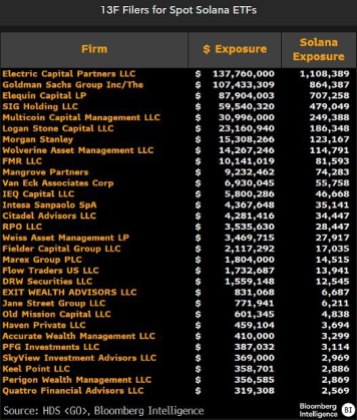
These investment vehicles are starting to show significant traction in terms of inflows, trading activity, and overall market presence amid intense demand from both institutional participants and crypto-native investors. Kyle Doops, a market expert and host of the Crypto Banter show, reported that the products have amassed nearly $1 billion in inflows since launching in late October 2025.

Such massive inflows underscore how demand for regulated exposure to SOL has picked up pace as investors search for new ways to access the evolving blockchain ecosystem. Furthermore, the milestone indicates growing institutional confidence in the network’s long-term potential.
Source: Chart from Kyle Doops on X

When compared to SOL’s market cap, this ETF’s net inflows represents a 2% of that value, achieved in roughly 18 weeks. For the Bitcoin Spot ETFs, it took the products about 55 weeks to reach a similar share, indicating the massive interest in the SOL ETFs and underscoring the increasing role of alternative crypto assets within the broader ETF landscape.

It is worth noting that the majority of investors in the ETFs over time appear to be market makers and crypto investment firms, and not retail players. With this wave of institutional investors, SOL ETFs continues to maintain its position as one of the fastest-growing funds in history.

SOL, A Hub For On-Chain Capital Movement

In the waning market landscape, Solana continues to stand out as a leader in on-chain finance and capital movements. The founder and Chief Executive Officer (CEO) of Sensei Holdings, Solana Sensei, revealed on X that the network’s stablecoin activity in the past month was massive, signaling a sharp increase in on-chain transactions and liquidity moving across its ecosystem.

According to the expert, around $650 billion in stablecoin volume moved on SOL in February alone, which is more than twice the previous high from late 2025. SOL network’s expanding function as a high-throughput center for digital asset liquidity is shown by this monthly spike. As finance evolves, stablecoins are emerging as one of the main pillars of cryptocurrency adoption, and the SOL network is where the majority of the traffic is occurring.

SOL trading at $85 on the 1D chart | Source: SOLUSDT on Tradingview.com

Trending Cryptos

Related Questions

QWhat major milestone have Solana Spot ETFs achieved a few months after their debut?

ASolana Spot ETFs have amassed nearly $1 billion in inflows since their launch in late October 2025.

QHow does the inflow growth of Solana Spot ETFs compare to that of Bitcoin Spot ETFs in terms of time to reach 2% of the asset's market cap?

AIt took Solana Spot ETFs roughly 18 weeks to reach inflows representing 2% of SOL's market cap, while Bitcoin Spot ETFs took about 55 weeks to achieve a similar share.

QAccording to the article, who are the majority of investors in the Solana Spot ETFs?

AThe majority of investors in the Solana Spot ETFs appear to be market makers and crypto investment firms, rather than retail players.

QWhat significant on-chain activity was reported for the Solana network in February, as mentioned in the article?

AAround $650 billion in stablecoin volume moved on the Solana network in February alone, which was more than twice the previous high from late 2025.

QWhat does the massive inflow into Solana Spot ETFs indicate about institutional sentiment towards the network?

AThe massive inflows underscore growing institutional confidence in the Solana network's long-term potential and the increasing role of alternative crypto assets within the broader ETF landscape.

Related Reads

Bitcoin Withdrawals Continue: 8 Years of Storage in a Coldcard Cold Wallet Ended in Zero

Coldcard Hardware Wallet Hacked: Losses Mount Due to Vulnerable Seed Generation A critical vulnerability in Coldcard hardware wallets has led to a continued wave of fund thefts. According to Galaxy Research, the total stolen has reached 1,367.05 BTC (approx. $88.6 million) from 4,585 addresses, a significant increase from the initial 594.5 BTC reported on July 30, 2026. Most of the stolen funds remain on the attackers' addresses. The issue is not with the current firmware, which Coinkite has updated, but with seed phrases generated on vulnerable devices between March 2021 and the release of fixed firmware versions. Due to a programmer error, devices switched from using a hardware random number generator to the software-based Yasmarang generator, which was initialized with publicly accessible data like the chip's serial number. This made the seed phrases predictable through offline brute-force attacks, meaning wallets remain at risk until funds are moved to a new wallet generated with the patched firmware. Affected devices include Mk2/Mk3 with firmware 4.0.1–4.1.9 (and up to 5.0.3), Mk4/Mk5 up to version 5.6.0, and Q models up to 1.5.0Q. The only exceptions are seeds created with a high-entropy method like at least 50 independent dice rolls or a strong unique BIP-39 passphrase. All other owners must generate a new seed on the fixed firmware and transfer their assets. A case highlighting the human impact involves a 39-year-old long-term investor who lost 2 BTC (approx. $130,000) in minutes. He had accumulated the Bitcoin over eight years through physical labor, viewing it as a financial lifeline and a retirement plan in a country suffering from hyperinflation. His story underscores that even conservative "buy and hold in cold storage" strategies can be compromised by such underlying technical flaws. From a technical perspective, this incident echoes historical failures where weak random number generators undermined cryptographic security, challenging the assumption that offline storage is automatically foolproof.

cryptonews.ru2h ago

Bitcoin Withdrawals Continue: 8 Years of Storage in a Coldcard Cold Wallet Ended in Zero

cryptonews.ru2h ago

Trading

Spot

Hot Articles

Discussions

Welcome to the HTX Community. Here, you can stay informed about the latest platform developments and gain access to professional market insights. Users' opinions on the price of SOL (SOL) are presented below.

活动图片















