Solana ($SOL) Price Prediction 2026 Turns Bearish: Can It Recover, Or Should We Look at SUBBD Token?

bitcoinistPublished on 2026-02-06Last updated on 2026-02-06

Abstract

Solana (SOL) is facing a bearish outlook in 2026, currently trading near the critical $80 support level. Technical indicators show a 'Strong Sell' bias, with momentum remaining weak despite oversold signals. A decisive break below $70 could confirm a deeper bearish trend, while a recovery would require reclaiming the low $90s. The broader crypto market's weakness, led by Bitcoin's decline, is adding significant pressure. As an alternative, the article highlights the SUBBD Token presale as a high-risk, high-reward narrative for traders seeking diversification. SUBBD, which has raised approximately $1.47 million, focuses on AI-powered tools for the creator economy, offering features like AI voice cloning and a fixed 20% APY for early supporters. It is presented as a speculative side bet uncorrelated to large-cap volatility, though it carries substantial execution and regulatory risks. The piece concludes by emphasizing the importance of independent research and cautious position sizing.

Trusted Editorial content, reviewed by leading industry experts and seasoned editors. Ad Disclosure

Quick Facts:

  • ➡️ SOL is hovering near $79–$81, and the $80 zone is the immediate battlefield.
  • ➡️ Technical dashboards show a ‘Strong Sell’ bias; momentum is weak despite oversold signals.
  • ➡️ A clean loss of $70 would confirm the bearish case; reclaiming the low $90s is the first step to recovery.
  • ➡️ SUBBD Token offers a separate, high-risk narrative (AI + creator economy) for traders looking outside the large-cap chop.

Solana is back in the danger zone. With $SOL hovering between $79 and $81, that psychological $80 handle is no longer acting as support, it’s a live stress test.

CoinMarketCap currently pegs Solana at $81.01, and the intraday range tells a story that makes even long-term spot holders uneasy, stretching from a $68.69 low to a $92.90 high.

The bigger issue is context. Crypto market structure has been heavy across the board, with Bitcoin drifting near $66K after rolling over hard from its 2025 peak.

When Bitcoin sneezes, altcoins usually catch pneumonia, and Solana is no exception. Liquidity has turned defensive, forcing high-throughput layer-1s like Solana to rotate from a long-term growth narrative into a ‘sell now, reassess later’ trade. In environments like this, throughput metrics and ecosystem headlines take a back seat to pure positioning.

There are some positives, but they’re muted. Spot ETF flow data from February 5 shows net inflows of roughly $2.82M. That’s directionally constructive, yet nowhere near large enough to reverse a breakdown if the broader market continues deleveraging.

Right now, traders are treating SOL as a short-term volatility vehicle rather than a conviction hold, which caps upside follow-through even on green days.

The comes SUBBD Token ($SUBBD), currently in a fast-growing presale.

Read more about $SUBBD here.

Bears Control Until SOL Reclaims Key Levels

Many analysts now see the $80 level as a line in the sand. If SOL fails to reclaim it decisively, the next logical downside pocket sits in the $72 to $75 range, where prior demand previously stepped in.

What often gets overlooked is the mechanical side of price action. Losing a round number like $80 doesn’t just affect sentiment, it triggers systematic behavior. Stop losses get swept, perpetual funding flips, and leverage unwinds before fundamentals even enter the conversation.

By the time on-chain narratives resurface, price discovery has already moved lower.

Looking ahead into 2026, the bearish framework centers on a few clear zones.

Near-term support lives around $70 to $72, which aligns with recent range lows and the next visible demand cluster.

A decisive break below $70 would open the door to a deeper sweep, reinforcing the broader pattern of lower highs and lower lows. On the upside, recovery isn’t about a $1 bounce or a relief wick, it requires reclaiming the mid-range, roughly the low $90s, to shift structure back toward neutral.

Catalysts exist, but they may not save the chart immediately. ETF inflows are positive in principle, yet the current magnitude simply isn’t enough to overpower macro-driven selling pressure.

On the network side, Solana’s Firedancer upgrade continues to fuel a strong resilience narrative, but markets have a habit of staying irrational longer than technical improvements take to roll out, which remains a frustrating reality for developers and long-term believers alike.

Scenario Outlook: What Has to Happen Next

  • In a bullish scenario, Solana successfully defends the $70 to $80 zone while ETF inflows accelerate beyond headline-sized numbers, restoring confidence and bid depth.
  • The base case looks far less exciting, with choppy consolidation between roughly $70 and $93 while Bitcoin continues to dictate direction.
  • The bearish case is straightforward: a clean loss of $70 that transforms this dip from a temporary shakeout into a structural drawdown.

For now, the $80 and $70 levels remain the market’s decision points. How price behaves around them will determine whether this is just another volatility flush or the start of a longer corrective phase.

$SUBBD is available here.

Why Some Traders Also Consider SUBBD Token as a Side Bet

When large-cap tokens get stuck in macro-driven chop, capital often rotates into presales. The appeal is simple: the return profile isn’t tightly coupled to daily Bitcoin swings.

That doesn’t make presales safer, in many cases, it’s the opposite, but it does make them less correlated in the short term.

This is where SUBBD Token comes into focus. It isn’t positioning itself as a Solana killer or a layer-1 competitor. Instead, it’s a higher-beta bet on AI-powered creator tooling.

SUBBD Token ($SUBBD) aims to merge Web3 payments with features such as an AI personal assistant, AI voice cloning, and AI-driven influencer creation, targeting the rapidly evolving creator economy.

According to the official presale page, SUBBD has raised approximately $1.47 million so far, with the current token price set at $0.0574925.
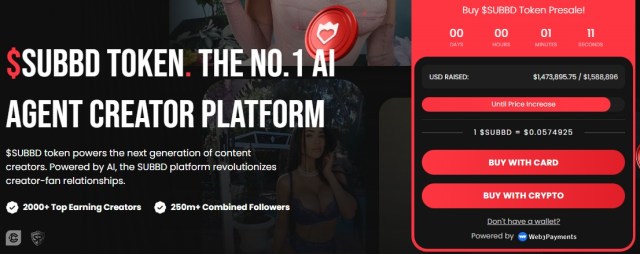
The value proposition is intentionally straightforward, offering a fixed 20% APY for the first year alongside XP multipliers designed to reward early supporters. It’s a very crypto-native incentive structure that appeals to yield-focused participants looking beyond large-cap stagnation.

That said, the risks are real and worth respecting. Presale tokens are illiquid, meaning there’s no easy exit if sentiment turns. Execution risk always looms large, as shipping working code is far more difficult than publishing a whitepaper.

Regulatory conditions around creator monetization and AI tooling can also change quickly, adding another layer of uncertainty.

For traders who are bearish on Solana’s near-term structure, researching SUBBD Token may offer a diversification angle rather than a replacement trade, as long as expectations stay grounded and position sizing reflects the risk profile.

Get your $SUBBD here.

This article is not financial advice. Independent research is essential, especially when factoring in volatility, liquidity constraints, and regulatory uncertainty.

Editorial Process for bitcoinist is centered on delivering thoroughly researched, accurate, and unbiased content. We uphold strict sourcing standards, and each page undergoes diligent review by our team of top technology experts and seasoned editors. This process ensures the integrity, relevance, and value of our content for our readers.

patrubogdan

Follow

Full Profile

Related Posts

RWA Perpetuals Record $15B in Volume, Putting LiquidChain’s $LIQUID Presale in Focus

$2.1B in Bitcoin Options Expire Today as Traders Watch Volatility And $BMIC’s Presale Narrative Builds

Metaplanet Will Keep Buying Bitcoin, Says Gerovich, as $HYPER Hits $31M Presale Milestone

Bitcoin ETFs See $434M in Outflows as $BTC Tests $60K Support – Can Bitcoin Hyper Take Over?

Peter Brandt Says Bitcoin is Heading to $42K – Has $SUBBD’s Time Arrived?

Bitcoin’s Crash Triggered IBIT’s Biggest Trading Day, as $HYPER Keeps Pumping

Trending Cryptos

Related Questions

QWhat is the current price range and key battle zone for Solana (SOL) according to the article?

ASolana is hovering near $79-$81, and the $80 zone is the immediate battlefield.

QWhat does the technical dashboard indicate about Solana's market bias and momentum?

ATechnical dashboards show a 'Strong Sell' bias, and momentum is weak despite oversold signals.

QWhat are the critical price levels that would confirm a bearish case or signal a recovery for SOL?

AA clean loss of $70 would confirm the bearish case, while reclaiming the low $90s is the first step to recovery.

QWhat is the SUBBD Token and what is its value proposition as described in the article?

ASUBBD Token ($SUBBD) is a presale token that aims to merge Web3 payments with AI-powered features like a personal assistant, voice cloning, and influencer creation, targeting the creator economy.

QWhat amount has the SUBBD Token raised in its presale and what is its current token price?

ASUBBD Token has raised approximately $1.47 million in its presale, with the current token price set at $0.0574925.

Related Reads

Annual Salary of Millions Competing for Electricians, Meta Rushes to Open Its Own Technical School

The AI boom is facing an unexpected bottleneck: a severe shortage of skilled construction workers and electricians. As tech giants like Meta, OpenAI, and Alphabet race to build massive data centers—such as OpenAI's $16 billion "Stargate" project—they are hitting a critical labor wall. The U.S. needs an estimated 130,000 more electricians, 240,000 construction workers, and 150,000 supervisors by 2030 for AI infrastructure alone, but tens of thousands of electrician jobs go unfilled each year. While AI companies offer high premiums, with electricians earning up to $280,000 annually, worker scarcity still causes massive losses—delays on a single project can cost $14.2 million per month. The complexity of building AI data centers, which require immense power (equivalent to powering hundreds of thousands of homes), sophisticated electrical systems, and advanced liquid cooling solutions, demands highly skilled technicians who are in short supply. To combat this, companies are investing heavily in training. Meta has committed $115 million to a free training school offering tuition, housing, and stipends, targeting 5,000 new workers. OpenAI is partnering with unions to secure skilled labor. These efforts are paying off, with a significant rise in Gen Z interest in trade schools over college. However, the power demands are staggering. AI data centers are driving a rapid surge in electricity consumption, projected to account for up to 12% of U.S. power use by 2028 and raising costs for consumers. Furthermore, the construction boom is project-based, leading to a potential future glut of trained workers once building peaks, which could depress wages industry-wide. The race for AI supremacy now depends as much on skilled hands as on advanced chips.

marsbit6m ago

Annual Salary of Millions Competing for Electricians, Meta Rushes to Open Its Own Technical School

marsbit6m ago

OpenAI No Longer Sells Its Most Expensive Model for Profit

OpenAI is shifting its business strategy away from promoting its most expensive, flagship models for every task. Recent price cuts—80% for GPT-5.6 Luna and 20% for Terra—signal a deeper change: the company now actively advises users that many tasks don't require the most powerful model. Instead, OpenAI recommends a tiered approach: use the high-end GPT-5.6 Sol for complex planning and analysis, then delegate execution to cheaper models like Luna. This mirrors moves by Anthropic, which recently launched Claude Opus 5 at half the price of its top model, Fable 5. Both companies are de-emphasizing flagship models as primary revenue drivers, using them instead for brand prestige and technological showcases. The industry is entering a "mass-market" phase, similar to automotive, where high-volume, cost-effective models handle daily operations and drive scale. OpenAI's price reductions are partly enabled by AI models themselves optimizing underlying code and infrastructure, creating a self-reinforcing cycle of efficiency gains and cost reduction. Competition is shifting from "who is smartest" to "who offers the best value." The goal is no longer selling individual models but fostering widespread API adoption and ecosystem lock-in. By making AI calls cheap and ubiquitous, companies like OpenAI aim to become the indispensable, utility-like infrastructure powering automated workflows—the "water and electricity" of software, quietly embedded everywhere.

marsbit6m ago

OpenAI No Longer Sells Its Most Expensive Model for Profit

marsbit6m ago

Will the Fed Definitely Raise Interest Rates in September? How Will Crypto and U.S. Stocks Withstand the Pressure?

The market's expectation for a September Fed rate hike surged dramatically in early August, jumping from under 50% to over 80% within a week. This shift followed a contentious July FOMC meeting, where a 9-3 vote to hold rates revealed growing dissent from hawkish members advocating for an immediate hike to combat persistent inflation. The primary catalyst for this repricing is rising oil prices, driven by renewed geopolitical tensions around the Strait of Hormuz, which threaten global supply. Energy costs directly influence inflation metrics, making the upcoming July CPI report (due August 12th) a critical data point. If it shows inflation reaccelerating, the probability of a September hike will solidify. For Bitcoin and crypto assets, this is typically bearish news. Bitcoin continues to behave as a high-beta, liquidity-sensitive risk asset. A rate hike raises the opportunity cost of holding non-yielding assets and could drive capital toward money markets, pressuring crypto prices in the short term. However, historical patterns suggest that if a hike is perceived as the end of a tightening cycle rather than the start, any negative price impact may be brief. U.S. stocks, particularly crypto-linked equities like Coinbase and growth-oriented tech stocks, are also vulnerable. Higher rates increase discount rates in valuation models, putting pressure on high-multiple companies. This coincides with a pivotal tech earnings season where investor focus has shifted from massive AI capital expenditure to tangible revenue and cash flow generation. Companies with negative cash flow and weak growth narratives could face heightened volatility if borrowing costs rise in September. In summary, a September Fed hike has evolved into a mainstream market scenario. Key factors to watch are oil prices, the July CPI report, and Fed communications, which will determine the final decision and its impact on volatile crypto and equity markets.

marsbit17m ago

Will the Fed Definitely Raise Interest Rates in September? How Will Crypto and U.S. Stocks Withstand the Pressure?

marsbit17m ago

Trading

Spot

Hot Articles

Discussions

Welcome to the HTX Community. Here, you can stay informed about the latest platform developments and gain access to professional market insights. Users' opinions on the price of SOL (SOL) are presented below.

活动图片















