Solana Labs CEO Says Ethereum-Style ‘Walkaway’ Thinking Is a Death Wish

bitcoinistPublished on 2026-01-19Last updated on 2026-01-19

Abstract

Solana Labs CEO Anatoly Yakovenko disagrees with Ethereum co-founder Vitalik Buterin's call for Ethereum to "ossify," arguing that continuous protocol iteration is essential for Solana's survival. Buterin had stated that Ethereum should reach a state where it remains functional even without ongoing updates, passing what he calls the "walkaway test." In contrast, Yakovenko believes that stopping innovation would cause Solana to lose relevance. He emphasizes that the network must constantly adapt to developer and user needs to avoid stagnation, though upgrades shouldn't rely on any single entity. Both share skepticism toward central dependency but differ on long-term upgrade philosophy.

Over the weekend, Solana Labs CEO Anatoly Yakovenko pushed back on Vitalik Buterin’s latest case for Ethereum “ossification,” arguing that for Solana, continuous protocol iteration is not optional, it is survival.

The exchange was sparked by a Jan. 12 post in which Buterin said “Ethereum itself must pass the walkaway test,” framing Ethereum as a base layer that should remain usable even if the community largely stops making substantive protocol changes.

“It must support applications that are more like tools [...] than like services that lose all functionality once the vendor loses interest in maintaining them,” Buterin wrote. “But building such applications is not possible on a base layer which itself depends on ongoing updates from a vendor in order to continue being usable [...] Hence, Ethereum itself must pass the walkaway test.”

Why Solana Can’t Afford To Ossify

Yakovenko replied that he “actually think[s] fairly differently on this,” laying out a philosophy that treats adaptability as core to Solana’s value proposition. “Solana needs to never stop iterating,” he wrote. “It shouldn’t depend on any single group or individual to do so, but if it ever stops changing to fit the needs of its devs and users, it will die.” In Yakovenko’s framing, the risk is not merely technical stagnation; it is a network losing relevance to the people building and transacting on it.

Buterin’s “walkaway test” rests on the idea that Ethereum should reach a point where its usefulness does not “strictly depend on any features that are not in the protocol already,” even if the ecosystem continues improving via client optimizations and limited parameter changes. He also sketched a set of medium-term protocol objectives, ranging from quantum resistance and scalable architecture to long-lived state design and decentralization safeguards, aimed at making Ethereum robust “for decades” and reducing the need for frequent disruptive upgrades.

Yakovenko’s critique is less about those specific goals than the premise that a base layer should aspire to being able to “ossify if we want to.” In his view, ossification is not a neutral milestone; it risks locking in a protocol that can’t keep pace with developer and user demands. “To not die requires to always be useful,” he wrote. “So the primary goal of protocol changes should be to solve a dev or user problem.” At the same time, he emphasized prioritization over maximalism: “That doesn’t mean solve every problem, in fact, saying no to most problems is necessary.”

A key overlap in both positions is a skepticism toward dependence on a single “vendor,” though they operationalize it differently. Buterin wants Ethereum’s base layer to become sufficiently complete that it can remain dependable even if the upgrade cadence slows dramatically. Yakovenko, by contrast, argues that Solana should assume upgrades will keep coming, but not necessarily from any one core team.

“You should always count on there being a next version of solana, just not necessarily from Anza or Labs or fd,” he wrote, referencing major entities in Solana’s development orbit. He then pointed to a future where governance and funding mechanisms could directly underwrite that work, suggesting “we are likely to end up in a world where a SIMD vote pays for the GPUs that write the code,” a nod to both on-chain coordination and the growing role of AI-assisted development.

At press time, SOL traded at $133.84.
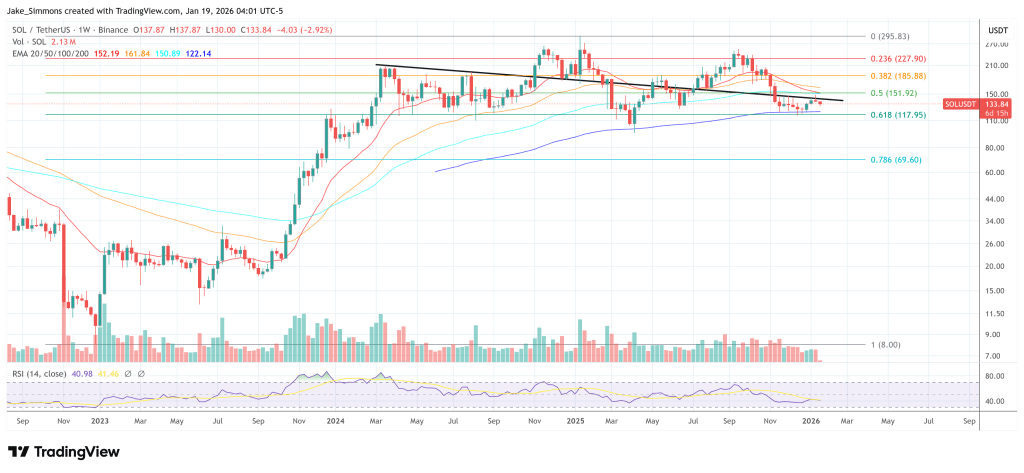
SOL remains below the black trendline, 1-week chart | Source: SOLUSDT on TradingView.com

Trending Cryptos

Related Questions

QWhat is the core disagreement between Solana Labs CEO Anatoly Yakovenko and Ethereum's Vitalik Buterin regarding blockchain development?

AAnatoly Yakovenko believes continuous protocol iteration is essential for survival and relevance, arguing that a blockchain must constantly adapt to developer and user needs. In contrast, Vitalik Buterin advocates for Ethereum's 'ossification,' where the base layer becomes so complete and stable that it remains usable even if major protocol updates cease.

QAccording to Vitalik Buterin, what is the 'walkaway test' and why is it important for Ethereum?

AButerin's 'walkaway test' is the idea that Ethereum's base layer should reach a state where its usefulness does not depend on ongoing updates or features not already in the protocol. It is important because it ensures applications built on Ethereum remain functional like tools, not services that fail if the vendor stops maintaining them, making the network robust for decades.

QWhy does Anatoly Yakovenko argue that Solana 'needs to never stop iterating'?

AYakovenko argues that if Solana ever stops changing to fit the needs of its developers and users, it will die. He views continuous adaptation as core to its survival and value proposition, preventing technical stagnation and loss of relevance, rather than seeing ossification as a neutral or positive milestone.

QHow do Buterin and Yakovenko differ in their views on dependence on a single 'vendor' or development team?

ABoth express skepticism toward dependence on a single vendor, but operationalize it differently. Buterin wants Ethereum's base layer to become complete enough to be dependable with minimal upgrade cadence. Yakovenko agrees upgrades shouldn't depend on one team, but assumes upgrades will keep coming from a decentralized set of contributors, not necessarily a core entity like Anza or Solana Labs.

QWhat future development mechanism does Yakovenko hint at for sustaining Solana's iteration?

AYakovenko hints at a future where on-chain governance and funding mechanisms, such as a SIMD (Solana Improvement Document) vote, could directly pay for development work, potentially even utilizing AI-assisted coding, ensuring continuous innovation without reliance on a single central team.

Related Reads

Ethereum Q1 2026 Report: Fees Decline, Users and Transaction Volume Hit New Highs

Ethereum Q1 2026 Report: Fees Down, Users & Transactions Hit New Highs Token Terminal's Q1 2026 report on Ethereum presents a pivotal development: the network achieved record highs in monthly active users (13.2M, +85.9% YoY), total transactions (200.4M, +81.5% YoY), and throughput (25.78 TPS), while transaction fees on the mainnet plummeted by 47.9% quarter-over-quarter. This shift is attributed to the network's strategic move into a "low fees for scale" phase, exemplified by the Fusaka upgrade which increased data capacity and lowered block space costs, releasing pent-up demand (a manifestation of Jevons's Paradox). The report highlights a core narrative shift for Ethereum: from a DeFi-centric blockchain to a global financial settlement layer. It maintains a dominant position in tokenized assets, holding majority market shares among top chains in stablecoins (61.8%), tokenized funds (73.0%), and tokenized commodities (84.0%). Growth in tokenized funds (+73.1% YoY) and commodities (+325.9% YoY) was particularly strong, driven by institutions like BlackRock and JPMorgan entering the space. Contrasting these usage gains, several USD-denominated value metrics declined in Q1: fully diluted market cap fell 30.3% QoQ, total value locked (TVL) dropped 11.0%, and ecosystem transaction volume decreased 24.0%. The report interprets this as Ethereum prioritizing long-term network expansion and cementing its role as the default settlement layer for finance over short-term fee capture. The commentary from Etherealize argues that, much like the early internet, Ethereum's open, permissionless model is poised to win over closed alternatives as institutional tokenization accelerates.

marsbit21m ago

Ethereum Q1 2026 Report: Fees Decline, Users and Transaction Volume Hit New Highs

marsbit21m ago

He Just Raised 2.7 Billion, and Li Fei-Fei Also Invested

Pete Florence, a former senior research scientist at Google DeepMind and a key contributor to the Vision-Language-Action (VLA) model architecture, is deliberately distancing his startup, Generalist AI, from the trendy "world model" label. He argues that the industry should prioritize concrete goals over buzzwords. His goal is to create robots that can perform a vast range of unseen tasks with high speed and success rates, without needing task-specific training data. Recently, his company raised $400 million (¥2.7 billion) at a $2 billion valuation. Notable investors include NVIDIA's NVentures, Bezos Expeditions, NFDG, as well as Xiaomi co-founder Lin Bin, Zoom founder Eric Yuan, and renowned AI scientist Fei-Fei Li. Florence's approach stems from his academic background at MIT under Professor Russ Tedrake, focusing on understanding the physical world. After joining DeepMind, he developed models like Transporter Network and co-created the VLA framework. He left in 2025 to found Generalist AI. The company has launched two models: GEN-0, which demonstrated that scaling laws apply to physical motion, and GEN-1. GEN-1 was trained on over 500,000 hours of physical interaction data collected via a specialized wearable device. It achieves a 99% success rate on precise mechanical tasks like folding boxes and maintains performance three times faster than its predecessor. Florence believes GEN-1 is reaching a commercial utility threshold similar to the GPT-3 inflection point. The substantial funding round, following GEN-1's release, signifies strong investor confidence in Generalist AI's practical, goal-driven path to creating versatile, useful robots, regardless of the "world model" terminology.

marsbit28m ago

He Just Raised 2.7 Billion, and Li Fei-Fei Also Invested

marsbit28m ago

Two Legends Lost in Three Days: Is Google's AI Talent Dam Cracking?

In three days, Google lost two AI legends. On June 18, Noam Shazeer, co-author of the seminal "Attention is All You Need" paper and Gemini co-lead, left for OpenAI. Just 48 hours later, John Jumper, 2024 Nobel laureate and AlphaFold lead, departed DeepMind for Anthropic. This follows Andrej Karpathy joining Anthropic in May. These moves highlight a structural trend: top AI talent is concentrating at mission-driven, pre-IPO firms like OpenAI and Anthropic, while Google becomes a primary source. The exodus stems from a core mission mismatch. Google's ad-centric model often subordinates AI research to product and revenue goals, creating friction for pioneers like Shazeer, who returned in 2024 only to leave again. In contrast, OpenAI and Anthropic offer singular focus on pushing AI boundaries, whether towards AGI or safety-aligned models, which deeply appeals to top researchers like Jumper. Financial incentives amplify the pull. With both OpenAI and Anthropic nearing IPO, employees stand to gain immensely from equity, an upside Google's mature stock cannot match. Furthermore, the 2023 merger of Google Brain and DeepMind, intended to consolidate strength, has instead created cultural tension and slowed the path from research to product, as evidenced by Gemini's pace. This talent redistribution is reshaping the AI landscape. While Google retains vast data and compute resources, its true crisis is the quiet, continuous loss of the people who define the field's future. The real moat in AI is not infrastructure, but the concentration of brilliant minds—a battle Google is currently losing.

marsbit2h ago

Two Legends Lost in Three Days: Is Google's AI Talent Dam Cracking?

marsbit2h ago

Behind the AI Report Card, Lies a Chinese 'Exam Setter'

Beyond the familiar performance charts like MMLU-Pro and MMMU, which major AI models strive to ace, stands a key "examiner": Chinese-Canadian researcher Wenhu Chen. An assistant professor at the University of Waterloo and founder of TIGERLab, Chen addresses the crucial need for more rigorous AI evaluation. As models like GPT-4 began scoring near-perfect results on older benchmarks like MMLU, it became difficult to distinguish their true capabilities. In response, Chen introduced MMLU-Pro in 2024, featuring harder, more reasoning-focused questions with more answer choices, successfully reintroducing meaningful performance gaps. His work extends to multi-modal evaluation with MMMU and its enhanced version, MMMU-Pro. These benchmarks test a model's ability to understand and reason with complex information from images, charts, and text across diverse academic subjects, exposing the significant challenges even top models face in genuine comprehension. Chen's background in complex QA, table reasoning, and his experience at Google DeepMind on projects like Gemini inform his approach. He understands that effective benchmarks must anticipate how models might "cheat" by memorizing data or avoiding visual analysis. His lab also actively researches video understanding and generation models (e.g., UniVideo, Vamba), ensuring his evaluation work is grounded in practical model-building challenges. Now at Meta's Super Intelligence Lab, Chen continues his focus on multi-modal data and evaluation, representing the deep yet often unseen contributions of Chinese talent in shaping the fundamental tools of the AI industry.

marsbit2h ago

Behind the AI Report Card, Lies a Chinese 'Exam Setter'

marsbit2h ago

Trading

Spot
Futures

Hot Articles

Discussions

Welcome to the HTX Community. Here, you can stay informed about the latest platform developments and gain access to professional market insights. Users' opinions on the price of ETH (ETH) are presented below.

活动图片