Solana Hit By One Of The Largest DDoS Attacks In Internet History

bitcoinistPublished on 2025-12-16Last updated on 2025-12-16

Abstract

Solana has successfully withstood one of the largest DDoS attacks in internet history, estimated at 6 Tbps, without significant performance degradation. Despite the massive scale of the attack, which lasted for over a week, the network maintained median transaction confirmations around 450ms and stable slot latency. Ecosystem builders highlighted that the attack had zero noticeable impact on regular users or traders. The event underscores that blockchains have become high-value targets for industrial-scale DDoS campaigns. Solana’s resilience is attributed to its engineering and validator infrastructure, though experts note that validator count alone isn’t the sole factor in network defense. At the time of reporting, SOL traded at $126.

Solana has been battling what some ecosystem builders are calling an internet-scale DDoS campaign — and, despite the usual “Solana is fragile” jokes, the network seems to be shrugging it off.

Pipe Network said of the ongoing attack via X today: “The ongoing DDoS attack on Solana is one of the largest in internet history. 6 Tbps volumetric attack translates to billions of packets per second. Under that kind of load, you’d normally expect rising latency, missed slots, or confirmation delays.”

Pipe further says that’s not what the data is showing. “Median tx confirmation ~450ms,” the team wrote, adding that p90 remains under 700ms and slot latency is holding at 0–1 slots. In other words, if you’re a regular user or trader, you might not even know anything’s happening. Which is kind of the point.
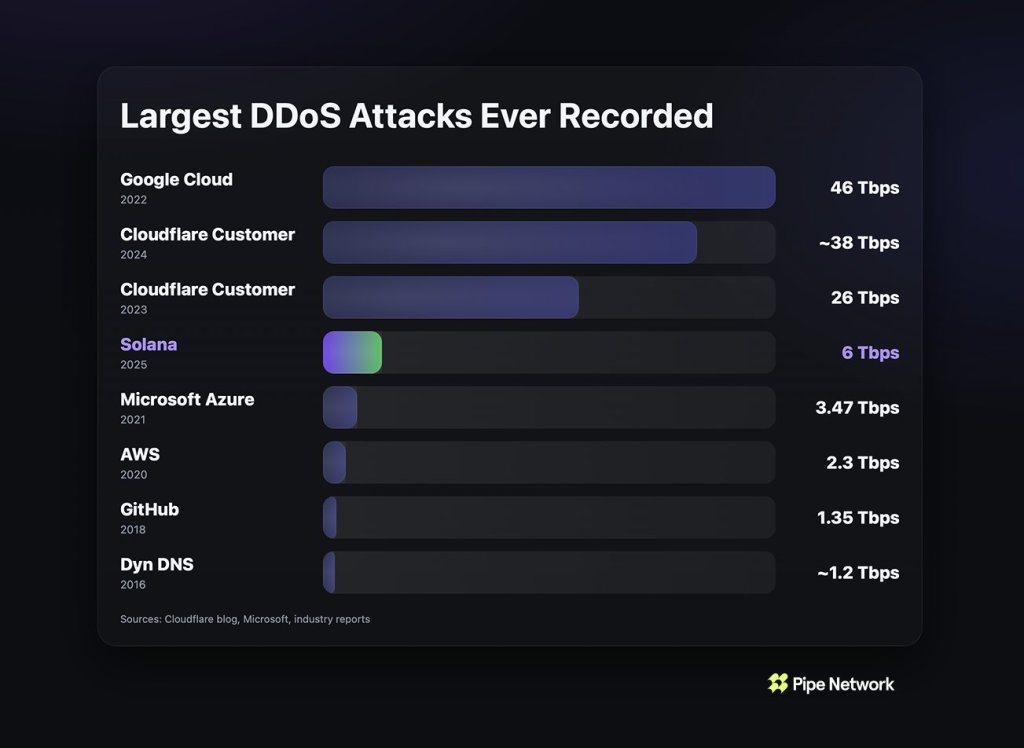
Largest DDos attacks in internet history | Source: X @pipenetwork

Reactions From The Solana Community

Raj Gokal, Solana Labs’ co-founder and COO, put it more bluntly in a reply to a broader DDoS debate: “have you heard about the ongoing DDOS against Solana that has had zero effect on performance?”

The backdrop here matters. Justin Bons had posted about Sui being DDoS’d yesterday, claiming it triggered “mass delays” and arguing that “127 validators is not enough,” with the broader warning: don’t let validator counts drift too low if you want a chain to be resilient.

Mert Mumtaz, CEO of Helius, largely agreed with the premise — but pushed back on the simplistic “more validators = solved” framing.

“I understand your point & mostly agree with you,” Mert wrote, before adding that “a chain is more resistant to DDoS with 100 professional high powered validators compared to 10k validators run by amateurs.” He also said there are scenarios where higher validator count can help, but emphasized it isn’t the core defense by itself. Then he dropped the key detail: Solana’s attack hasn’t been a one-day headline, it’s been going on for a while.

“And fyi there has been a colossal ddos attack on Solana for weeks now,” Mert wrote, later adding that Solana “has been under a colossal DDoS attack for at least over a week now btw” — and that the fact most users haven’t felt it is “a big testament to the level of engineering present here.”

Solana co-founder Anatoly Yakovenko chimed in with a more technical angle on why validator count can matter in specific leader-hand-off dynamics: “Validators count helps if the previous leader can finish their block while the current one is being hit. Then the cost of ddos approaches the cost of ddos the whole network.”

Translation: if an attacker wants to reliably disrupt block production, they may have to sustain pressure across more of the network, not just pick off a single leader at the wrong moment. That gets expensive fast.

SolanaFloor summed it up via X: “Solana has been under a sustained DDoS attack for the past week, peaking near 6 Tbps, the 4th largest attack ever recorded for any distributed system. Network data shows no impact, with sub second confirmations and stable slot latency. The Sui network was also targeted by a DDoS attack yesterday, resulting in delays in block production and periods of degraded network performance.”

And there’s a more strategic takeaway that’s starting to sound less theoretical each month: blockchains are now juicy targets. David Rhodus, founder of Permissionless Labs (and a contributor to Pipe Network), said: “This puts Solana among the most heavily DDoSed targets in internet history. It reinforces that blockchains are now Tier-1 DDoS targets. This is not “script kiddie” activity — 6 Tbps is industrial-scale.”

If you’re a validator, Mumtaz offered the practical advice you’d expect in a week like this: have backups across multiple hosting providers and regions. Because even if the chain holds, your own infrastructure might not.

The broader point, though, is the new baseline: these networks are getting stress-tested like mainstream internet services now. Solana’s claim today is that it passed — quietly, under load, and without users noticing. That’s the kind of victory that doesn’t look dramatic on a chart. It just [...] works.

At press time, Solana traded at $126.
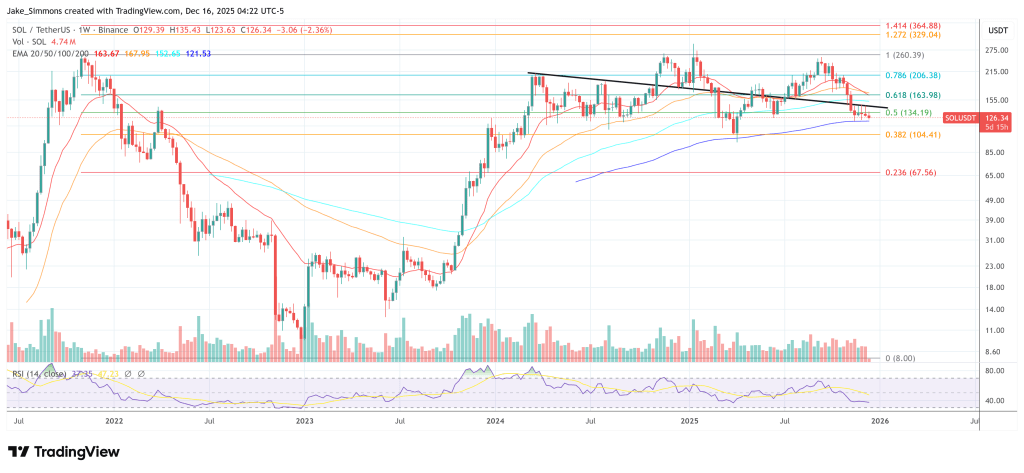
SOL remains above the 200-week EMA, 1-week chart | Source: SOLUSDT on TradingView.com

Related Reads

The Value Distribution of Stablecoins

**Summary: The Value Distribution of Stablecoins** The article argues that stablecoins are evolving from mere trading tools into broader channels for dollar access. It divides the stablecoin ecosystem into four layers to analyze how value is distributed: 1. **Issuance Layer:** Mints stablecoins, holds reserve assets, and captures the spread between reserve yield and user costs (e.g., Tether, Circle). This layer currently earns the largest profit margin. 2. **Infrastructure Layer:** Connects stablecoins to the traditional financial system, handling fiat on/off-ramps, banking integration, compliance (KYC/AML), and asset management (e.g., Bridge, BVNK). This is the "unglamorous" but critical work, building the essential bridges between crypto and real-world finance. 3. **Acquiring/Distribution Layer:** Integrates stablecoins into merchant systems, manages payment flows, and provides enterprise financial software (e.g., Stripe, Coinbase). They act as the access point for businesses. 4. **Application Layer:** The end-users and businesses that ultimately use stablecoins for payments, settlements, or as a store of value. They benefit from convenience but have little pricing power. The core thesis is that while the issuance layer currently dominates profits, the often-overlooked **infrastructure layer holds significant long-term potential**. The real challenge and barrier to mass adoption is not the on-chain transfer of stablecoins (which is simple), but the complex "last mile" integration into existing business workflows, banking systems, and regulatory frameworks across different countries. Companies in this layer are currently in a "land grab" phase, investing heavily to build networks, secure bank partnerships, and establish compliance pathways. While their position is currently pressured by the profitable issuers above and distribution platforms below, the article suggests that if stablecoins become a default financial rail for businesses, the infrastructure providers who have done the hard work of integration will ultimately gain strong pricing power and become entrenched, essential players.

marsbit5h ago

The Value Distribution of Stablecoins

marsbit5h ago

The Value Distribution of Stablecoins

The Value Distribution of Stablecoins The article argues that stablecoins are evolving from a mere trading tool into a broad "dollar channel." It analyzes the industry's value chain through four layers: 1. **Issuance Layer (e.g., Tether, Circle):** The top layer that mints stablecoins, holds reserve assets, and captures the thickest interest rate spread. 2. **Infrastructure Layer (e.g., Bridge, BVNK):** Connects stablecoins to the traditional financial system, handling critical but complex "dirty work" like fiat on/off-ramps, banking integration, compliance (KYC/AML), and cross-border settlement. 3. **Acquiring/Distribution Layer (e.g., Stripe, Coinbase):** Embeds stablecoins into merchant systems, manages payment flows, and integrates with enterprise software. 4. **Application Layer:** End-users and businesses that ultimately use stablecoins for payments, settlement, or storing value. The author posits that while the issuance layer currently captures the most profit, the most overlooked and potentially critical layer is infrastructure. The core challenge for stablecoin adoption isn't the on-chain transfer (which is simple), but bridging the gap between blockchain and the real-world financial system. This involves solving practical problems for businesses: fiat conversion, reconciliation, tax handling, and user onboarding. Infrastructure companies are currently in a difficult "land-grab" phase—building networks, securing banking relationships, and achieving compliance country-by-country. They face pressure from both the profitable issuance layer above and distribution platforms below. However, the author suggests this layer is building a crucial moat. Once stablecoins become a default business rail, the infrastructure players who have done the hard work of integration may gain significant, durable value and pricing power.

链捕手5h ago

The Value Distribution of Stablecoins

链捕手5h ago

Trading

Spot
Futures

Hot Articles

Discussions

Welcome to the HTX Community. Here, you can stay informed about the latest platform developments and gain access to professional market insights. Users' opinions on the price of SOL (SOL) are presented below.

活动图片















