Solana Hit By One Of The Largest DDoS Attacks In Internet History

bitcoinistPublished on 2025-12-16Last updated on 2025-12-16

Abstract

Solana has successfully withstood one of the largest DDoS attacks in internet history, estimated at 6 Tbps, without significant performance degradation. Despite the massive scale of the attack, which lasted for over a week, the network maintained median transaction confirmations around 450ms and stable slot latency. Ecosystem builders highlighted that the attack had zero noticeable impact on regular users or traders. The event underscores that blockchains have become high-value targets for industrial-scale DDoS campaigns. Solana’s resilience is attributed to its engineering and validator infrastructure, though experts note that validator count alone isn’t the sole factor in network defense. At the time of reporting, SOL traded at $126.

Solana has been battling what some ecosystem builders are calling an internet-scale DDoS campaign — and, despite the usual “Solana is fragile” jokes, the network seems to be shrugging it off.

Pipe Network said of the ongoing attack via X today: “The ongoing DDoS attack on Solana is one of the largest in internet history. 6 Tbps volumetric attack translates to billions of packets per second. Under that kind of load, you’d normally expect rising latency, missed slots, or confirmation delays.”

Pipe further says that’s not what the data is showing. “Median tx confirmation ~450ms,” the team wrote, adding that p90 remains under 700ms and slot latency is holding at 0–1 slots. In other words, if you’re a regular user or trader, you might not even know anything’s happening. Which is kind of the point.
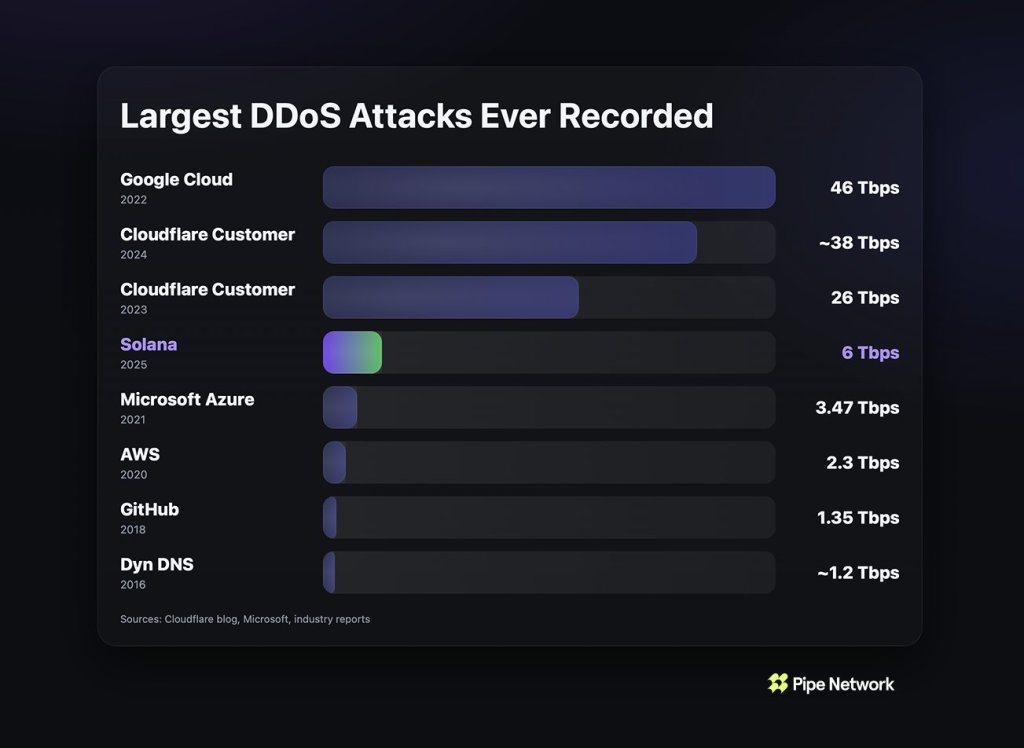
Largest DDos attacks in internet history | Source: X @pipenetwork

Reactions From The Solana Community

Raj Gokal, Solana Labs’ co-founder and COO, put it more bluntly in a reply to a broader DDoS debate: “have you heard about the ongoing DDOS against Solana that has had zero effect on performance?”

The backdrop here matters. Justin Bons had posted about Sui being DDoS’d yesterday, claiming it triggered “mass delays” and arguing that “127 validators is not enough,” with the broader warning: don’t let validator counts drift too low if you want a chain to be resilient.

Mert Mumtaz, CEO of Helius, largely agreed with the premise — but pushed back on the simplistic “more validators = solved” framing.

“I understand your point & mostly agree with you,” Mert wrote, before adding that “a chain is more resistant to DDoS with 100 professional high powered validators compared to 10k validators run by amateurs.” He also said there are scenarios where higher validator count can help, but emphasized it isn’t the core defense by itself. Then he dropped the key detail: Solana’s attack hasn’t been a one-day headline, it’s been going on for a while.

“And fyi there has been a colossal ddos attack on Solana for weeks now,” Mert wrote, later adding that Solana “has been under a colossal DDoS attack for at least over a week now btw” — and that the fact most users haven’t felt it is “a big testament to the level of engineering present here.”

Solana co-founder Anatoly Yakovenko chimed in with a more technical angle on why validator count can matter in specific leader-hand-off dynamics: “Validators count helps if the previous leader can finish their block while the current one is being hit. Then the cost of ddos approaches the cost of ddos the whole network.”

Translation: if an attacker wants to reliably disrupt block production, they may have to sustain pressure across more of the network, not just pick off a single leader at the wrong moment. That gets expensive fast.

SolanaFloor summed it up via X: “Solana has been under a sustained DDoS attack for the past week, peaking near 6 Tbps, the 4th largest attack ever recorded for any distributed system. Network data shows no impact, with sub second confirmations and stable slot latency. The Sui network was also targeted by a DDoS attack yesterday, resulting in delays in block production and periods of degraded network performance.”

And there’s a more strategic takeaway that’s starting to sound less theoretical each month: blockchains are now juicy targets. David Rhodus, founder of Permissionless Labs (and a contributor to Pipe Network), said: “This puts Solana among the most heavily DDoSed targets in internet history. It reinforces that blockchains are now Tier-1 DDoS targets. This is not “script kiddie” activity — 6 Tbps is industrial-scale.”

If you’re a validator, Mumtaz offered the practical advice you’d expect in a week like this: have backups across multiple hosting providers and regions. Because even if the chain holds, your own infrastructure might not.

The broader point, though, is the new baseline: these networks are getting stress-tested like mainstream internet services now. Solana’s claim today is that it passed — quietly, under load, and without users noticing. That’s the kind of victory that doesn’t look dramatic on a chart. It just [...] works.

At press time, Solana traded at $126.
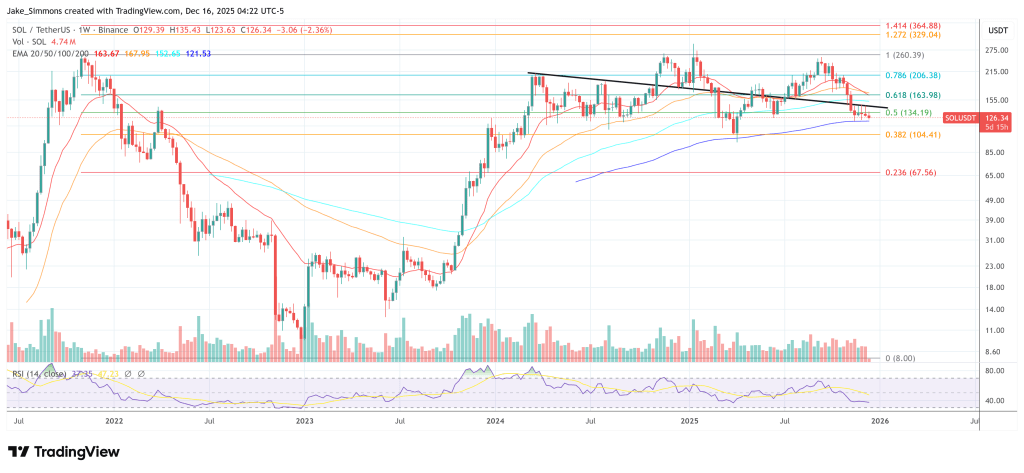
SOL remains above the 200-week EMA, 1-week chart | Source: SOLUSDT on TradingView.com

Trending Cryptos

Related Reads

Kraken Changed Its Vote at the Last Minute, Solana's Inflation Policy Narrowsly Passes by 0.33 Percent

Kraken’s last-minute vote reversal secured the passage of SGP-0002, a pivotal Solana governance proposal to accelerate the network’s annual inflation reduction from 15% to 30%. The final vote tally was 67.001%, narrowly exceeding the required 66.667% supermajority by just 0.334 percentage points. This change will bring Solana’s terminal inflation rate of 1.5% forward to around 2029, reducing future SOL issuance over six years by approximately 18.9 million tokens (about 2.6% of current supply). The vote, the first major test of Solana’s new on-chain governance system, saw intense drama. The Kraken 2 validator, controlling about 8.9 million staked SOL, switched from support to opposition hours before the deadline, pushing the "yes" vote below the passing threshold. A flurry of lobbying, including direct outreach by Helius CEO Mert Mumtaz, ensued. Kraken ultimately flipped back to supporting the proposal, and JitoSOL holders used the "staker override" mechanism to bypass opposing validators and vote directly with their stake. While SGP-0002 passed, a companion proposal (SGP-0003) to restructure transaction fees failed, indicating community willingness to adjust token supply but hesitance to change fee economics. The approved proposal now moves to a technical implementation phase, requiring client teams to code and activate the change. The event highlighted both the power of large validators and the resilience of Solana’s governance mechanisms, marking a significant, albeit messy, step in decentralized monetary policy management.

marsbit13m ago

Kraken Changed Its Vote at the Last Minute, Solana's Inflation Policy Narrowsly Passes by 0.33 Percent

marsbit13m ago

Trading Volume Surges 10 Times in a Month, Who's Driving UNI's Soaring Price?

The article discusses the recent surge in the price of UNI, the governance token of Uniswap, which reached a high above $5.4 on August 31, marking a three-month increase of over 100%. The resurgence is attributed primarily to two key developments. First, Uniswap was designated as the primary Automated Market Maker (AMM) on the newly launched Robinhood Chain. Data shows Uniswap generated $4.29 million in fees in 24 hours on this chain and facilitated a tenfold increase in stock token trading volume over a month, reaching approximately $130 million daily. Second, a fundamental change in UNI's tokenomics, approved in December 2025, activated a "fee switch" mechanism. A portion of protocol fees is now directed to a "TokenJar" contract. Arbitrage bots can destroy an equivalent value of UNI tokens to claim these fees, creating a perpetual buy-and-burn pressure. This mechanism has led to the burning of over 110 million UNI tokens (worth $630 million), with recent daily burns exceeding $400,000 in value, nearly half contributed by activity on Robinhood Chain. The symbiotic relationship is highlighted: Uniswap gains a substantial new source of on-chain revenue to fuel its token deflation, while Robinhood Chain leverages Uniswap's deep liquidity and decentralized infrastructure for its stock token offerings. This integration represents a deeper convergence of traditional and decentralized finance.

marsbit27m ago

Trading Volume Surges 10 Times in a Month, Who's Driving UNI's Soaring Price?

marsbit27m ago

Marvell: Can't Compare to NVIDIA, Can't Meet Expectations, Overvaluation Gets Squeezed First?

Marvell Technology (MRVL.O) reported its Q2 FY2027 earnings (ending July 2026) after market close on August 27. Key points include: The company raised its full-year revenue outlook for FY2027 to $12 billion (from $11.5B) and for FY2028 to $18 billion (from $16.5B). However, these upward revisions were only slightly above market expectations and significantly trailed NVIDIA's recent explosive guidance. The Data Center segment, accounting for 79% of revenue, grew 19% quarter-over-quarter to $2.17 billion, primarily driven by connectivity products. For FY2028, management forecasts over 60% growth for this segment, again below NVIDIA's >70% outlook. A major disappointment for investors was the lack of an upward revision to the Custom ASIC business guidance, despite Marvell's recent partnership agreement with Google. The market had anticipated potential gains from Google's TPU orders, but the maintained guidance for "over 100% growth" in FY2028 (with no specific target for FY2027) led to concerns that the Google deal may be a less favorable "framework agreement" where Marvell holds a weaker negotiating position. Adjusted gross margin was flat at 58.3%. Q3 revenue guidance is $3.15 billion, slightly above consensus. Overall, the report was largely in line with expectations, but the subsequent stock decline is attributed to growth forecasts that failed to meet heightened market expectations (particularly versus NVIDIA) and lingering uncertainty around the tangible benefits of the Google ASIC partnership. High valuation faces near-term pressure, but expectations for >50% growth in the coming years and long-term ASIC opportunity may provide support.

marsbit1h ago

Marvell: Can't Compare to NVIDIA, Can't Meet Expectations, Overvaluation Gets Squeezed First?

marsbit1h ago

US Stock Market Trend (August 31st): Kashkari's Hawkish Remarks Weigh on Chip Stocks, US-Iran Weekend Strikes Boost Oil Prices

U.S. stock markets ended lower on Friday following hawkish remarks from Federal Reserve Chair Wash at the Jackson Hole symposium, which sharply increased the probability of a September rate hike from 35% to nearly 60%. Major indexes fell: the S&P 500 dropped 0.25%, the Nasdaq declined 0.52%, and the Dow was essentially flat. This shift in interest rate expectations pressured rate-sensitive assets, leading to significant declines in chip stocks. The Philadelphia Semiconductor Index fell 3.47%, with Nvidia dropping 4.57%, erasing about half its post-earnings gains. Geopolitical tensions also escalated over the weekend as the U.S. and Iran exchanged military strikes, raising concerns over the security of oil transit through the Strait of Hormuz. This pushed oil prices up over 2% in early Asian trading on Monday, reintroducing a geopolitical risk premium. In other energy news, former President Trump announced a landmark 25-year oil deal with Venezuela, aiming to significantly increase the country's oil production. However, this long-term supply boost was overshadowed in the short term by the Middle East conflict and the dominant market focus on interest rates. The core market narrative for the coming week revolves around the interplay between re-priced hawkish rate expectations and escalating geopolitical risks. Key areas to watch include the trajectory of Treasury yields, the evolution of U.S.-Iran tensions and its impact on oil prices, and whether the sell-off in high-valuation tech and semiconductor stocks stabilizes or continues under the pressure of higher rates.

marsbit1h ago

US Stock Market Trend (August 31st): Kashkari's Hawkish Remarks Weigh on Chip Stocks, US-Iran Weekend Strikes Boost Oil Prices

marsbit1h ago

Trading

Spot

Hot Articles

Discussions

Welcome to the HTX Community. Here, you can stay informed about the latest platform developments and gain access to professional market insights. Users' opinions on the price of SOL (SOL) are presented below.

活动图片