Solana Gets A Big Infra Signal As Alibaba Demos High-Performance RPCs

bitcoinistPublished on 2026-02-11Last updated on 2026-02-11

Abstract

Alibaba Cloud demonstrated high-performance Solana RPC connectivity during a keynote, showcasing a significant infrastructure development for the blockchain. The demo highlighted a migration of a Solana archive node to Alibaba's in-house database, completed in just two days with the aid of AI-assisted coding. Key improvements included a reduction in RPC call latency; a "get slot" call dropped from 25ms to 10ms, while a "get block" call for a 4MB payload saw latency fall to under 200ms. This was achieved by routing traffic through Alibaba's private backbone network instead of the public internet, emphasizing stability and suitability for low-latency, trading-heavy applications. The company also highlighted its global data center footprint as a perfect match for Solana's needs. Although not a formal product announcement, the public benchmarking by a major cloud provider is a notable vote of confidence for the Solana ecosystem.

Solana picked up an infrastructure vote of confidence on Wednesday after Alibaba Cloud used a Hong Kong keynote to demo “high-performance” Solana RPC connectivity, framing the work as part of its broader push to fuse AI tooling with Web3 developer workflows.

In a clip shared by Solana’s official X account, the demo came during an Accelerate APAC 2026 keynote titled “Fueling Web3 Innovation with AI on Cloud,” delivered by Zhao Qingyuan of Alibaba Cloud Intelligence Group. The pitch was straightforward: reduce latency and operational overhead for builders who rely on fast, reliable RPC access, especially in trading-heavy use cases where milliseconds can matter.

Alibaba Flexes Solana RPC Throughput

Zhao framed the talk as a practical example of how large language models can compress development cycles. In the keynote, he said he recently migrated a archive node away from a Google Bigtable setup to an Alibaba Cloud in-house database implementation over a weekend, leaning on AI-assisted coding despite limited prior familiarity with Solana’s usual developer stack.

“Just this weekend, I spent two days — I migrated the Solana archive node from a Google Bigtable implementation to Alibaba Cloud’s in-house database implementation,” Zhao said. “I haven’t even learned Rust before, and I just used web coding to do this in two days. And it will download the data from Hugging Face for the historical slots, and it will synchronize the data with the mainnet, and it can provide the RPC service.”

The remarks landed alongside Alibaba Cloud’s broader messaging around its Qwen family of models, positioned by the company as a general-purpose LLM stack that can be used for coding, assistants, and multimodal workflows.

The more market-relevant part of the demo was the latency claim. Zhao described a setup where users connect to RPC nodes through Alibaba Cloud’s backbone network rather than via general public internet routes.

In a table shown during the talk, he said a “get slot” RPC call latency was reduced from roughly 25 milliseconds to about 10 milliseconds under the backbone-network approach, calling it “a huge reduction.” For “get block,” described as a 4MB block payload, he said latency fell from “more than 200 milliseconds” to “less than 200 milliseconds,” while emphasizing stability and suitability for low-latency workloads.

Alibaba Cloud also leaned into geography. Zhao pointed to the firm’s global footprint, highlighting regions such as Frankfurt, the US, and multiple Asia-Pacific hubs including Tokyo, Singapore, and Hong Kong, as a “perfect match” for Solana’s builder base and latency-sensitive applications.

While the clip stops short of announcing a formal partnership or a productized Solana RPC offering with pricing or SLAs, the optics are notable: a major cloud provider using a Solana ecosystem stage to publicly benchmark RPC latency improvements, and explicitly tying that to trading and “co-location for the high frequency calls.”

At press time, SOL traded at $81.
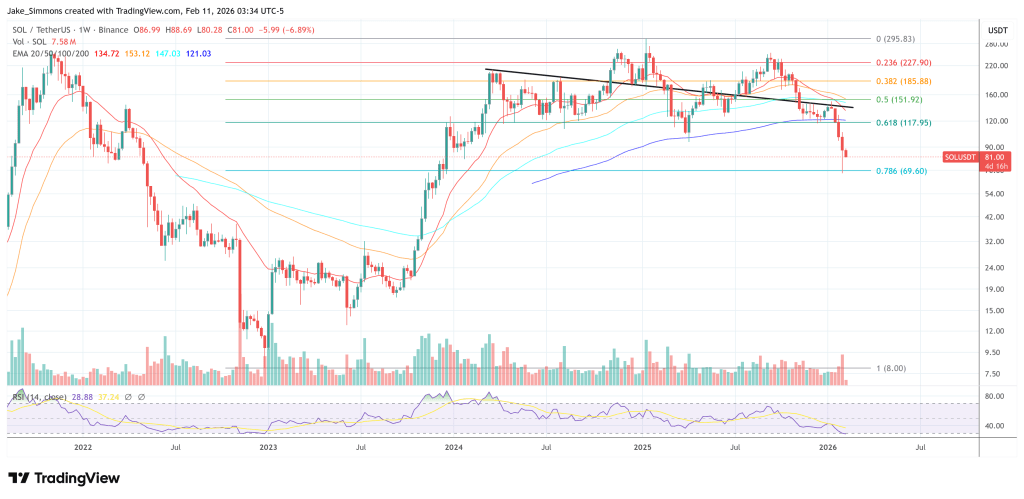
SOL stays above the 0.786 Fib, 1-week chart | Source: SOLUSDT on TradingView.com

Trending Cryptos

Related Questions

QWhat did Alibaba Cloud demonstrate regarding Solana at the Accelerate APAC 2026 keynote?

AAlibaba Cloud demonstrated 'high-performance' Solana RPC connectivity, showcasing reduced latency and operational overhead for developers, particularly in trading-heavy use cases.

QHow did Zhao Qingyuan from Alibaba Cloud migrate the Solana archive node, and what was notable about his approach?

AZhao Qingyuan migrated a Solana archive node from a Google Bigtable implementation to Alibaba Cloud's in-house database over a weekend using AI-assisted coding, despite having limited prior familiarity with Rust or Solana's developer stack.

QWhat latency improvements did Alibaba Cloud claim for Solana RPC calls using their backbone network?

AFor a 'get slot' RPC call, latency was reduced from roughly 25 milliseconds to about 10 milliseconds. For a 'get block' call with a 4MB payload, latency fell from 'more than 200 milliseconds' to 'less than 200 milliseconds'.

QHow did Alibaba Cloud position its Qwen family of models in relation to this demonstration?

AAlibaba Cloud positioned its Qwen family of models as a general-purpose LLM stack that can be used for coding, assistants, and multimodal workflows, using the demo as a practical example of how AI can compress development cycles.

QWhat was the market context for SOL at the time of the article's publication?

AAt press time, SOL was trading at $81.

Related Reads

Bitcoin Withdrawals Continue: 8 Years of Storage in a Coldcard Cold Wallet Ended in Zero

Coldcard Hardware Wallet Hacked: Losses Mount Due to Vulnerable Seed Generation A critical vulnerability in Coldcard hardware wallets has led to a continued wave of fund thefts. According to Galaxy Research, the total stolen has reached 1,367.05 BTC (approx. $88.6 million) from 4,585 addresses, a significant increase from the initial 594.5 BTC reported on July 30, 2026. Most of the stolen funds remain on the attackers' addresses. The issue is not with the current firmware, which Coinkite has updated, but with seed phrases generated on vulnerable devices between March 2021 and the release of fixed firmware versions. Due to a programmer error, devices switched from using a hardware random number generator to the software-based Yasmarang generator, which was initialized with publicly accessible data like the chip's serial number. This made the seed phrases predictable through offline brute-force attacks, meaning wallets remain at risk until funds are moved to a new wallet generated with the patched firmware. Affected devices include Mk2/Mk3 with firmware 4.0.1–4.1.9 (and up to 5.0.3), Mk4/Mk5 up to version 5.6.0, and Q models up to 1.5.0Q. The only exceptions are seeds created with a high-entropy method like at least 50 independent dice rolls or a strong unique BIP-39 passphrase. All other owners must generate a new seed on the fixed firmware and transfer their assets. A case highlighting the human impact involves a 39-year-old long-term investor who lost 2 BTC (approx. $130,000) in minutes. He had accumulated the Bitcoin over eight years through physical labor, viewing it as a financial lifeline and a retirement plan in a country suffering from hyperinflation. His story underscores that even conservative "buy and hold in cold storage" strategies can be compromised by such underlying technical flaws. From a technical perspective, this incident echoes historical failures where weak random number generators undermined cryptographic security, challenging the assumption that offline storage is automatically foolproof.

cryptonews.ru4h ago

Bitcoin Withdrawals Continue: 8 Years of Storage in a Coldcard Cold Wallet Ended in Zero

cryptonews.ru4h ago

Trading

Spot

Hot Articles

Discussions

Welcome to the HTX Community. Here, you can stay informed about the latest platform developments and gain access to professional market insights. Users' opinions on the price of SOL (SOL) are presented below.

活动图片















