Solana eyes $117 – But here’s why SOL bulls still look fragile

ambcryptoPublished on 2026-03-25Last updated on 2026-03-25

Abstract

Solana (SOL) is gradually climbing, trading near $91.64, but remains over 76% below its 2025 peak. The recent rebound, marked by higher highs and lows, lacks strong conviction. A potential short squeeze could push prices toward the $94–$96 range, where significant short liquidity lies. Key resistance is at $117; reclaiming it would signal strength, while failure to hold above $100 may lead to a drop toward $67.60. Open Interest (OI) dropped from $5.92B to $4.85B before a slight recovery, indicating shaky bullish sentiment. Despite some optimism from ceasefire hopes in geopolitical conflicts, SOL's upward move remains fragile and vulnerable to rejection without sustained momentum and higher OI.

Solana is grinding higher, but nobody should call it safe. The token is still buried more than 76% below its 2025 peak.

Even so, the past few weeks dragged out higher highs, higher lows, and a move back above $90. However, this rebound needed conviction.

War headlines still hung over the market, but growing ceasefire hopes in the U.S.-Israel-Iran conflict gave risk assets some breathing room.

SOL hunts for short liquidity after a long wipeout

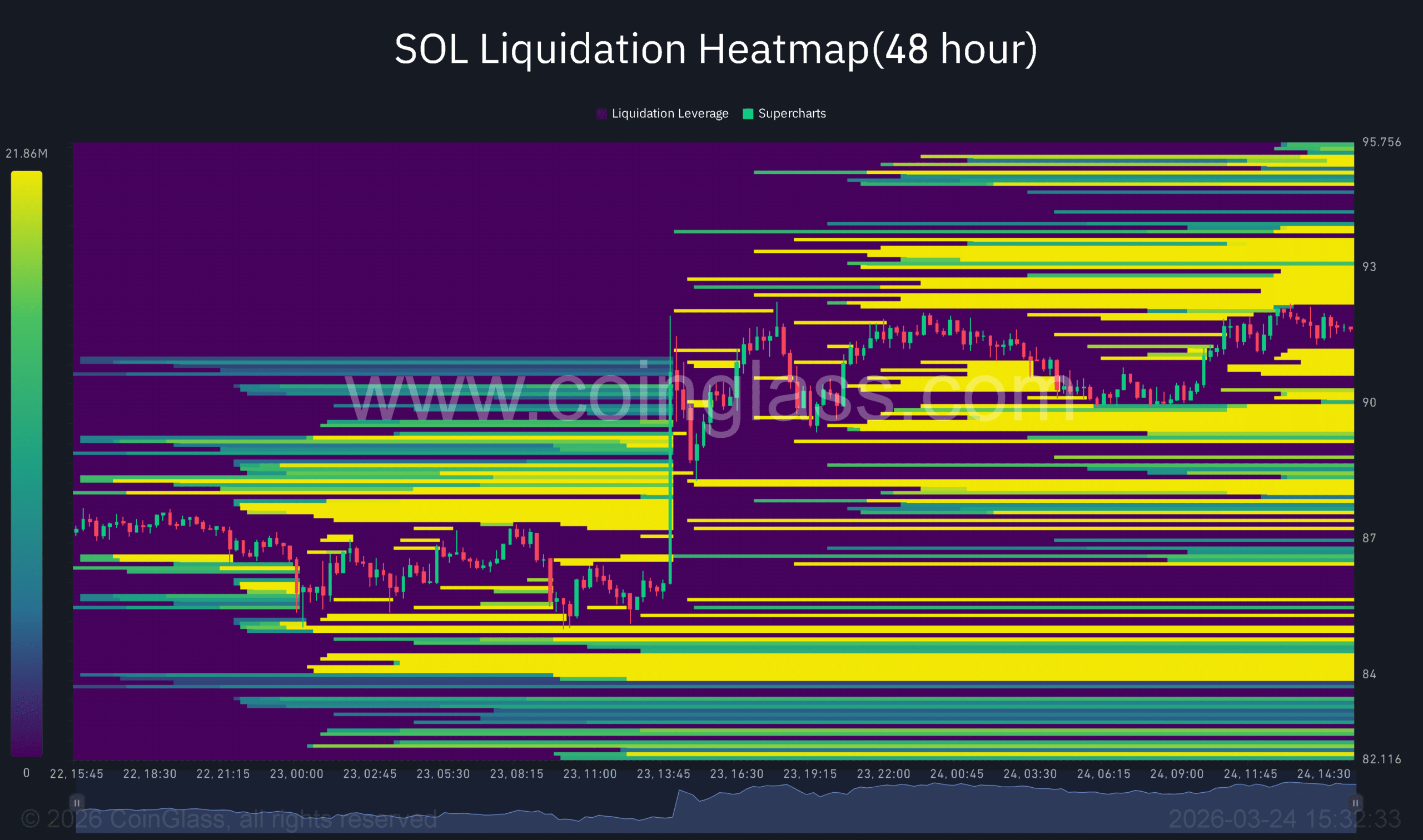
Solana cleared long liquidity, then started leaning toward shorts. On the 24-hour and 48-hour liquidation heatmaps, heavy topside liquidity sat between $94 and $96. If the price kept rising, shorts could have been forced out fast.
Source: CoinGlass

That was the attraction. Short squeezes turned violent because trapped traders became fuel. As a result, SOL did not need hype. It only needed strength to keep pushing and punish the late bears.

Can Solana reclaim $117 and keep rising?

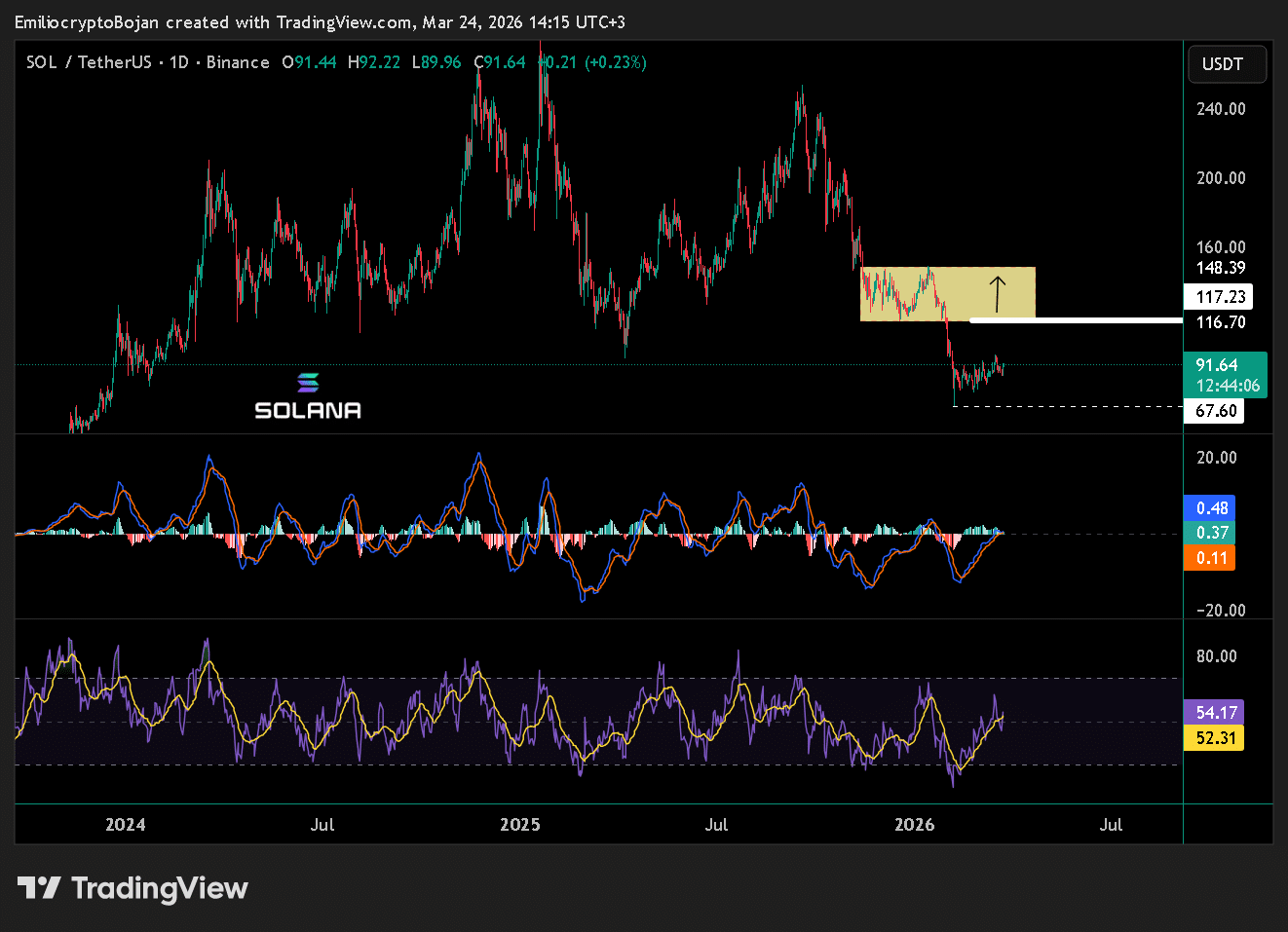
At the time of writing, Solana [SOL] traded near $91.64 inside a rising structure. The chart pointed toward the broader $117-$145 range, but $117 stayed the reclaim. Clear that level, and Solana would have looked stronger than during the sideways mess.
Source: TradingView

However, failure to reclaim even $100 will signal weakness. Therefore, the bulls still have work to do. If momentum fades, the door back toward $67.60 will open again. That threat stays alive.

Are bulls leaving, and is it a warning sign?

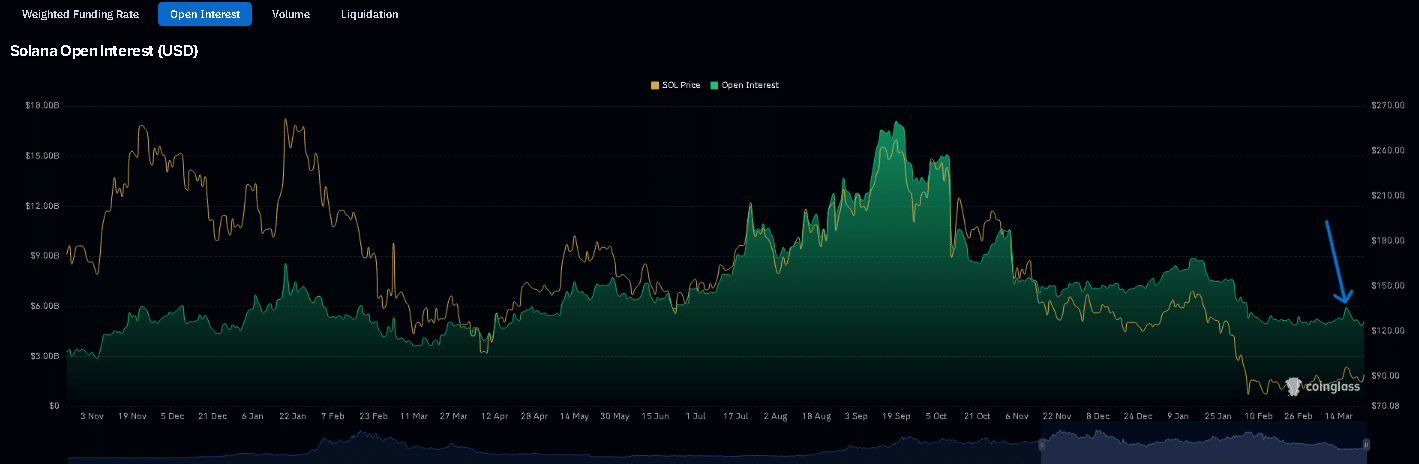
Open Interest made the setup shakier. Why? Ceasefire hopes in the U.S.-Israel conflict with Iran briefly lifted sentiment, pushing OI to $5.92B. However, that strength faded fast, with OI dropping to $4.85B before recovering near $5.1B.
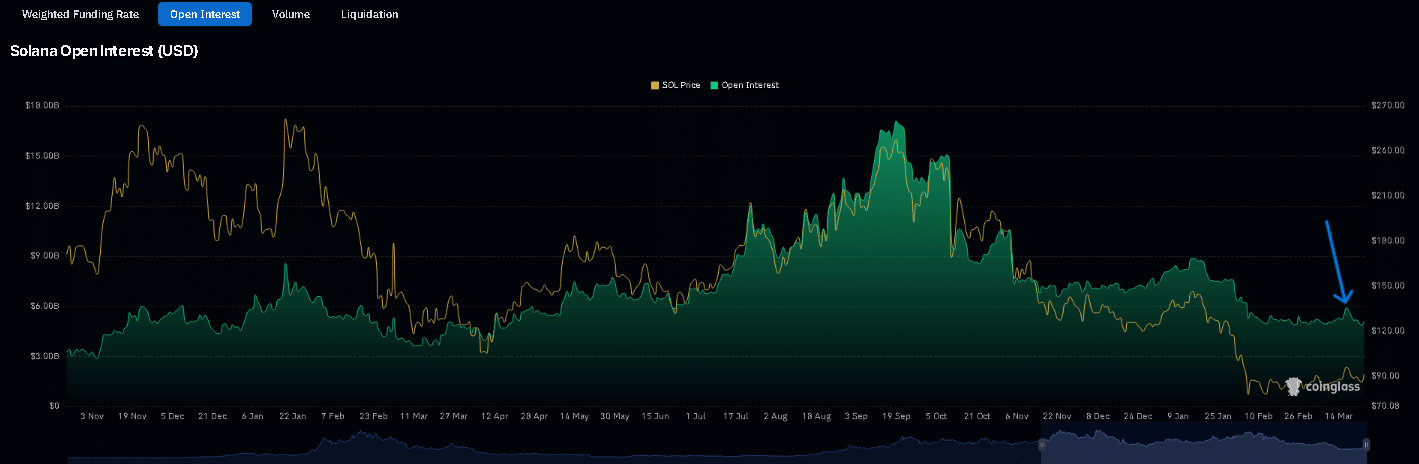
Source: CoinGlass

That drop did not mean the bulls were gone. However, it did show that conviction was shaky. Looking ahead, stronger OI would have helped confirm continuation. Failure to do which, this rebound would have remained vulnerable to another rejection.


Final Summary

  • Solana’s rebound looked cleaner, but $117 still stood there like a wall.
  • Falling OI kept the setup fragile, because weak conviction could still ruin the move.

Related Questions

QWhat is the key resistance level that Solana needs to reclaim to signal stronger bullish momentum?

ASolana needs to reclaim the $117 level to signal stronger bullish momentum and look stronger than during the previous period of sideways movement.

QWhy does the article suggest that Solana's bullish setup remains fragile despite the recent price increase?

AThe setup remains fragile due to falling Open Interest (OI), which indicates shaky conviction among traders and makes the rebound vulnerable to another rejection.

QWhat was the significance of the liquidity between $94 and $96 on the liquidation heatmaps?

AHeavy topside liquidity between $94 and $96 meant that if the price continued rising, it could trigger a short squeeze, forcing out short traders and providing fuel for a violent price move upward.

QWhat price level could Solana potentially fall back to if the current bullish momentum fades?

AIf the bullish momentum fades, Solana could fall back toward the $67.60 level, reopening the door to further downside.

QHow did geopolitical events involving the U.S., Israel, and Iran impact market sentiment and Solana's Open Interest?

AGrowing ceasefire hopes in the U.S.-Israel-Iran conflict briefly lifted market sentiment, pushing Solana's Open Interest to $5.92B. However, this strength faded quickly, and OI dropped to $4.85B before a partial recovery, showing unstable conviction.

Related Reads

TechFlow Intelligence Bureau: Chip Stocks Lose Trillions in a Single Day, Bitcoin Falls Below $60,000, US-Iran Conflict Escalates

**Daily Tech & Markets Roundup: AI Advances, Market Turmoil, and Geopolitical Tensions** **AI / LLMs**: Anthropic's internal report on AI self-improvement sparked serious discussions about Recursive Self-Improvement (RSI). Meanwhile, debate continues on AI coding tools after Claude was accused of introducing bugs into the rsync codebase. In positive news, DeepSeek V4 Flash impressed in local deployment tests, and GitHub Copilot now supports custom endpoints for local models. A surprising research turn suggests removing chain-of-thought prompting can sometimes improve LLM performance. **Crypto / Web3**: Bitcoin plunged below $60,000, with its RSI hitting levels last seen during the COVID-19 crash, driven by strong U.S. jobs data reviving interest rate hike fears. Discussions highlight Ethereum DeFi's continued lack of a smooth consumer payment layer. **Chips / Hardware**: Chip stocks suffered a massive sell-off, with the Philadelphia Semiconductor Index posting its worst single-day drop in six years, erasing over a trillion dollars in value. Marvell, Micron, AMD, and Intel were among the biggest losers. **Tech Companies**: A leaked Microsoft document revealing goals to make Copilot "addictive" drew criticism. LinkedIn founder Reid Hoffman left Microsoft's board to focus full-time on his AI agent startup, Manus. Google was revealed to be paying SpaceX $920 million monthly for AI training compute. **Markets & Macro**: A blowout U.S. jobs report (172k vs. 80k expected) crushed hopes for near-term rate cuts, sending Treasury yields soaring and triggering a broad market sell-off. CEOs from Kraft, McDonald's, and Whirlpool simultaneously warned U.S. consumers are exhausting their savings. **Geopolitics**: U.S.-Iran tensions escalated with missile/drone interceptions and U.S. strikes on Iranian radar sites, keeping the critical Strait of Hormuz largely closed since late February and posing ongoing oil supply risks. **The Bottom Line**: The strong jobs data acted as a single trigger for correlated sell-offs across equities, crypto, and chips. Underlying the volatility is a stark contradiction between robust employment data and warnings of consumer weakness, alongside geopolitical risks that could reignite inflation, leaving markets to price in a fraught macro outlook with no clear "soft landing" path.

marsbit3h ago

TechFlow Intelligence Bureau: Chip Stocks Lose Trillions in a Single Day, Bitcoin Falls Below $60,000, US-Iran Conflict Escalates

marsbit3h ago

It Took Me a Year to See the Bitter Truth About Agent Payments

After a year building infrastructure for the Agent economy, engaging with major players like Stripe, Visa, and Coinbase, the author shares a sobering analysis of the current state of Agent payments. The core finding is a stark lack of genuine, immediate demand across most envisioned use cases. The article breaks down four key market segments: 1. **Agent-to-Merchant (Consumer Shopping):** For most product categories (e.g., clothing, electronics), conversational AI shopping is a step backwards from visual e-commerce interfaces. While agents excel at understanding needs, they can't replace side-by-side product comparison. Real merchant interest is defensive "Agent Engine Optimization," not driven by current customer demand. Potential exists for high-frequency, low-decision purchases (like food delivery) or navigating complex store UIs, but these require massive B2C distribution channels dominated by giants like Amazon. 2. **Agent-to-API (Developer Services):** Developers already have subscriptions and billing relationships for APIs (compute, data). Prepaid balances solve micro-payment issues for low transaction volumes. A deeper structural problem is that major SaaS vendors' business models rely on enterprise contracts, resisting granular pay-per-call pricing. While protocols like MPP and x402 serve the long tail of niche services, this market is small and developers are historically low-willingness-to-pay. 3. **Agent-to-Agent:** This remains largely theoretical with minimal transaction volume. While it represents a long-term bet on a fundamentally new transaction infrastructure (sub-second, micro-penny to million-dollar, multi-party settlements), it does not constitute a present market. 4. **Agent-to-Finance:** This is the only category with existing, paying demand. Integrating AI into financial workflows (trading, portfolio management) is a natural evolution and enables new capabilities like autonomous rebalancing. However, competition favors established, regulated institutions. The "real problem" is not moving money between agents, but the broader challenge of **coordination**—orchestrating work between agents and humans, verifying outcomes, and settling results. Payment is just one component of settlement, which is itself part of coordination. Companies that solve the coordination layer will subsume payment, not the other way around. While well-funded incumbents build defensively for a long-term future, startups must find where the market is today—which, for the author's team, lies outside these four categories in an area of real, growing, and underserved activity.

marsbit4h ago

It Took Me a Year to See the Bitter Truth About Agent Payments

marsbit4h ago

Trading

Spot
Futures

Hot Articles

Discussions

Welcome to the HTX Community. Here, you can stay informed about the latest platform developments and gain access to professional market insights. Users' opinions on the price of SOL (SOL) are presented below.

活动图片















