Solana ETFs Just Crossed A New Record Level, But Can Price Reclaim $100?

bitcoinistPublished on 2026-03-13Last updated on 2026-03-13

Abstract

Solana ETFs have reached a record $1.5 billion in net inflows since their July 2025 launch, a period during which SOL's price declined by 57%. This significant institutional demand, with half the assets coming from large firms filing 13F disclosures, presents a stark contrast to the bearish market sentiment and SOL's drop below $100 to a low of $85. Analysts suggest this sustained ETF momentum could create buying pressure that catalyzes a price recovery. One analyst projects that reclaiming the $100 level could trigger a breakout from a long-term descending channel, potentially driving SOL's price toward $250.

Solana ETFs are breaking records even as SOL prices are in a downtrend. While bearish sentiment dominates the crypto market, billions of dollars continue to flow in, painting a contrasting picture between price action and institutional demand. As the cryptocurrency attempts a recovery, analysts are once again eyeing a return to the $100 level. However, the question remains whether the current ETF momentum could be the catalyst that drives a price recovery.

Solana ETFs Hit Record Levels Amidst Price Decline

Solana has been experiencing a rough stretch in the markets lately, with its price falling well below $100 and hitting a low of $85. The drop marks a prolonged bearish trend that has tested the patience of many investors who entered the market at higher levels.

Despite weak price action, Solana Spot ETFs are attracting capital at an unprecedented rate, surprising even seasoned market watchers. This suggests that long-term conviction in the cryptocurrency remains strong even as short-term selling persists.

Notably, Bloomberg ETF analyst Eric Balchunas brought Solana’s ETF numbers into focus in a recent post on X, highlighting that the investment fund has accumulated an impressive $1.5 billion in net inflows since its launch in July 2025. He noted that this remarkable growth occurred despite SOL’s 57% price crash from its ETF launch date, which was one of the toughest debut periods for any ETF product.
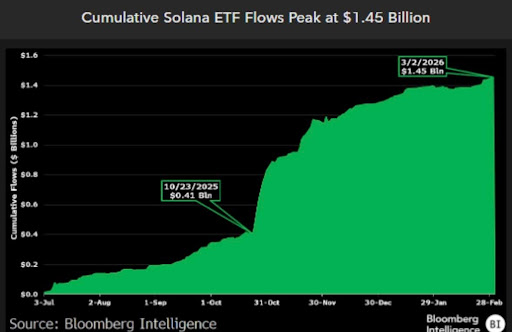
Source: Bloomberg

Balchunas pointed out that when Solana’s market cap is compared to Bitcoin’s, the numbers look even more impressive. On that basis, the inflows into Solana are roughly $54 billion for Spot Bitcoin ETFs, approximately double what BTC itself attracted at the same point in its ETF journey. He noted that the key difference here is that Bitcoin was surging at the time, whereas Solana reached equivalent inflows while in decline.

The Bloomberg analyst also highlighted Solana’s ETF composition, noting that approximately 50% of the fund’s assets came from institutional investors that filed 13F disclosures. He described this as a “serious” investor base, suggesting that large-scale firms are backing Solana and may be positioning for the long term.

SOL Price Roadmap To A $100 Recovery

If Solana’s ETF momentum and institutional demand continue to rise, it would not be surprising if the cryptocurrency attempts another price recovery back toward the $100 region. Usually, demand from ETFs helps create consistent buying pressure, as fund inflows translate into actual purchases of the underlying asset, supporting its price over time. However, whether Solana can turn its current ETF demand into sustained price recovery remains to be seen.
Source: X

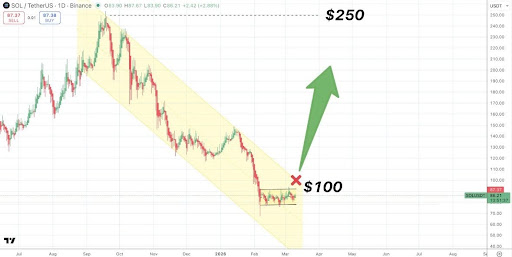
On the more technical side, crypto analyst Satoshi Flipper has issued a forecast suggesting that Solana may be preparing to reclaim the $100 level. He projects that once this happens, the cryptocurrency will automatically break out of a descending channel that has been in place for the past seven months. If the breakout plays out as expected, the analyst projects that the move could carry the SOL price well beyond $100, potentially driving it toward $250.

SOL recovers again | Source: SOLUSDT on Tradingview.com

Trending Cryptos

Related Questions

QWhat is the current trend of Solana ETFs despite the price decline of SOL?

ASolana Spot ETFs are breaking records and attracting capital at an unprecedented rate, with $1.5 billion in net inflows since their launch in July 2025, even as the SOL price has declined significantly.

QAccording to Bloomberg analyst Eric Balchunas, how do Solana ETF inflows compare to Bitcoin ETF inflows on a market cap basis?

AOn a market cap basis, the inflows into Solana ETFs are roughly equivalent to $54 billion for Spot Bitcoin ETFs, which is approximately double what Bitcoin attracted at the same point in its ETF journey.

QWhat percentage of the Solana ETF assets came from institutional investors filing 13F disclosures?

AApproximately 50% of the Solana ETF's assets came from institutional investors that filed 13F disclosures.

QWhat key price level are analysts watching for a potential Solana recovery?

AAnalysts are eyeing a return to the $100 level as a key milestone for Solana's potential price recovery.

QWhat is crypto analyst Satoshi Flipper's price projection for SOL if it breaks out of its descending channel?

ASatoshi Flipper projects that if Solana breaks out of its descending channel, the price could carry well beyond $100, potentially driving it toward $250.

Related Reads

Annual Salary of Millions Competing for Electricians, Meta Rushes to Open Its Own Technical School

The AI boom is facing an unexpected bottleneck: a severe shortage of skilled construction workers and electricians. As tech giants like Meta, OpenAI, and Alphabet race to build massive data centers—such as OpenAI's $16 billion "Stargate" project—they are hitting a critical labor wall. The U.S. needs an estimated 130,000 more electricians, 240,000 construction workers, and 150,000 supervisors by 2030 for AI infrastructure alone, but tens of thousands of electrician jobs go unfilled each year. While AI companies offer high premiums, with electricians earning up to $280,000 annually, worker scarcity still causes massive losses—delays on a single project can cost $14.2 million per month. The complexity of building AI data centers, which require immense power (equivalent to powering hundreds of thousands of homes), sophisticated electrical systems, and advanced liquid cooling solutions, demands highly skilled technicians who are in short supply. To combat this, companies are investing heavily in training. Meta has committed $115 million to a free training school offering tuition, housing, and stipends, targeting 5,000 new workers. OpenAI is partnering with unions to secure skilled labor. These efforts are paying off, with a significant rise in Gen Z interest in trade schools over college. However, the power demands are staggering. AI data centers are driving a rapid surge in electricity consumption, projected to account for up to 12% of U.S. power use by 2028 and raising costs for consumers. Furthermore, the construction boom is project-based, leading to a potential future glut of trained workers once building peaks, which could depress wages industry-wide. The race for AI supremacy now depends as much on skilled hands as on advanced chips.

marsbit59m ago

Annual Salary of Millions Competing for Electricians, Meta Rushes to Open Its Own Technical School

marsbit59m ago

OpenAI No Longer Sells Its Most Expensive Model for Profit

OpenAI is shifting its business strategy away from promoting its most expensive, flagship models for every task. Recent price cuts—80% for GPT-5.6 Luna and 20% for Terra—signal a deeper change: the company now actively advises users that many tasks don't require the most powerful model. Instead, OpenAI recommends a tiered approach: use the high-end GPT-5.6 Sol for complex planning and analysis, then delegate execution to cheaper models like Luna. This mirrors moves by Anthropic, which recently launched Claude Opus 5 at half the price of its top model, Fable 5. Both companies are de-emphasizing flagship models as primary revenue drivers, using them instead for brand prestige and technological showcases. The industry is entering a "mass-market" phase, similar to automotive, where high-volume, cost-effective models handle daily operations and drive scale. OpenAI's price reductions are partly enabled by AI models themselves optimizing underlying code and infrastructure, creating a self-reinforcing cycle of efficiency gains and cost reduction. Competition is shifting from "who is smartest" to "who offers the best value." The goal is no longer selling individual models but fostering widespread API adoption and ecosystem lock-in. By making AI calls cheap and ubiquitous, companies like OpenAI aim to become the indispensable, utility-like infrastructure powering automated workflows—the "water and electricity" of software, quietly embedded everywhere.

marsbit59m ago

OpenAI No Longer Sells Its Most Expensive Model for Profit

marsbit59m ago

Trading

Spot

Hot Articles

Discussions

Welcome to the HTX Community. Here, you can stay informed about the latest platform developments and gain access to professional market insights. Users' opinions on the price of SOL (SOL) are presented below.

活动图片














